More like this
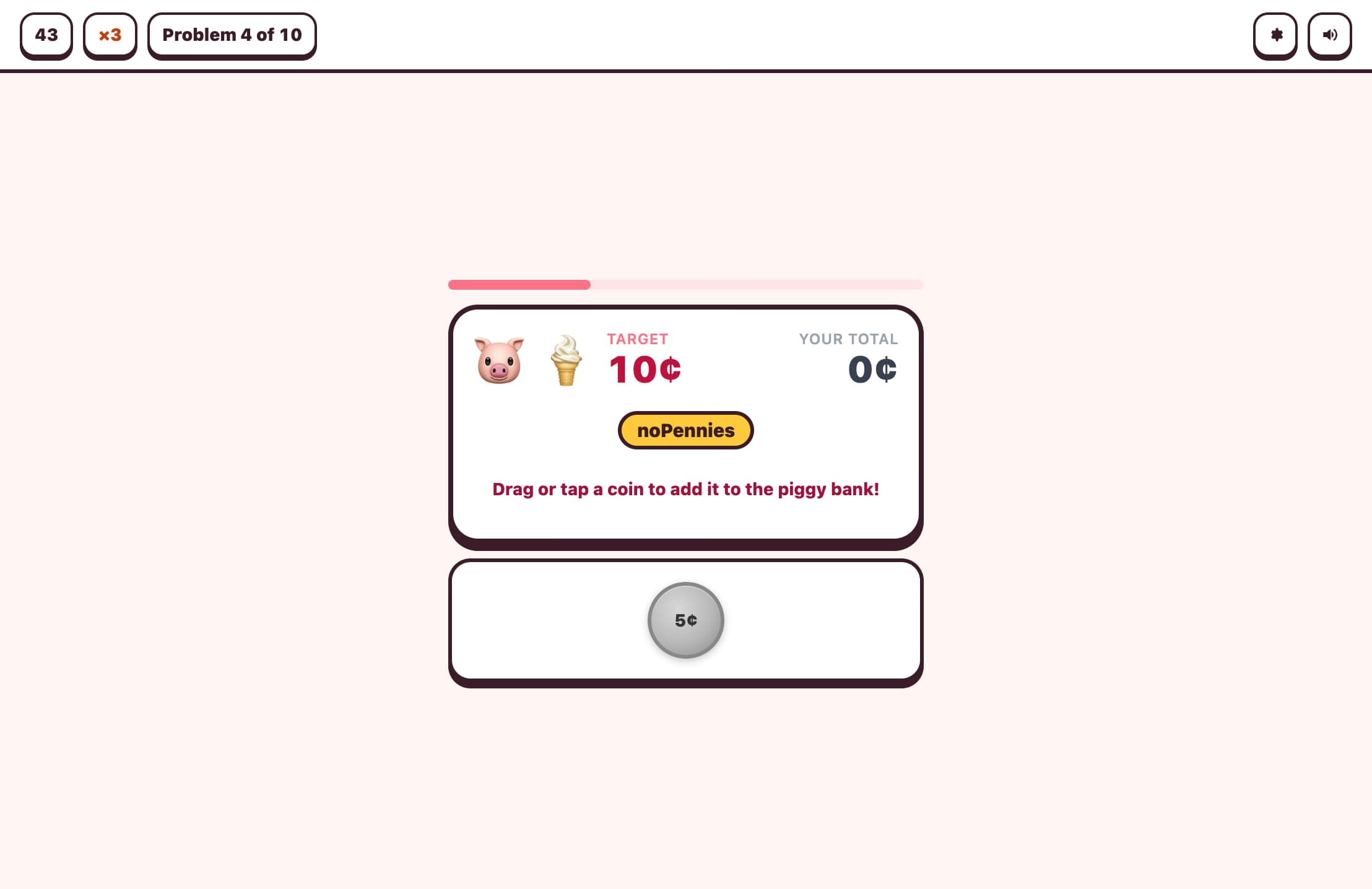
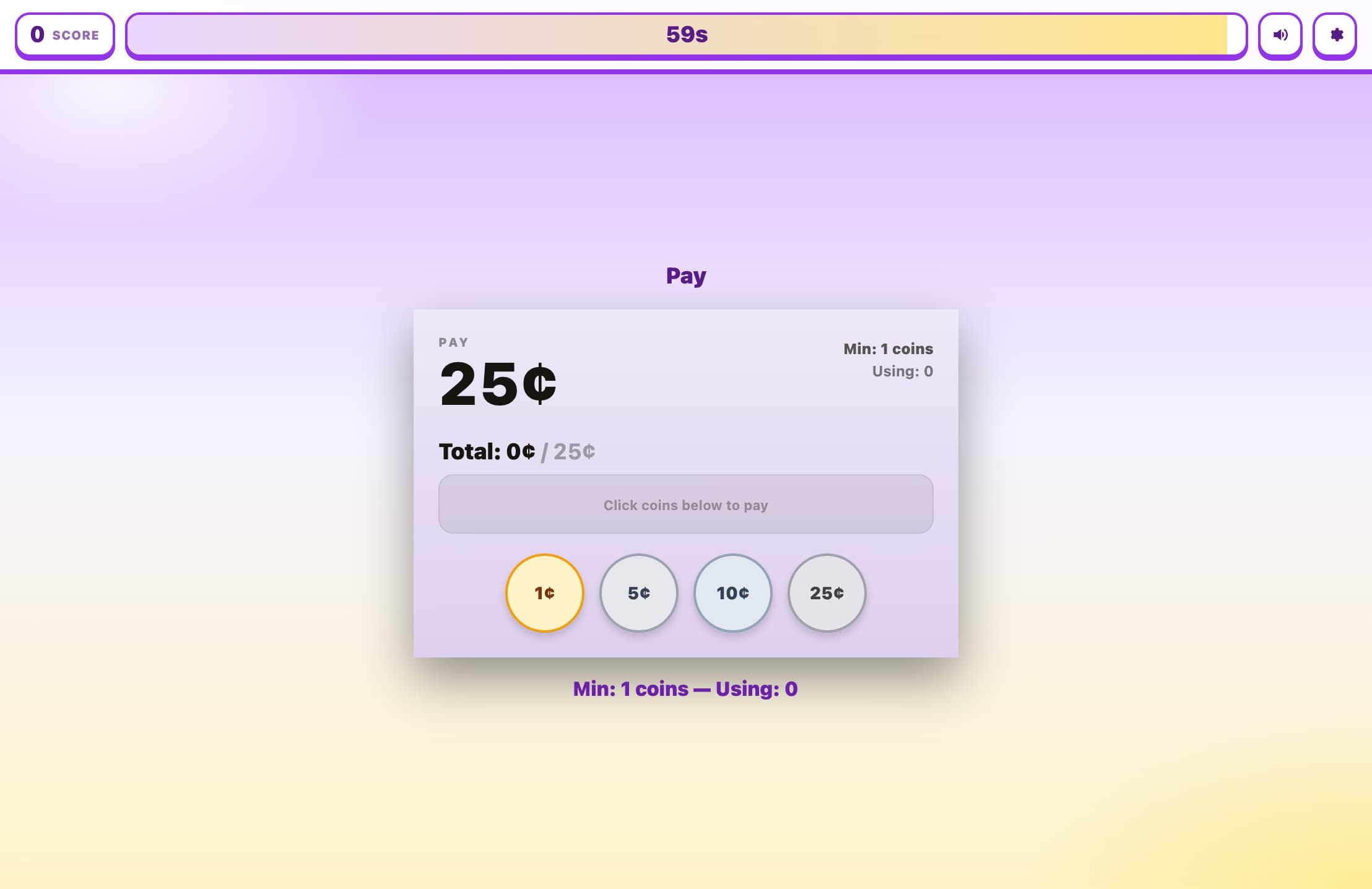
How to Play Make Change Beginner
Read the Change Owed
The card shows the price paid and the item's price. The big green number is the correct change you should keep. For example: paid 25¢, item cost 17¢ — change owed is 8¢.
Look at the Coins You Received
A grid of coin buttons shows all the coins the cashier gave back. Their total is more than the correct change — some are extra.
Tap the Extra Coins to Return Them
Tap any coin that you don't need to keep. It will dim and show an ✕, meaning you're giving it back. Tap it again to un-return it if you change your mind.
Match the Change Owed Exactly
Watch the 'Keeping' total as you tap. When it equals the 'Change Owed' amount exactly, you score a point and a new round begins!
Key Features
Tap to Return Extra Coins
The cashier hands you back a pile of coins that's worth more than the correct change. Tap individual coins to 'return' them (they grey out with an ✕). Keep tapping until only the right amount remains.
Real-Time Progress Bar
A progress bar and running total update instantly as you tap each coin, so you always know how close you are to the exact change amount. The total turns green when you hit it exactly.
Three Difficulty Levels
Easy uses only pennies and nickels with change up to 25¢. Medium adds dimes with change up to 50¢. Hard introduces quarters and extends to 99¢ — all amounts stay under one dollar.
Timed and Practice Modes
In 60-Second Rush, make correct change for as many purchases as you can. In Practice mode, there's no timer — ideal for classroom use, homework help, or learners who need extra time.
What is Make Change Beginner?
Make Change Beginner is an interactive coin game that teaches students how to make change by working backwards from an overpayment. Rather than building up coins to a target (as in other coin games), players start with too many coins and must identify and remove the extras. This 'elimination' approach mirrors what a cashier actually does when checking change, making it an authentic and practical money skill. All amounts are under one dollar, using U.S. coins: pennies (1¢), nickels (5¢), dimes (10¢), and quarters (25¢).
Why Play Make Change Beginner?
Builds Real Cashier Skills
Checking change by removing extras mirrors how cashiers and customers actually verify transactions. This game builds the mental habit of comparing a coin total to an expected amount — a practical life skill used daily.
Reversal Thinking Strengthens Number Sense
Starting with too much and reducing to the target develops subtraction intuition. Students practice 'how much too much is this?' — a key component of number sense and mental math.
Safe to Experiment
Tapping a coin to return it can be undone with another tap. This forgiveness encourages experimentation without fear of mistakes, which is especially important for young learners building confidence with money.
Perfect for Classroom or Home
Practice mode removes all time pressure, making it ideal for individual practice, homework help, or small-group instruction. Timed mode adds friendly competition for older students who are ready for a challenge.
Frequently Asked Questions
Can I undo a coin I tapped by mistake?
Yes! Tap any dimmed (returned) coin to bring it back into your hand. You can toggle coins back and forth as many times as you like until you find the right combination.
Why does the cashier always overpay?
The game always gives you slightly more coins than you need so you have something to 'return.' The extra coins are random — sometimes just one extra, sometimes a few — so each round is a fresh puzzle.
What coin denominations are used?
The game uses U.S. coins. Easy mode uses only pennies (1¢) and nickels (5¢). Medium adds dimes (10¢). Hard includes all four types: pennies, nickels, dimes, and quarters (25¢). All change amounts stay under $1.00.
Is there a wrong answer penalty?
No — there's no penalty for tapping the wrong coins. Since coins can be toggled on and off freely, you can always adjust without any punishment. The game rewards getting it right, not punishing mistakes.
What grade level is this game for?
Easy mode is designed for 1st grade (ages 6–7) learning pennies and nickels. Medium suits 2nd grade (ages 7–8) adding dimes. Hard mode works well for 2nd–3rd grade students who have learned all four common coin types.