Math Games
Discover all games tagged with Math. Free to play — no download, no account.
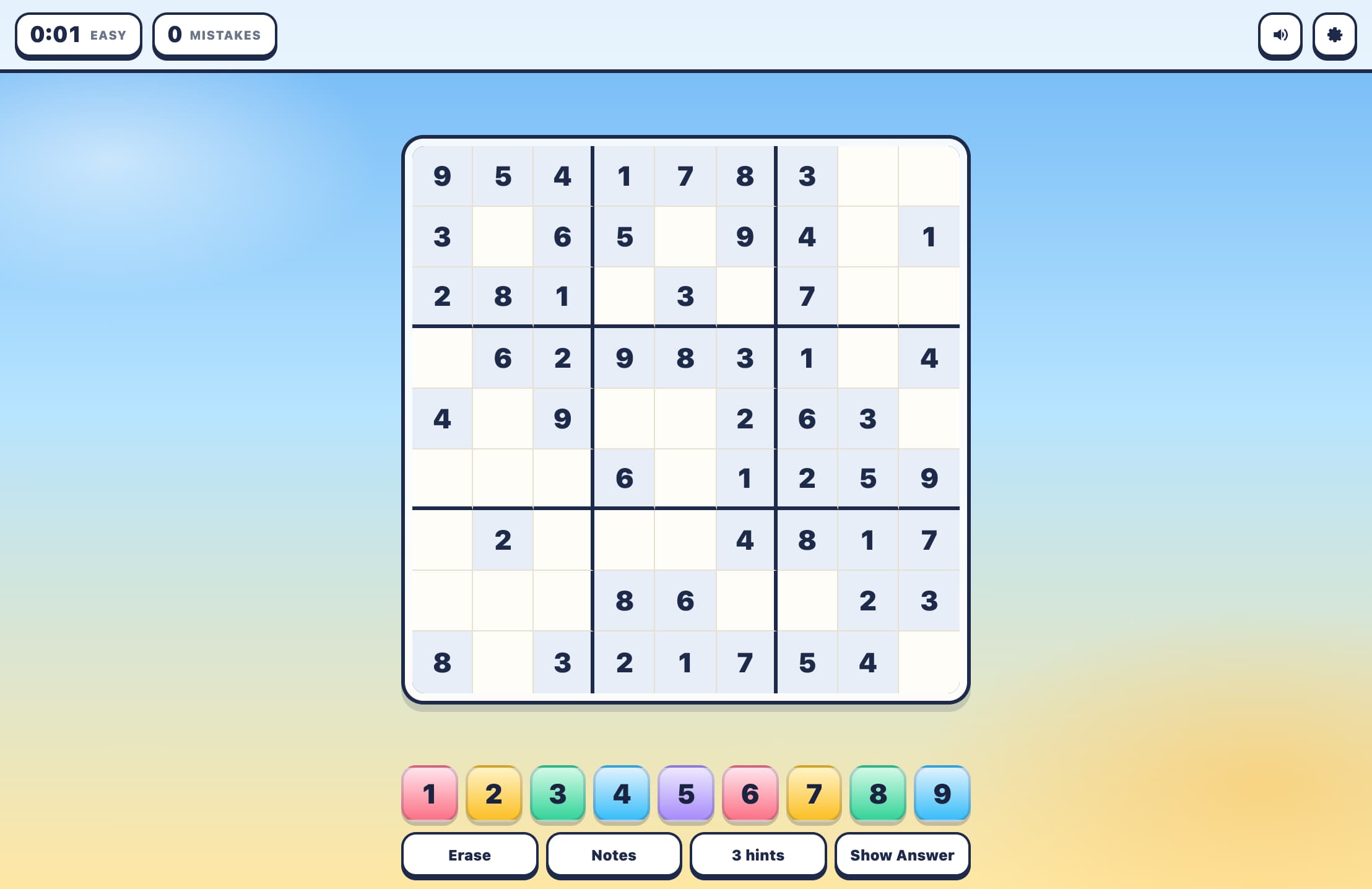
Sudoku
Classic 9×9 Sudoku with four difficulty levels — Easy, Medium, Hard, and Expert. Features a live timer, mistake counter, pencil notes, and 3 hints per puzzle. Beat your best time!
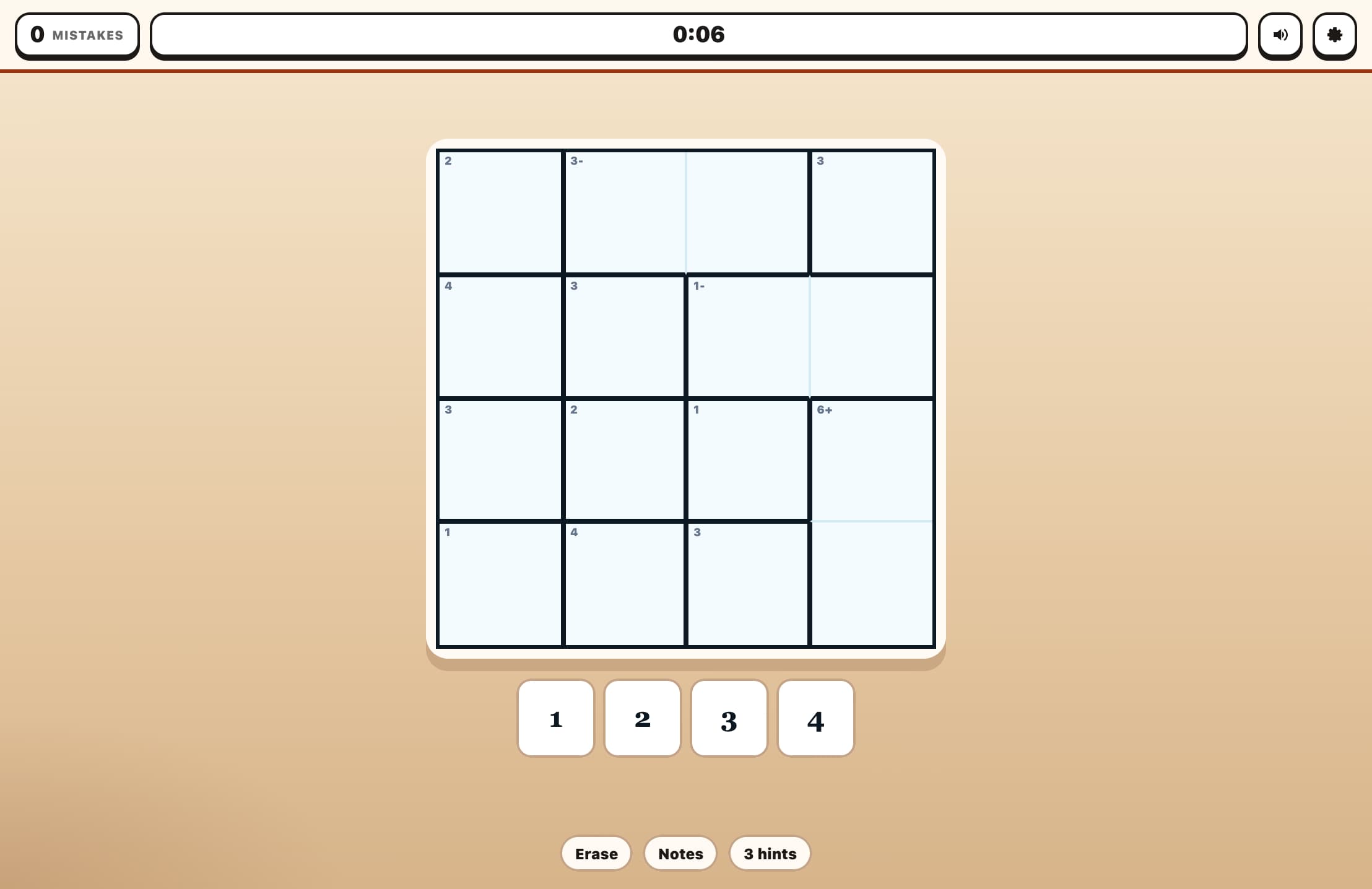
MathDoku
A KenKen-style arithmetic puzzle! Fill the grid with 1–N so every row and column contains each number exactly once. Each outlined cage must equal its target value using addition, subtraction, multiplication, or division. Choose from 4×4, 5×5, or 6×6 grids.
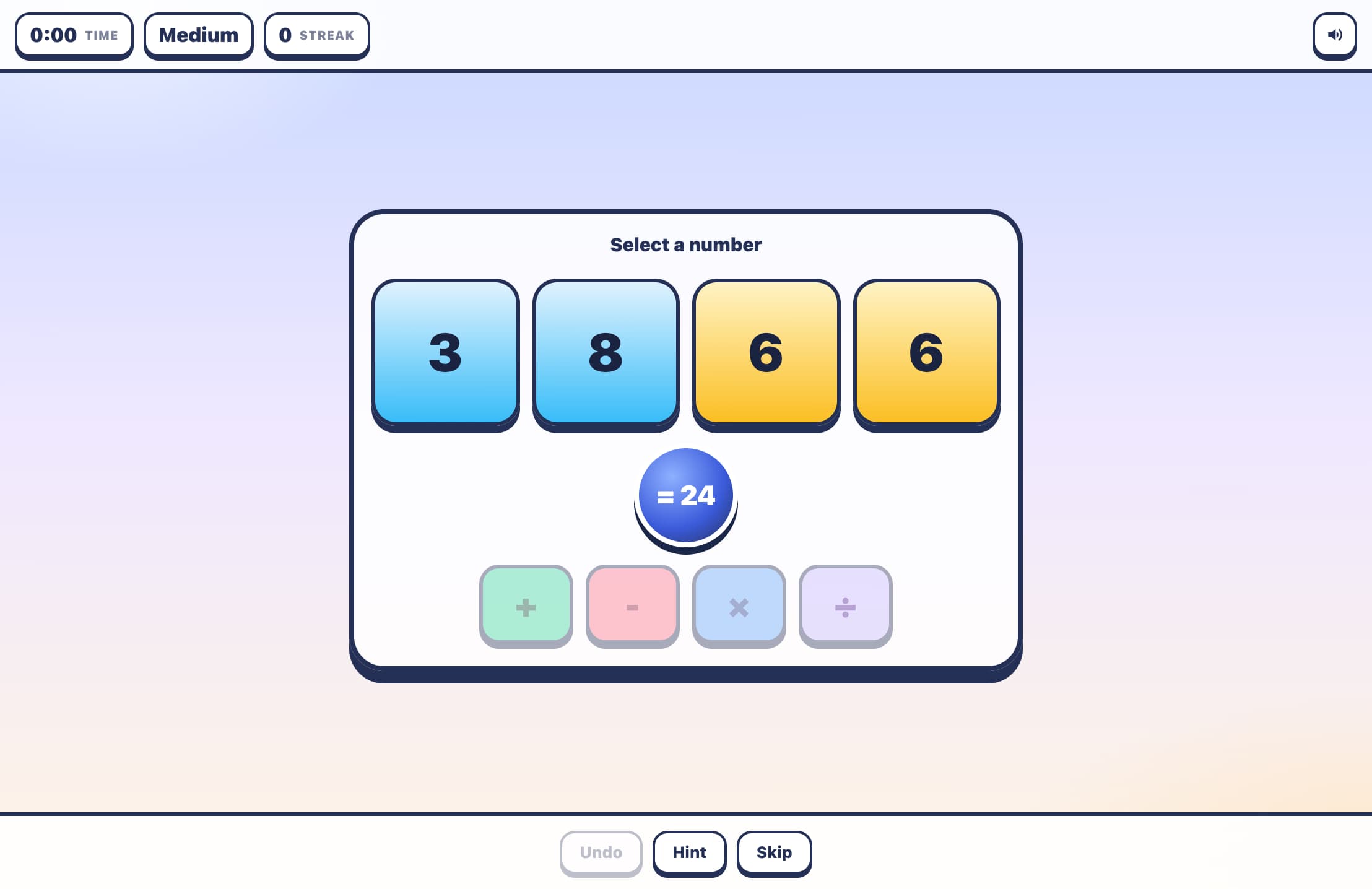
24 Game
Make exactly 24. You get 4 numbers and the operations +, −, ×, ÷. Use every number once. Pick Easy, Medium, or Hard, build a Streak, and beat your best Time.
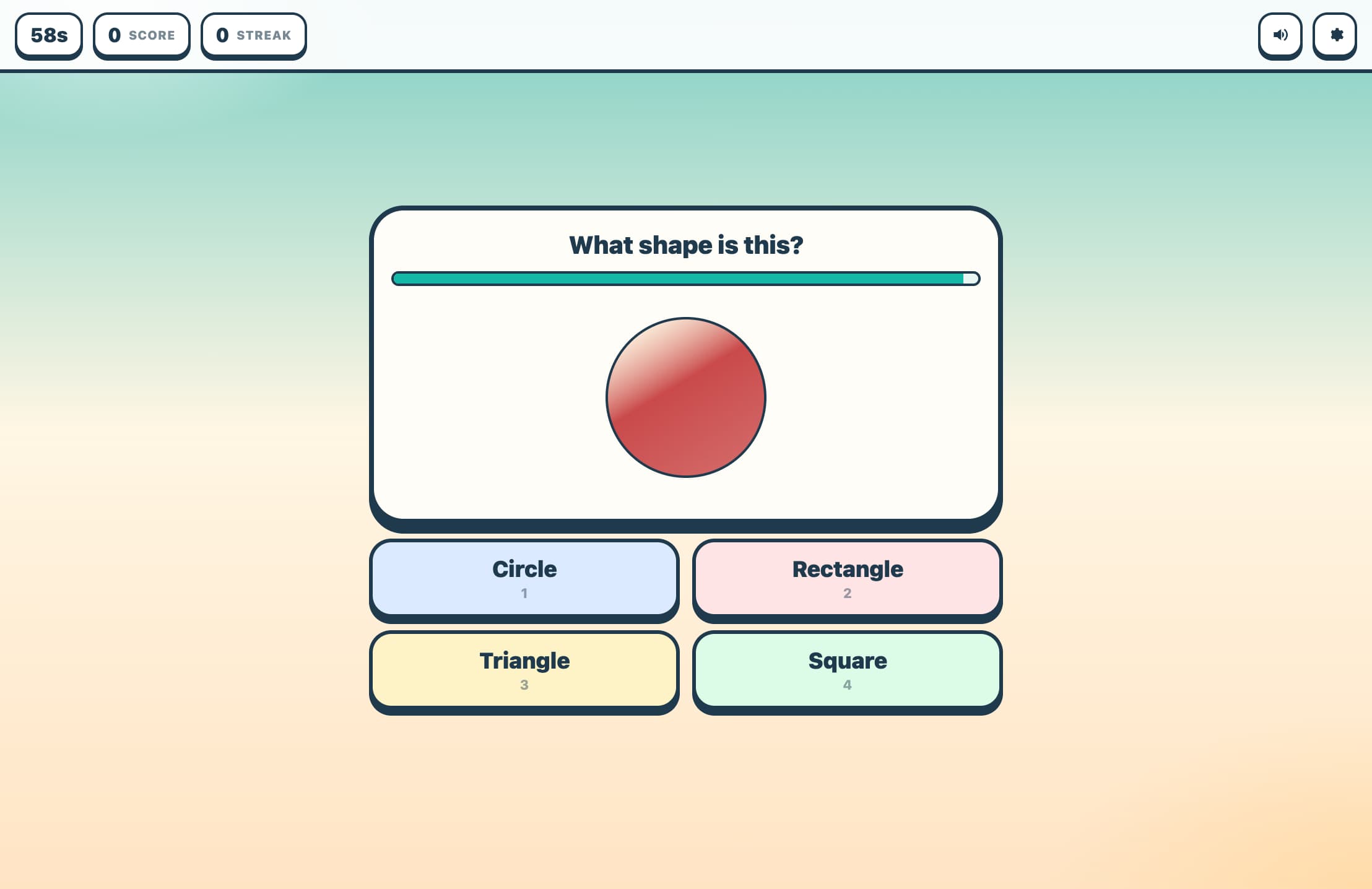
Identify Shapes by Sides & Corners
Identify 2D shapes like triangles, squares, pentagons, hexagons, and more by counting their sides and corners. Features colorful SVG shapes, multiple question types (name, sides count, corners count), and three difficulty levels.
Count and Add Cute Animal Groups
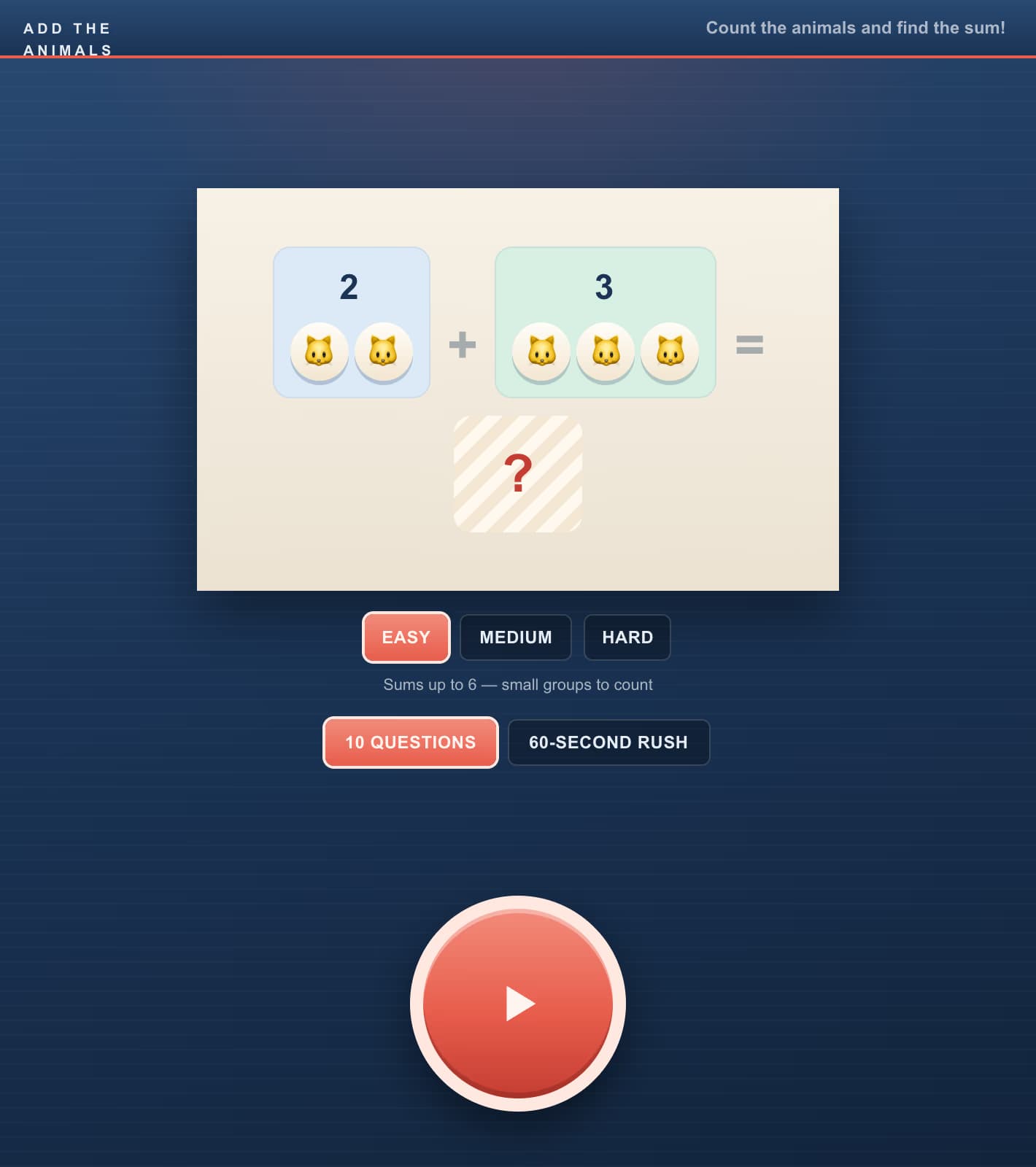
2 cats + 3 cats = ? Count adorable animal emoji to solve addition problems up to 10. A visual and engaging way for young learners to practice adding numbers through counting.
High School Math Quiz
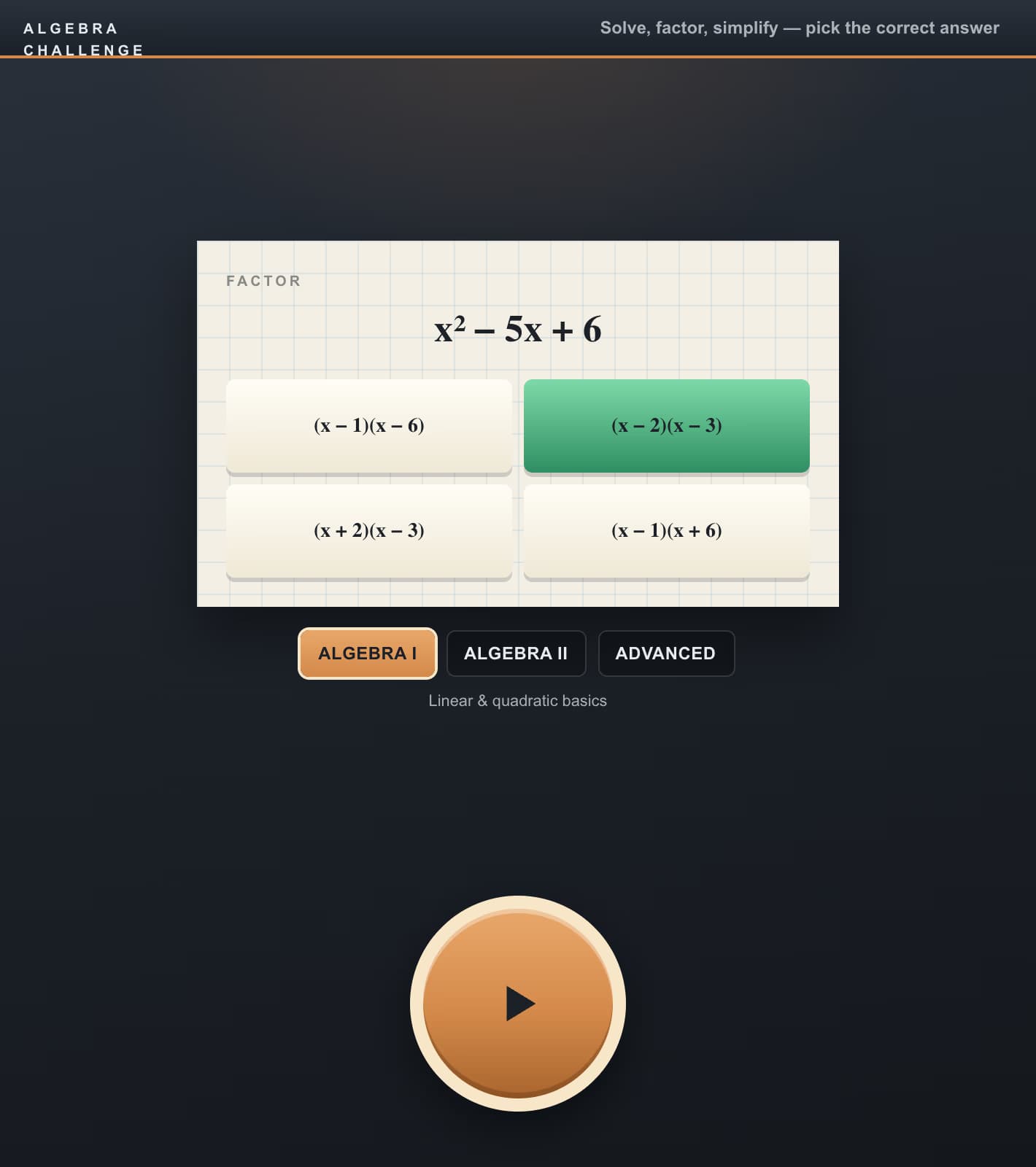
Solve equations, factor polynomials, simplify expressions — pick the correct answer from four choices. 45 problems across three tiers: Algebra I (linear equations, slope, basic factoring), Algebra II (quadratics, systems, logs, sequences), and Advanced (pre-calculus, complex numbers, inverse functions, infinite series).
Guess Geometry Angles
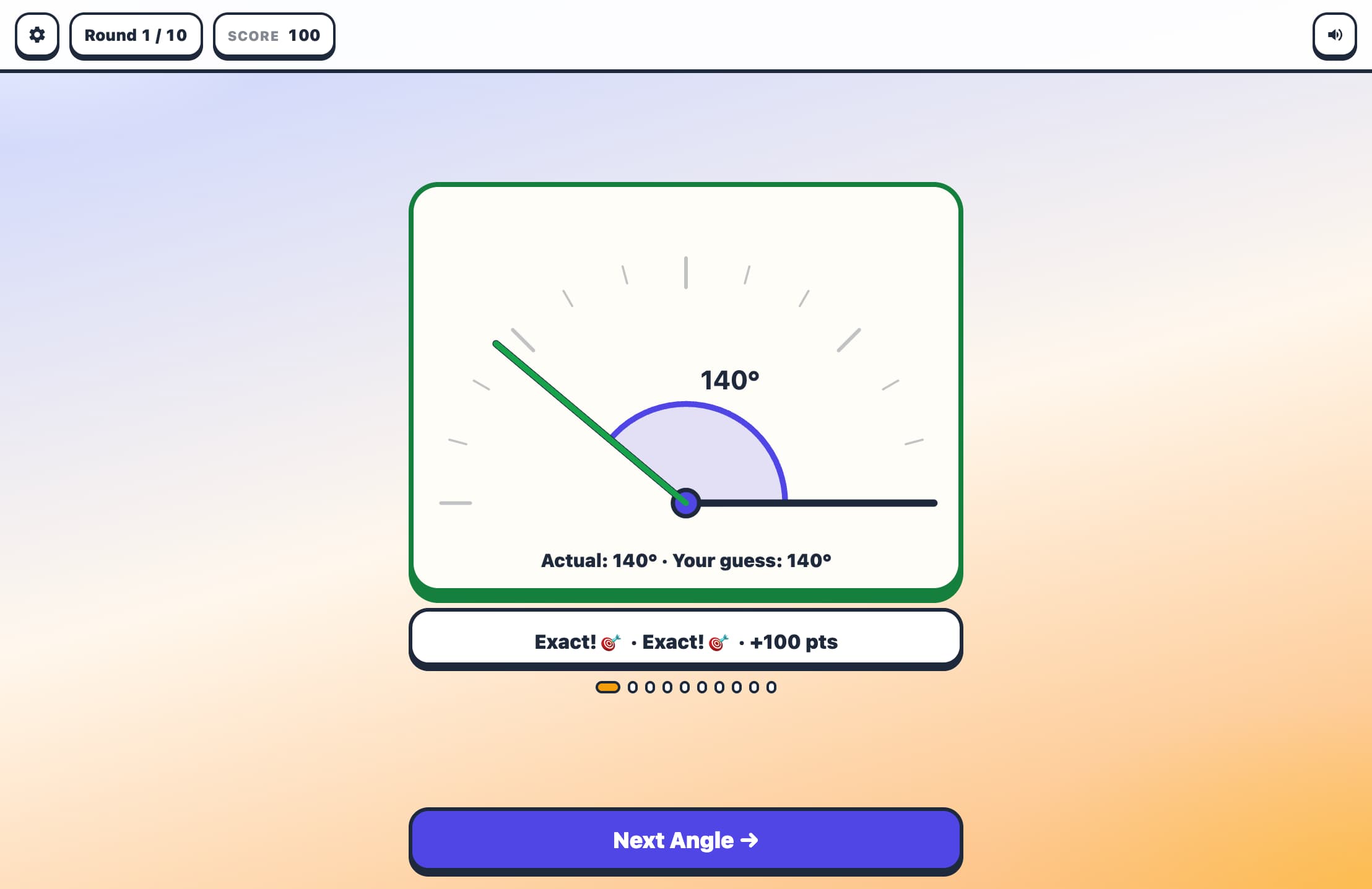
Train your eye for geometry! An angle is drawn on screen using two rays from a common vertex. Estimate the angle in degrees, then lock in your answer. The closer your guess, the higher your score — within 2° earns a perfect bullseye!
Count Coins Then Add to the Target
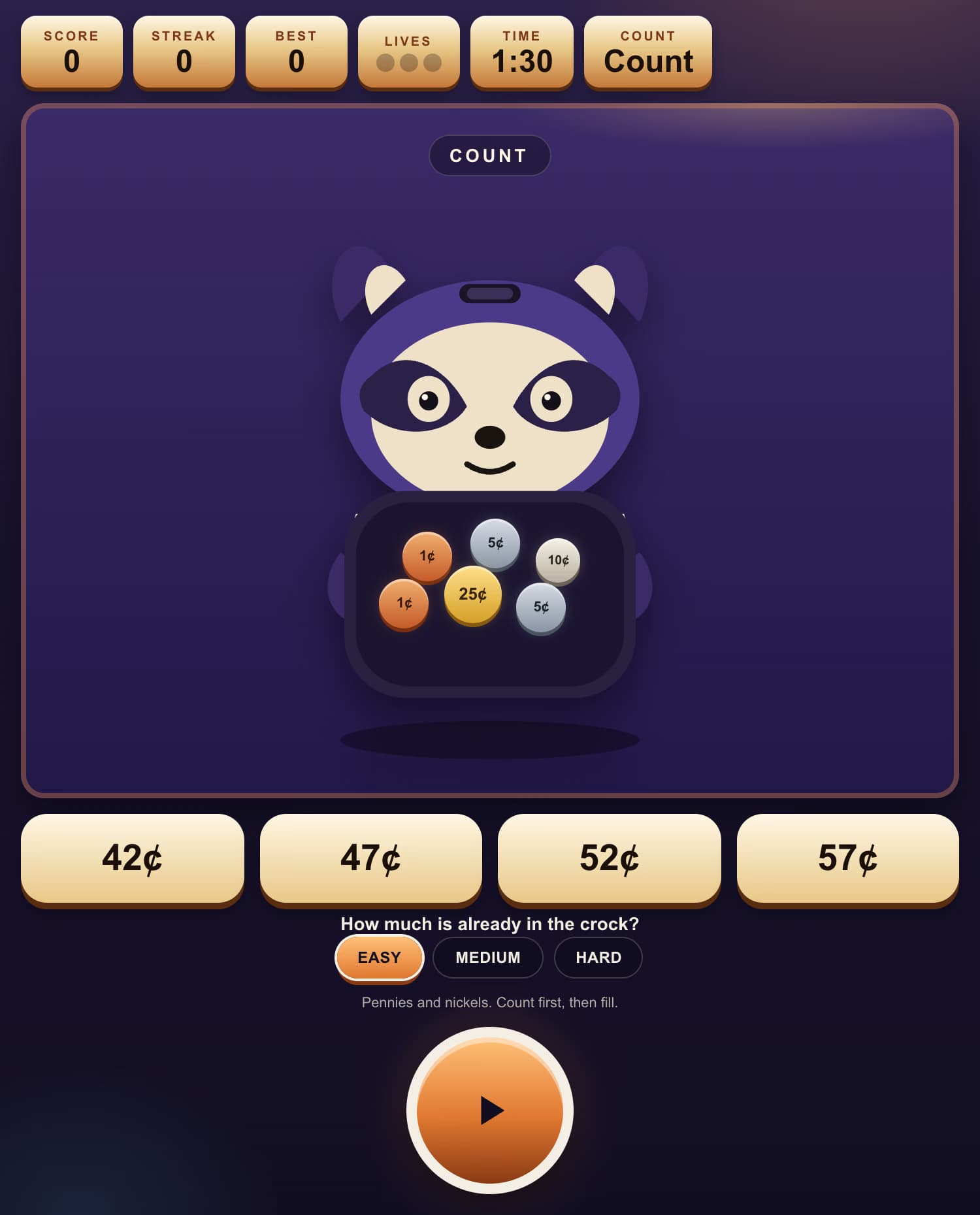
A copper-lit workshop and a plump ceramic raccoon crock. First count the pennies, nickels, dimes, and quarters already in the belly. Then tap coins from the walnut tray to reach a new total. Built for first through third graders practicing coin values and adding money.
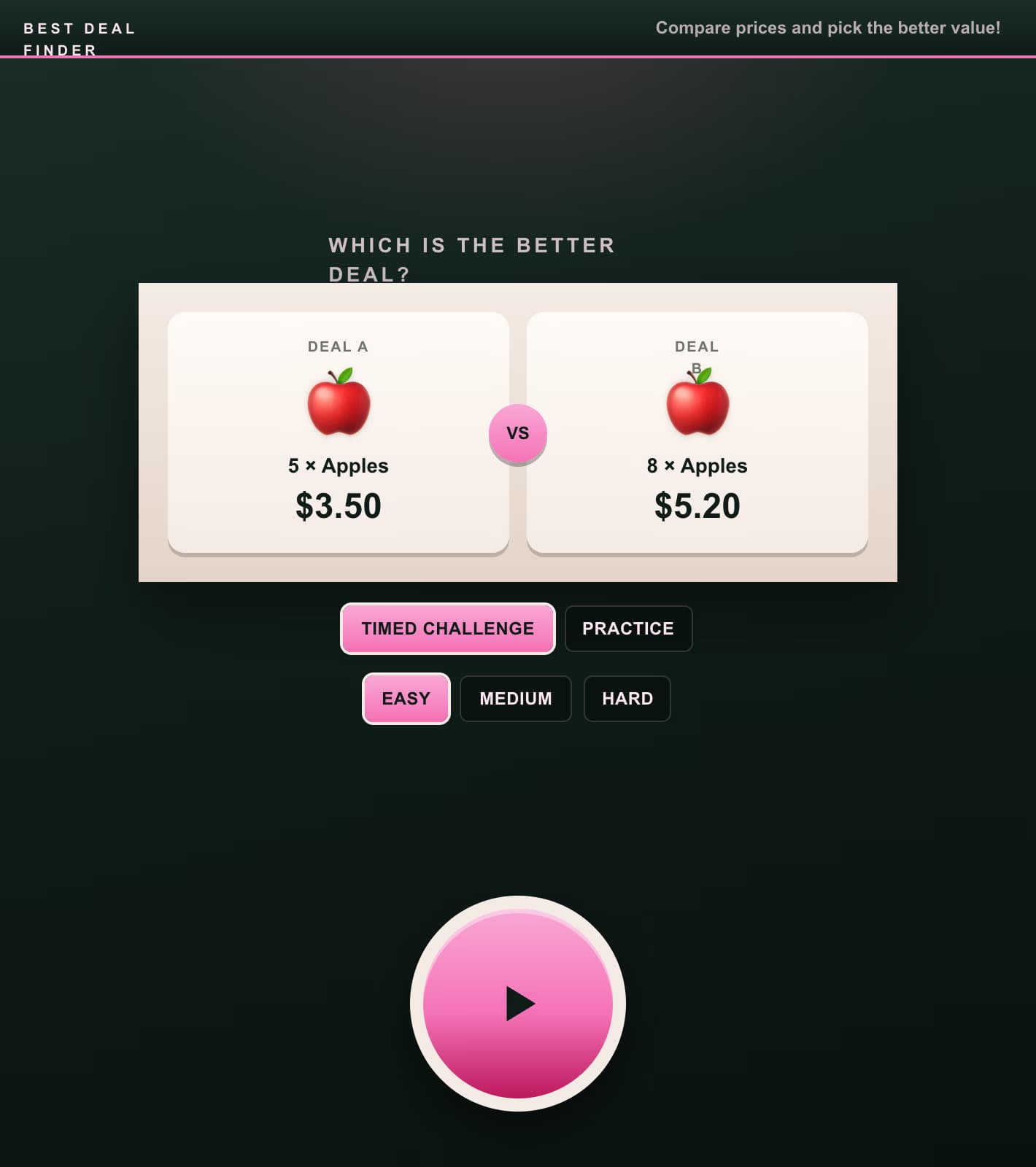
Compare Prices and Pick the Better Value
Compare two prices for the same item quantity and pick the better value. Introduces unit price thinking for grades 3–5. Practice finding the best deal by calculating price per item.
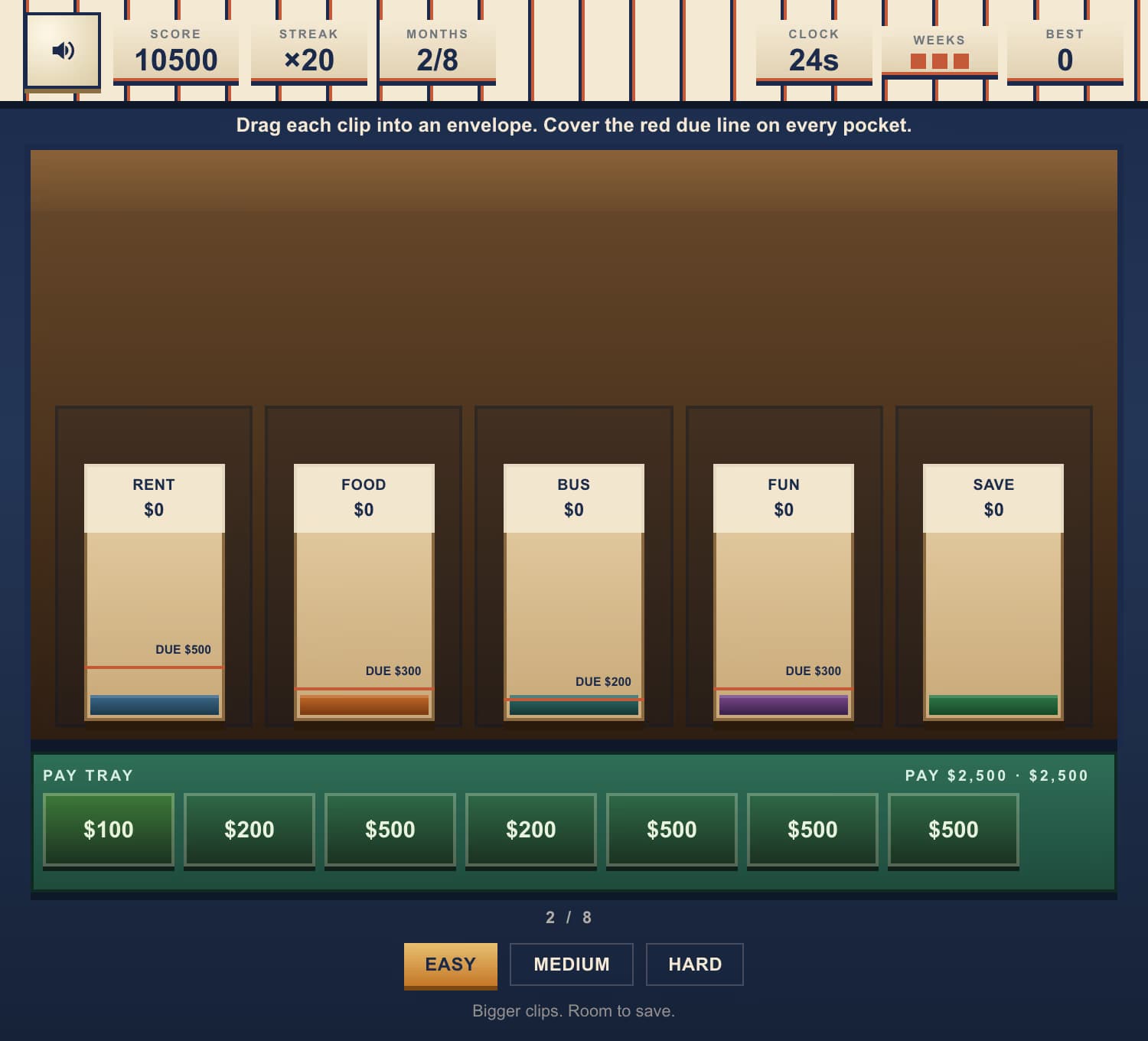
Stuff Payday Envelopes Before the Clock
A Saturday pay desk. Clips of cash land on a green blotter. Drag each clip into rent, food, bus, fun, or save. Cover the red due line on every envelope before the stamp clock hits zero. Built for money math: zero-based budgeting with moving bills, not plus and minus buttons.
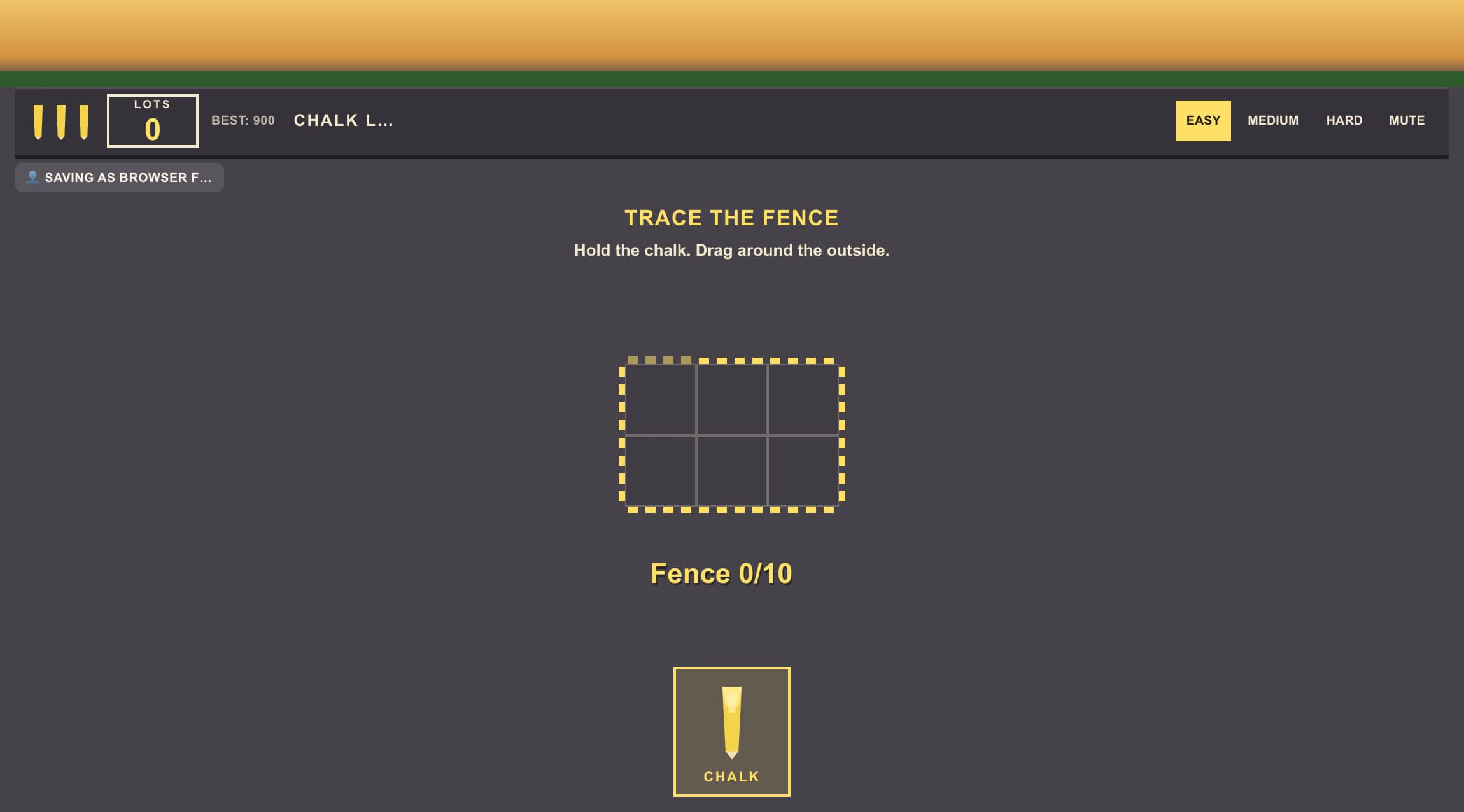
Perimeter and Area by Counting Squares
Draw on a driveway in Chalk Lot. Trace the fence to count the walk around a rectangle, or fill the squares to count how many unit squares fit inside. Third grade geometry: perimeter and area by counting, not by a hidden formula.
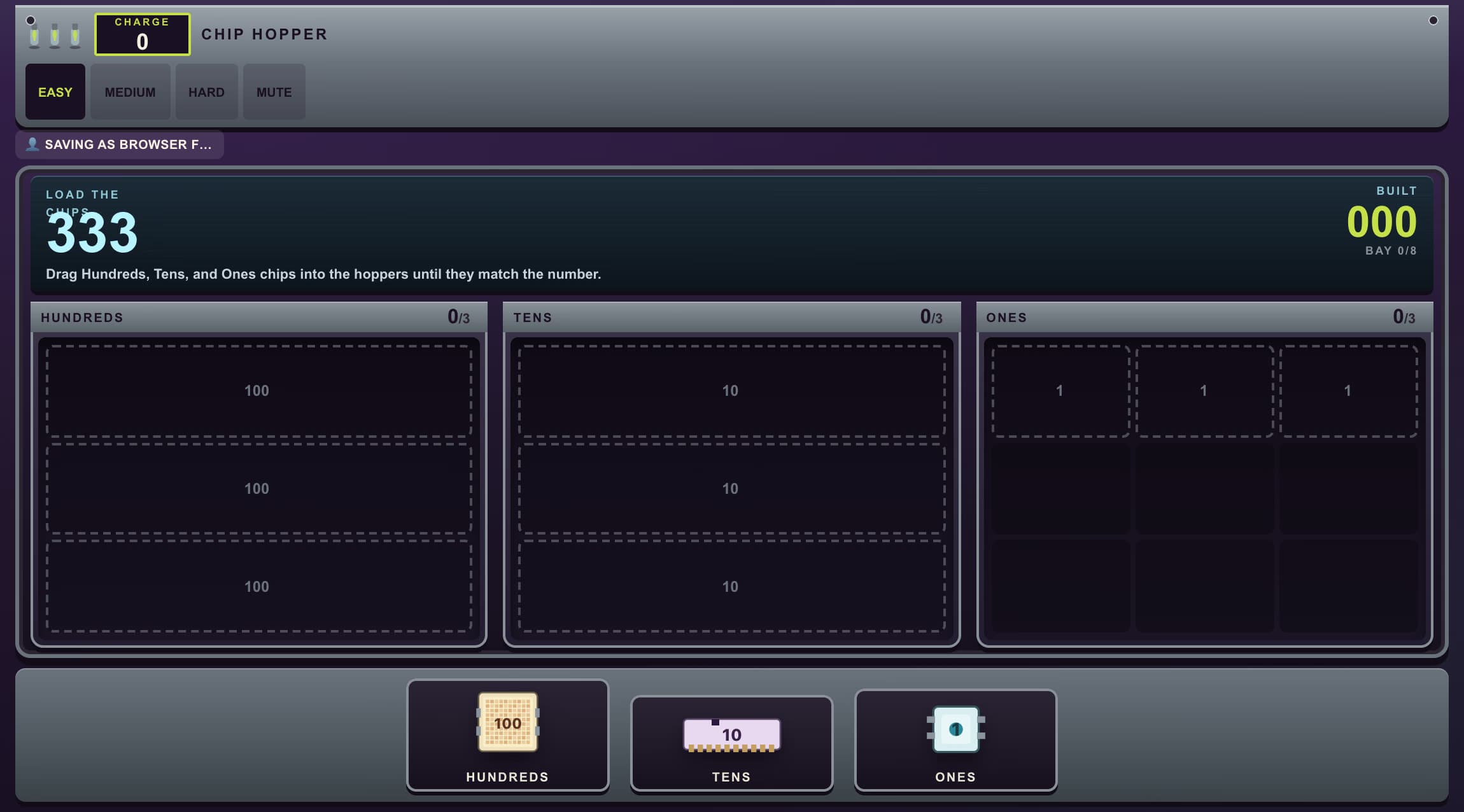
3-Digit Place Value Machine
Muggo's Chip Hopper is a broken three-digit place value machine. A CRT shows a number. Drag Hundreds, Tens, and Ones chips into the hoppers until they match the number. Second grade kids practice place value by loading visual blocks of hundreds, tens, and ones. Charge points grow with a streak.
Find the Multiples Crossing
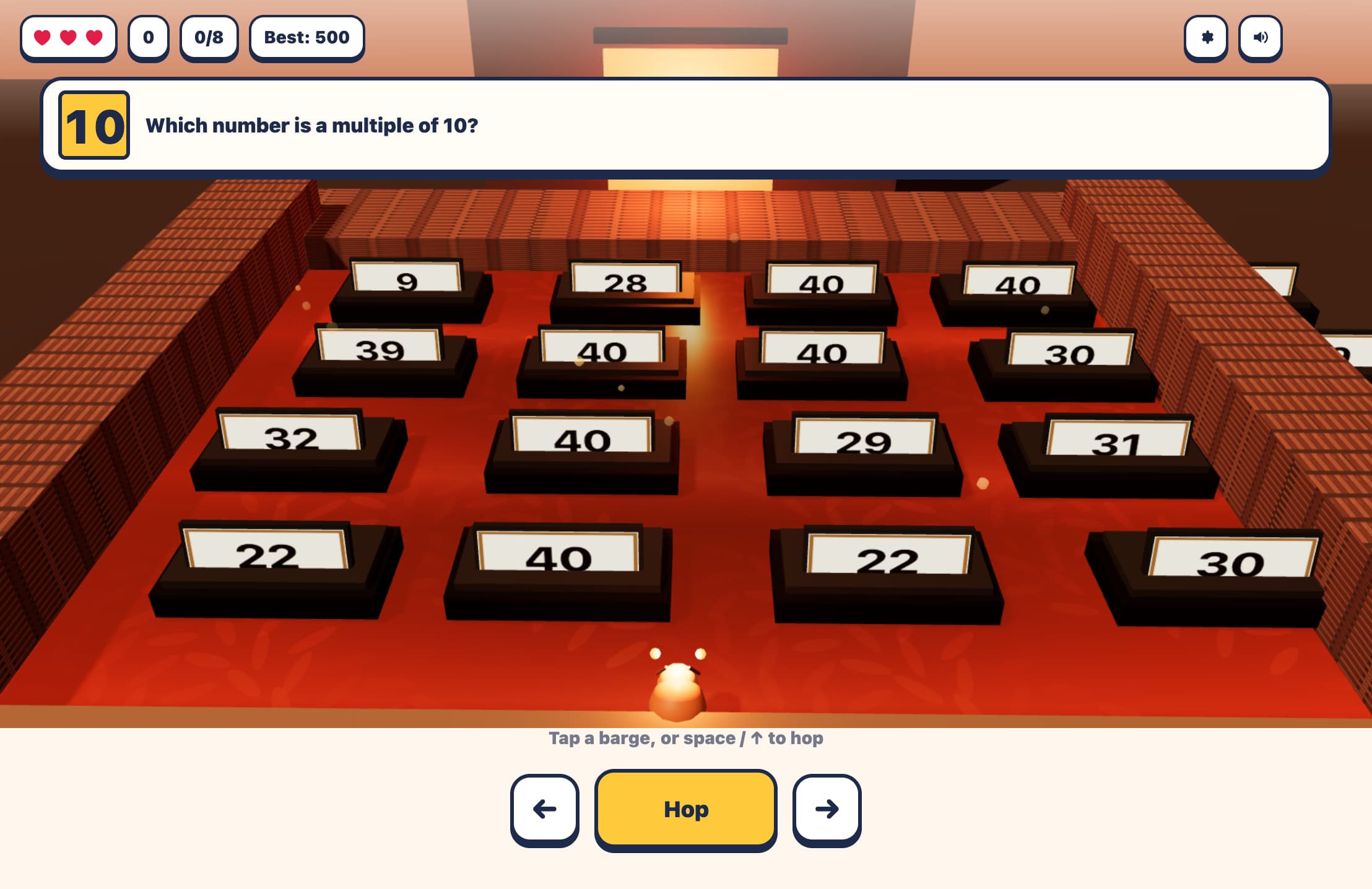
Hop a lantern beetle across an ash canal on moving iron barges. A sign asks which number is a multiple of 8—or 3, or 12. Land only on barges that match. A wrong number dumps you in the slag. Built for third- through fifth-grade multiples practice.
Addition Facts Glass Orb
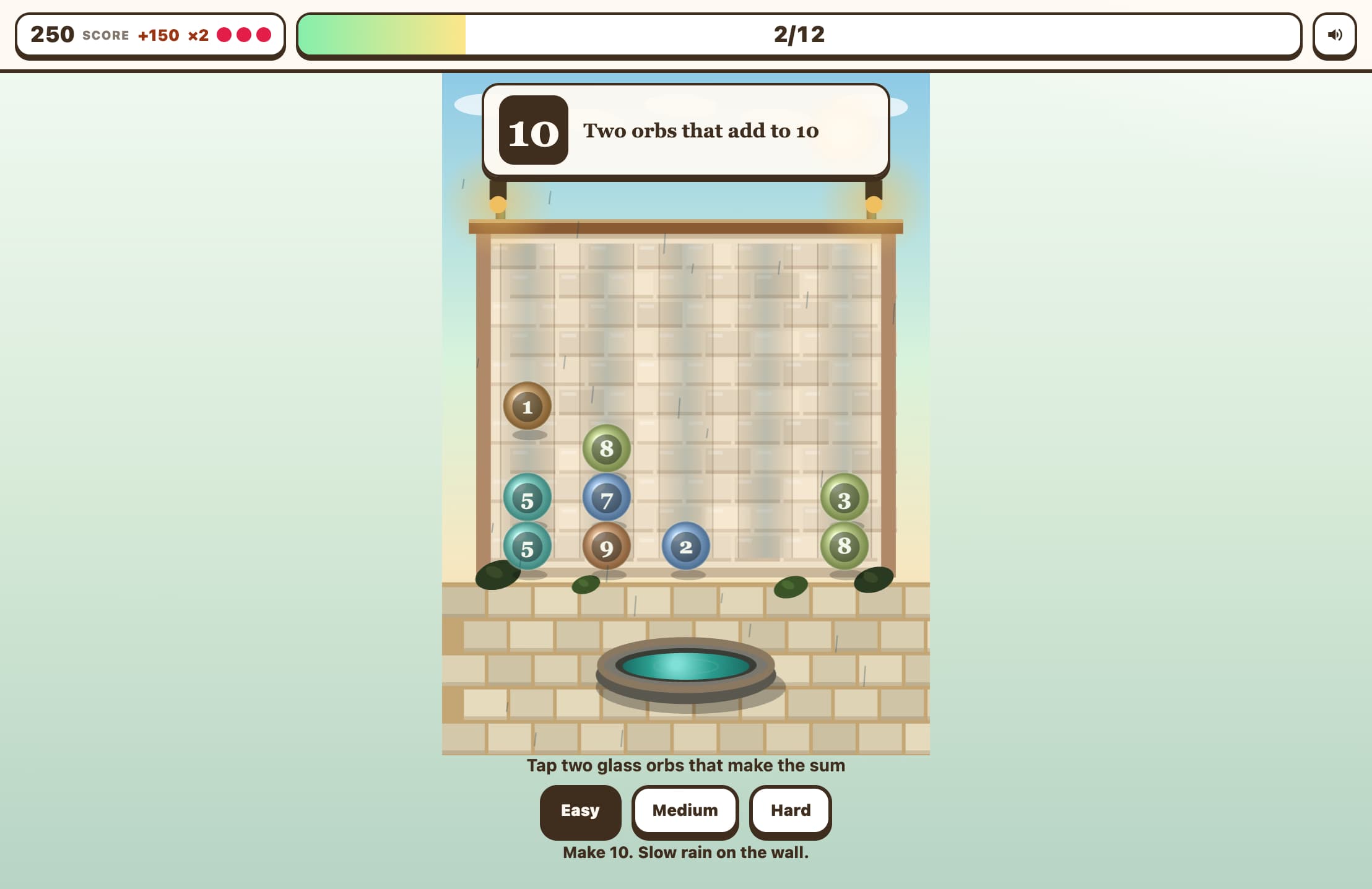
A moonlit limestone courtyard. Numbered glass rain orbs slide down wet stone channels. Tap two that add to the sum on the well plaque. A match melts into the cistern. A miss cracks and resets the streak. If the wall fills, a life is lost. Built for first- and second-grade addition facts.
Math Estimation
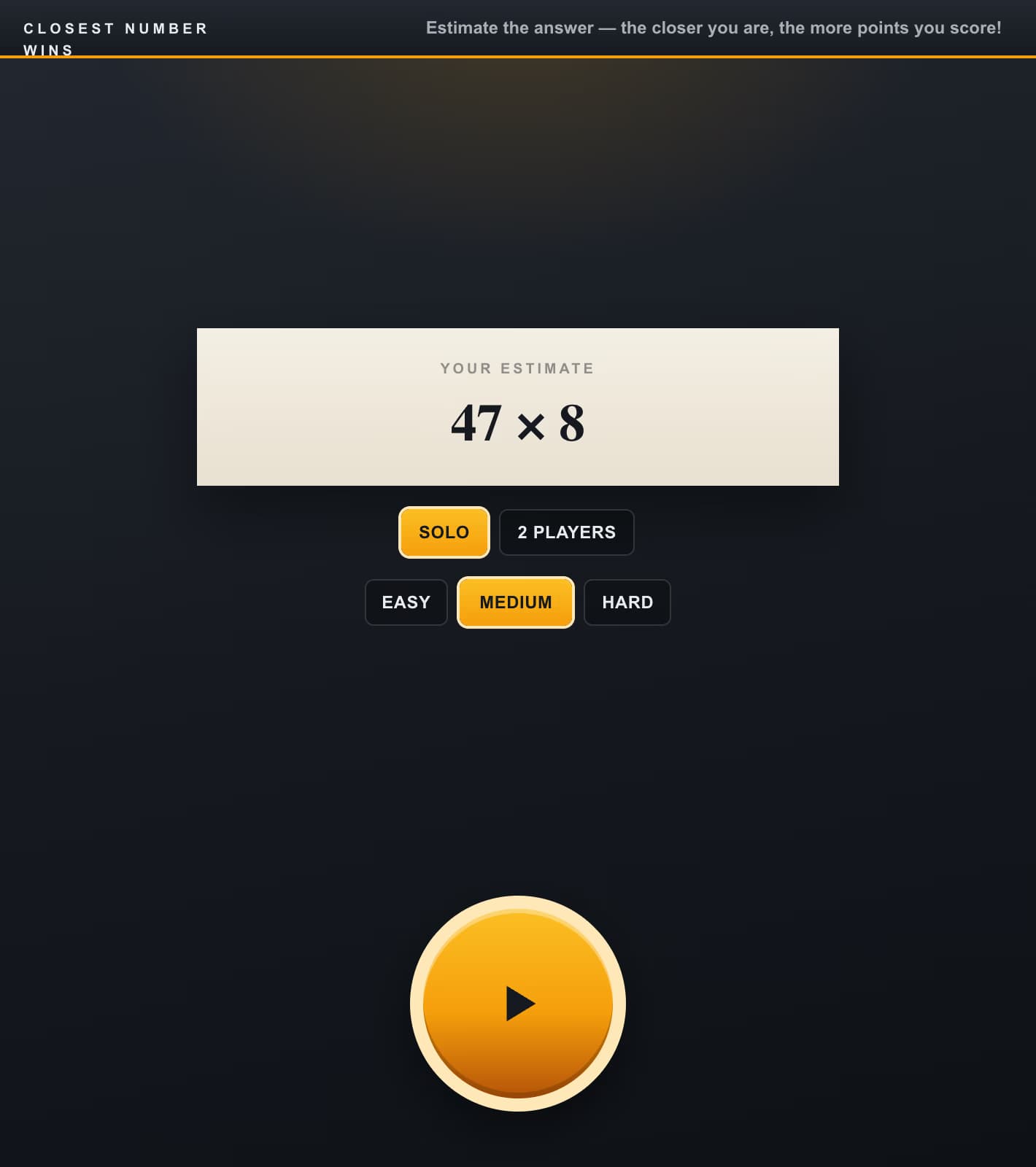
Estimate the result of a math expression. The player with the closest guess scores the most points — great for multiplayer fun!
Click Falling Coins to Reach the Target Amount
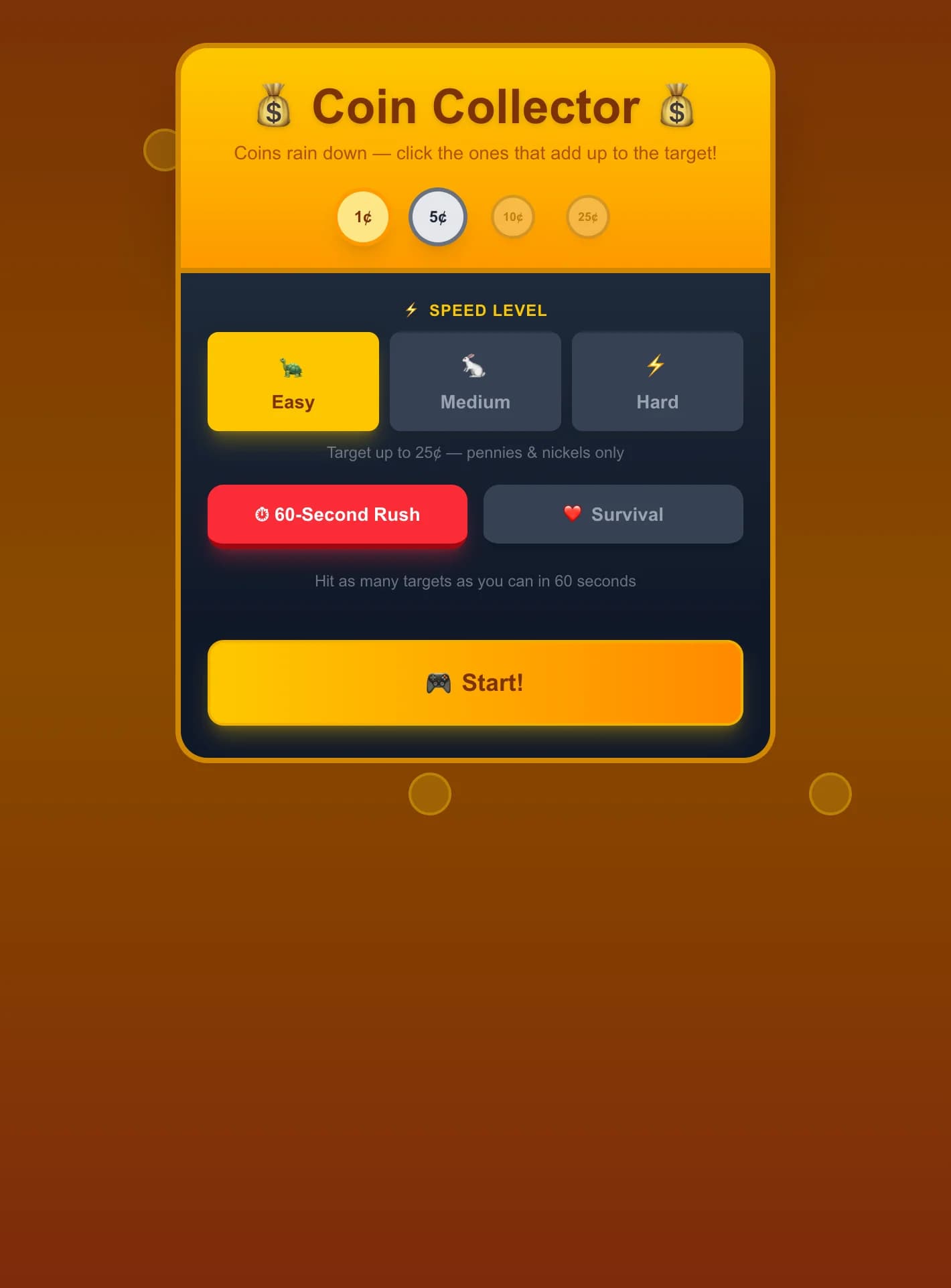
Coins rain down from the top of the screen — click only the ones that add up to the target amount before time runs out. A fast-paced money math game that sharpens coin recognition and mental addition for all ages.
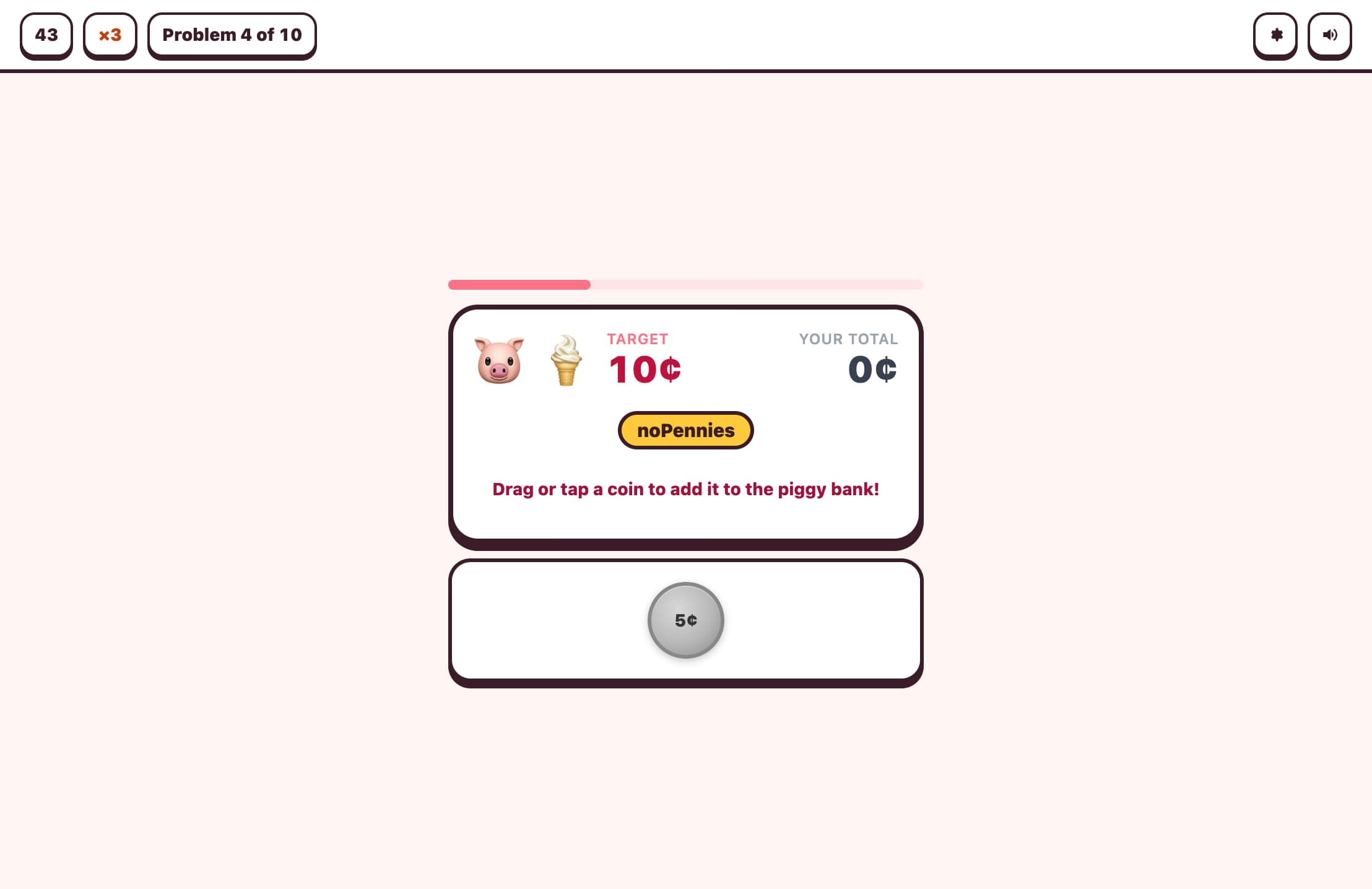
Drag Coins to Reach the Target Amount
Drag or tap pennies, nickels, dimes, and quarters into a piggy bank to make exact target amounts! Three difficulty levels introduce money concepts step by step — from 1–10¢ with just pennies and nickels, up to 50¢ with all four US coin types.
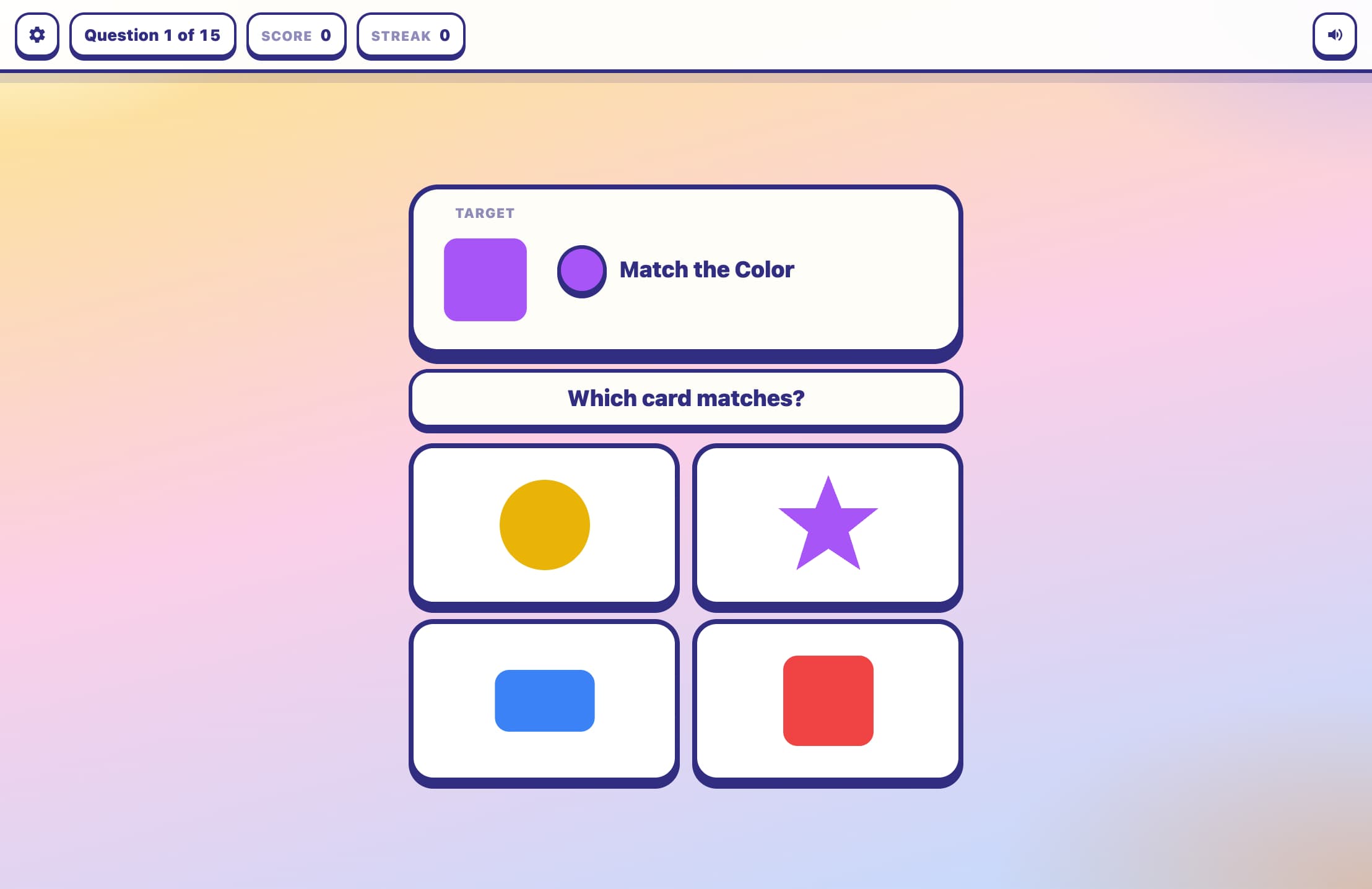
Classification and Sorting
A gentle introduction to classification and sorting! Match objects by color, shape, or both. Find the card that follows the rule — from easy single-attribute sorting to tricky two-attribute matching with near-miss distractors.
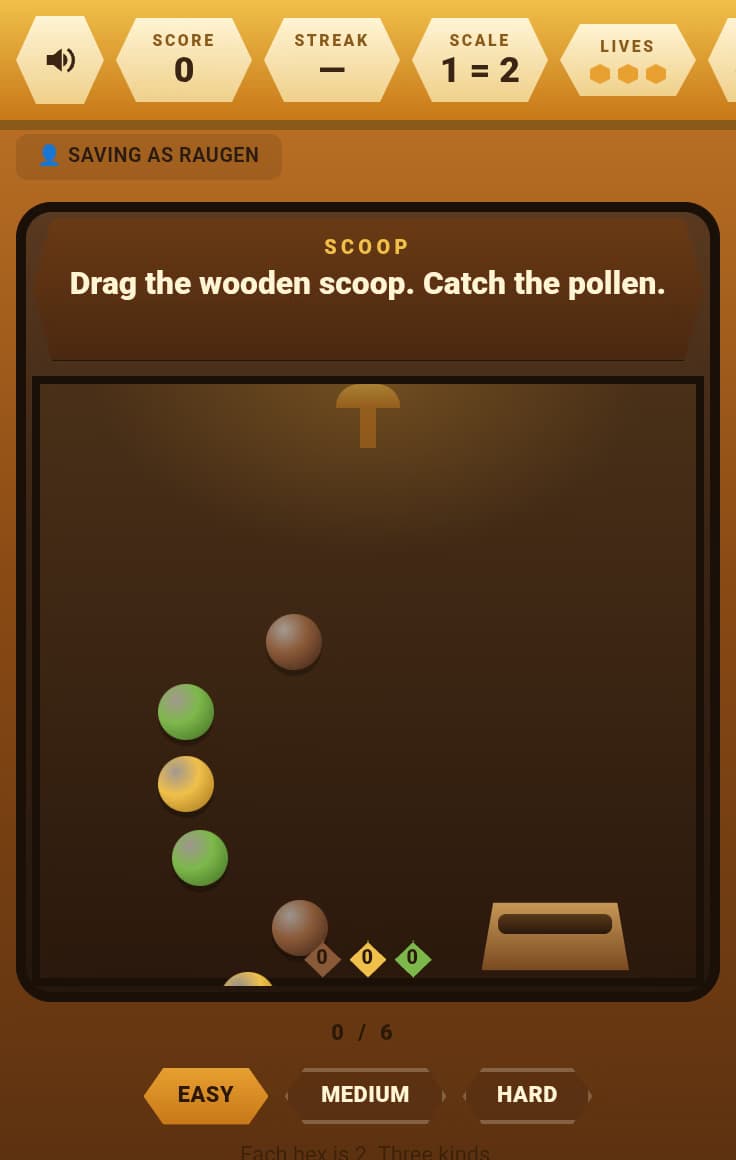
Scaled Bar Graphs
A warm beeswax loft. Pollen beads drift down from the comb. Scoop them with a wooden trough, then stamp a scaled honeycomb graph — each hex stands for 2, 5, or 10 beads. Built for third-grade scaled bar graphs.
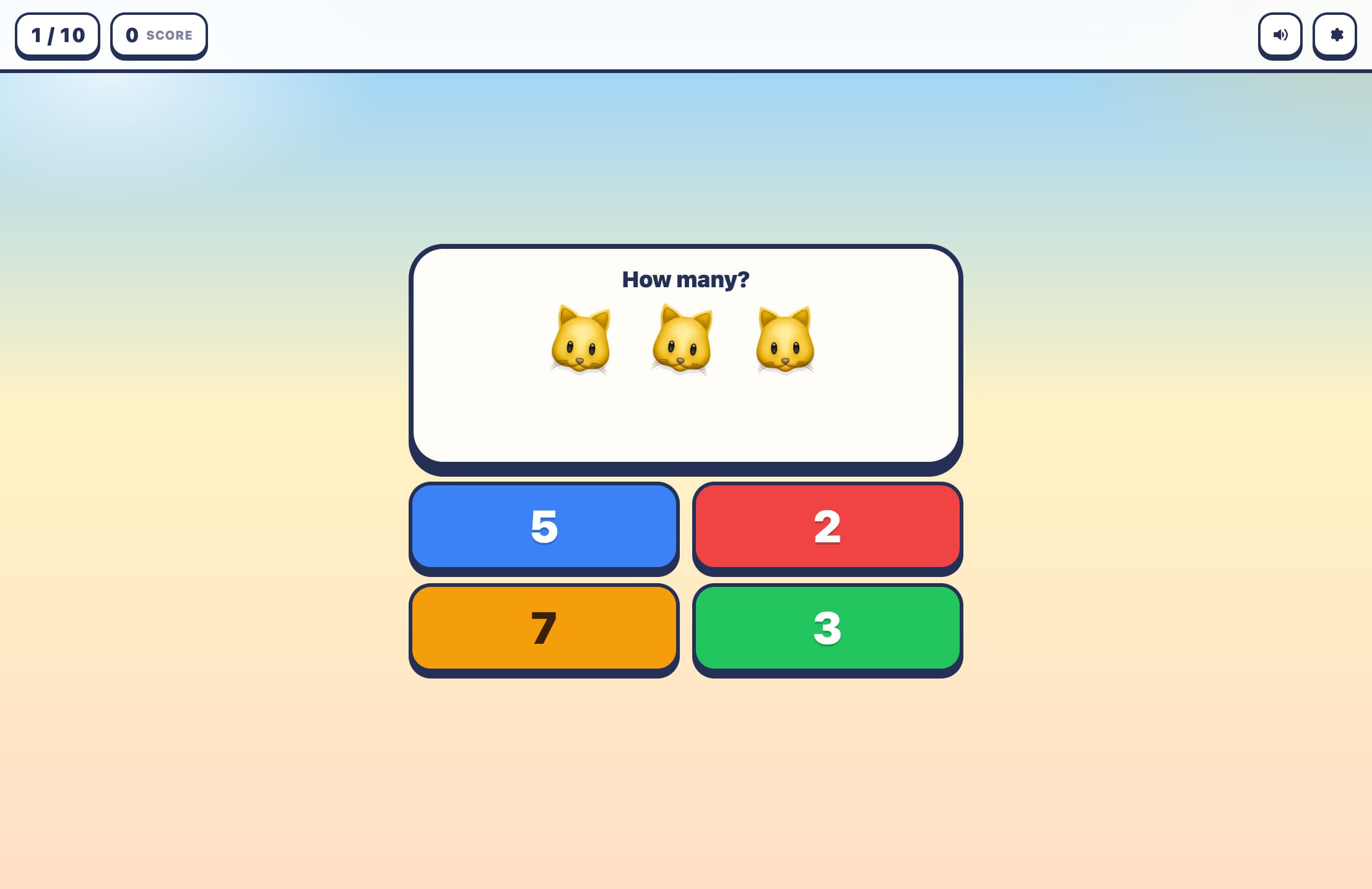
Kids Counting Game 1 to 20
A colorful counting game where you count cartoon emoji items and tap the right number. Perfect intro to counting 1–20 for young learners.
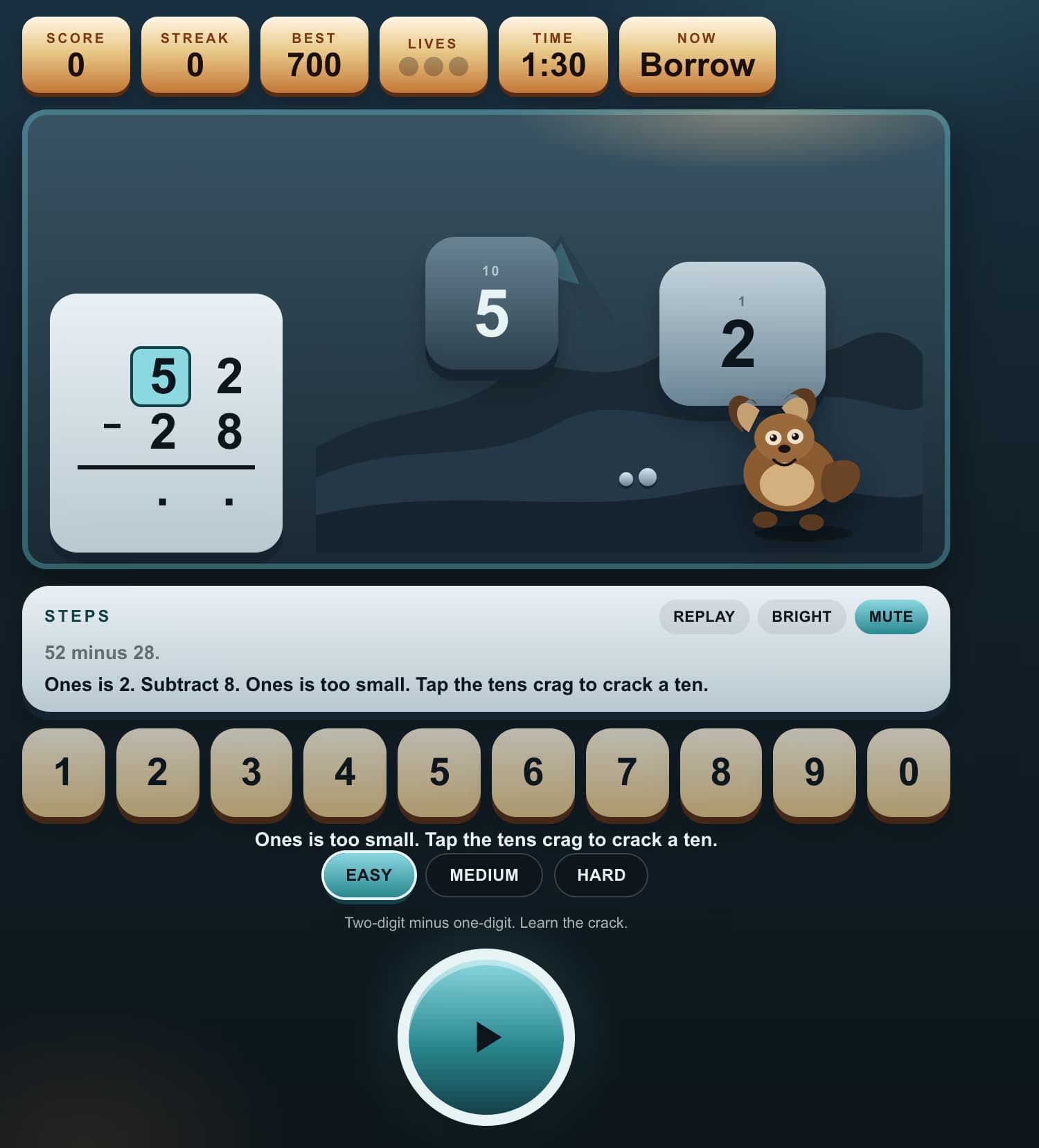
Two-Digit Subtraction with Regrouping
A dusk slate ridge, frost stones, and a bronze ibex. When the ones digit cannot take the subtraction, tap the tens crag to crack a ten. Ten pebbles tumble to the ones ledge. Then write the ones digit and the tens digit on the number pad. Built for third-grade two-digit subtraction with borrowing.
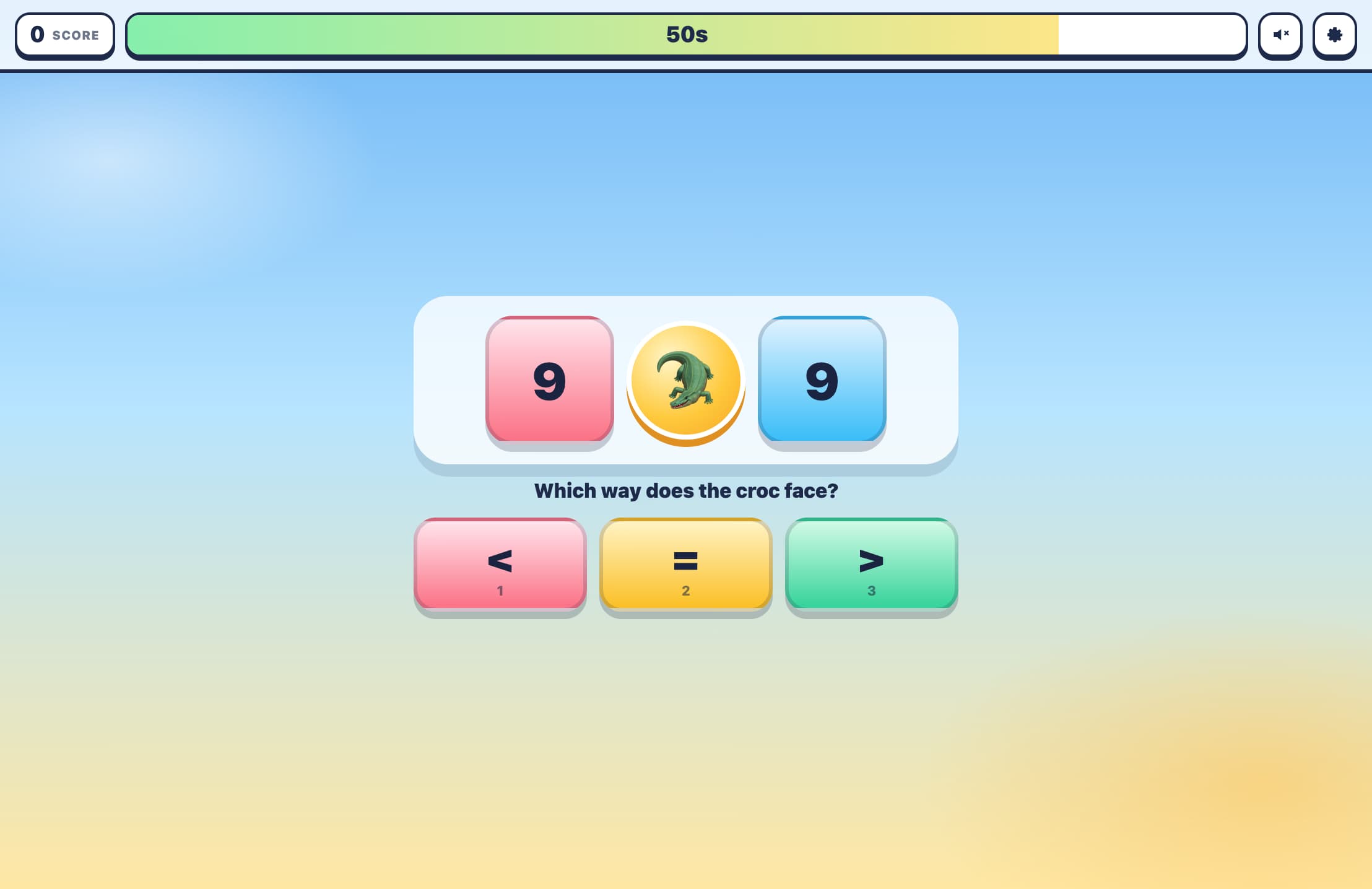
Greater Than Less Than
The hungry crocodile always eats the bigger number! Place the >, <, or = sign between two numbers up to 100. A fun animated crocodile turns to face the larger number after each answer.
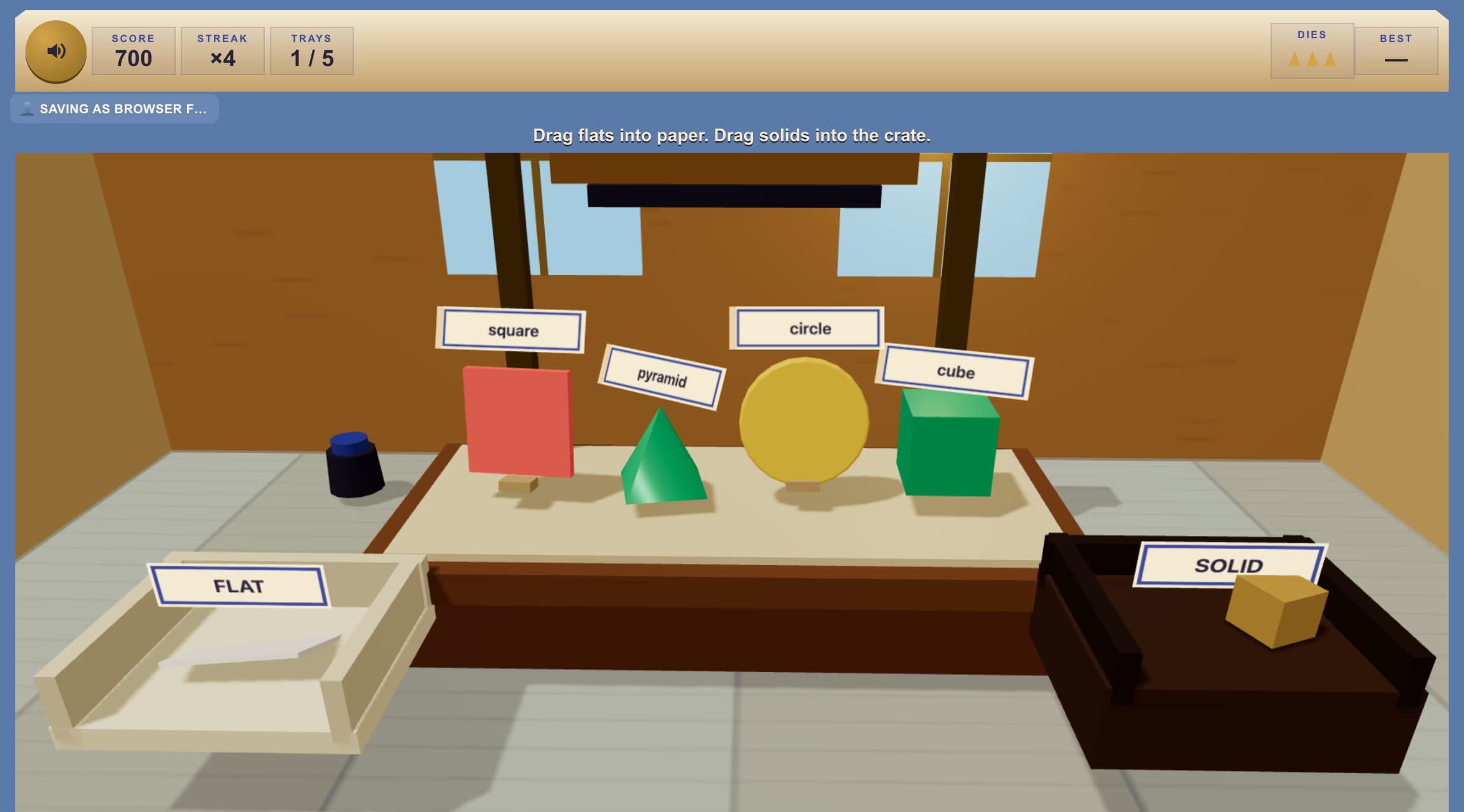
Flat or Solid
A kraft packing loft is waiting on the next tray. Drag paper-flat 2D shapes into the Flat bin and chunky 3D solids into the Solid crate. Kindergarten geometry practice: circles stay flat, cubes take up space. Clear five trays, keep three brass dies, and race the press on harder runs.
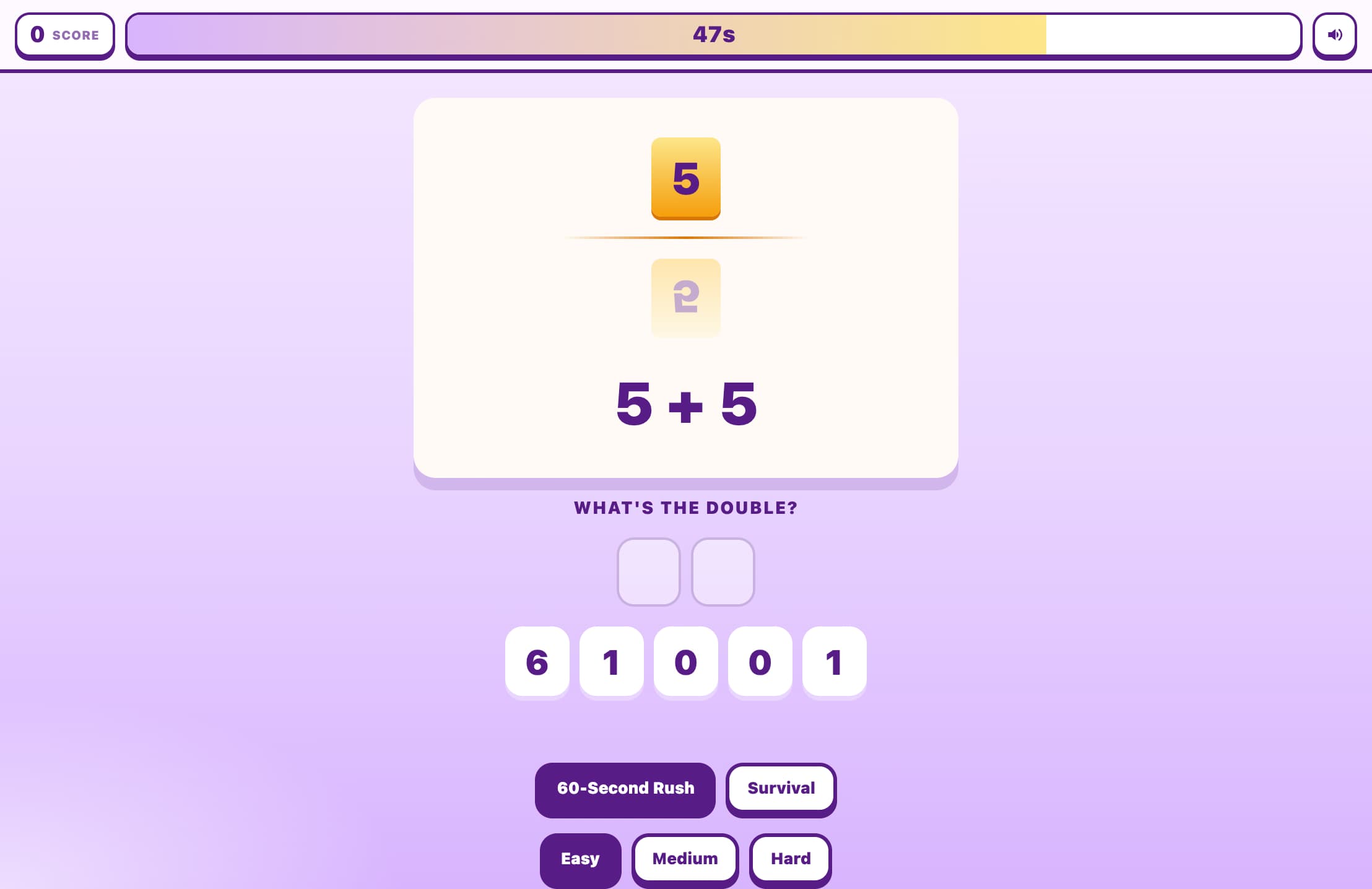
Doubles Facts
Practice doubles addition facts (1+1, 2+2, … 10+10) with a fun mirror/shadow visual theme. See the number and its reflection, then tap the correct double. Three difficulty levels including near-doubles.
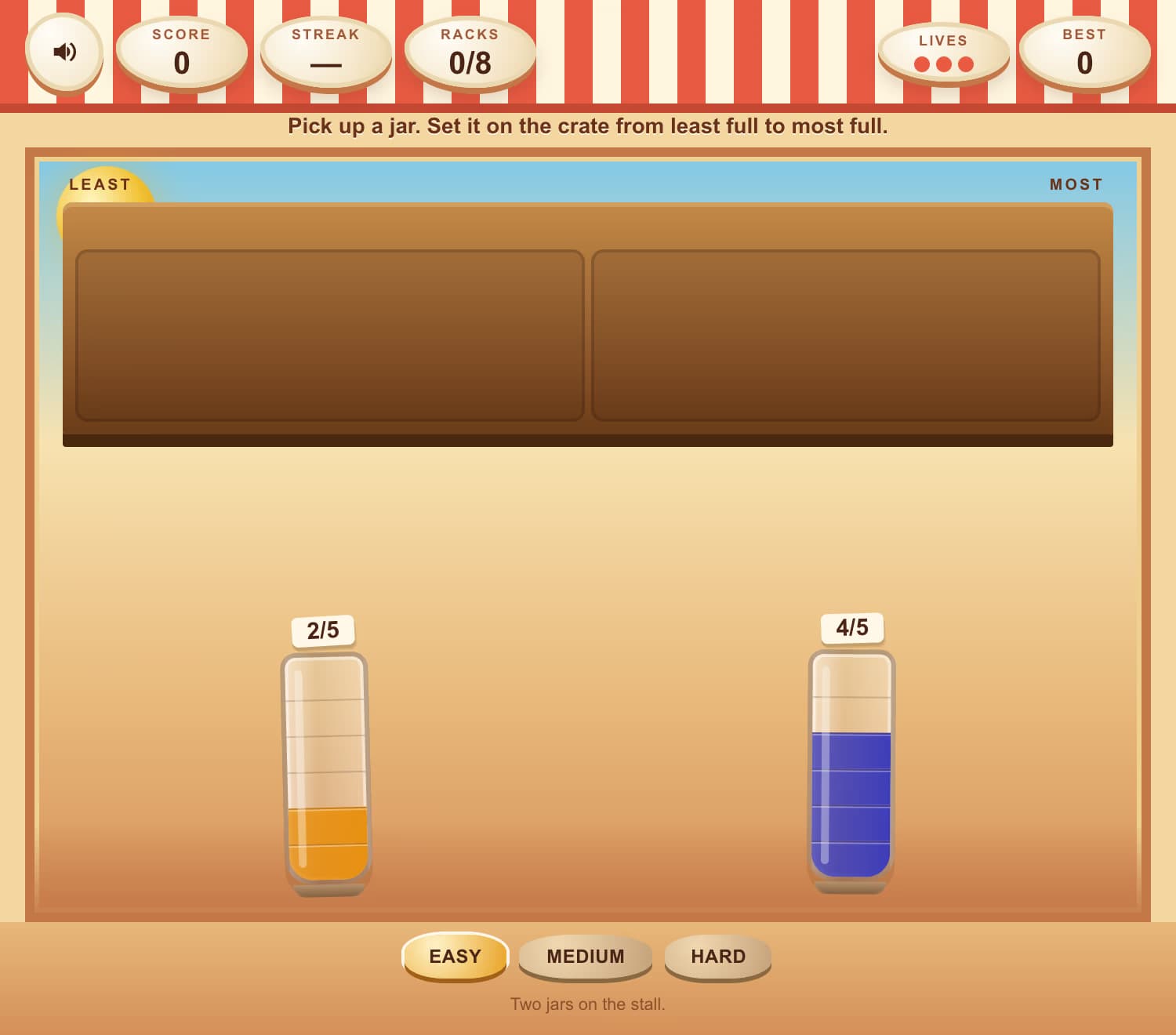
Order Fractions With Like Denominators
A sunlit dye stall, glass jars, and a wooden crate. Each jar is a strip model of a fraction with the same denominator. Pick a jar up and set it on the crate from least full to most full. Wrong seats slosh. Eight crates win a run. Built for fourth-grade ordering fractions.
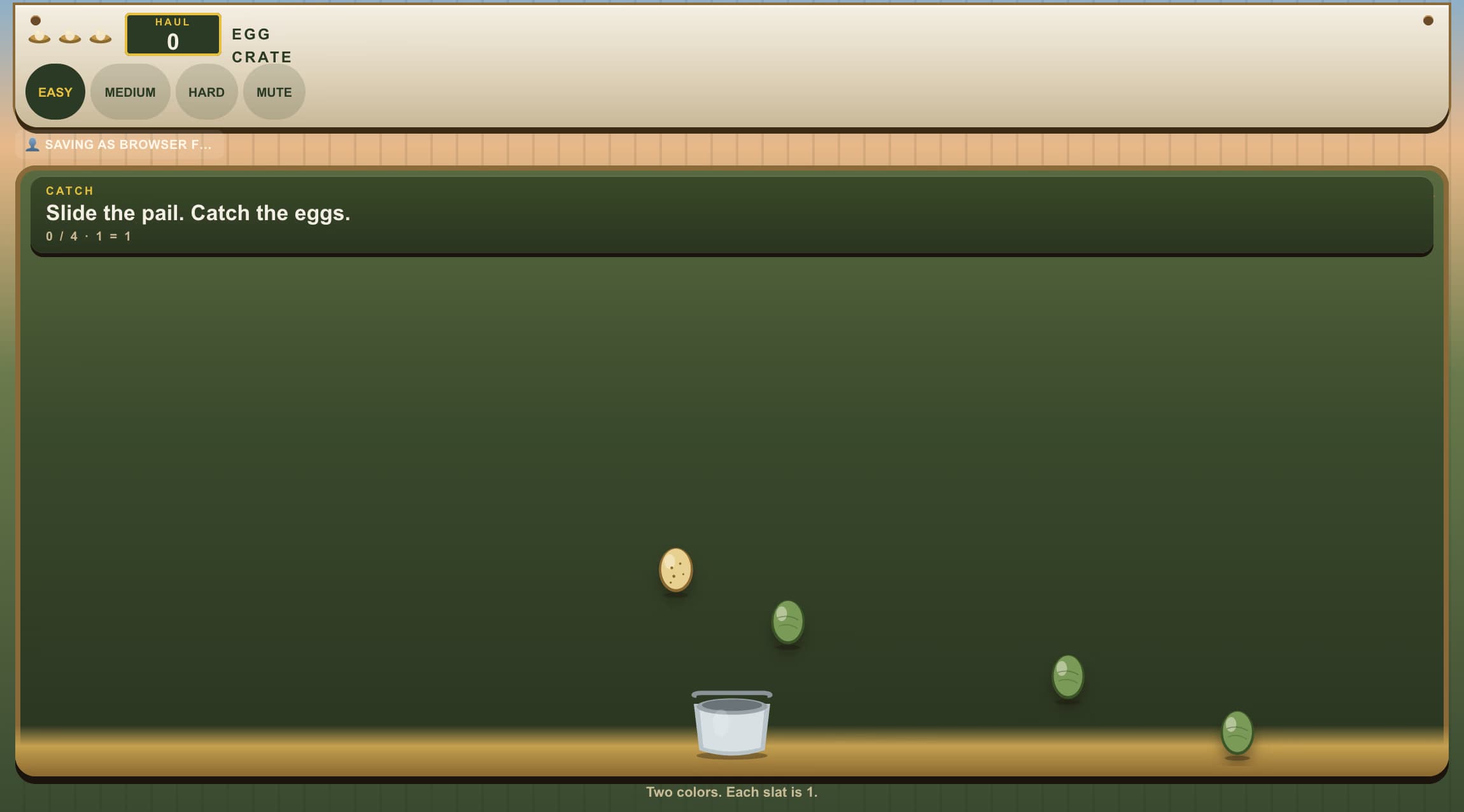
Catch, Sort, and Stack Bar Graphs
The hens are laying faster than the pail can swing. Slide the pail to Catch the eggs, Sort the eggs into color crates, then Stack the bars on a chalkboard graph. Third grade kids collect and organize data while they build a bar graph from a real clutch.
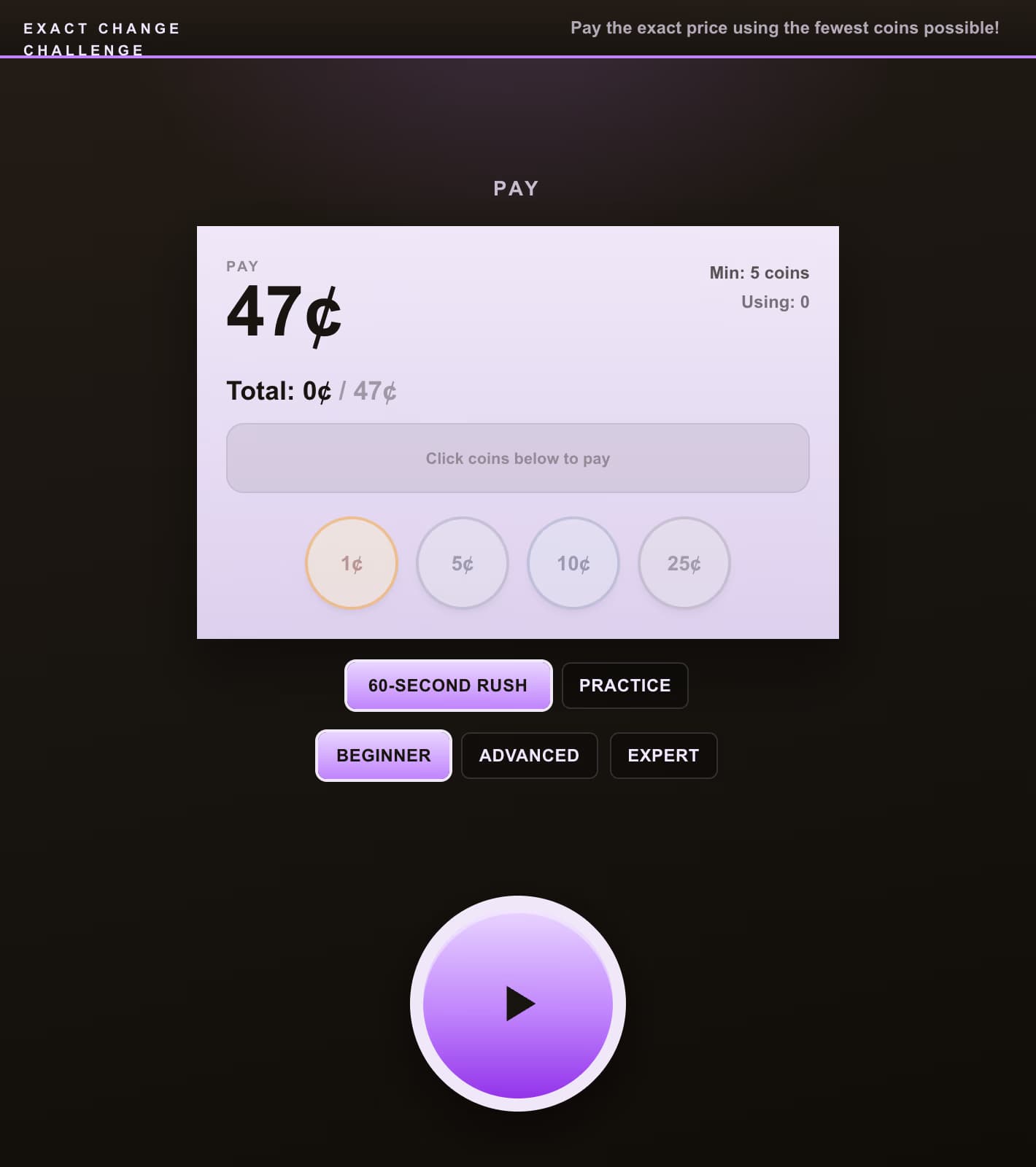
Pay with the Fewest Coins Possible
Pay for an item using the fewest coins possible. Teaches coin efficiency and combination strategies for amounts up to $5. A strategy-based money math game for all ages.
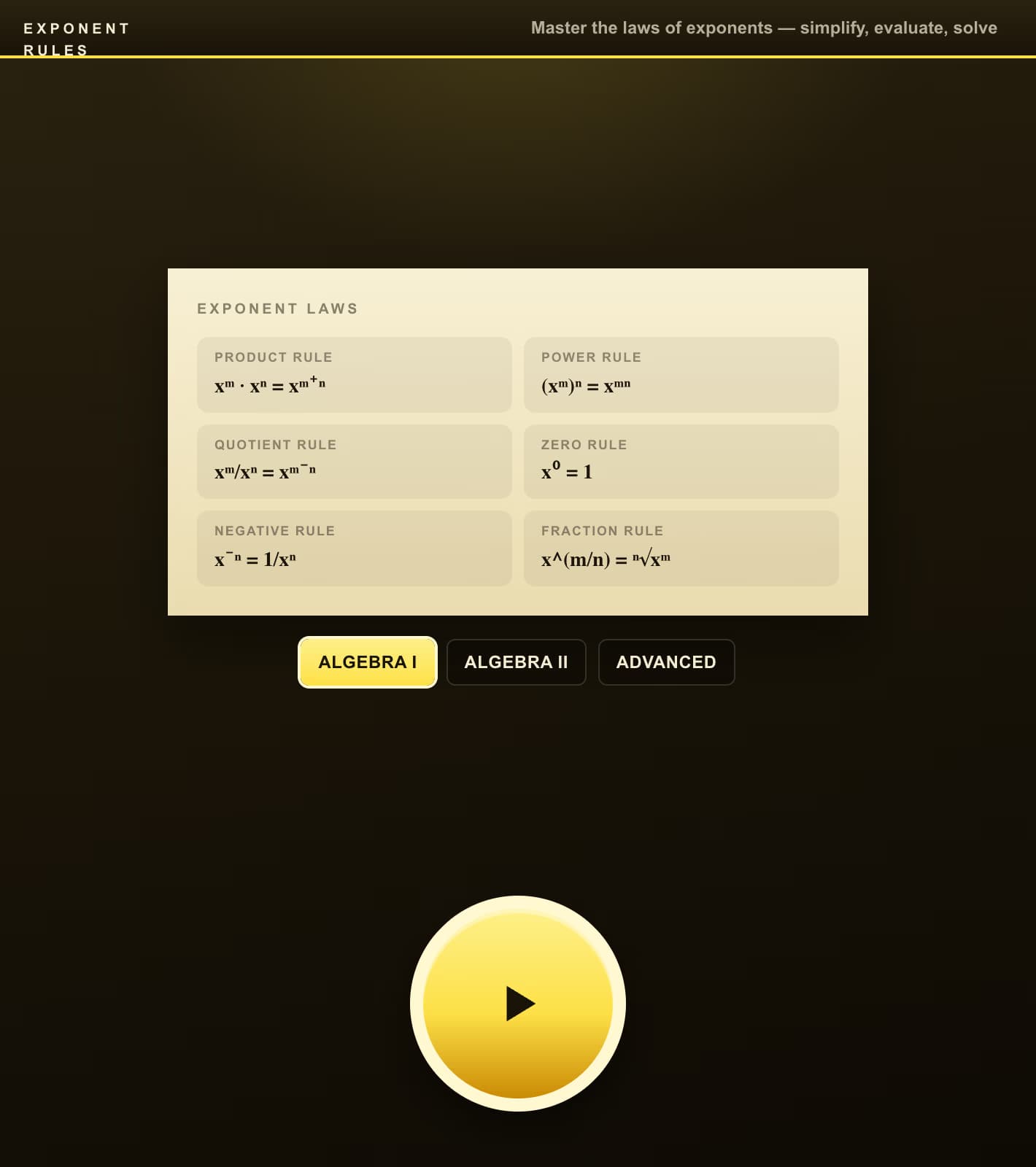
High School Math Quiz
Master the laws of exponents — pick the correct simplified form or value from four choices. 45 problems across three tiers: Algebra I (product, quotient, power, zero, and negative exponent rules), Algebra II (fractional exponents, scientific notation, combining multiple rules), and Advanced (solving exponential equations, complex multi-rule simplifications).
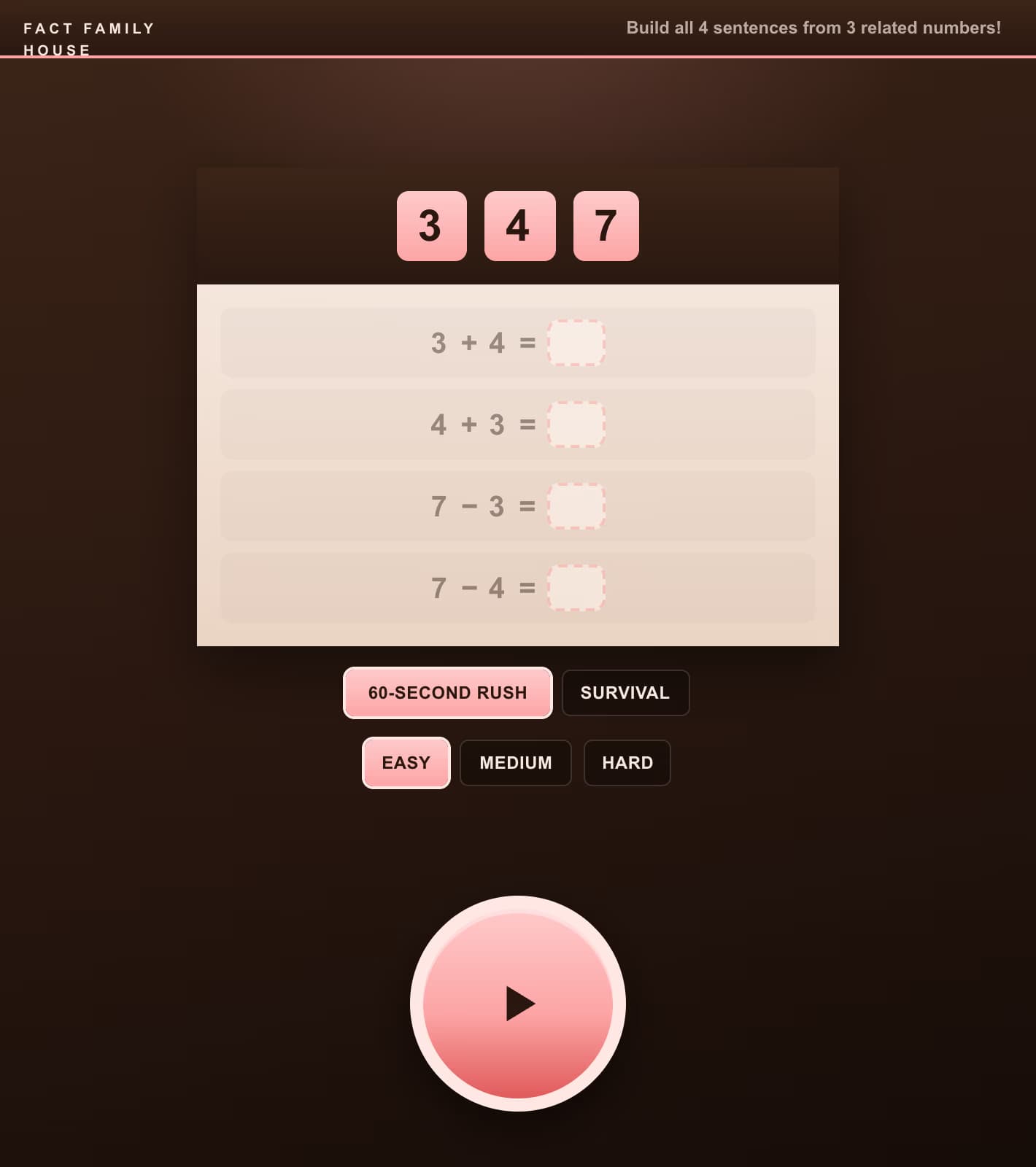
Addition & Subtraction Sentences
Given 3 related numbers (e.g., 3, 4, 7), fill in the missing number in all 4 addition and subtraction sentences. A house-shaped visual shows the family numbers on the roof with equations inside.
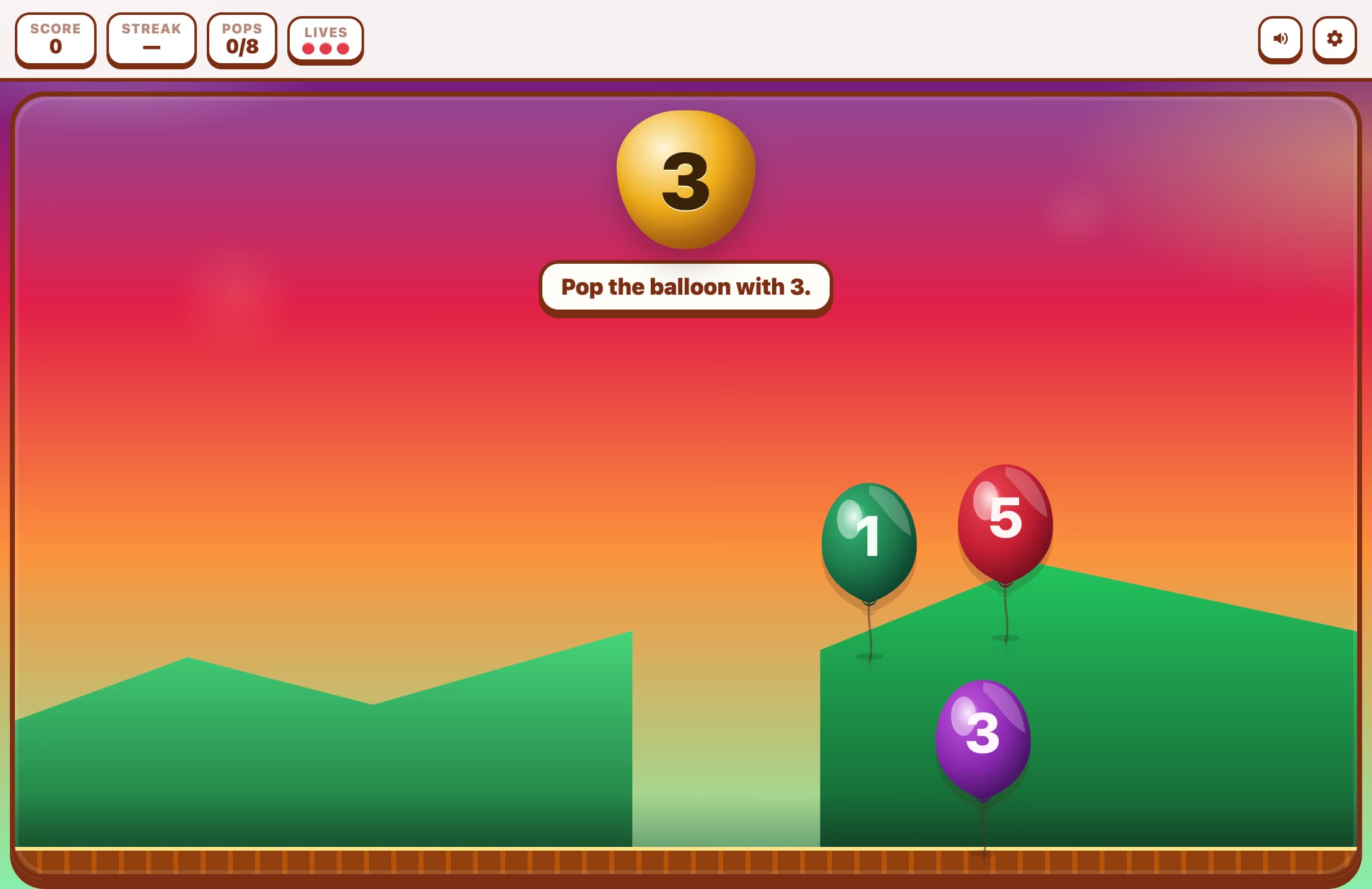
Pop Balloons Numbers 0-10
A dusk garden where glossy latex balloons rise on the warm air. Hear the call, watch the lift, and pop the balloon that shows the matching number before it floats away. Built for preschool and kindergarten number identification from 0 to 10.
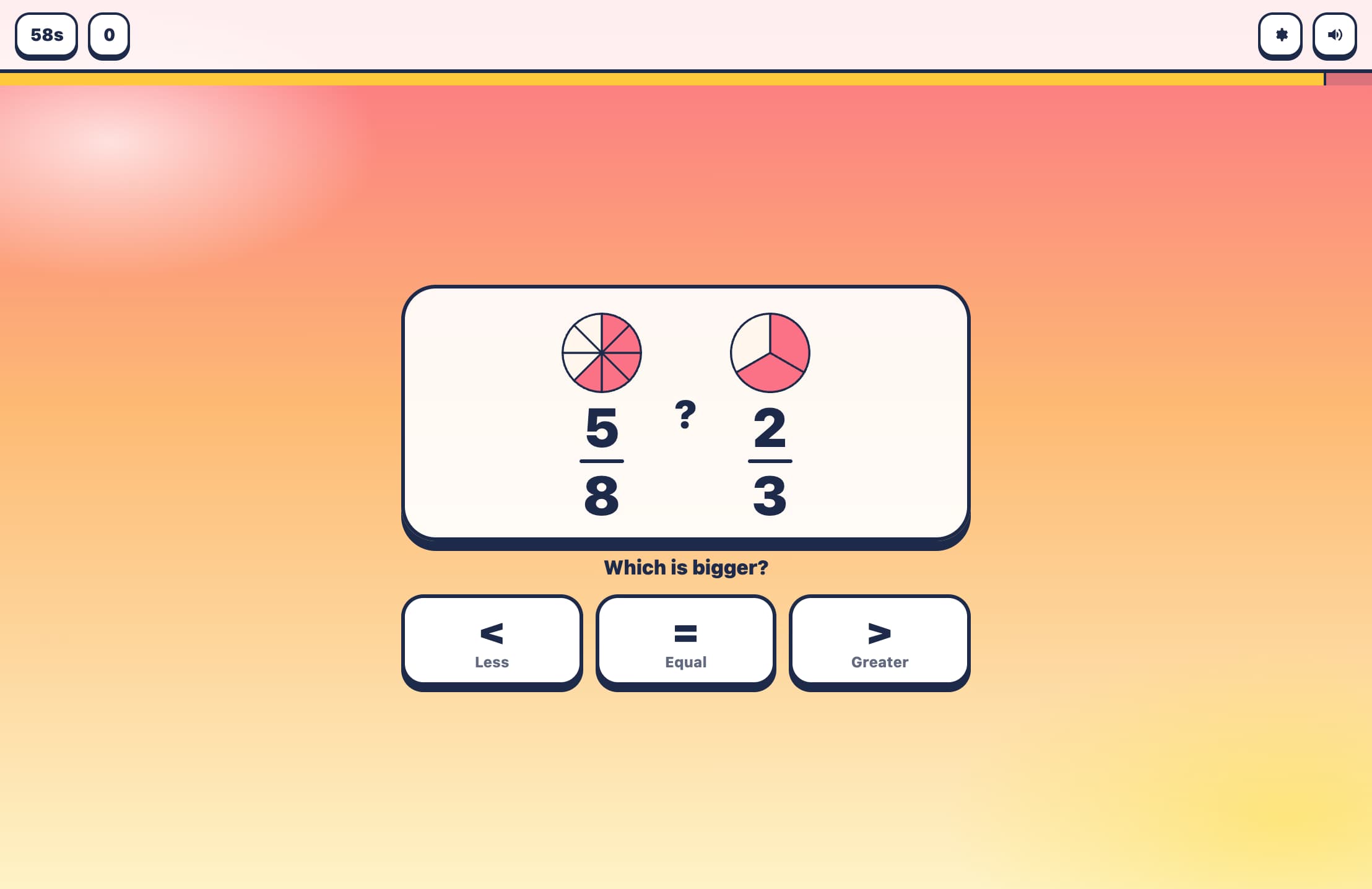
Compare and Sort Fractions
Compare or sort fractions in this fast-paced math challenge. Which fraction is bigger? Tap them in order smallest to largest — race the clock or survive on 3 lives!
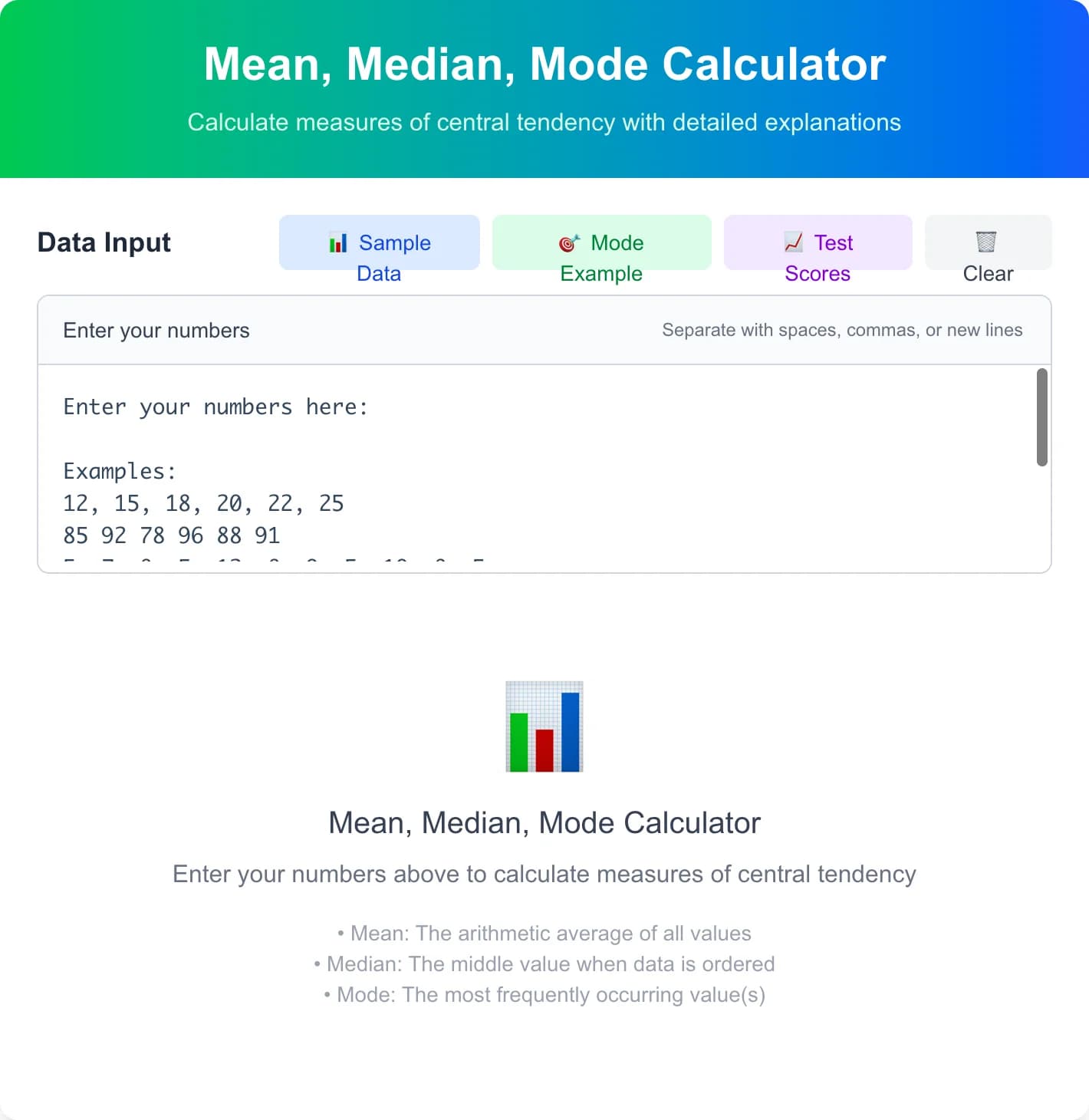
Statistical Measures Calculator
Calculate mean, median, and mode of any dataset with our free online statistical calculator. Get detailed step-by-step calculations, frequency tables, and comprehensive statistical analysis.
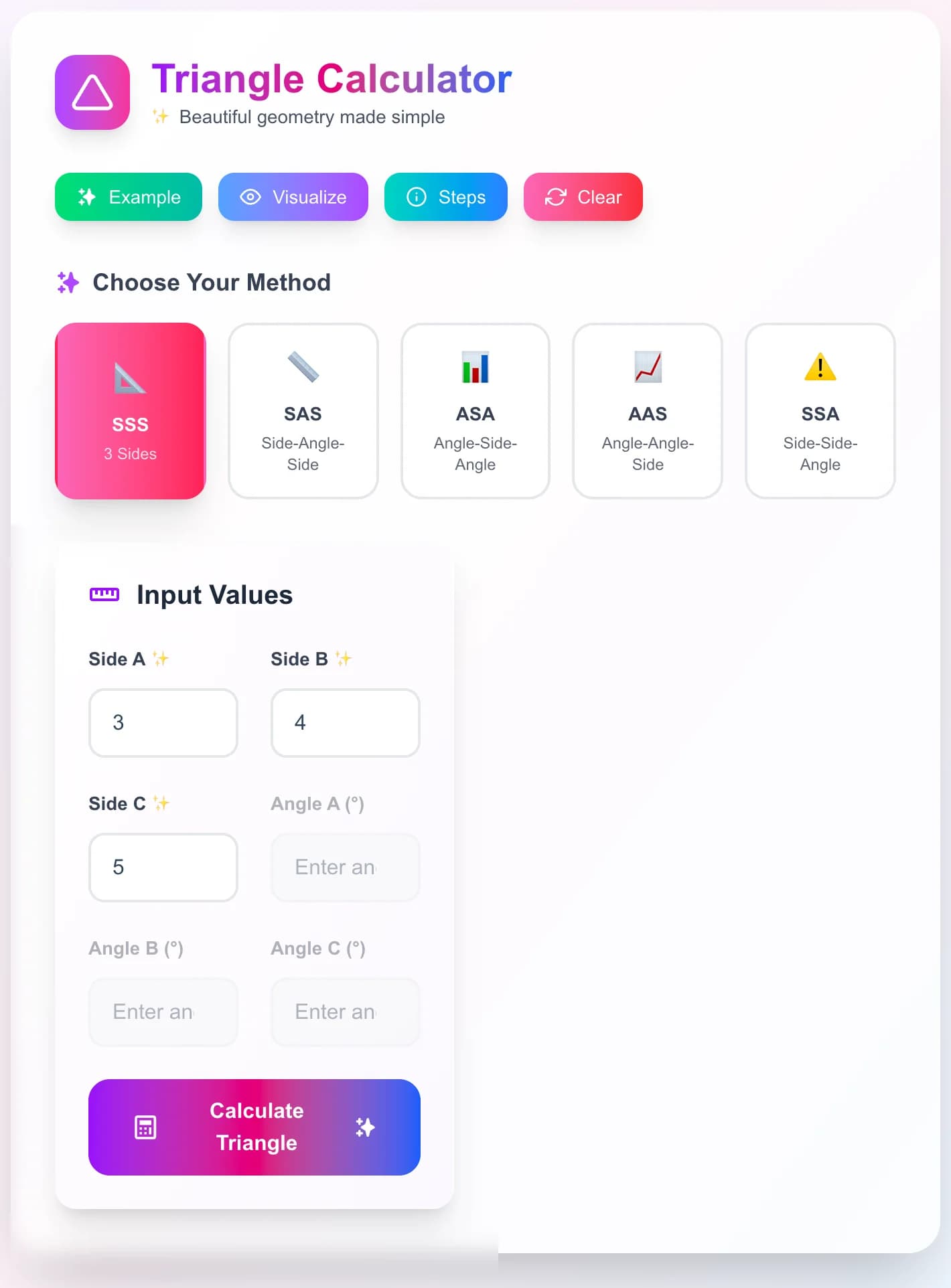
Solve Any Triangle with SSS, SAS, ASA, AAS, SSA
Calculate triangle sides, angles, area, and perimeter using our advanced triangle calculator. Supports SSS, SAS, ASA, AAS, and SSA methods with step-by-step solutions and interactive visualization.
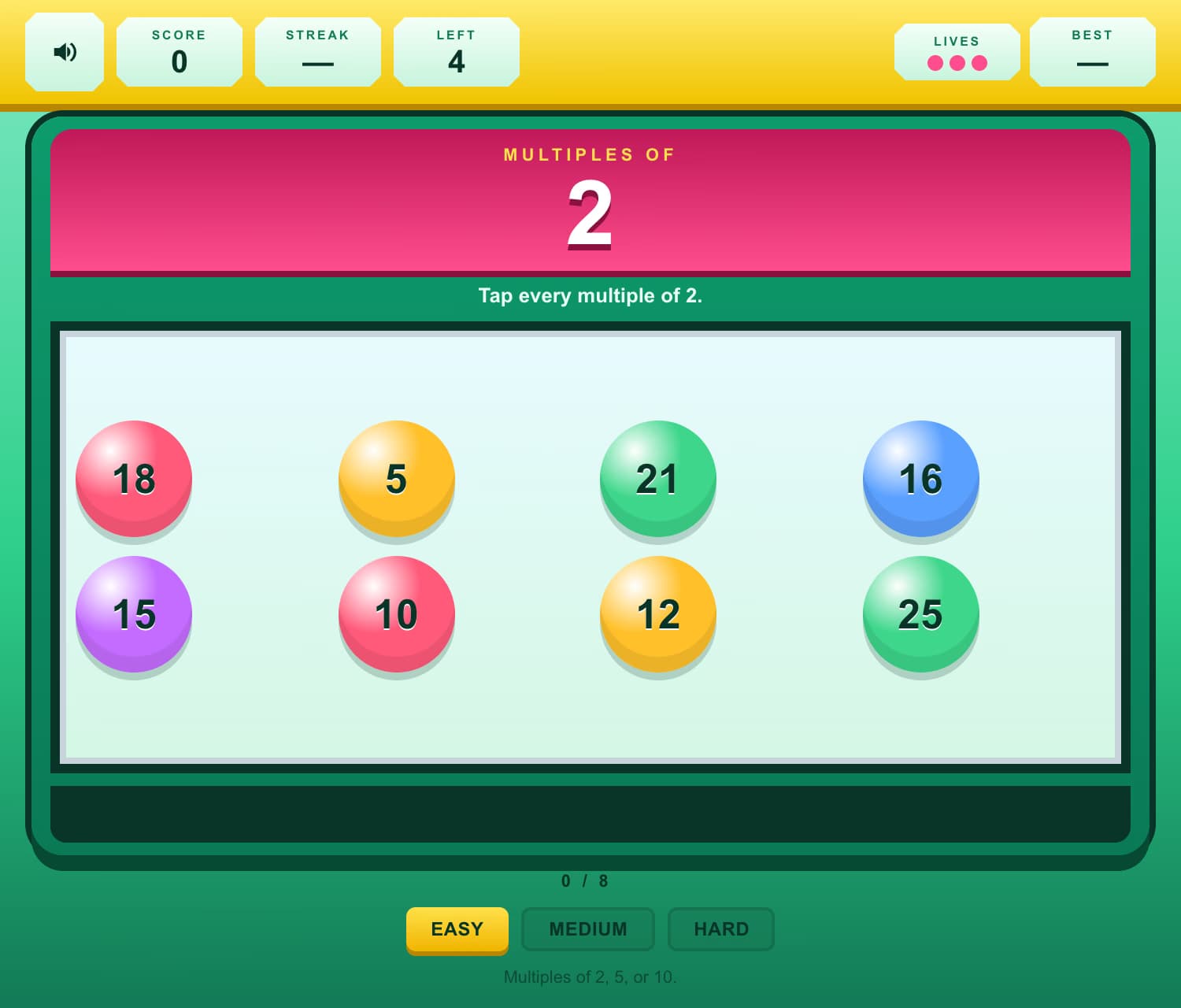
Claw Machine Multiples
A bright carnival claw machine packed with numbered gumballs. Drag the claw or tap a prize. Grab every ball that is a multiple of the factor on the marquee. A wrong prize costs a life. Built for fourth-grade multiples and skip-counting.
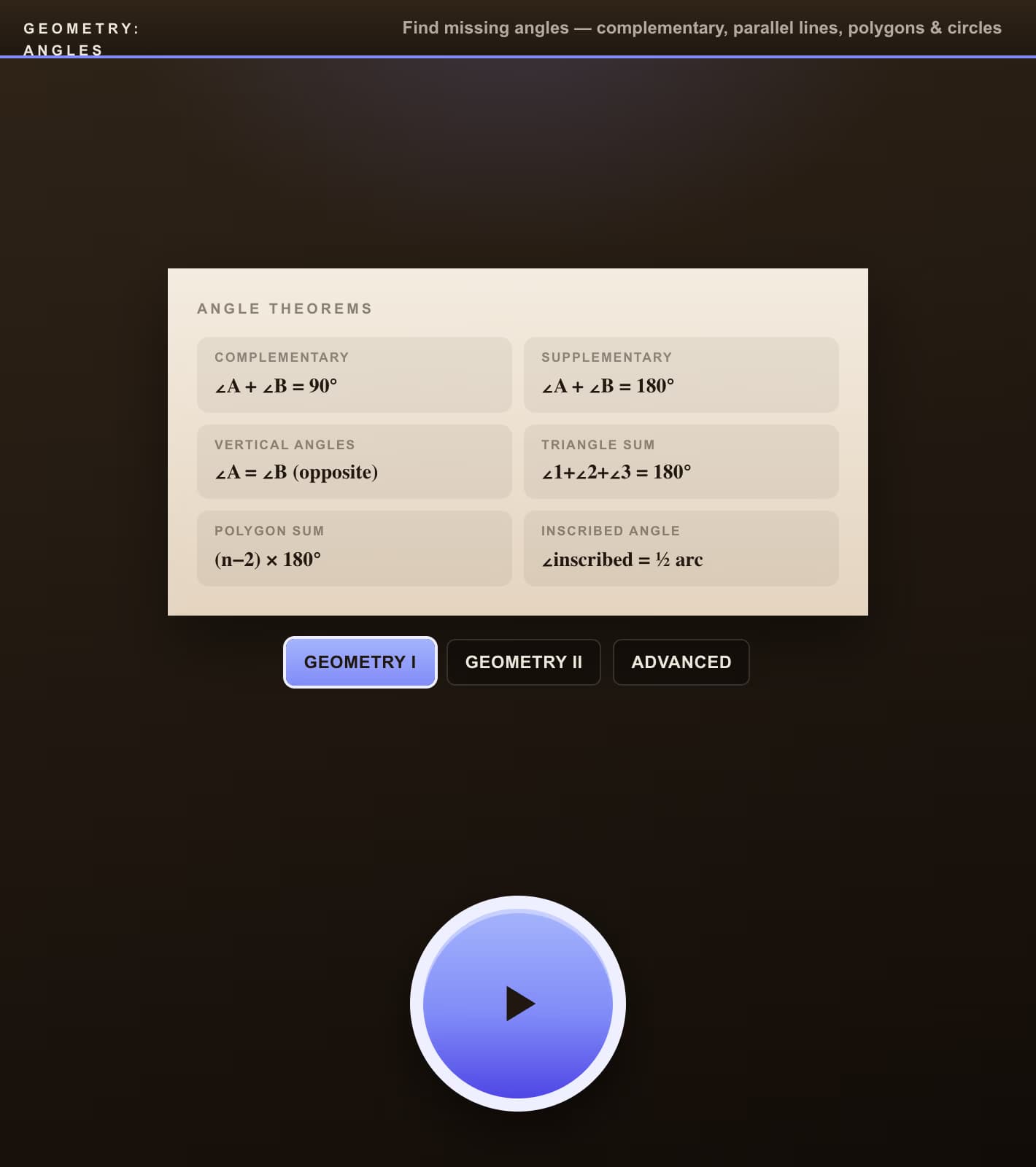
High School Math Quiz
Find missing angles and apply key theorems — pick the correct answer from four choices. 45 problems across three tiers: Geometry I (complementary, supplementary, vertical, linear pair, triangle sum), Geometry II (parallel line angle pairs, polygon interior sums, inscribed angle theorem), and Advanced (multi-step proofs, circle chord angles, exterior angle formulas, cyclic quadrilaterals).
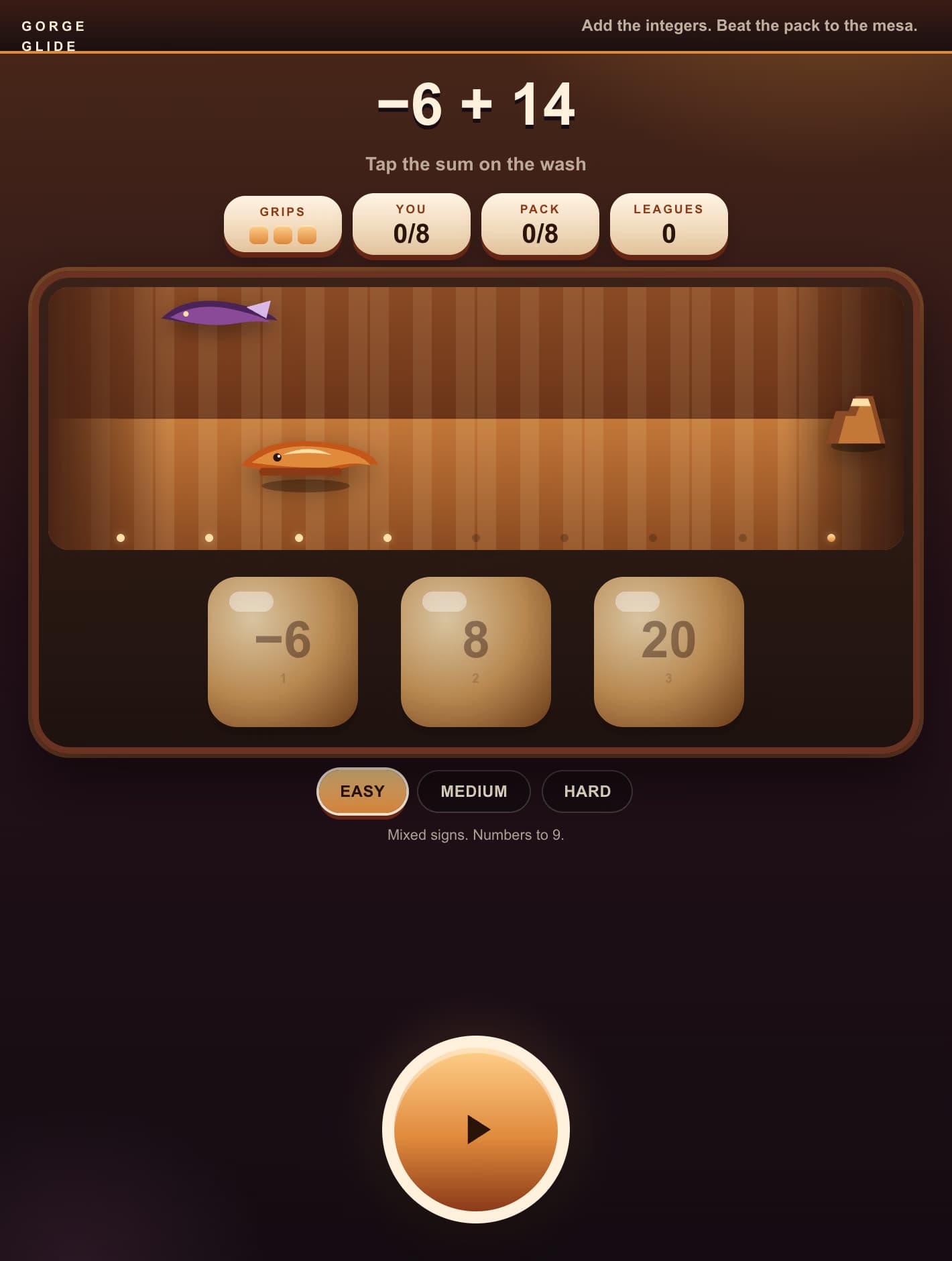
Adding Integers Race
A dusk canyon, a copper sled, and a dusk-plum pack racing for the mesa. An integer sum such as −6 + 14 sits above the wash. Tap the clay marker that is the true total. A correct glide surges you up the gorge. A miss lets the pack close in and costs a grip. First to the mesa wins. Built for seventh-grade integer addition.
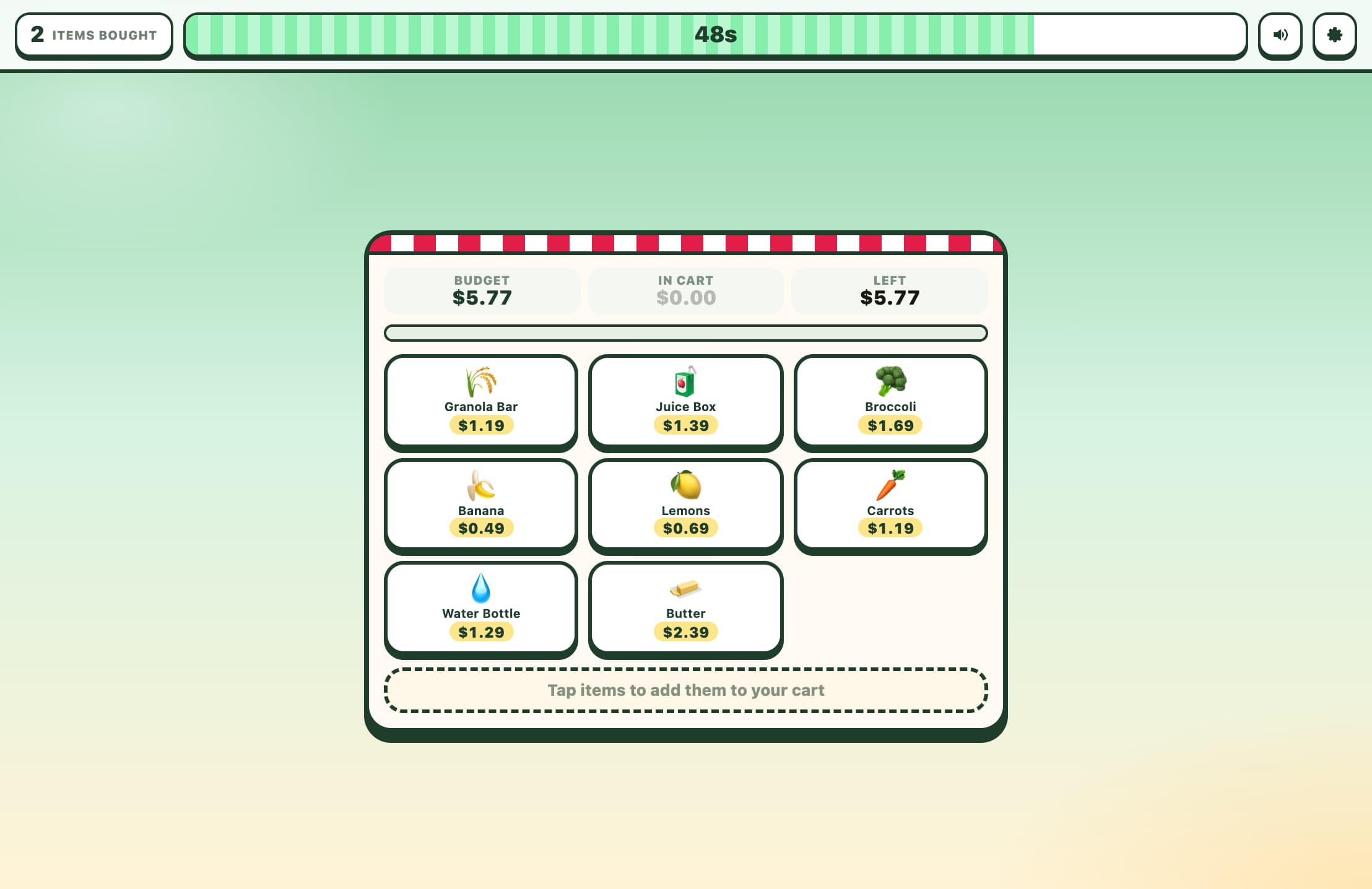
Fill Your Cart Without Going Over Budget
Fill a shopping cart with grocery items without going over a set budget. Encourages addition, estimation, and simple budgeting for grades 3–4. Practice real-world money skills in a fun supermarket setting.
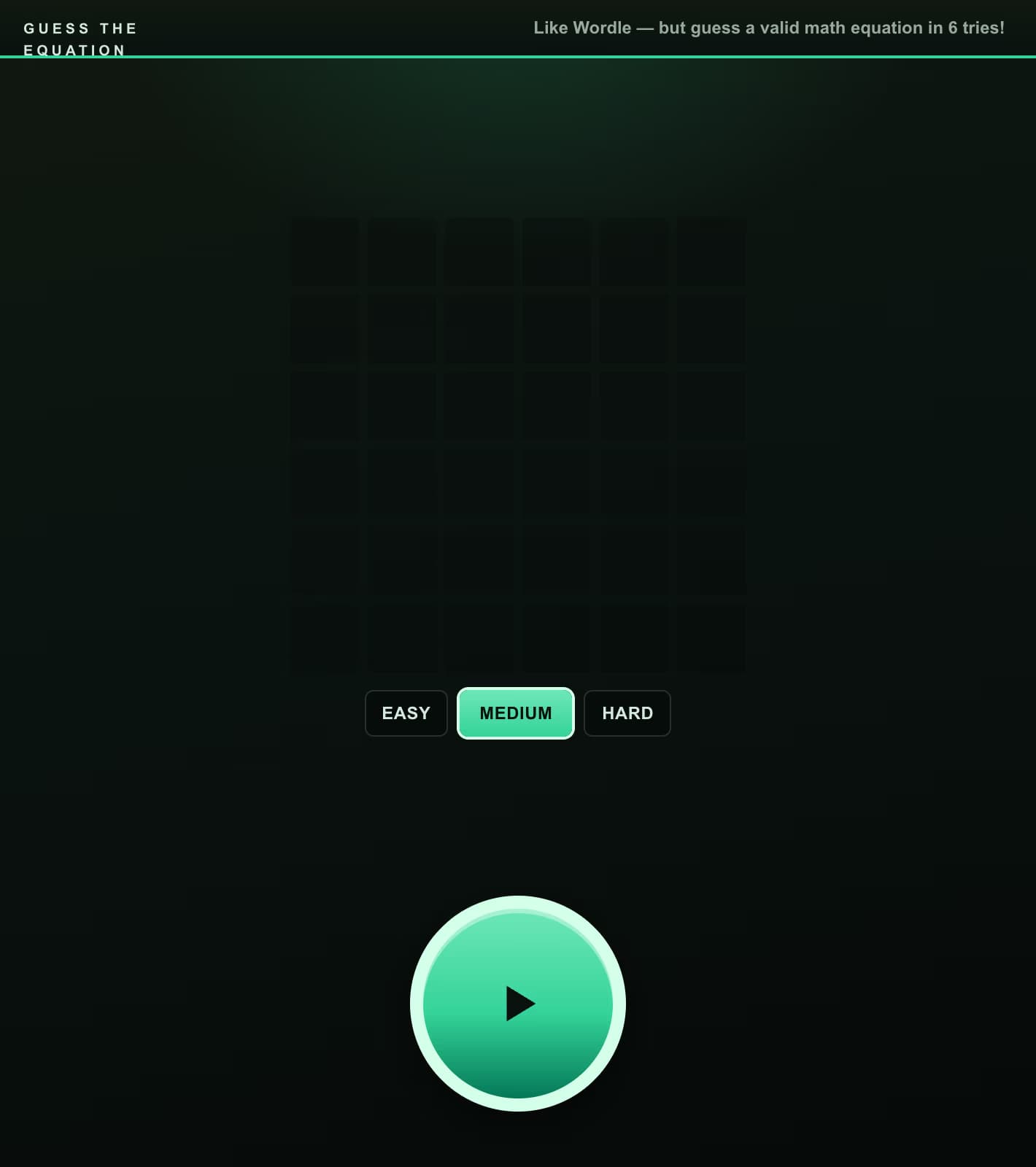
Wordle Math Puzzle Game (Nerdle)
Inspired by Nerdle — guess the hidden math equation one character at a time in 6 tries. Every guess must be a valid equation (left side evaluates to the right side). 🟩 Green means the right character in the right place, 🟪 Purple means right character but wrong place, ⬛ Gray means not in the equation at all.
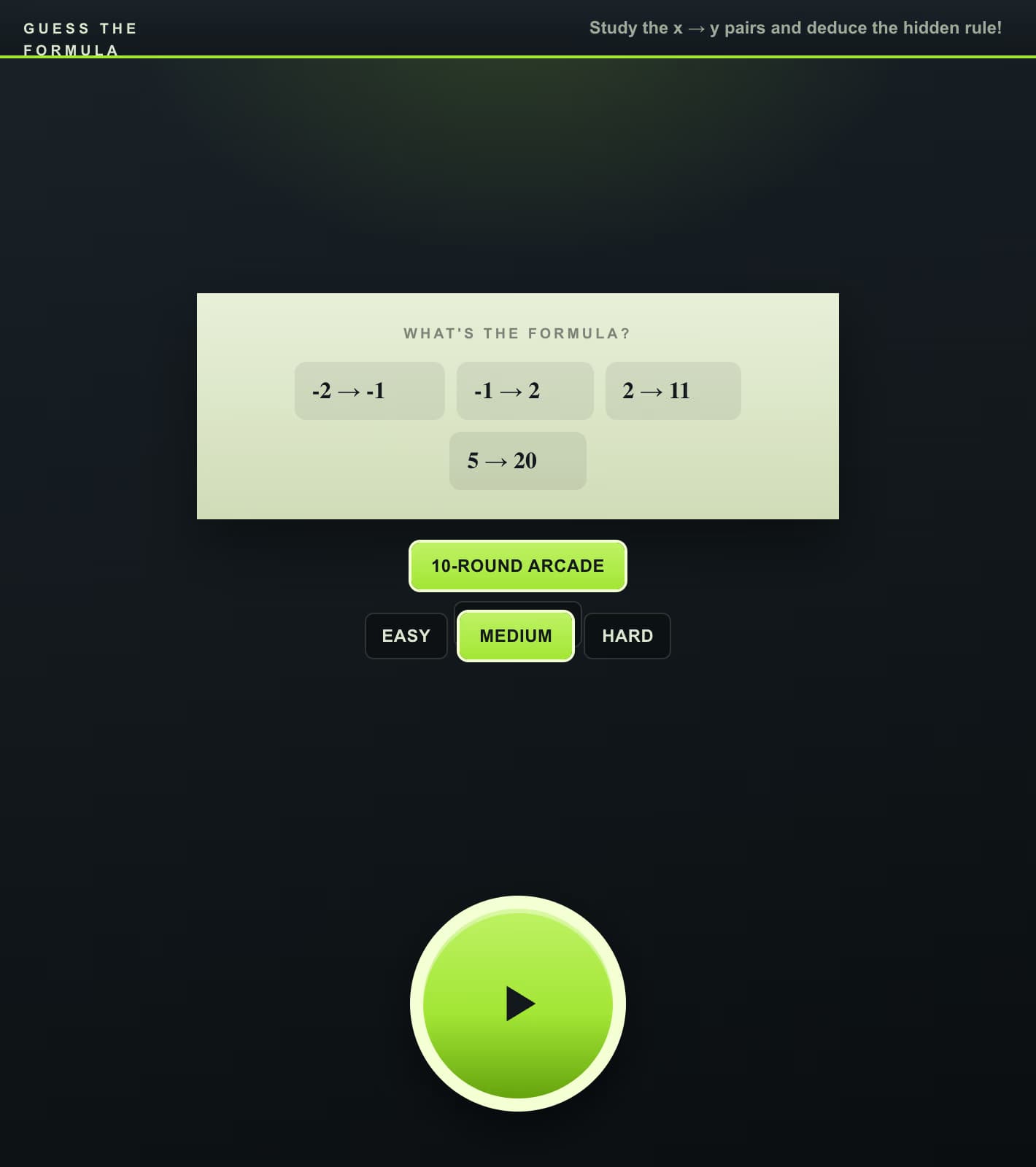
Math Function Deduction
You're shown a table of x → y pairs — your job is to identify which of four formulas generated the data. Study the numbers, spot the pattern (linear, quadratic, exponential, modulo?), and select the correct formula before time runs out. On Medium and Hard difficulties you can also 'probe' additional x values to gather more evidence.
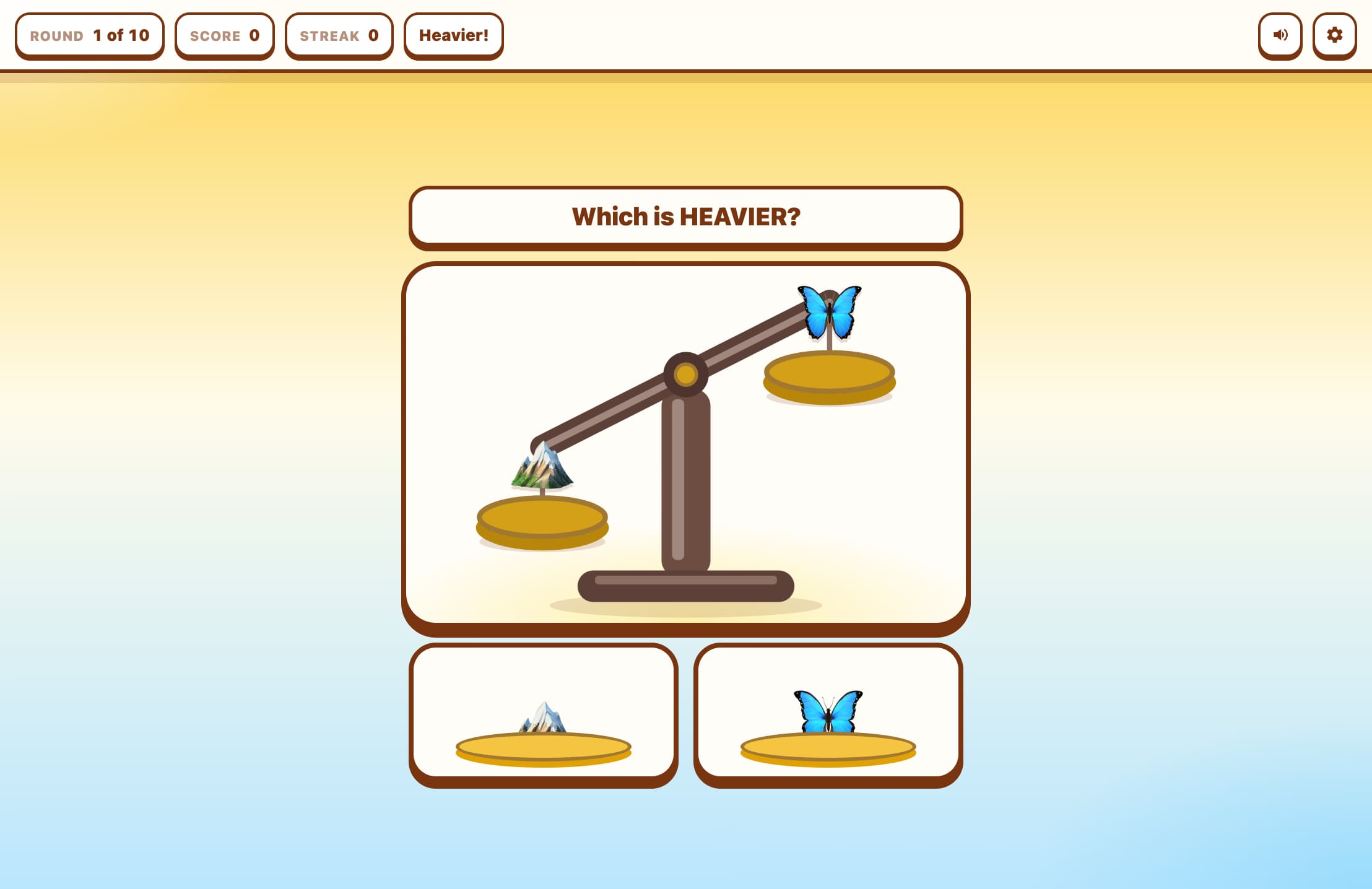
Balance Scale Measurement
Watch a balance scale tip and decide which side is heavier or lighter! A rock vs a feather, an elephant vs a butterfly — learn about weight and measurement concepts through an interactive animated scale.
One-Step Equations Court
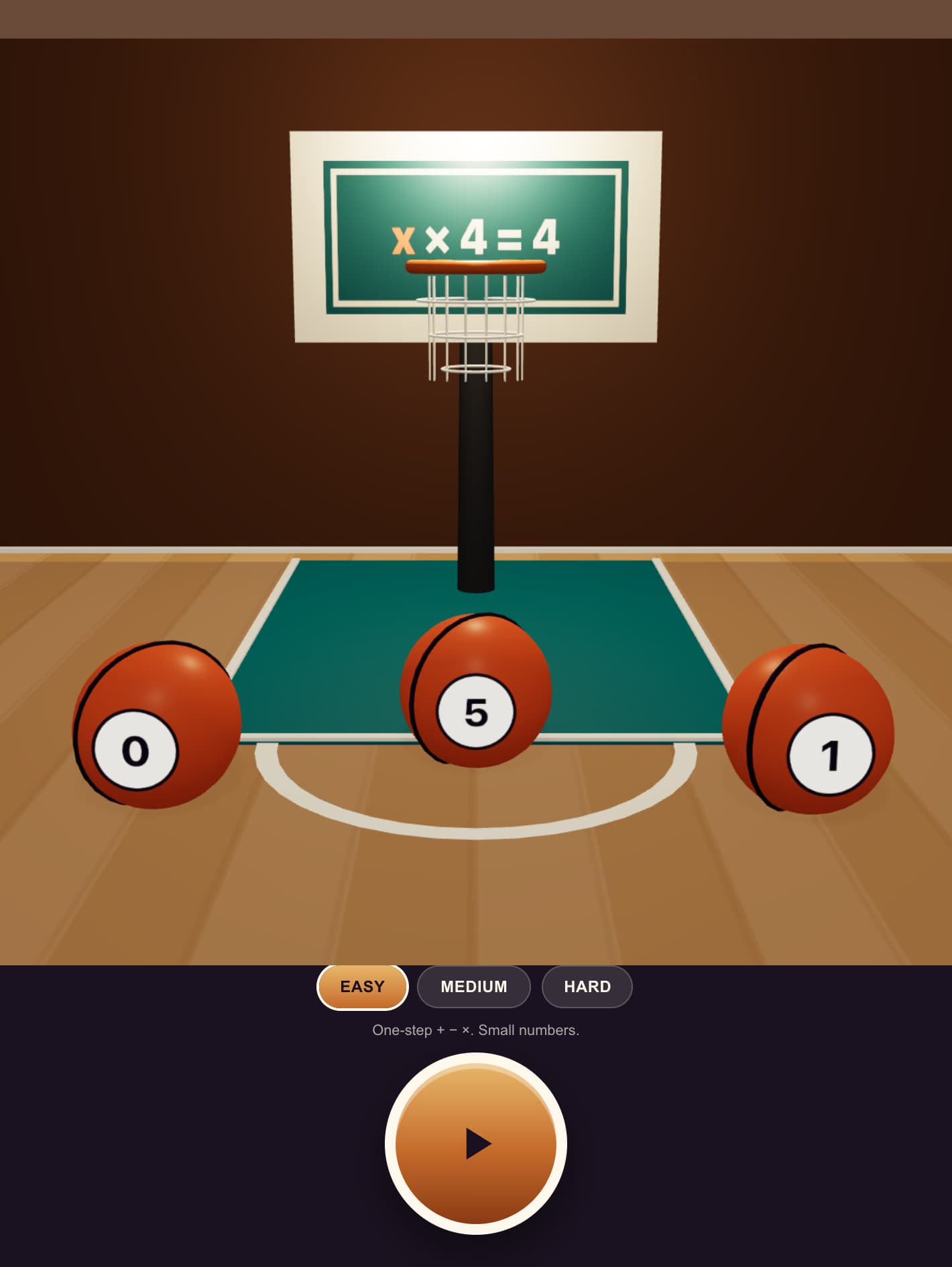
A dusk arena, a hoop, and numbered balls on the floor. An equation such as x × 4 = 12 sits above the court. Tap the ball that is x. A make flies to the rim. A miss clanks and costs a life. Three misses end the run. Built for fifth-grade one-step equations.
Conditional Logic Quiz
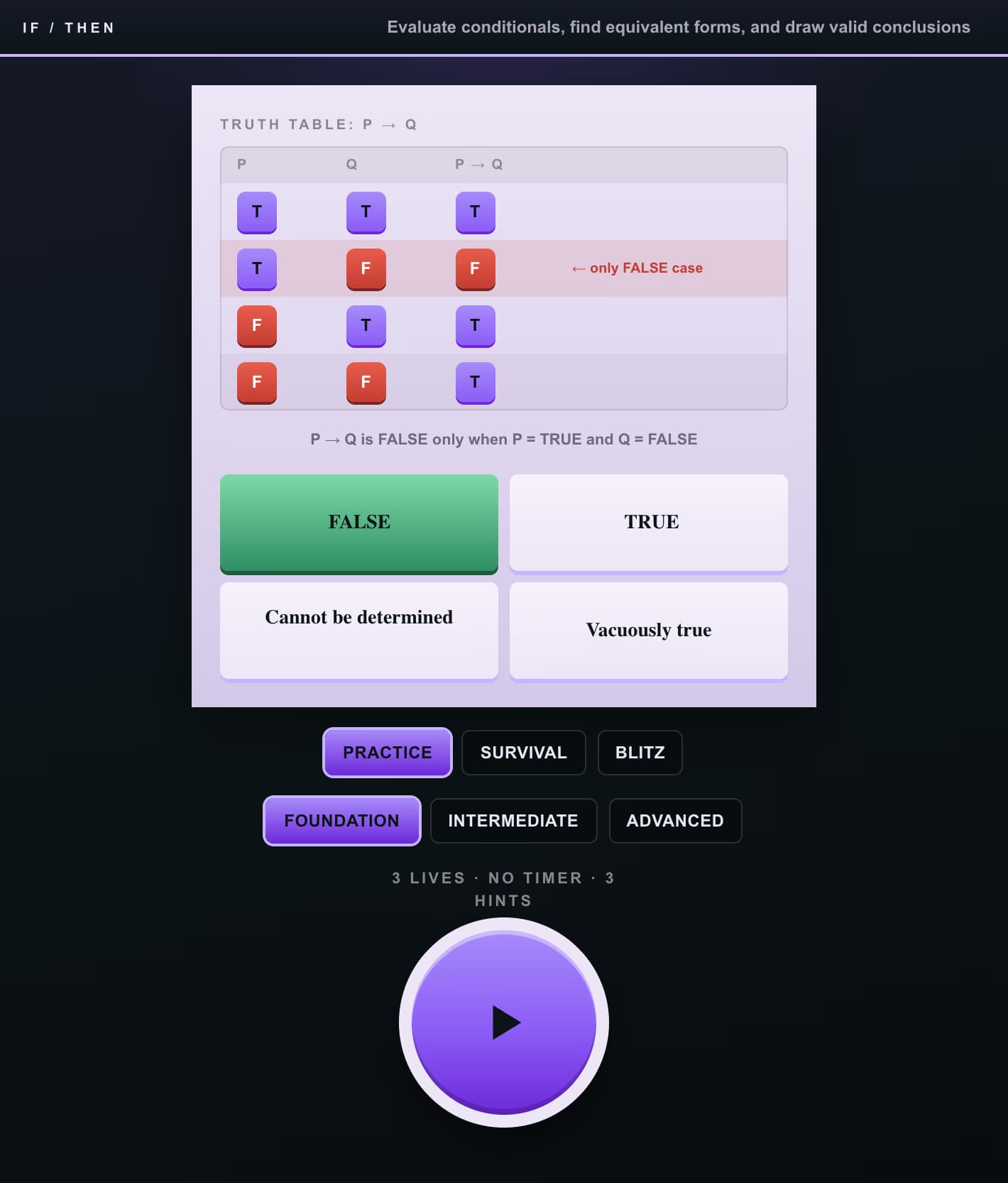
Master the logic of if/then conditionals (P → Q). 45 problems across three levels: Foundation covers the truth table for P→Q (vacuous truth, the one false case), Modus Ponens, Modus Tollens, and why Affirming the Consequent and Denying the Antecedent are invalid. Intermediate adds the contrapositive, converse, inverse, biconditional (P↔Q), the disjunction equivalence (¬P∨Q), and hypothetical syllogism. Advanced covers chained conditionals, negation of conditionals (¬(P→Q) = P∧¬Q), tautologies, complex truth value analysis, and edge cases.
Graphing on a Coordinate Plane
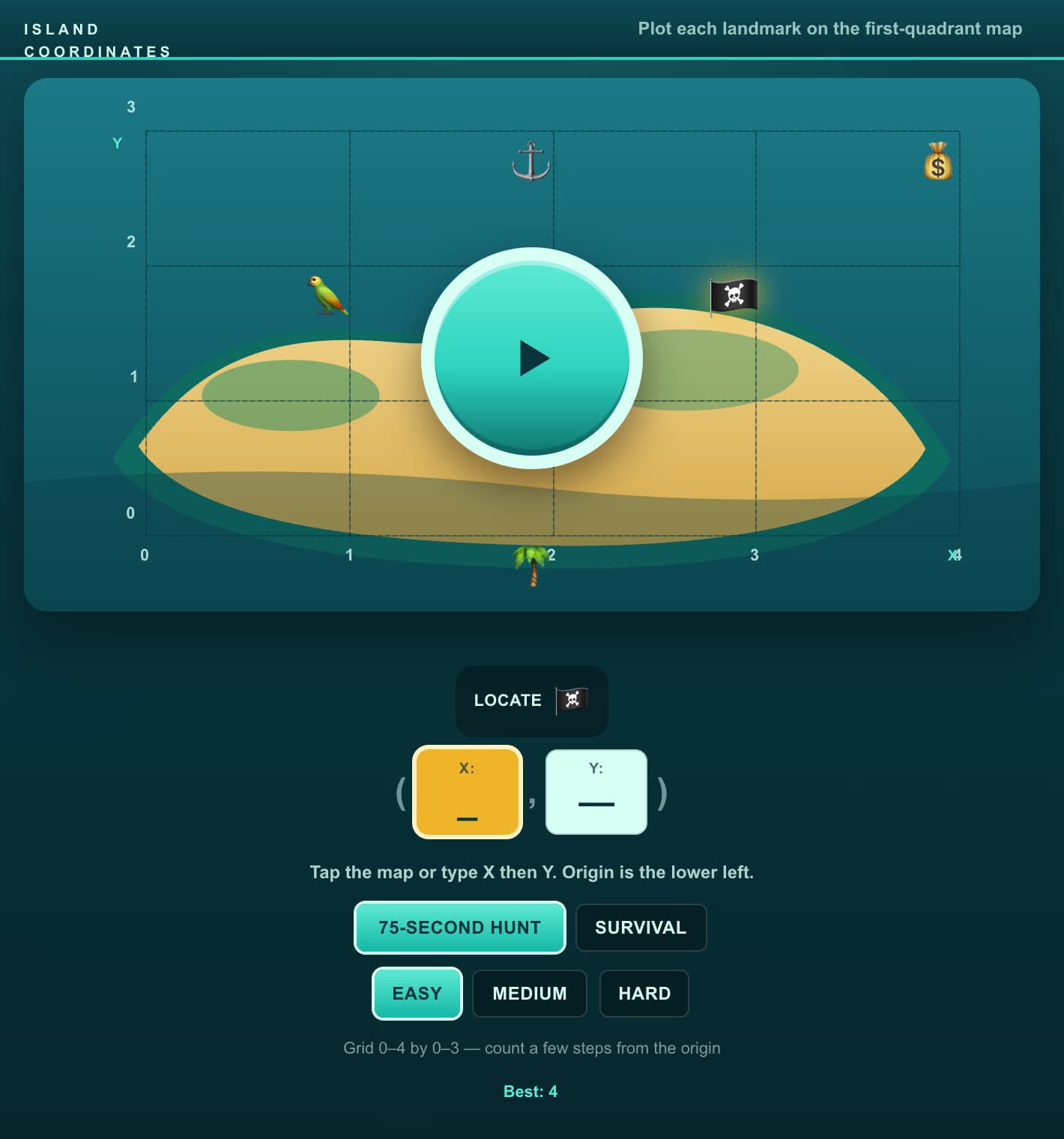
Find each landmark on a first-quadrant treasure map and enter its X and Y. Kids plot pirates, chests, and palms on a dashed grid from the origin, building coordinate-plane fluency for fourth and fifth grade.
Multiplication Arrays
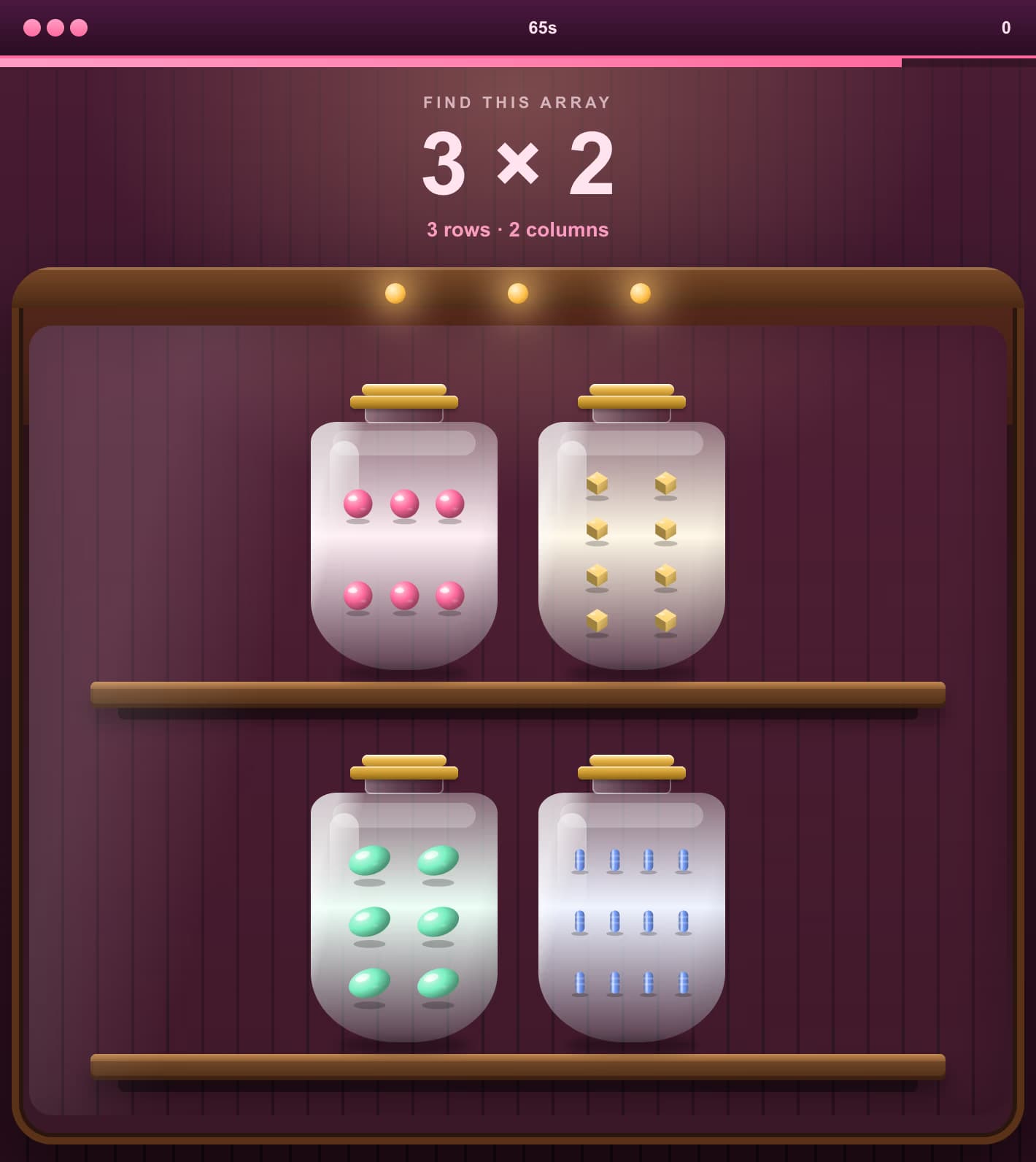
Find the jar whose candy is stacked in the matching array. Third graders count rows and columns to match facts like 3 × 4, building the picture of one-digit multiplication instead of only memorizing products.
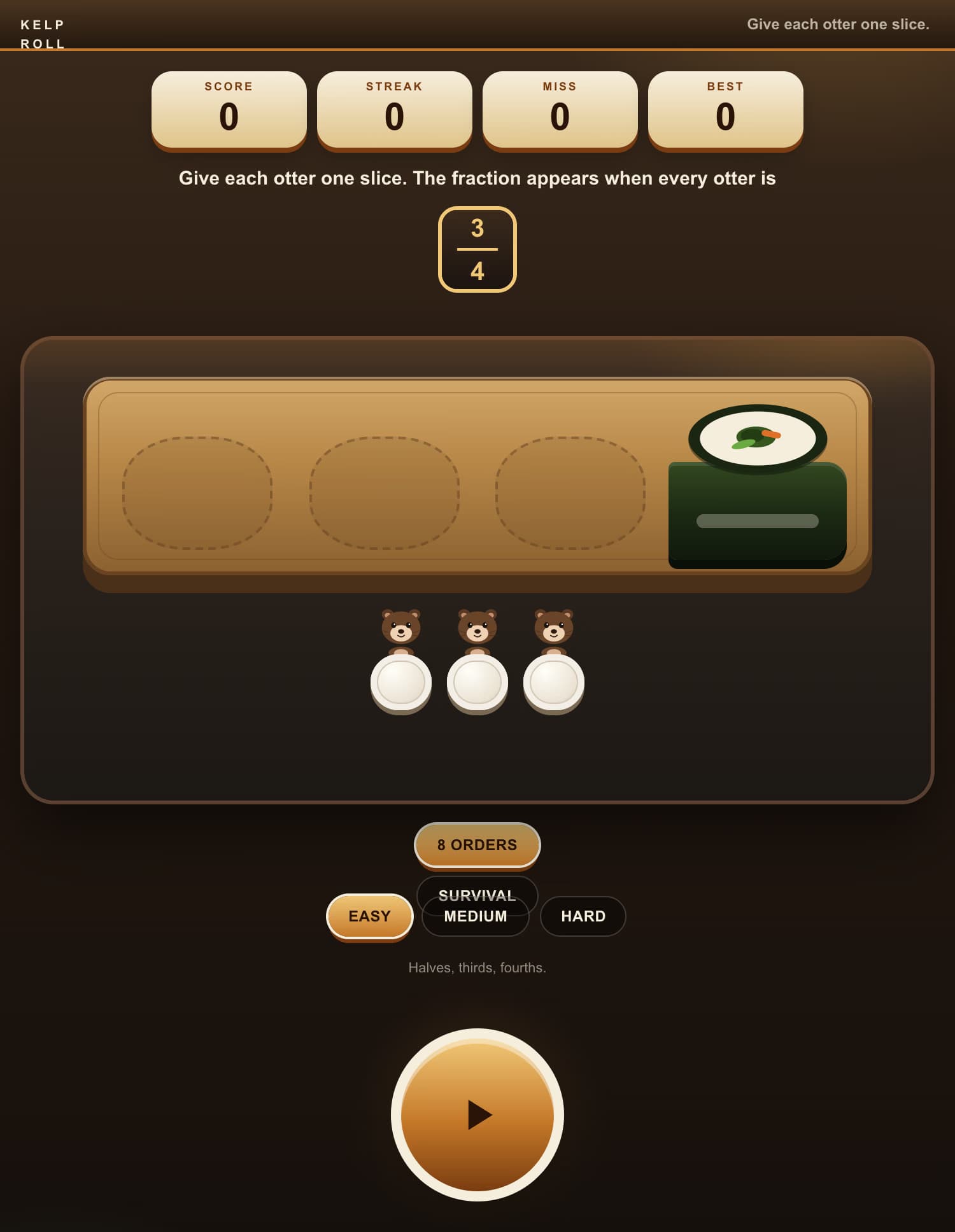
Serve Equal Shares and Name the Fraction
A tide kitchen, a kelp roll cut into equal rings, and hungry otters with empty plates. Tap one ring for each guest. When every plate is full, the fraction of the roll you served lights up. Built for third-grade equal parts.
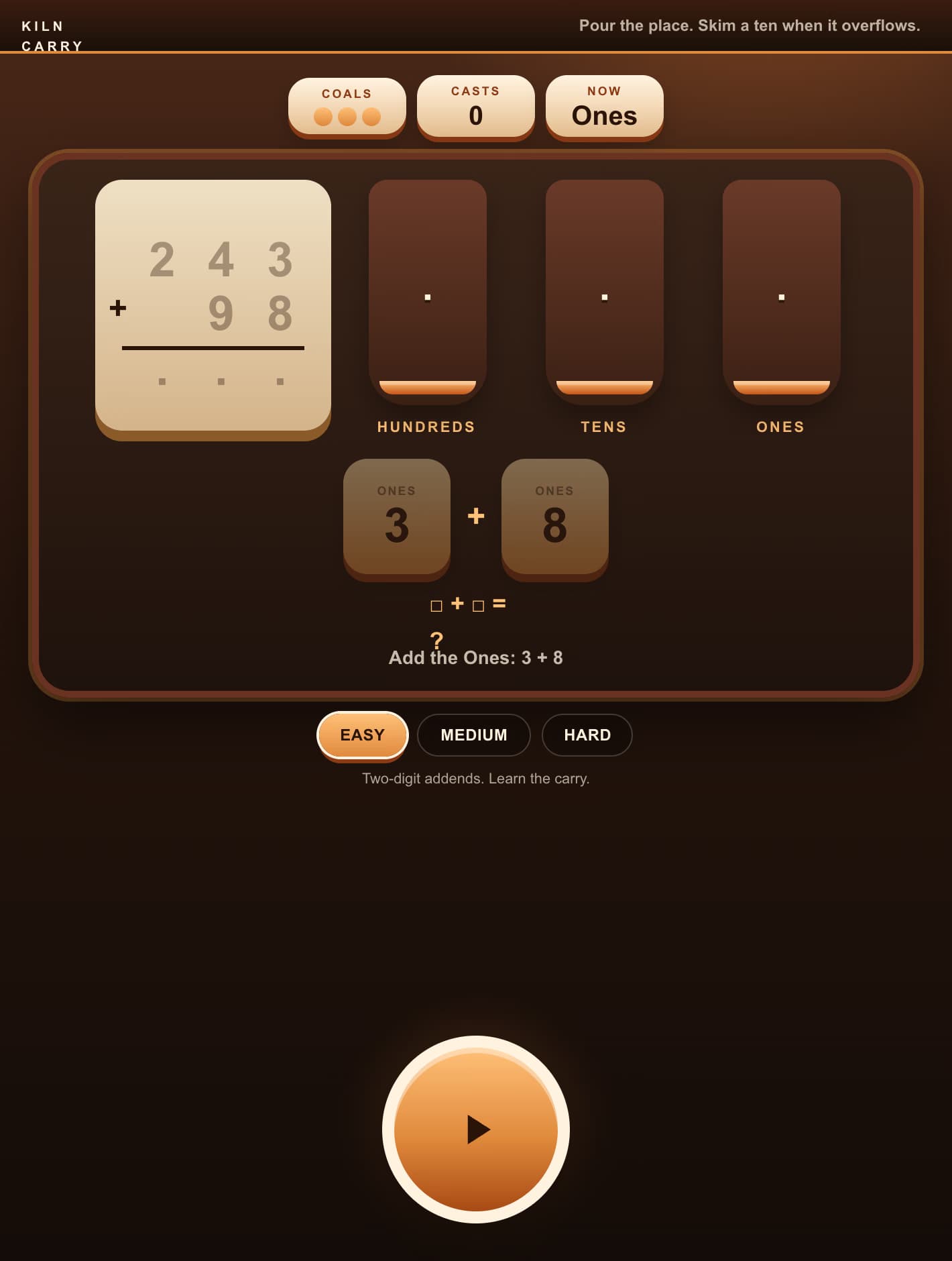
Two- and Three-Digit Addition
A soot forge, three clay kilns, and a slate of two- or three-digit addition. Pour both place digits into the current kiln. If the melt hits ten or more, skim a ten to the next kiln. If it stays under ten, stamp the digit. Work ones, then tens, then hundreds. Built for third-grade multi-digit addition.
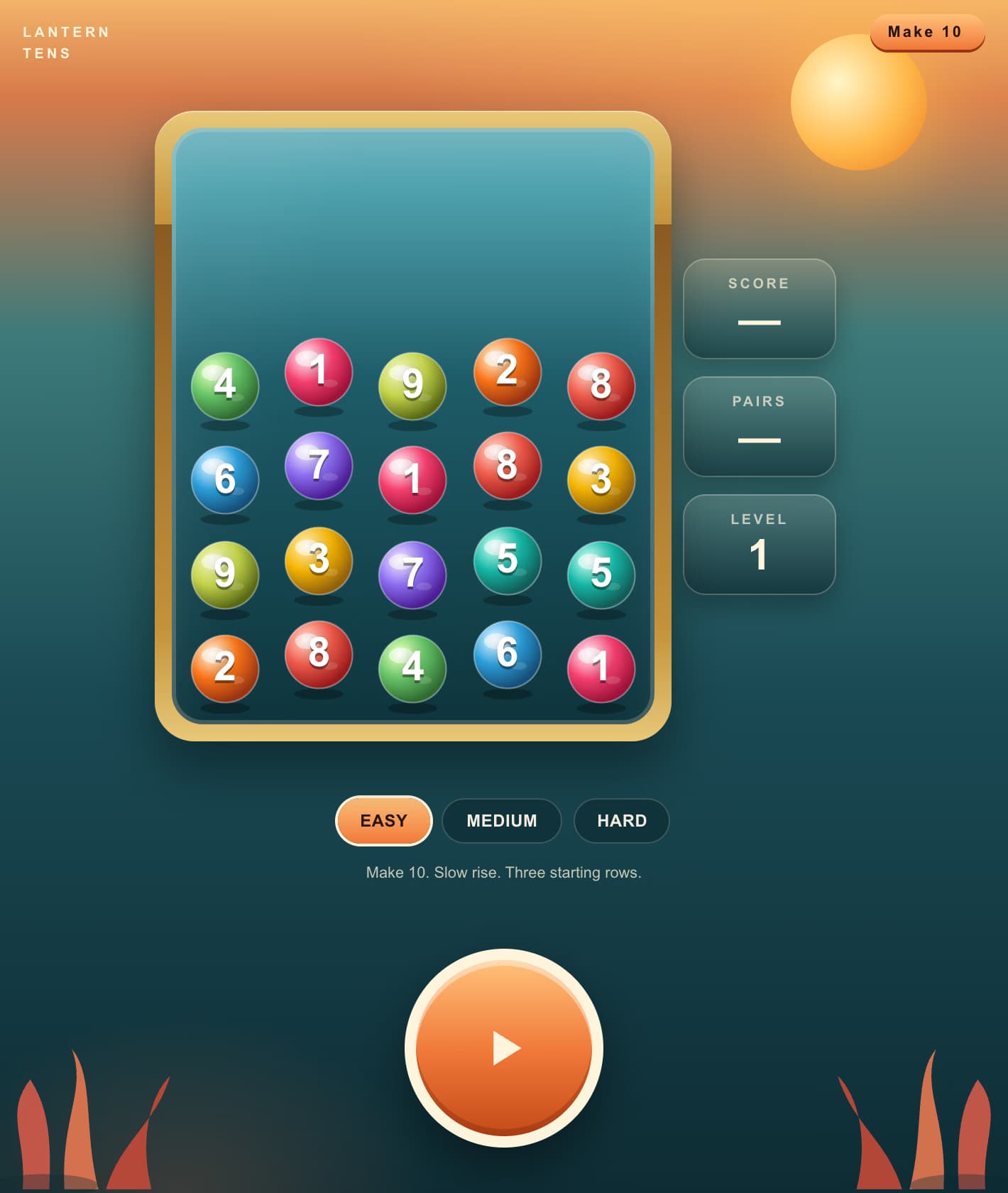
Addition to 10 Bubble
Tap two glowing lanterns whose numbers add to 10. They pop, the well settles, and a new row rises from below. Clear pairs fast before the lanterns overflow. Levels speed up the rise so addition facts have to stay automatic.
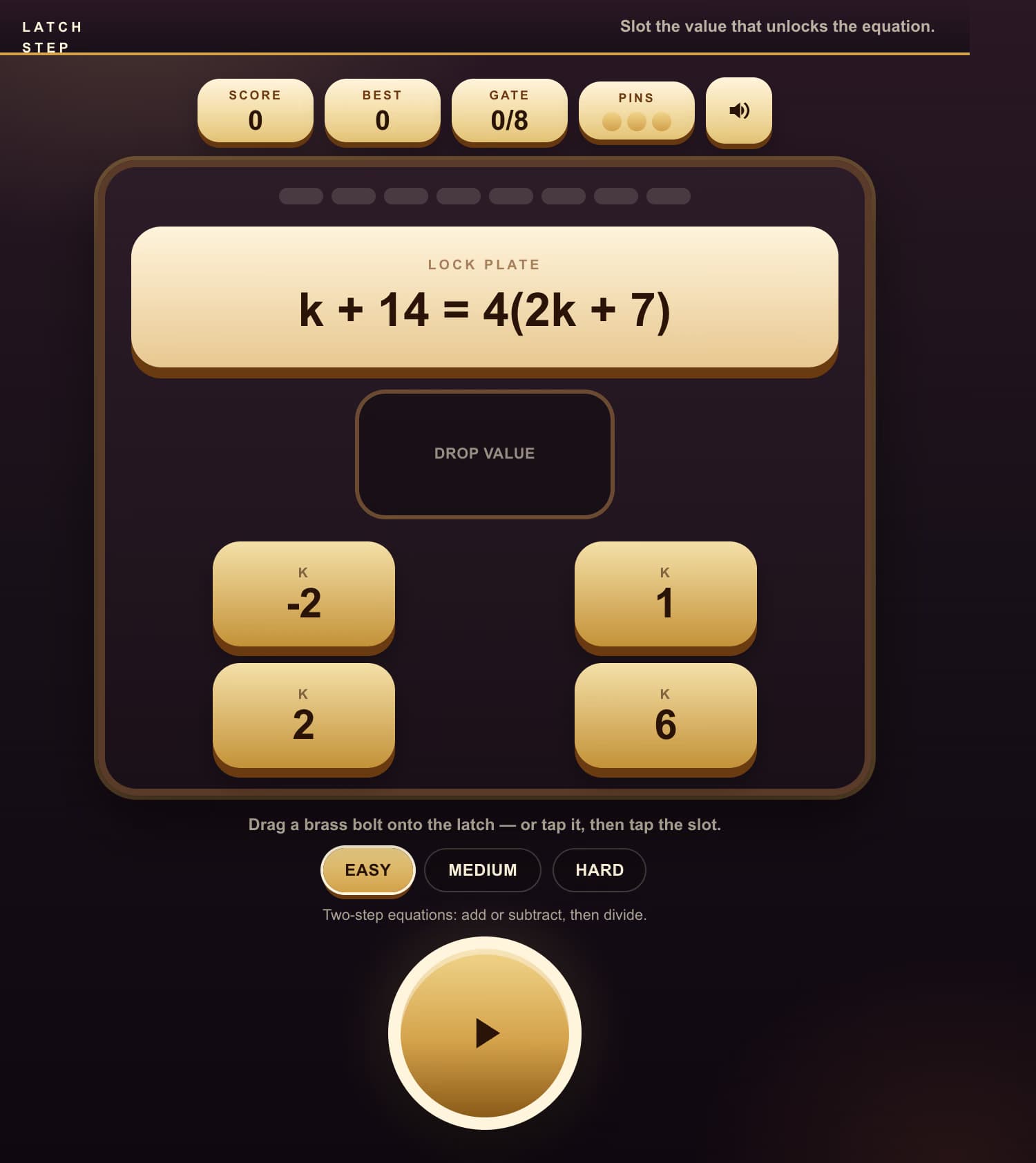
Multi-Step Equations
Solve one-variable multi-step equations and slot the right value into the latch. Eight gates, a live score chase, and a vault that seals if the pins run out. Built for middle-school algebra: distribute, combine like terms, and isolate the variable.
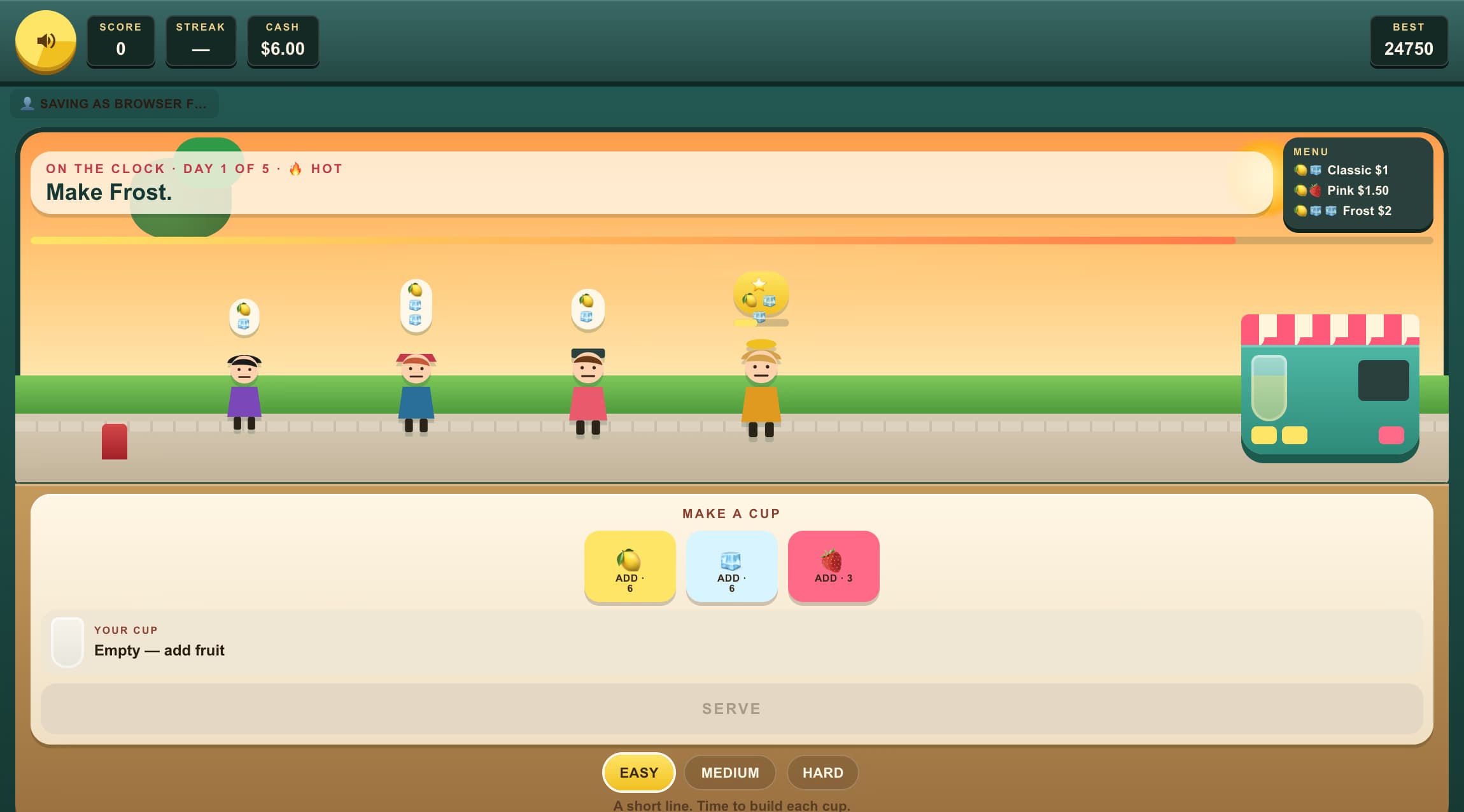
Sell by Day, Shop by Night
Run a sidewalk lemonade cart with a real day-and-night loop. By day, mix Classic, Pink, or Frost and serve the line before they walk. After dark the stand closes — spend cash on fruit and read tomorrow's weather before you open again.
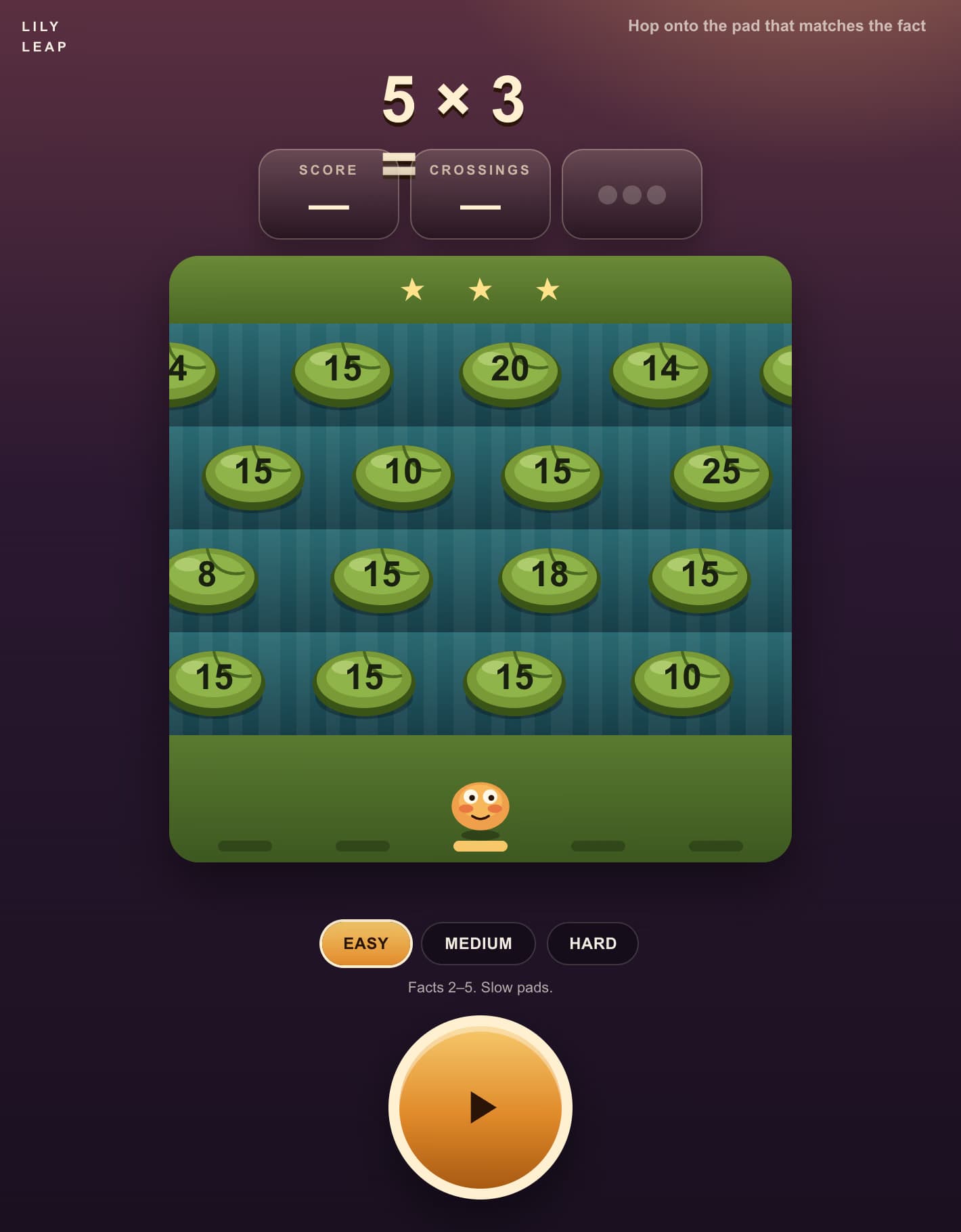
Multiplication Facts Crossing
Hop Pip the toad across a dusk marsh. A fact such as 5 × 3 sits above the water. Leap only onto lily pads that show the product. Pads drift, so you time the jump. Space or the hop button moves forward; arrows step sideways. Three lives. Facts get faster after each crossing.
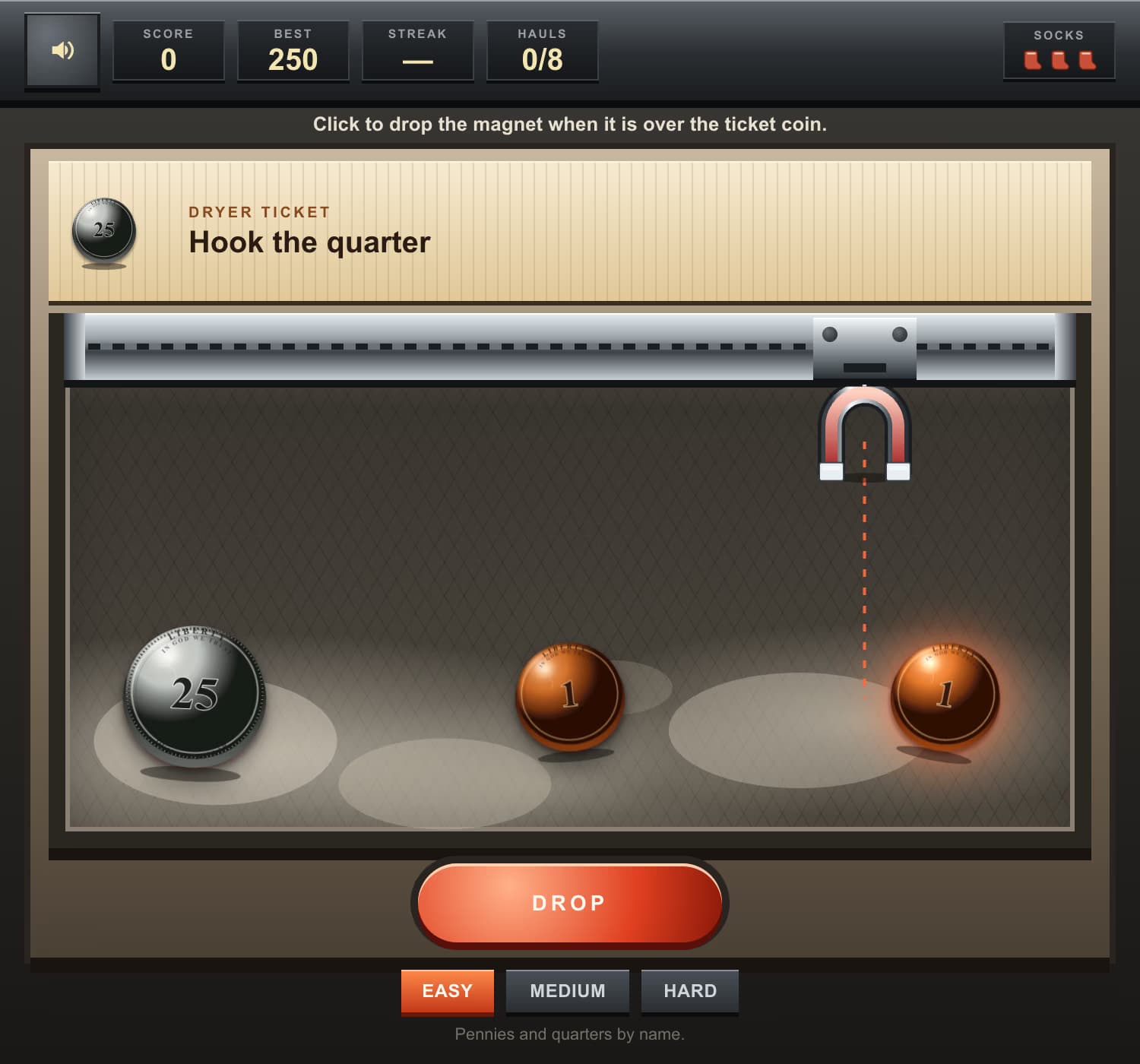
Time the Magnet and Catch the Ticket Coin
A laundromat lint drawer packed with pennies, nickels, dimes, and quarters. The dryer ticket names a coin, a value, or the most or least. A magnet swings over the drawer. Tap when it hangs over the right coin and it drops. Built for first- and second-grade coin ID — a timed drop, not a tap on a labeled picture.
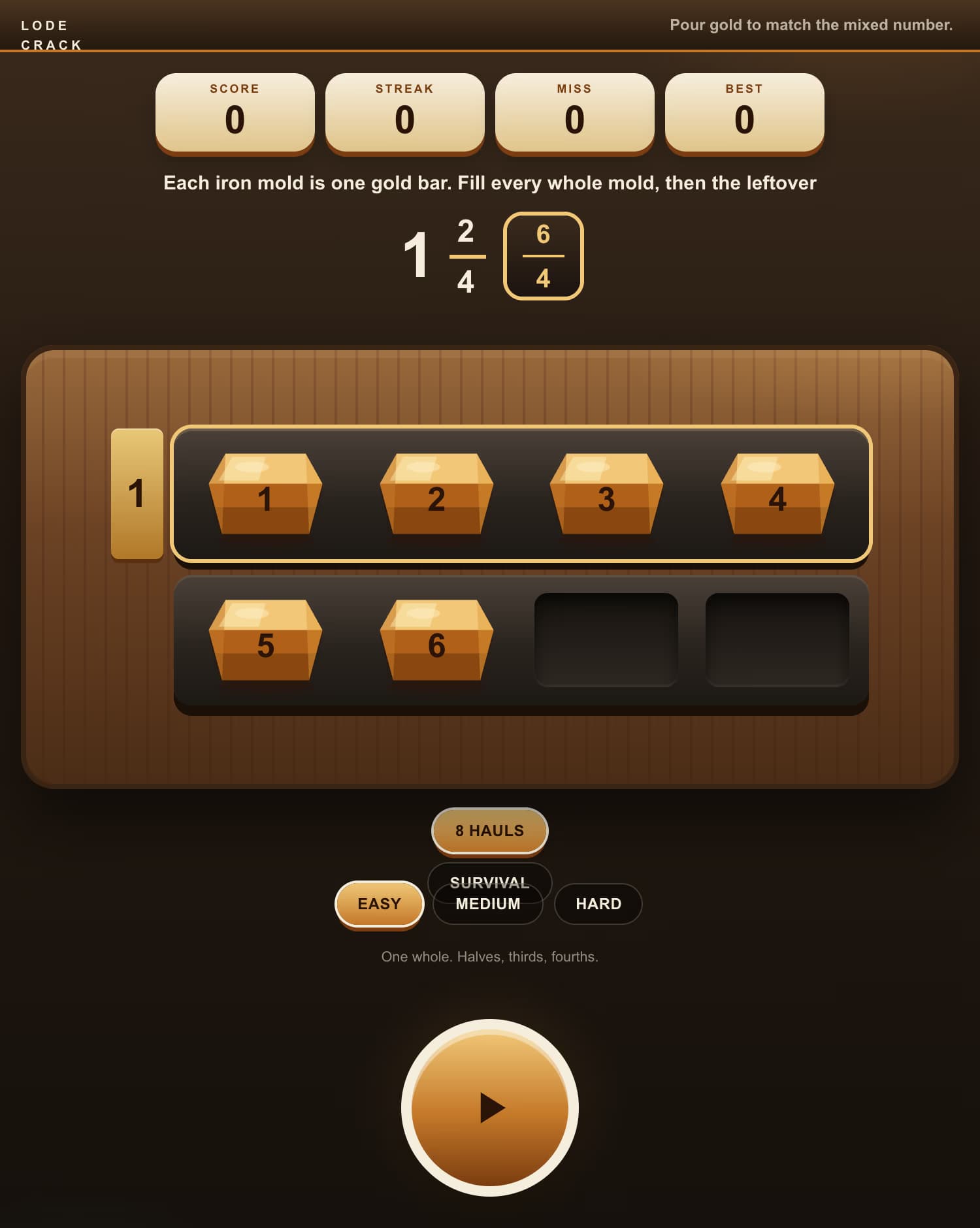
Convert a Mixed Number to an Improper Fraction
A mine workbench, iron molds, and gold ingots. Each mold is one whole cut into equal chunks. Pour the whole molds, then the leftover gold. When the haul matches the mix, the improper fraction lights up. Built for fourth-grade mixed numbers.
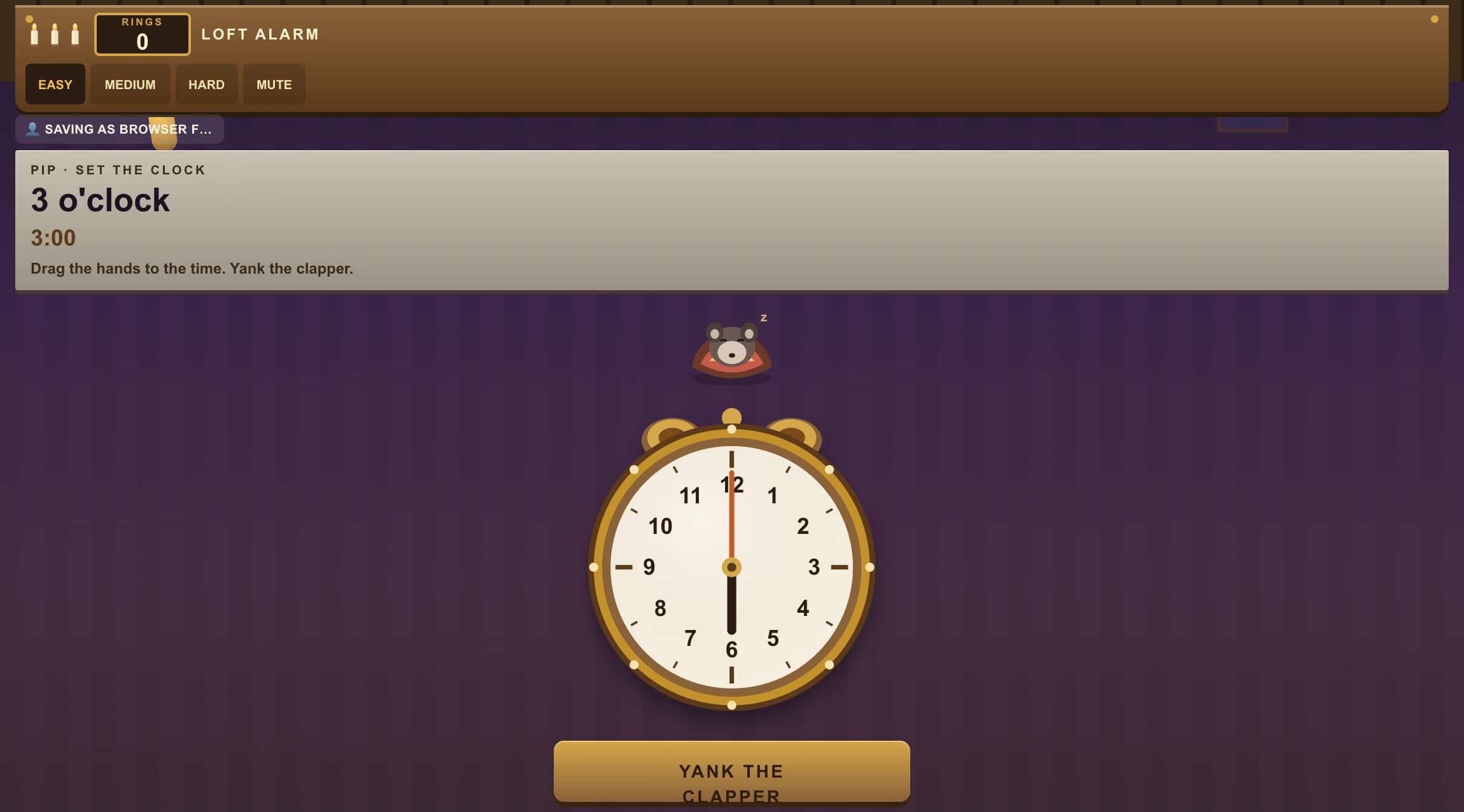
Set the Clock to Fifteen Minutes
Help Pip wake up in Loft Alarm. Listen for the time on the tin plaque, drag the hour and minute hands on the brass alarm clock, then Yank the clapper. A hit rings the bells and sits Pip up. Second-grade practice telling time to fifteen minutes on an analog clock.
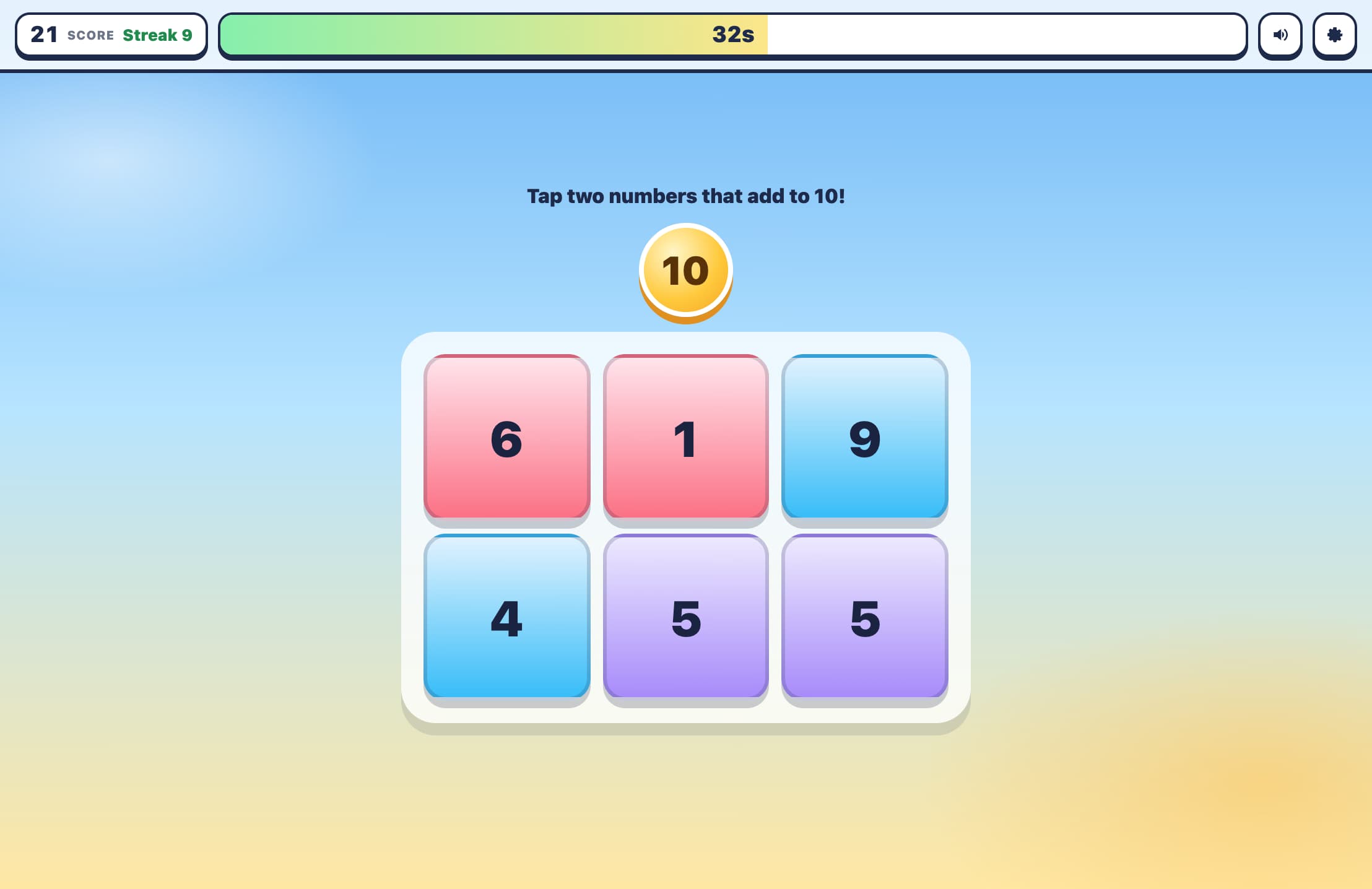
Pair Numbers That Add to 10
Tap number tiles to form pairs that sum to 10. Clear the board as fast as you can! Builds instant recall of addition facts. Three difficulty levels: bonds to 10, 20, or 50.
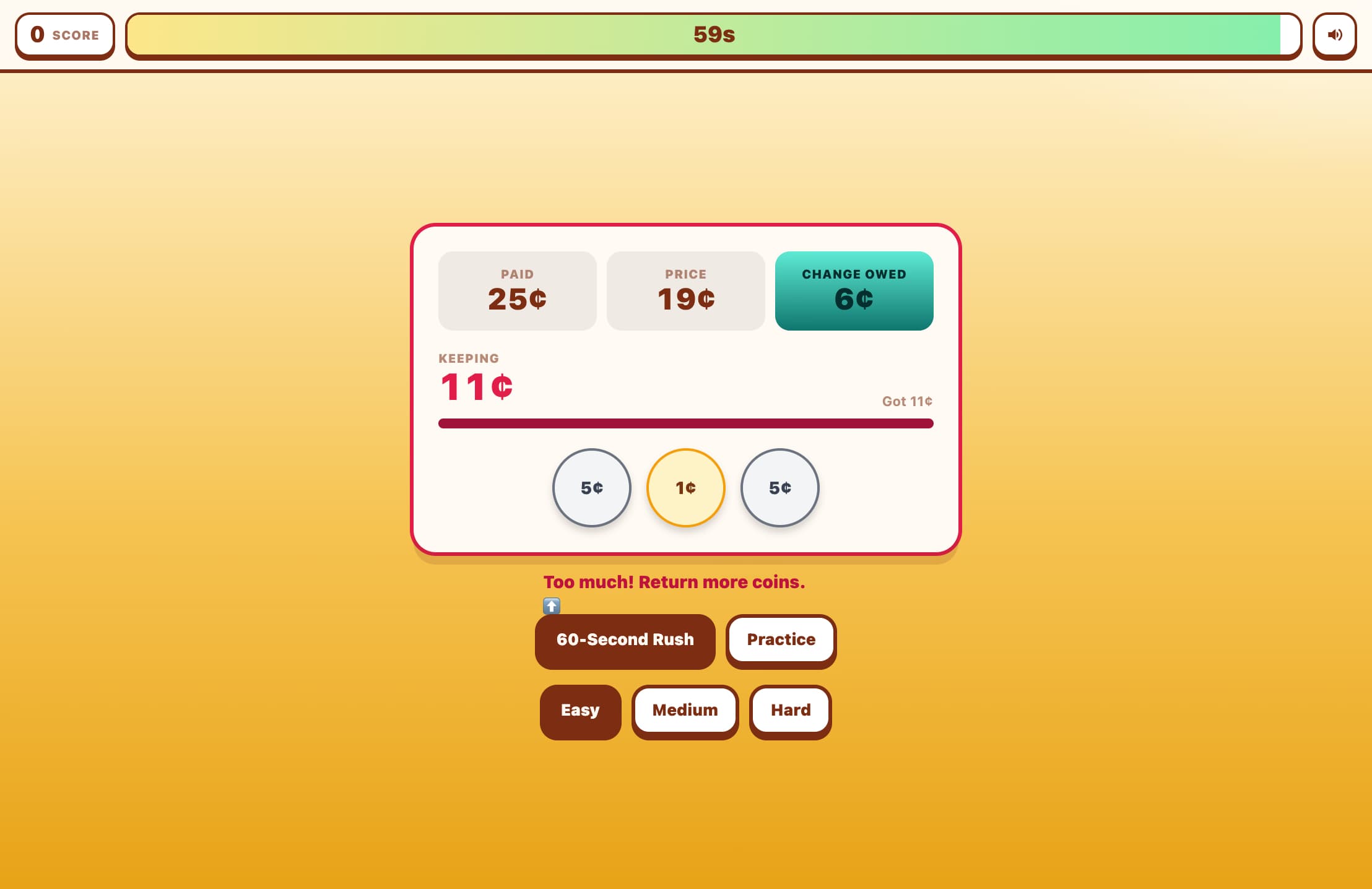
Return the Correct Coins
A cashier gives too much money — tap the extra coins to return the correct change. Amounts stay under $1, perfect for 1st and 2nd graders learning to make change.
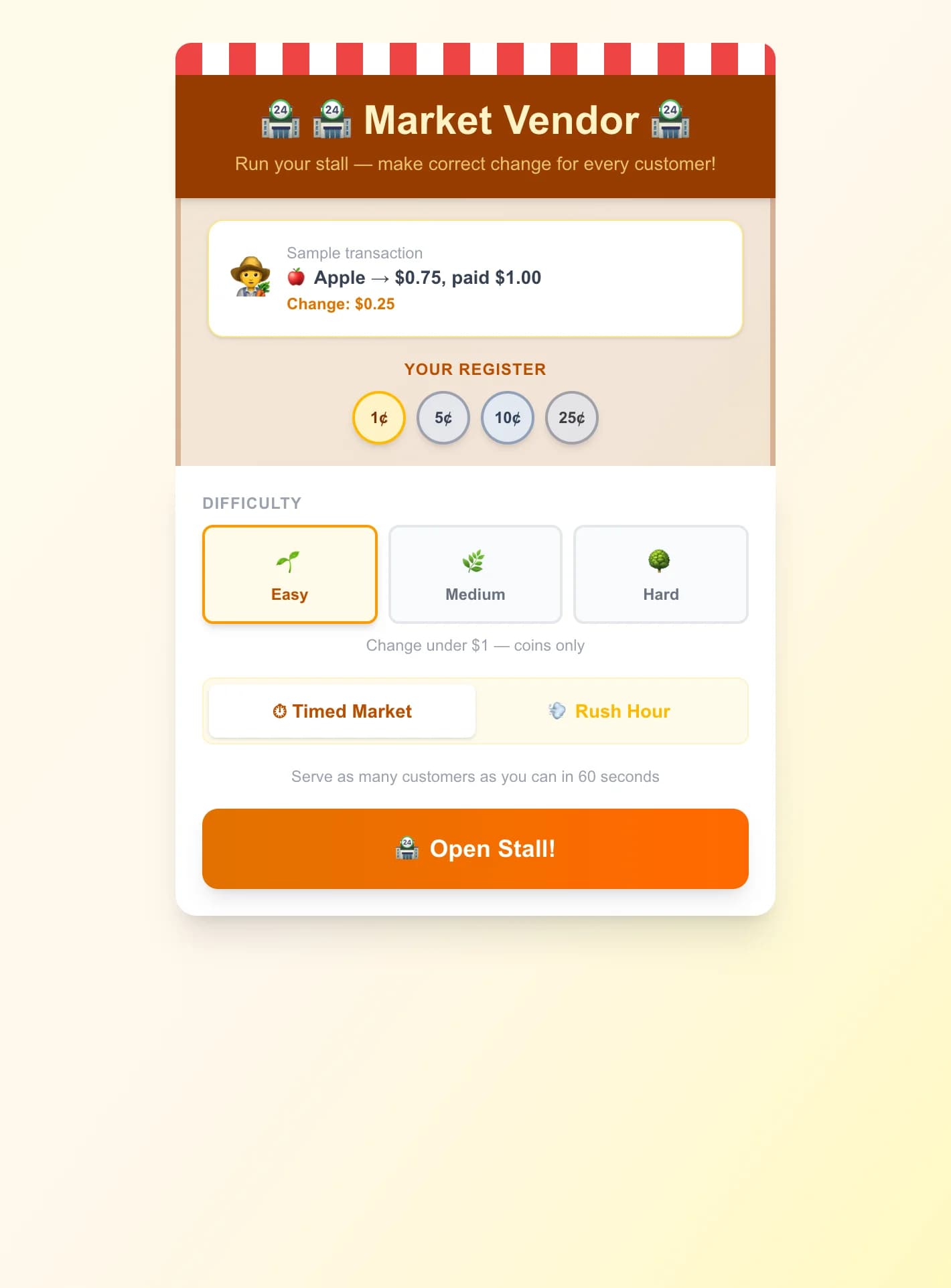
Give Correct Change to Customers at Your Stall
Run a market stall — customers hand you bills and you give back the correct change. Escalating difficulty from simple coin change to multi-bill transactions. A fast-paced, real-world money skills game.
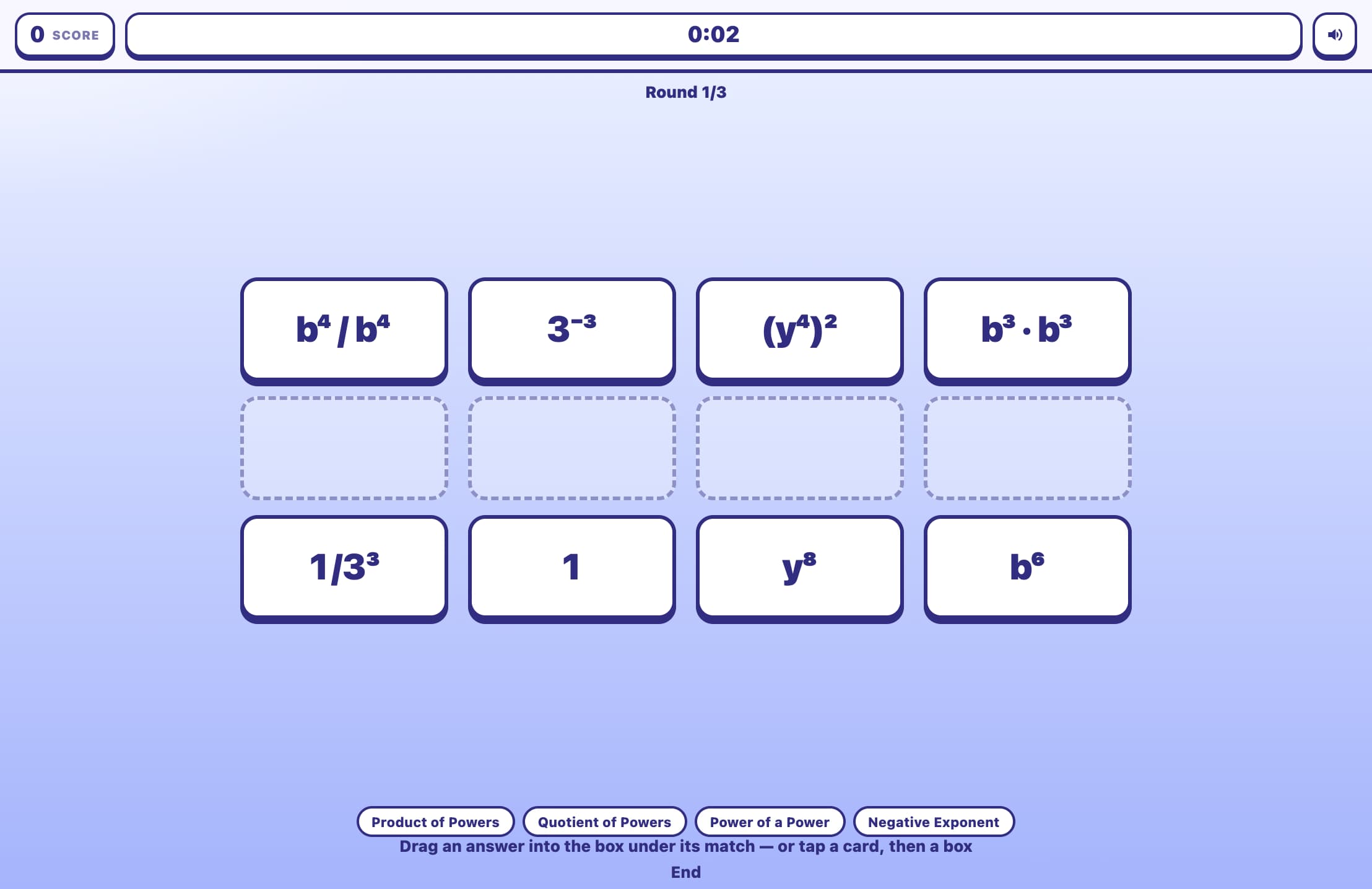
Match: Properties of Exponents
Deepen your understanding of exponents with this eighth-grade math game! In Match: Properties of Exponents, learners put their knowledge to the test as they match equivalent expressions using the properties of exponents. Three rounds of practice cover four properties — a great way to practice simplifying expressions with exponents.
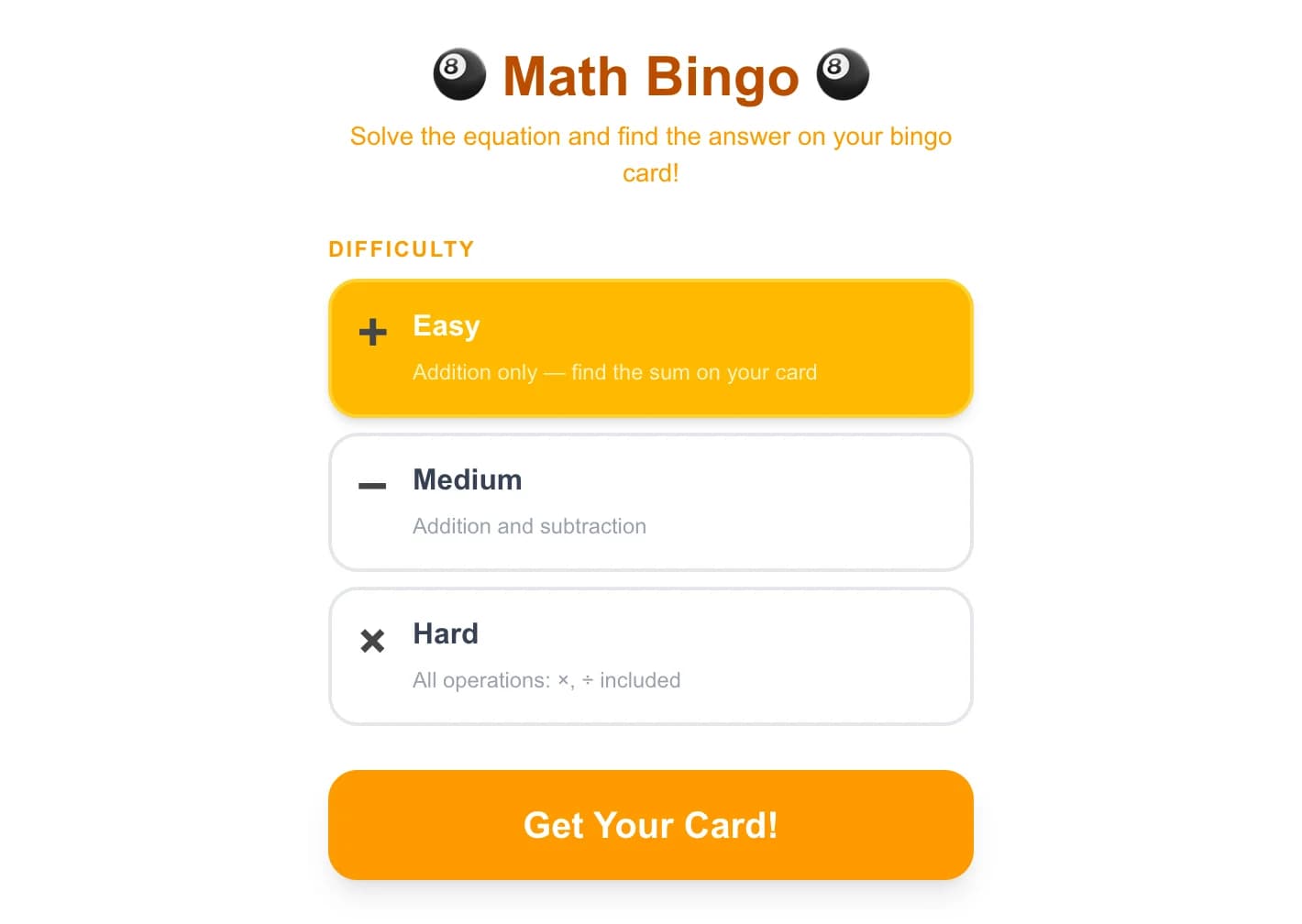
Solve Equations to Mark Your Bingo Card
A classic bingo card filled with numbers 1–24 — but instead of hearing a number called, kids solve a math equation and find the answer on their card! Three difficulty levels take players from simple addition sums up through mixed subtraction and on to multiplication and division. First to complete a row, column, or diagonal wins BINGO!
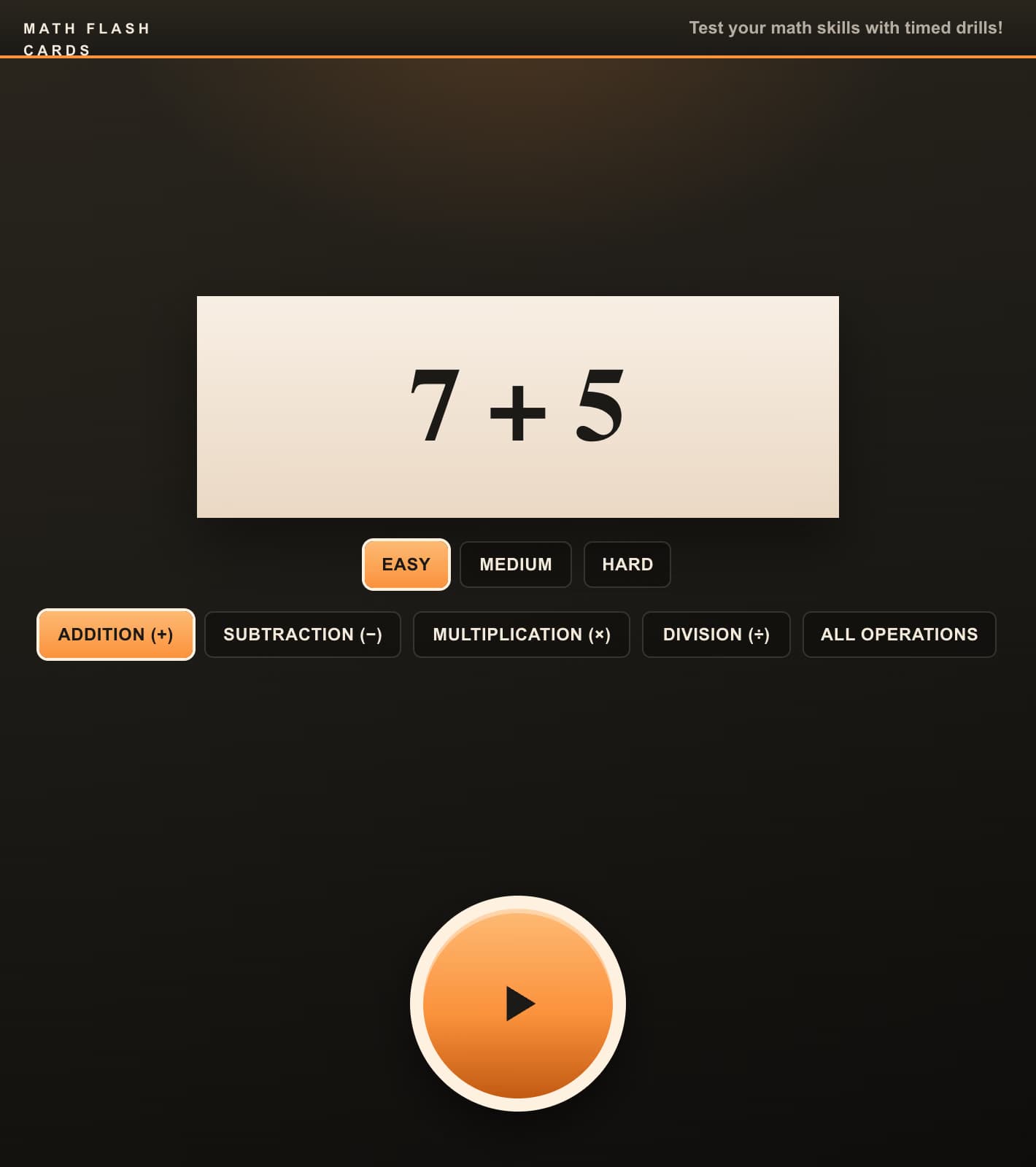
Timed Math Drill
Practice addition, subtraction, multiplication, and division with timed flash cards. Choose Easy, Medium, or Hard difficulty, track your streak, and sharpen your mental math skills in just 60 seconds!
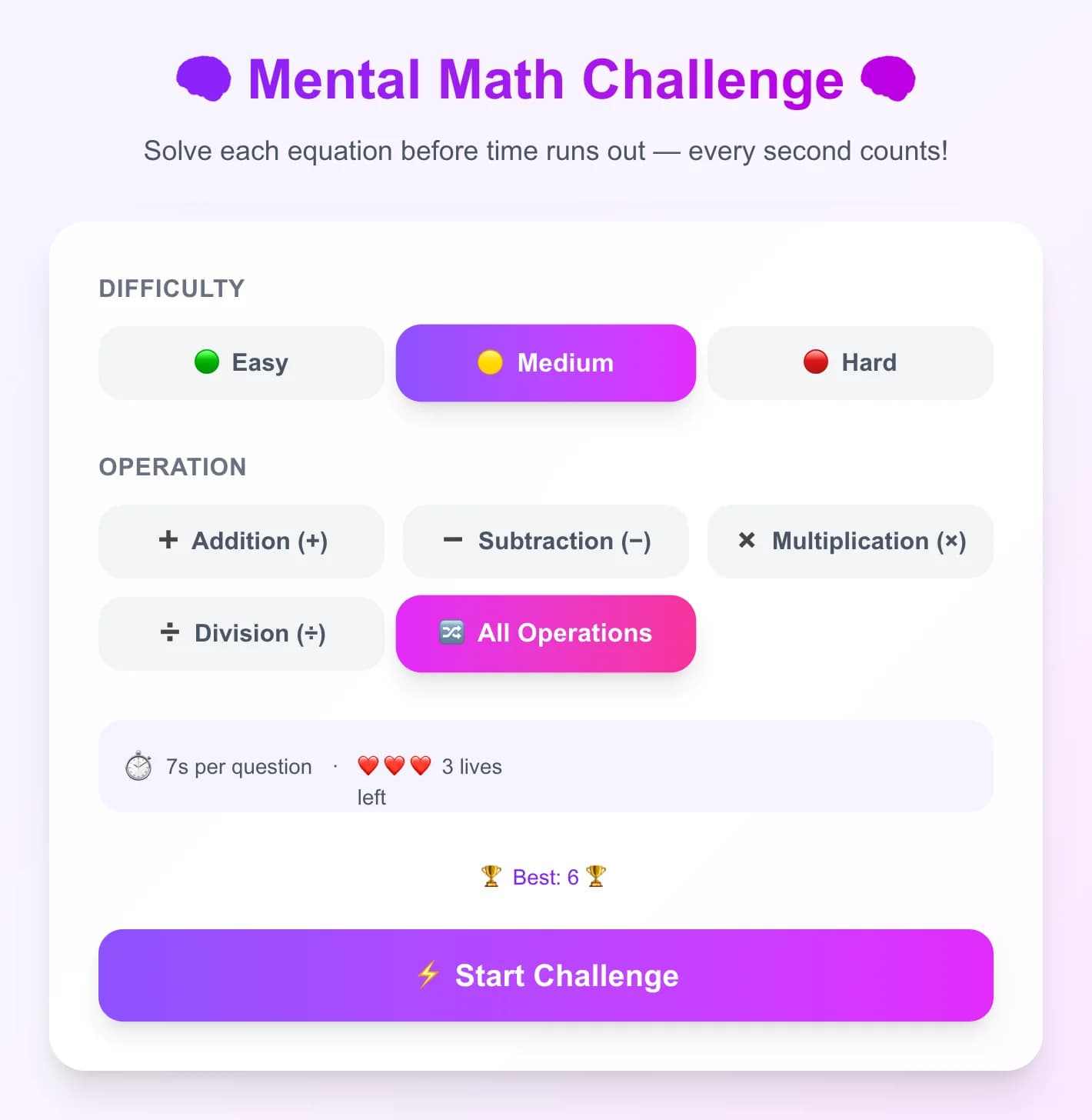
Rapid-Fire Math Game with High Scores
A rapid-fire math game where you solve equations before a per-question countdown expires. Choose difficulty and operations, survive on 3 lives, and chase your personal high score — saved locally so you can always beat it.
Equivalent Fractions Jumping
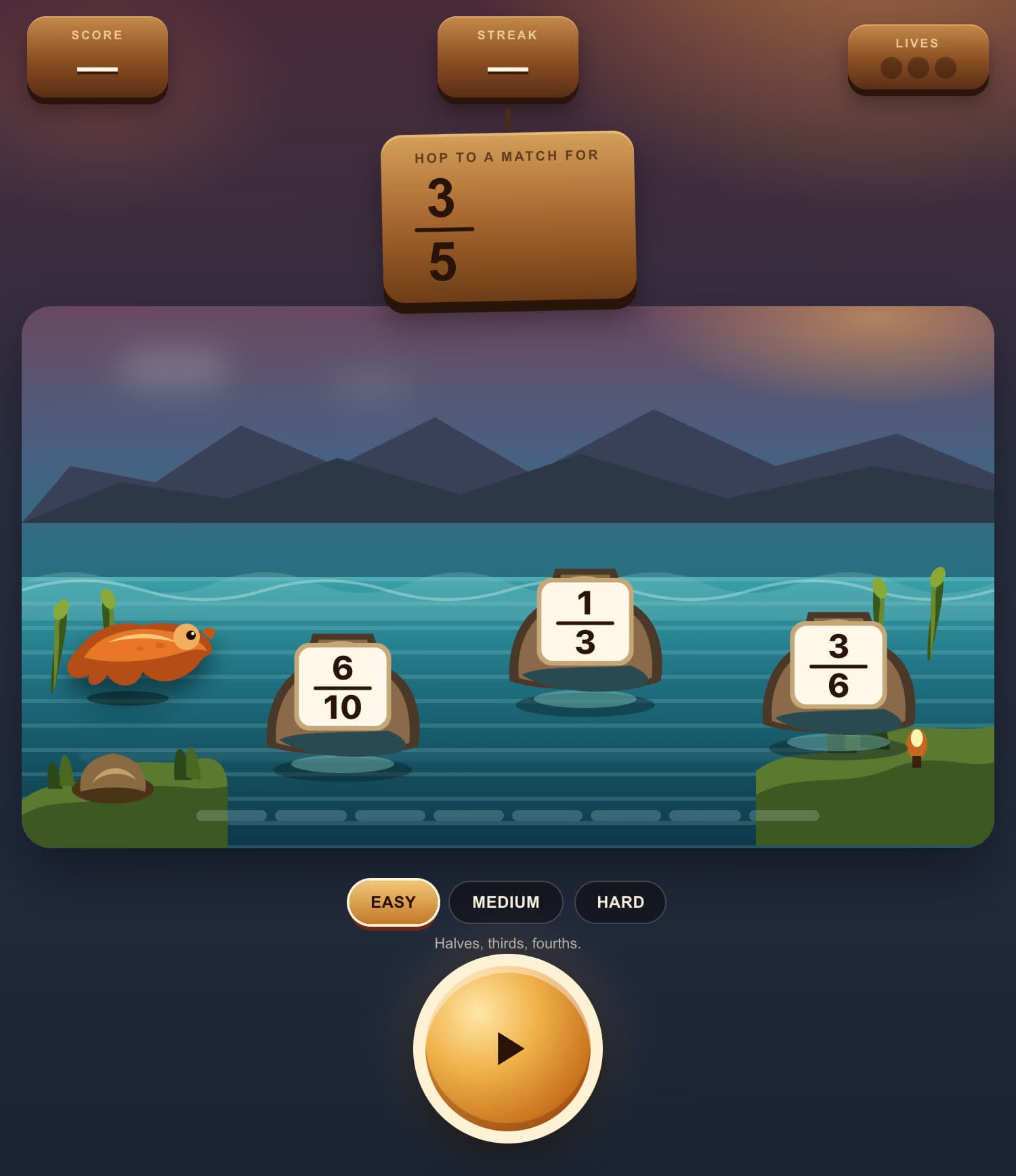
Help a copper gecko hop across a twilight canyon. A fraction such as 1/2 sits on the prompt plaque. Jump only onto sandstone pillars that show an equivalent, like 2/4 or 3/6. Space, Hop, or a tap on a stone sends the gecko. A miss drops into the wash and costs a life. Eight safe hops reach the lantern camp.
Fill the Blank in Number Sequences
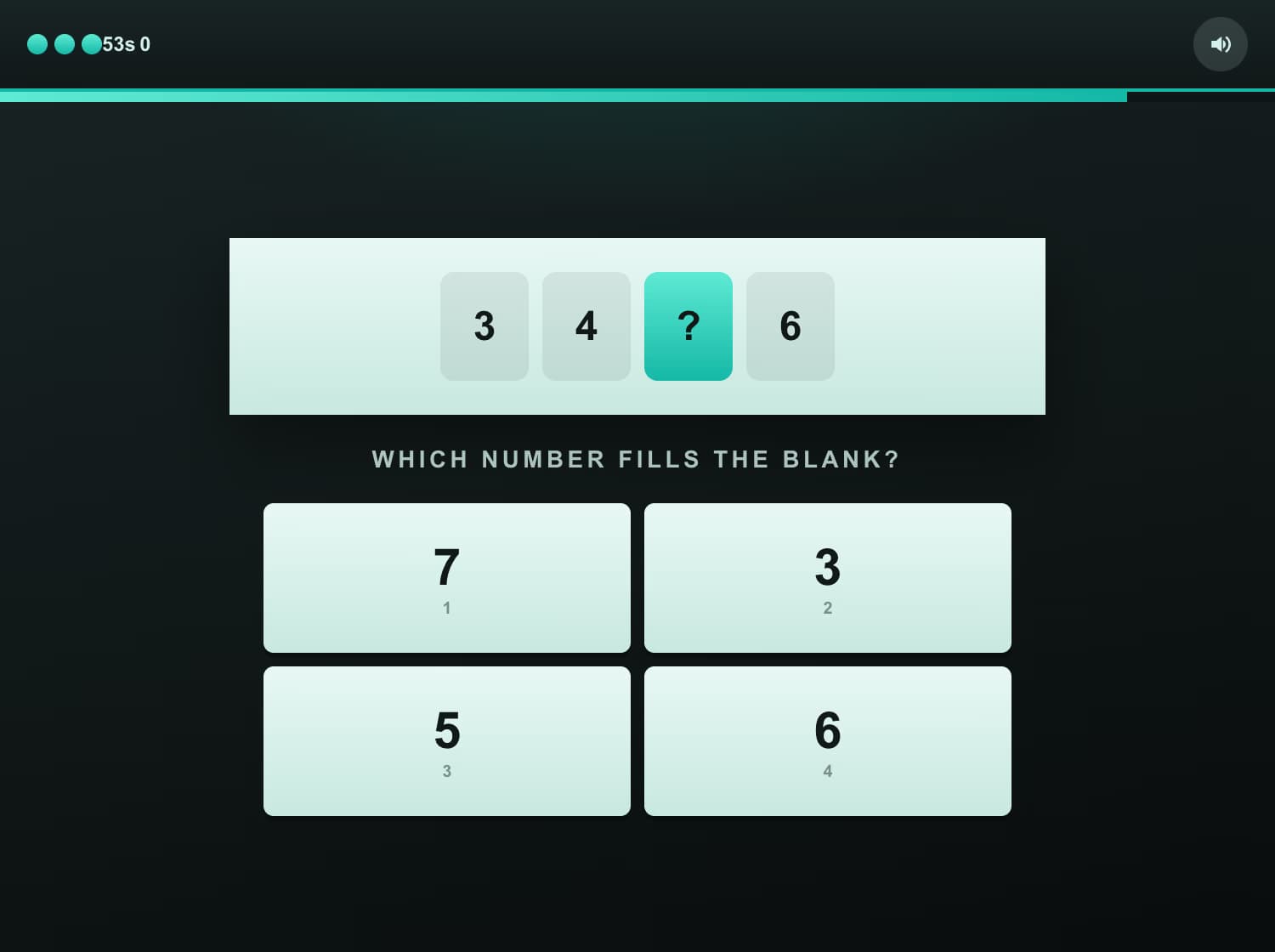
Find the missing number in arithmetic sequences — 3, 4, __, 6. Tap one of four big colorful answer buttons. Race the clock in 60-second mode or survive on 3 lives. Easy, medium, and hard difficulty levels.
Compare Two Groups and Build Number Sense
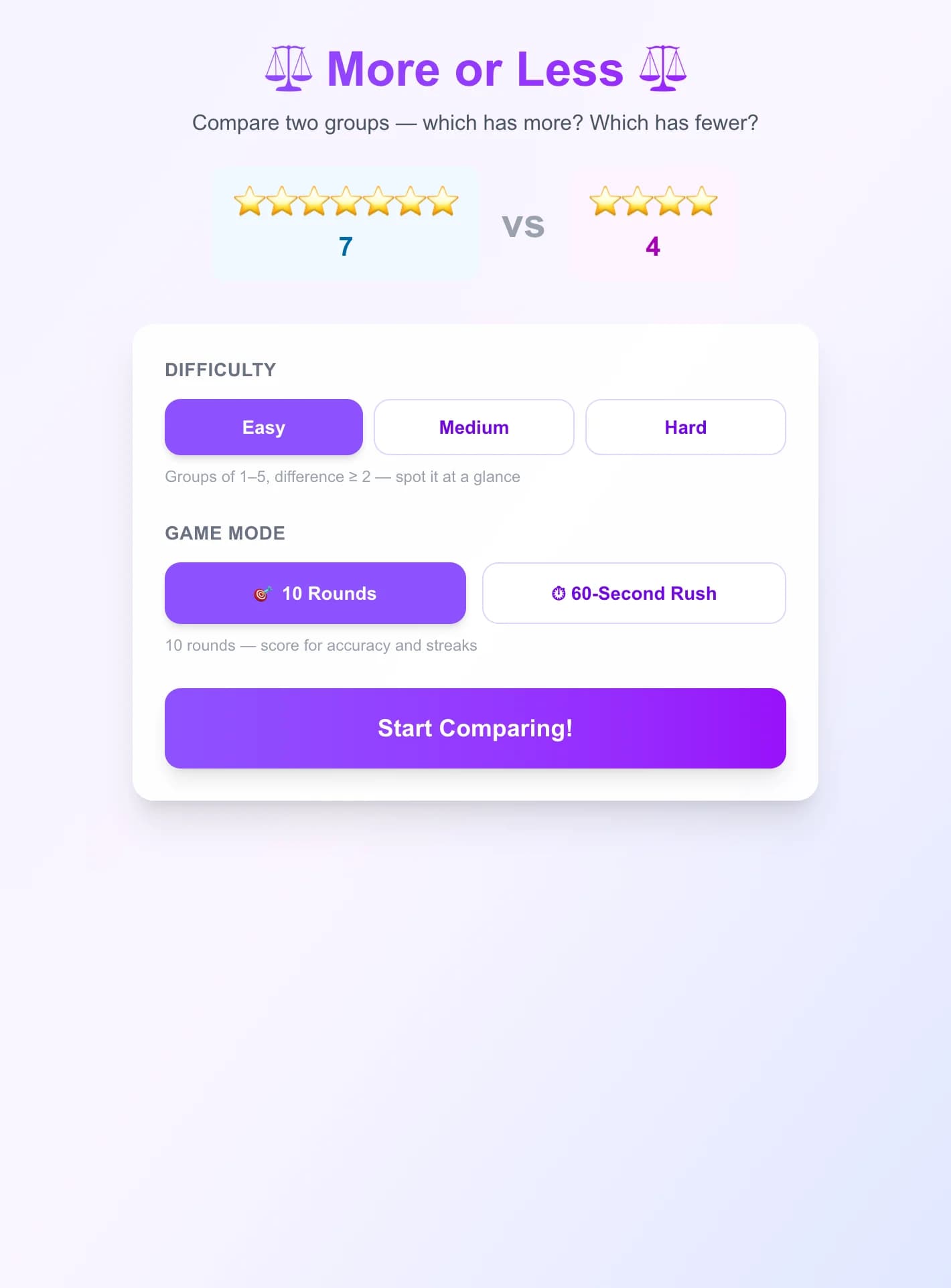
Two groups of objects appear side by side — tap the one with more (or fewer)! A quick, visual way to build number sense and comparison skills for young learners.
Fill the Missing Part
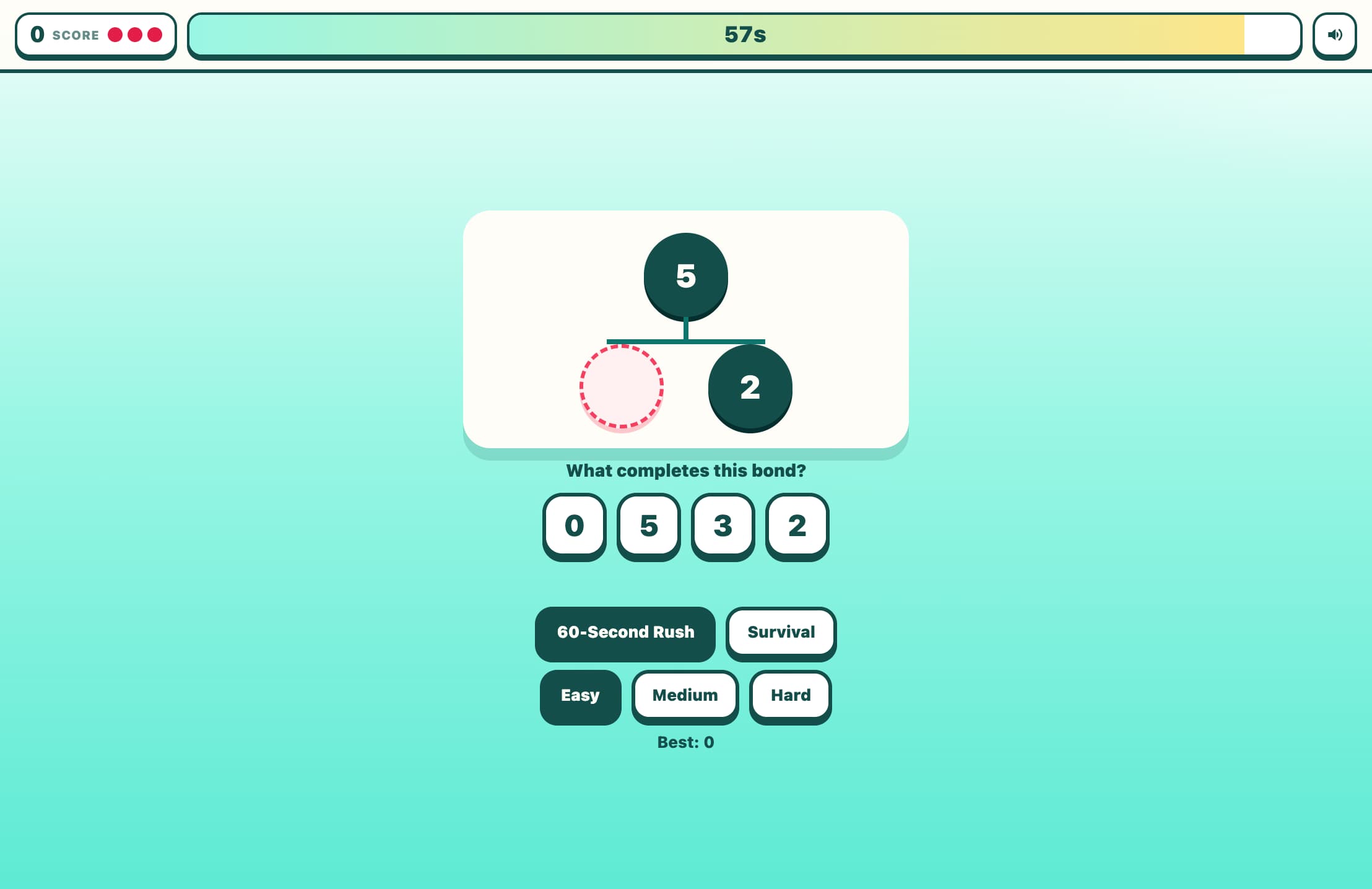
Complete number bonds by finding the missing part — 7 = 3 + ?. Visual circles and connecting lines show the whole and its parts. Race the clock in 60-second mode or survive on 3 lives. Easy, medium, and hard levels.

Ascending Order Sorting
Colorful numbered bubbles float upward — tap them in ascending order (smallest to largest) before they escape off the top of the screen. Miss one and lose a life!
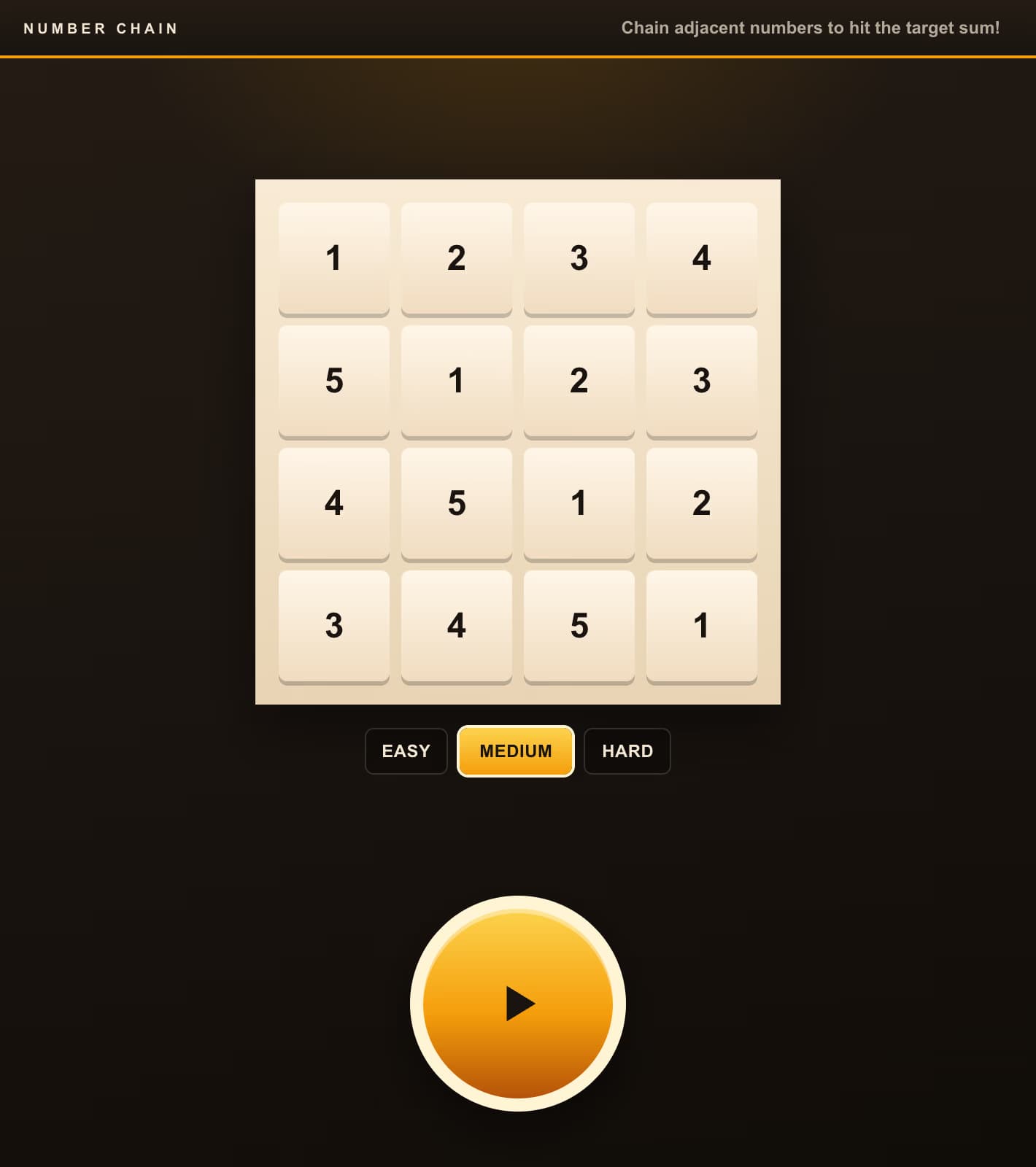
Math Path Puzzle Game | Connect Numbers to Reach Target Sum
A math puzzle game inspired by word ladder: trace a path through a 4×4 number grid, chaining adjacent cells until their sum exactly matches the target. 10 levels, 3 lives, and a high score to chase — every chain is a new puzzle.
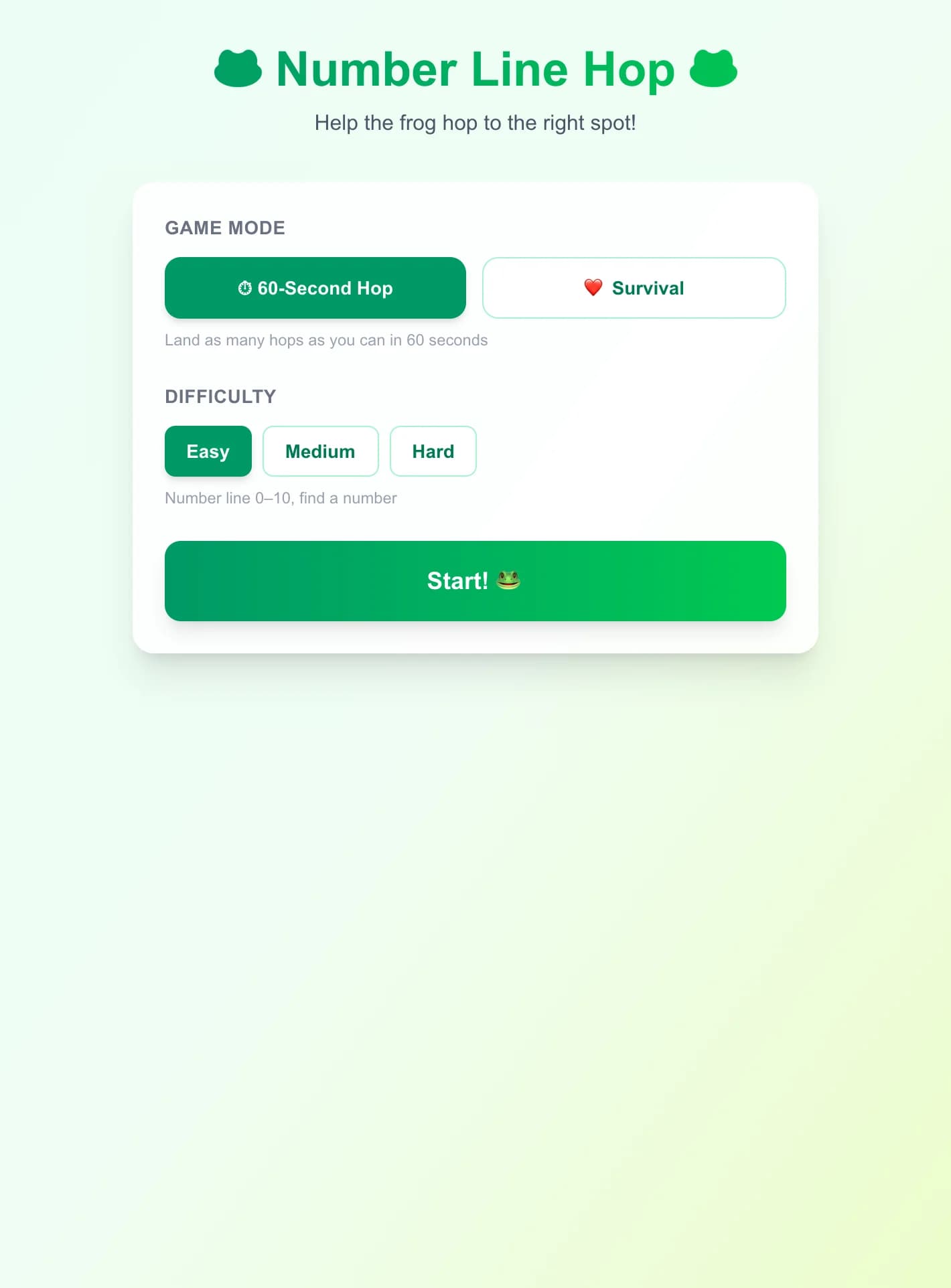
Position Numbers on a Number Line
A frog hops on a number line to land on the correct position for a given number or arithmetic result. Click or tap the number line to place the frog at the right spot. Covers numbers, addition, and subtraction with visual feedback.
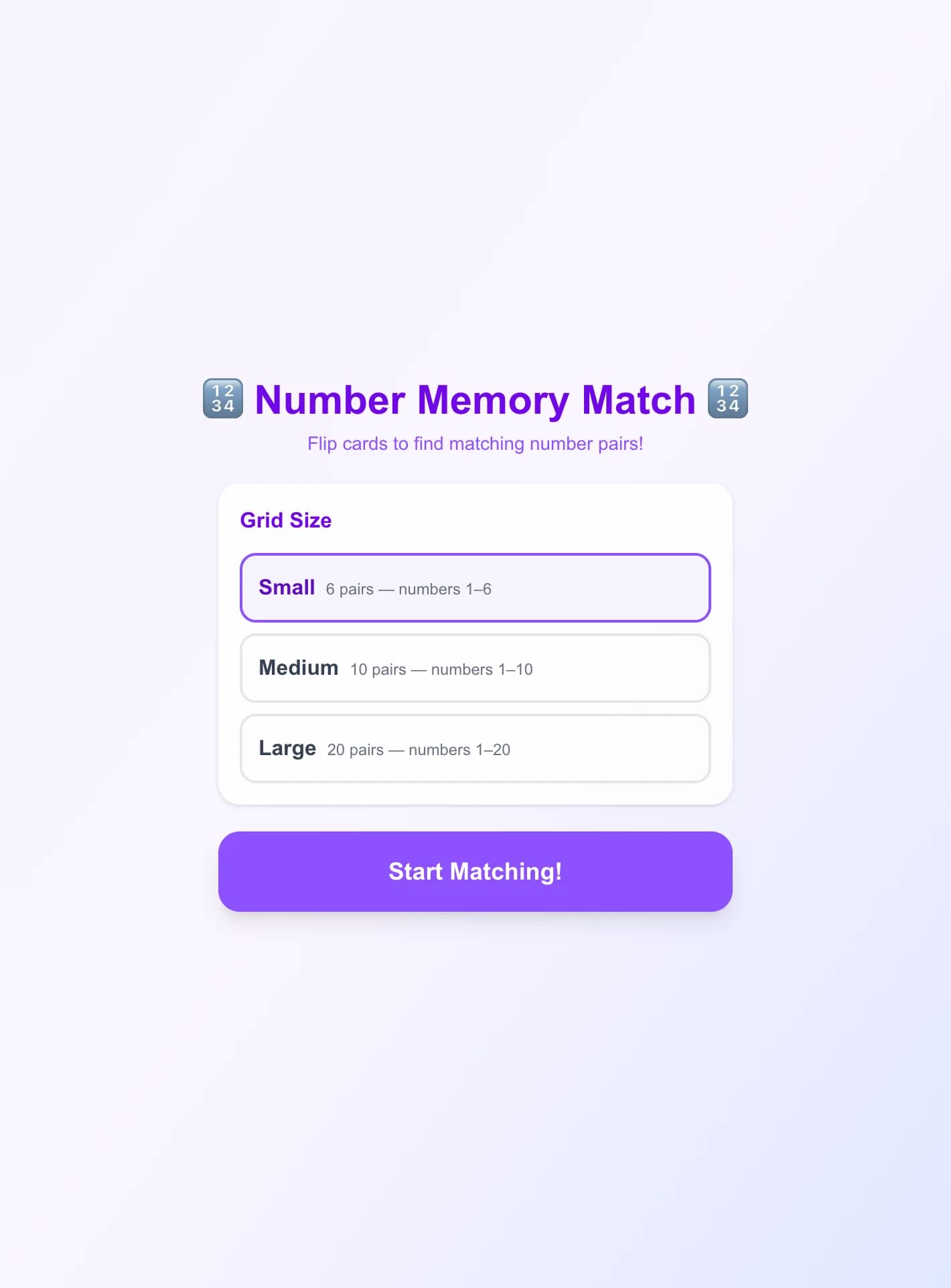
Classic Concentration Game with Numbers 1–20
Flip cards to find matching number pairs in this classic memory/concentration game! Three grid sizes — 6, 10, or 20 pairs — let young learners practice number recognition while exercising visual memory and concentration.
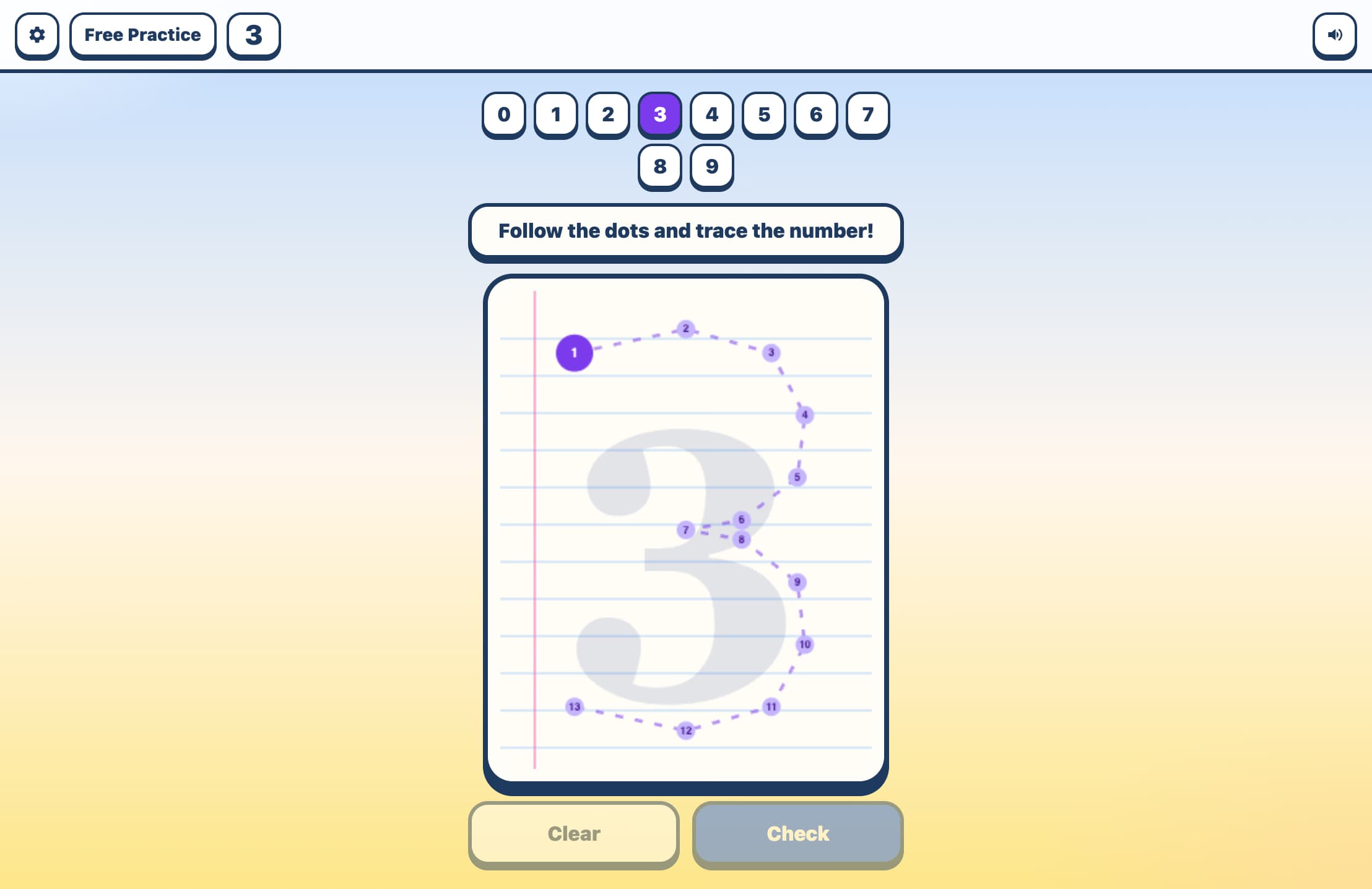
Practice Writing Digits 0-9
Trace the shape of digits 0–9 with your finger or mouse. Follow numbered guide dots, draw over the faint digit outline, then check your accuracy. Free Practice and 10-digit Challenge modes.
Number Sorting
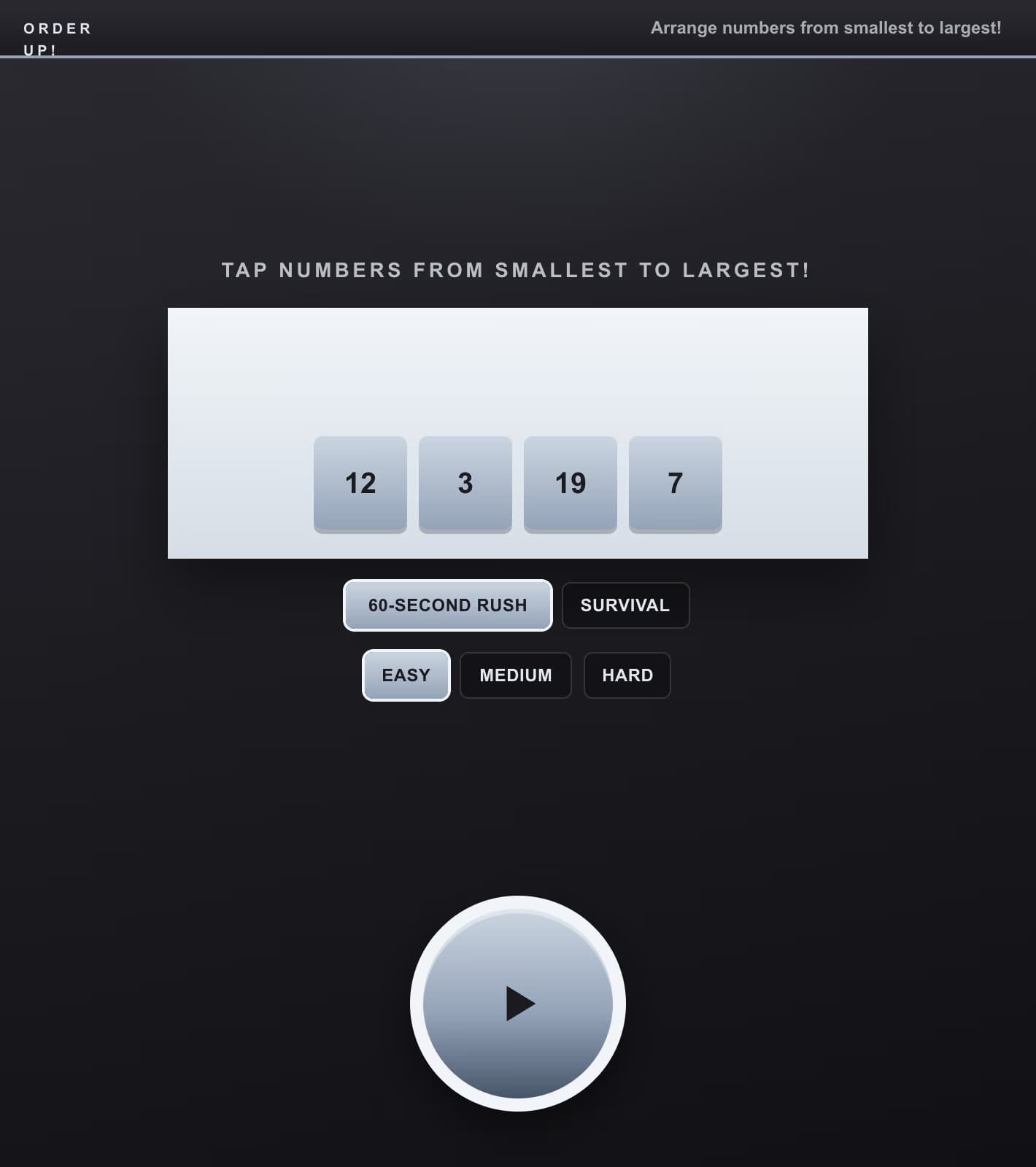
Arrange a shuffled set of numbers from smallest to largest by tapping them in the correct order. Race against time or play in survival mode with three difficulty levels covering numbers 1–100.
Place Value to the Hundreds
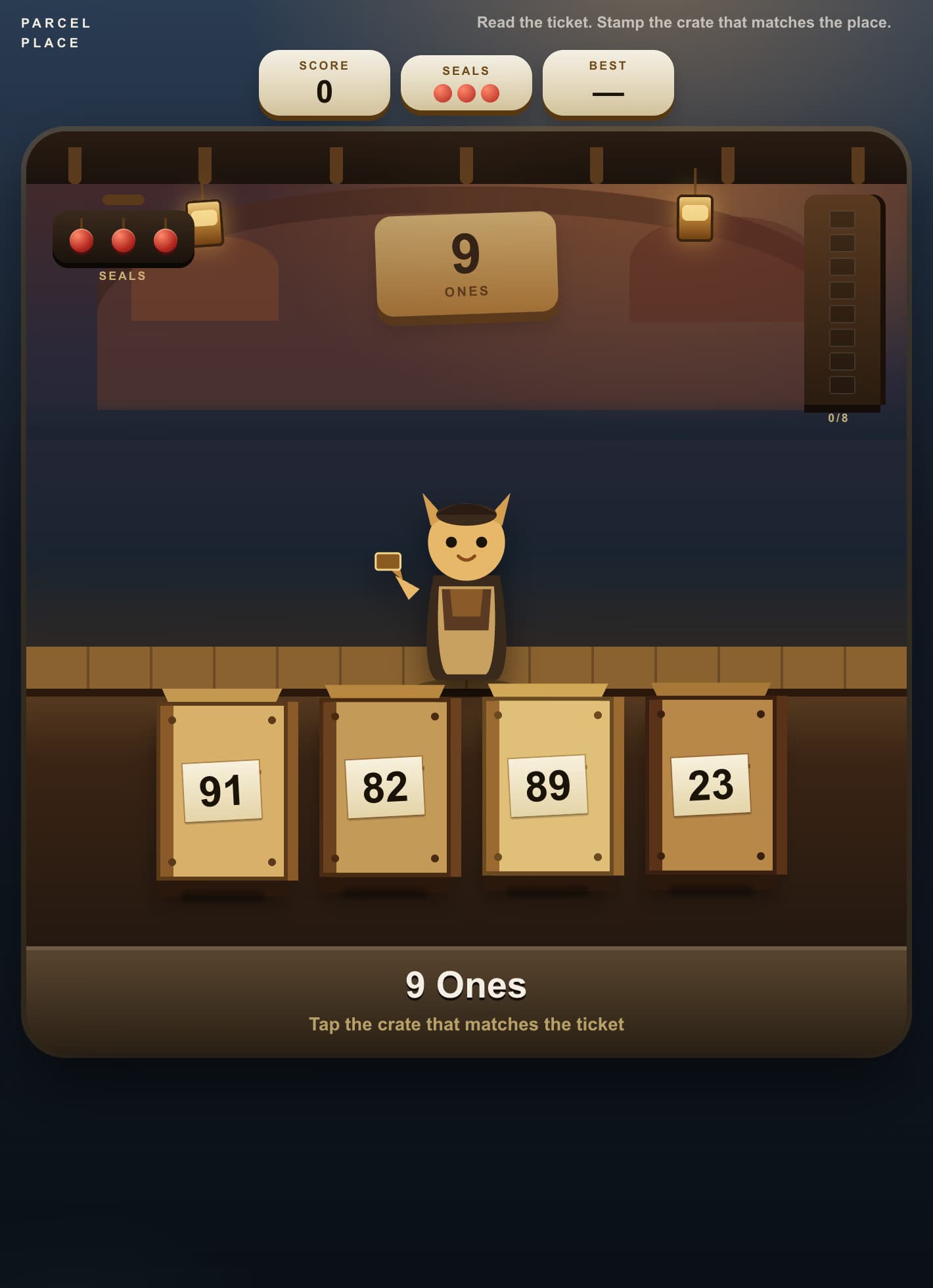
A dusk depot, brass-tagged crates, and a ticket that names a place. Four parcels sit on the bench. Tap the number that has the given ones, tens, or hundreds. A hit stamps the order. A miss costs a wax seal. Built for second-grade place value through the hundreds place.
Complete the Repeating Pattern
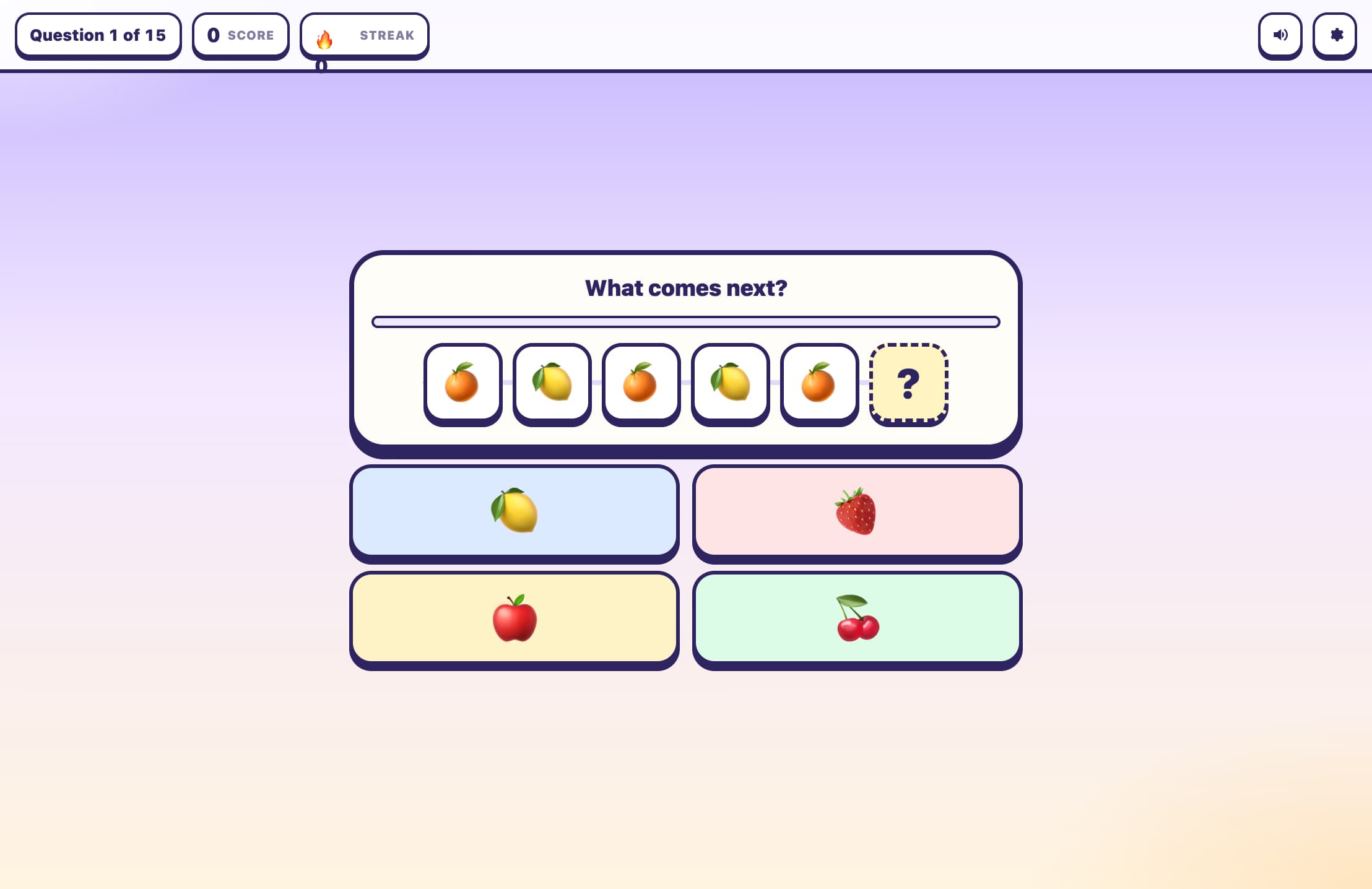
What comes next? Complete repeating patterns made of emoji like 🔴🔵🔴🔵__? Choose from 4 options. From simple AB patterns to complex ABCD sequences — great for early math, logical reasoning, and pre-algebra thinking!
Coin Counting & Making Change
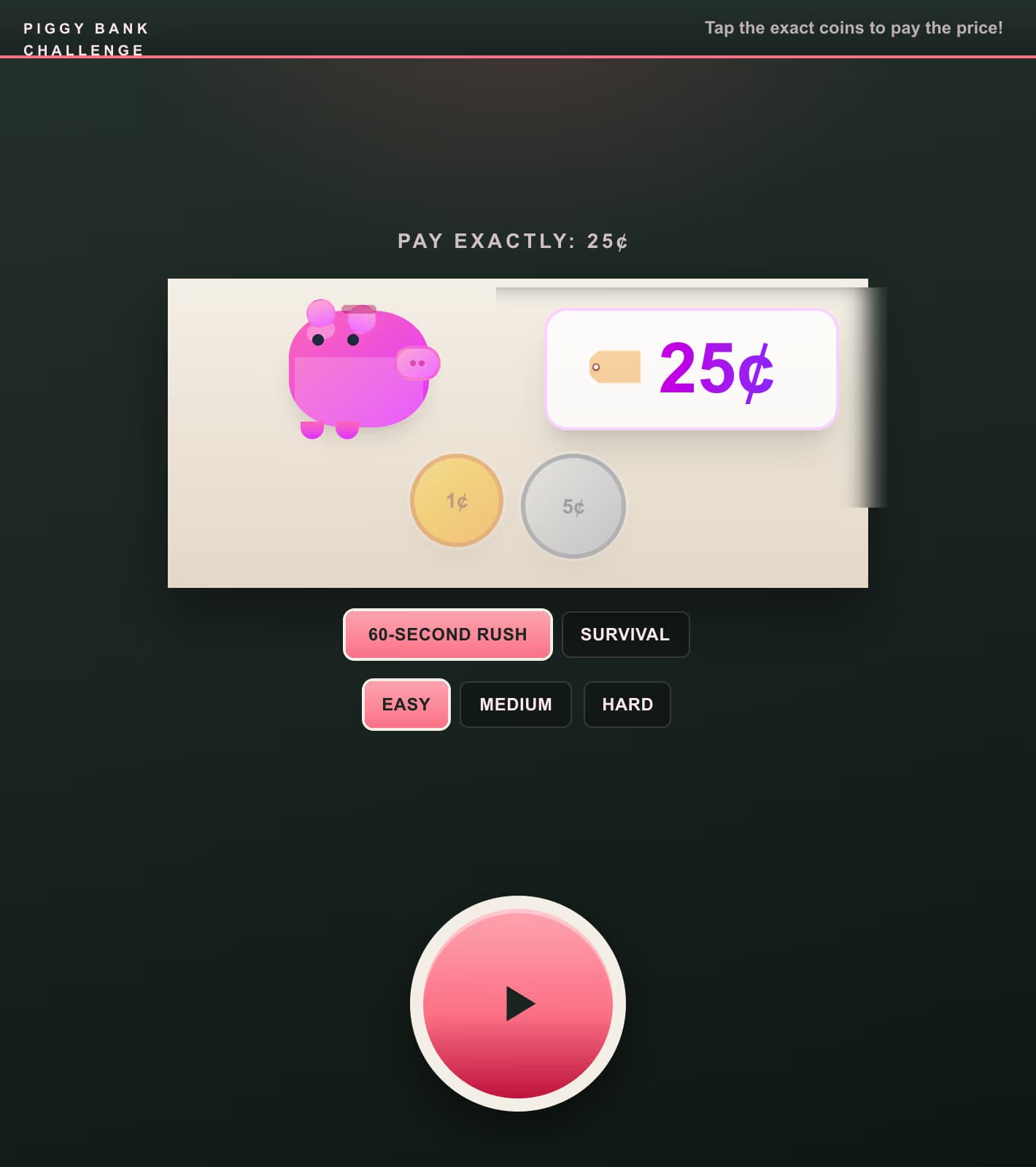
A price tag shows a small amount — tap the exact coins (pennies, nickels, dimes, quarters) to pay for it. Builds coin recognition, counting, and making-change skills with amounts up to $1.00.
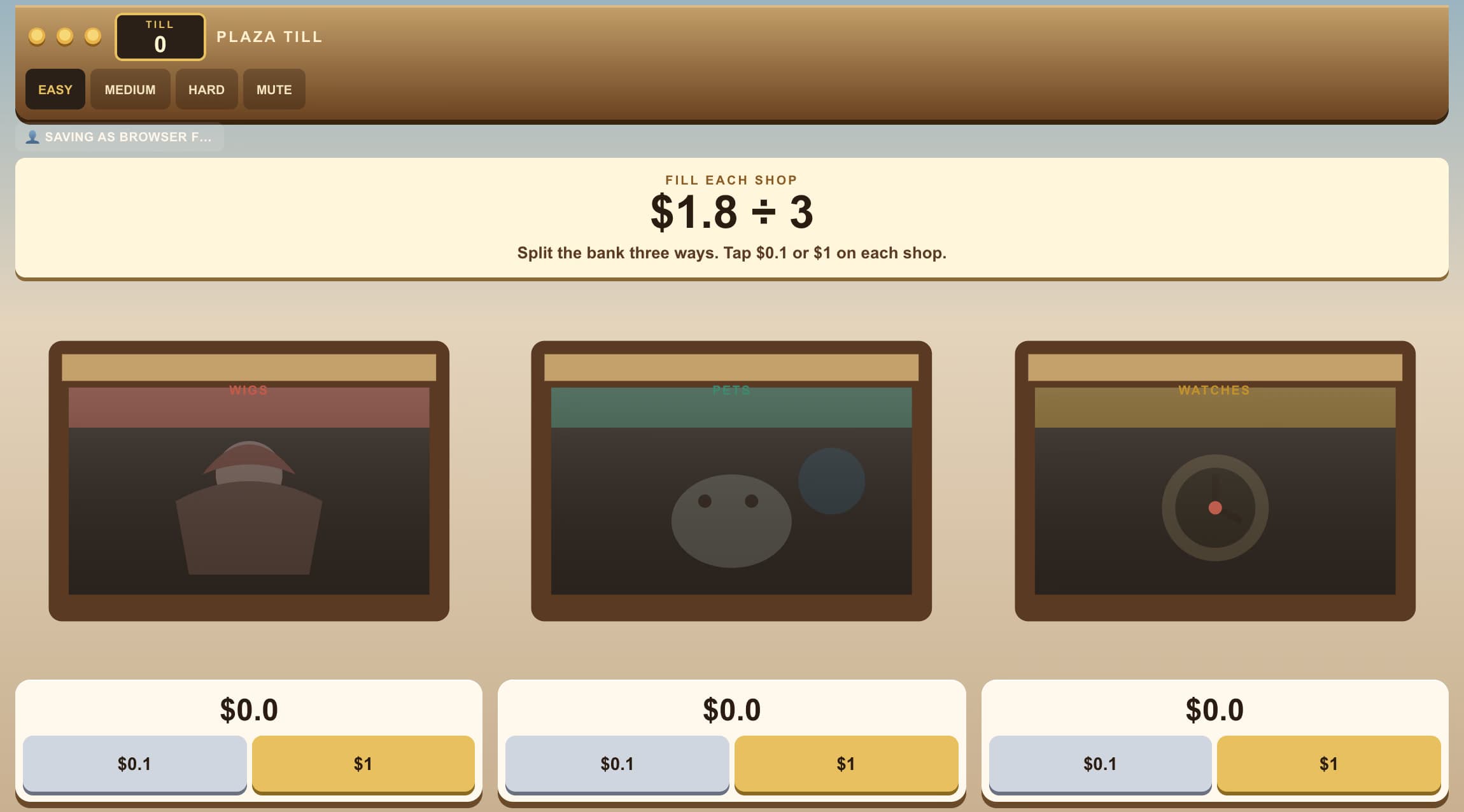
Shopping Decimal Division to the Tenths Place
Shop the night plaza in Plaza Till. A leather Bank shows a total to split three ways among Wigs, Pets, and Watches. Pick $1 or $0.1, then pour equal shares into each till to the tenth. Fifth-grade decimal division with Till points for a clean floor.
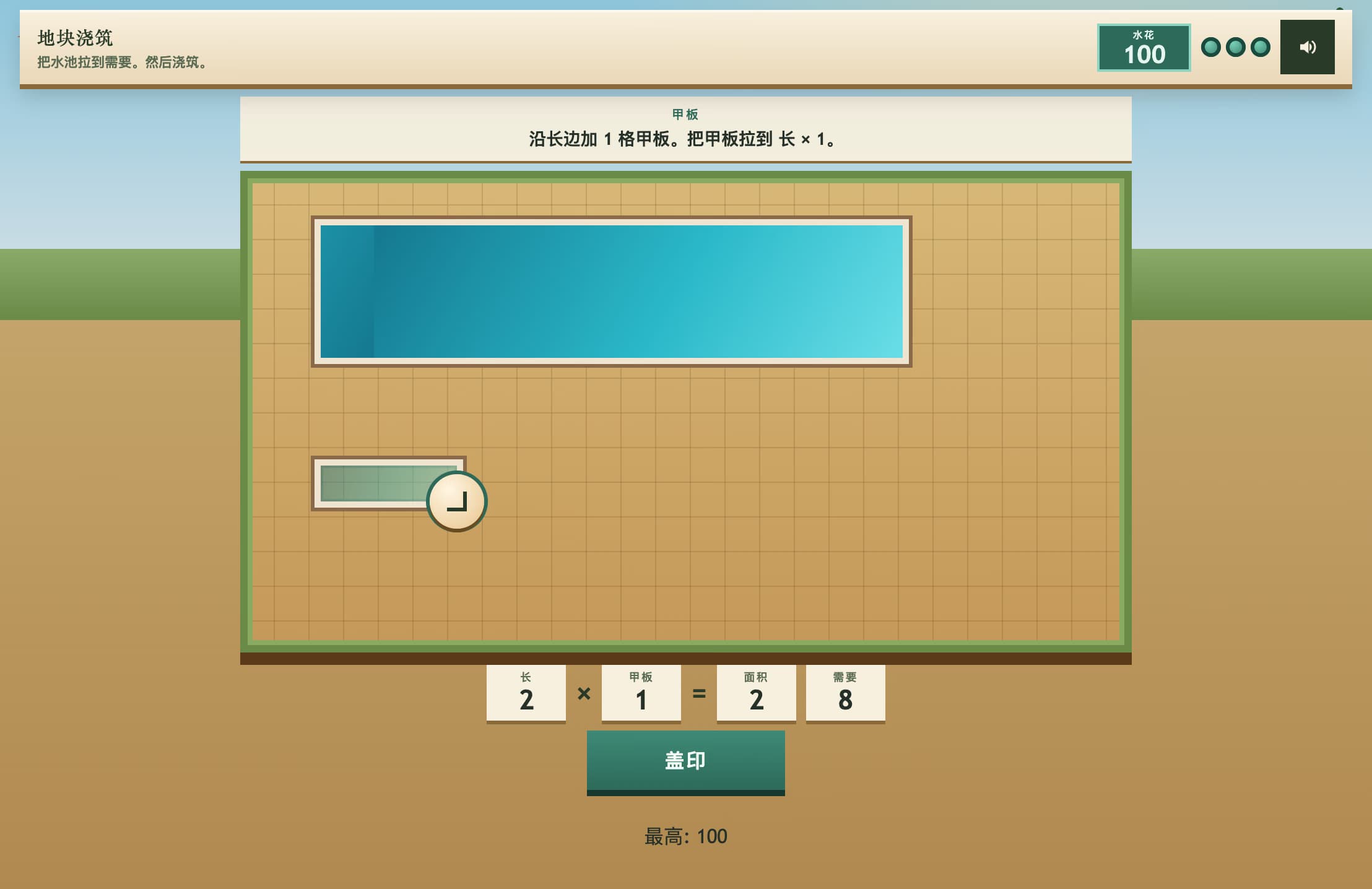
Area Models and Multiplication Word Problems
Architects on the ready. Stretch the basin on a backyard lot until Length × Width equals Need, then Pour. Follow-up word problems ask kids to Stamp a Deck, Stamp a Spa, or Split the patio and Pour each patch. Fifth grade multiplication and area, with Splashes that grow on a streak.
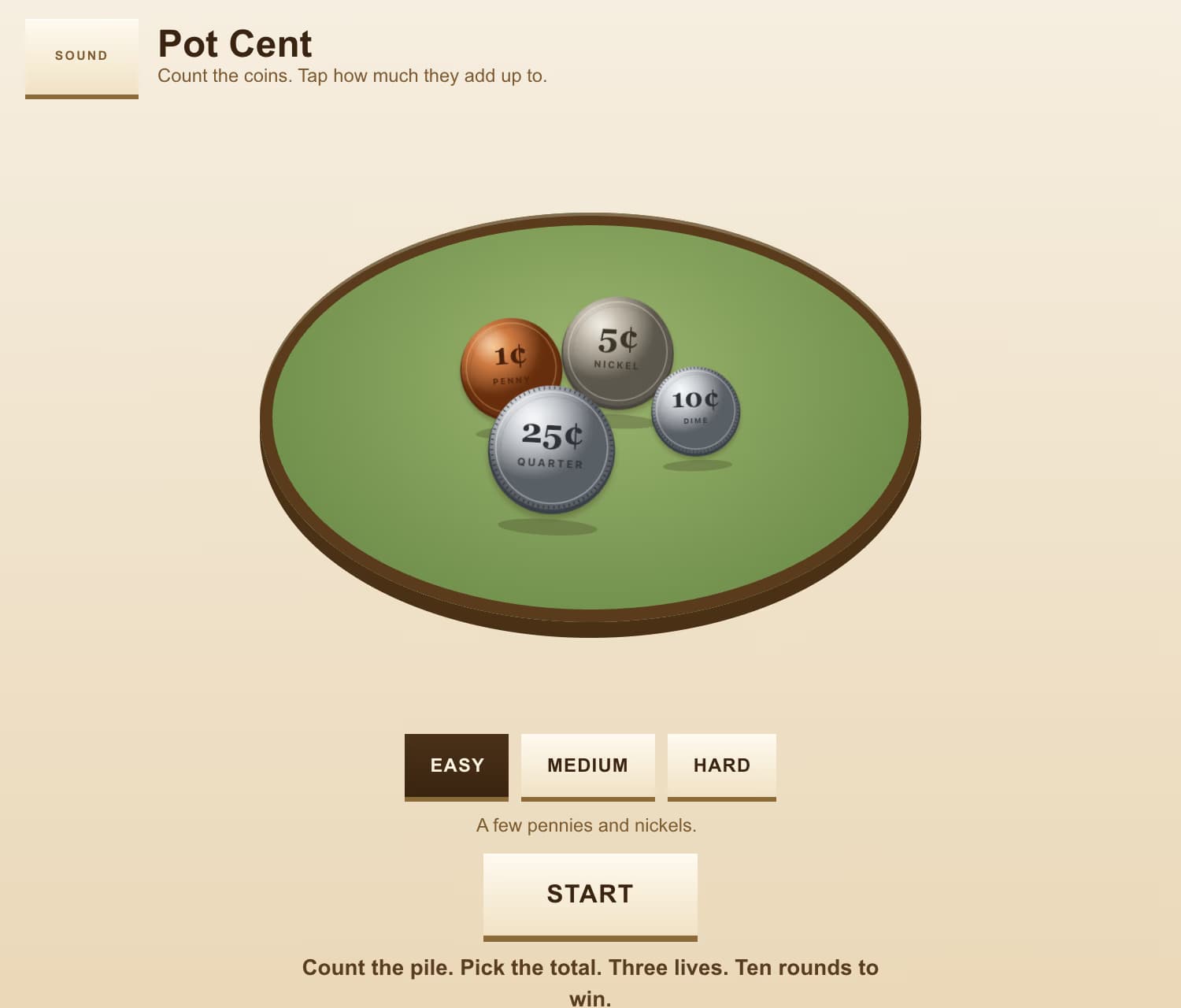
Count Coins and Tap the Total
Count a small pile of U.S. pennies, nickels, dimes, and quarters, then tap the matching total. A lobby to pick Easy, Medium, or Hard. Three lives, a streak bonus, and ten rounds to win. Built for first through third grade money math.
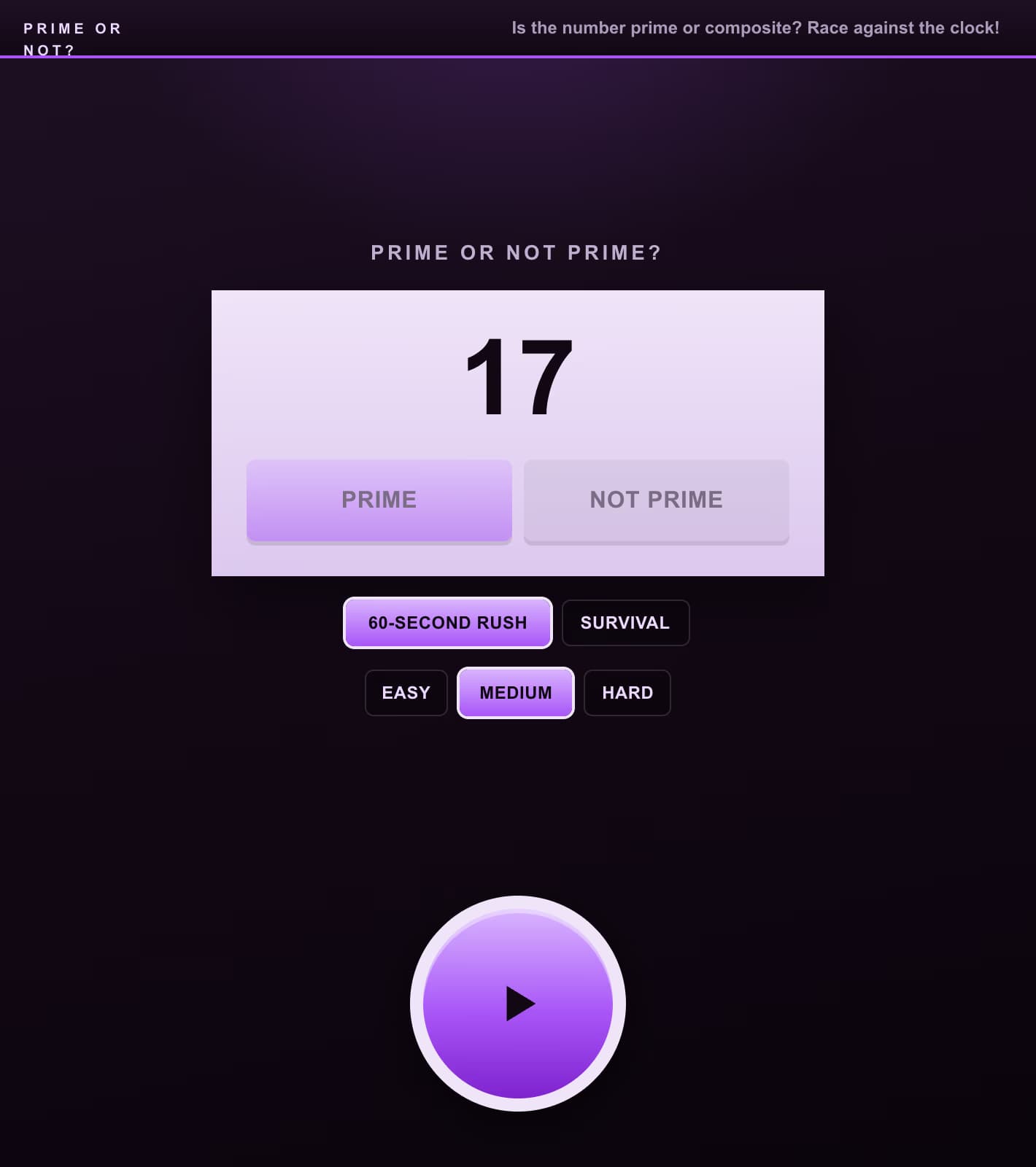
Prime Number Classification
A fast-paced number classification game. Is the number prime or composite? Race against the clock and beat your streak!
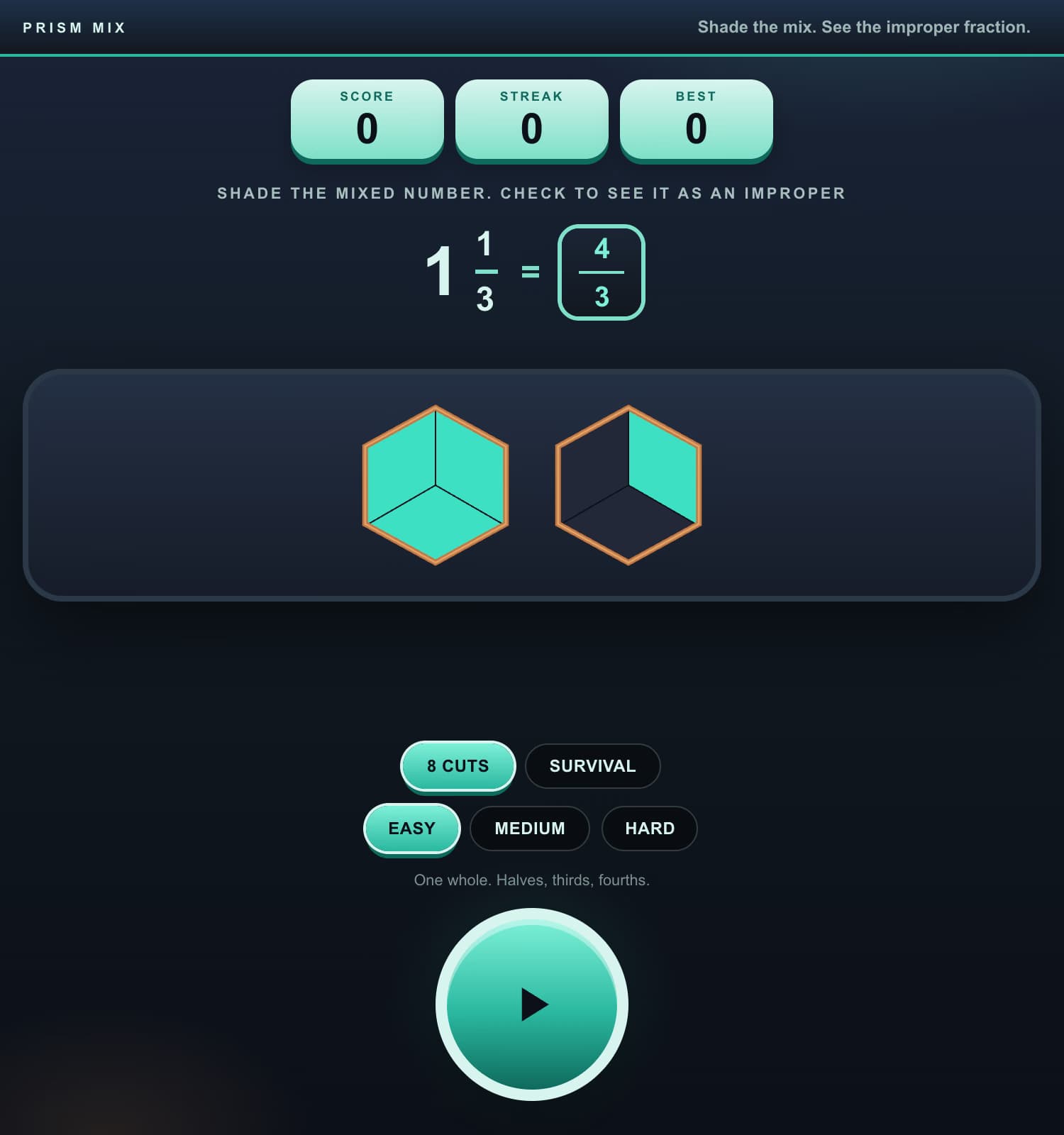
Convert Mixed Numbers to Improper Fractions
A dusk glass studio, copper frames, and hexagonal prisms. Shade facets to match a mixed number like 1 1/6. Then type the improper fraction on the workbench pad. A clean shade and a clean write both score. Built for fourth-grade mixed numbers.
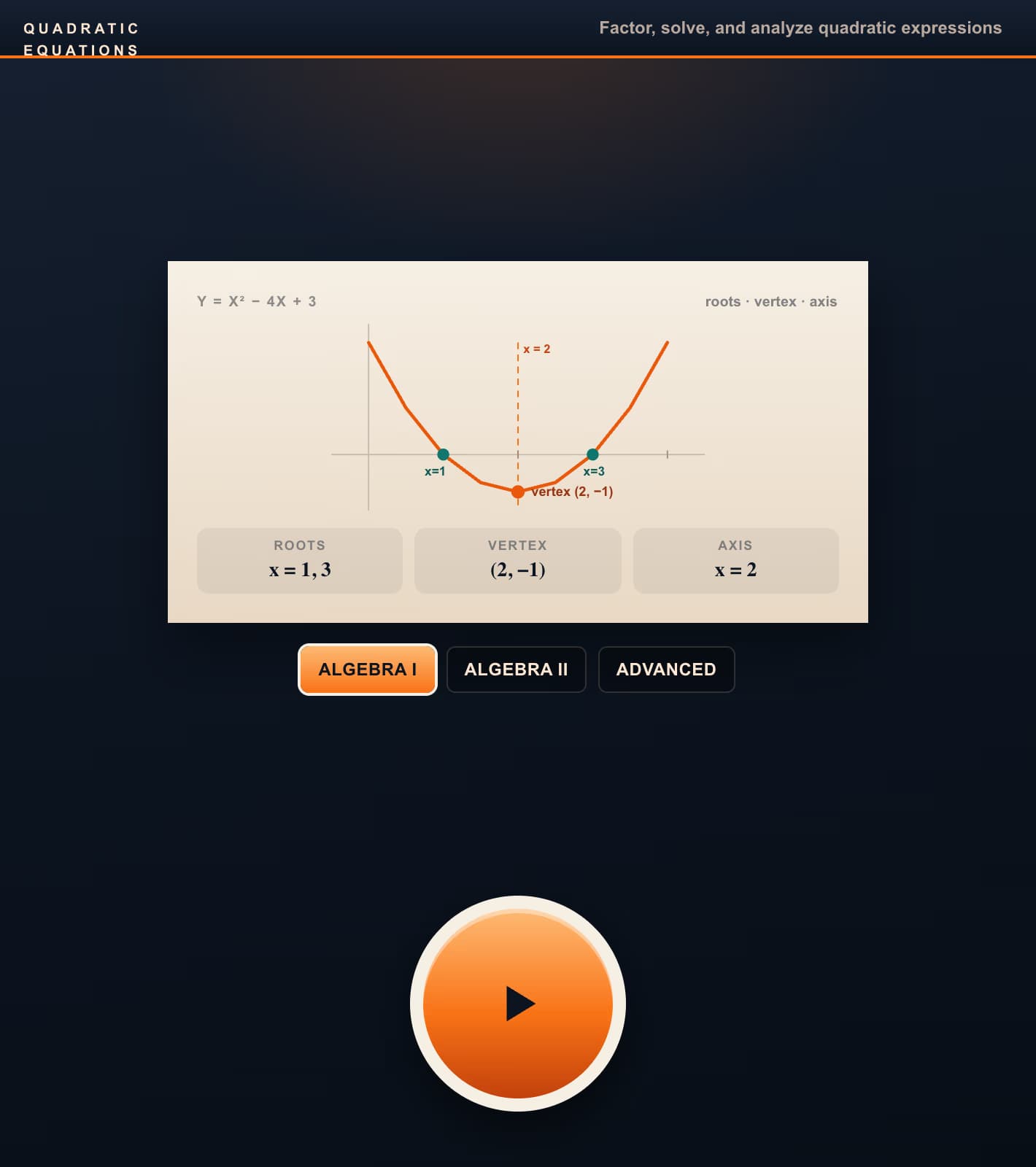
High School Math Quiz
Factor, solve, and analyze quadratic equations — pick the correct answer from four choices. 45 problems across three tiers: Algebra I (factoring trinomials, solving by roots, parabola direction), Algebra II (quadratic formula, vertex form, completing the square, discriminant), and Advanced (Vieta's formulas, transformations, applications, function composition).
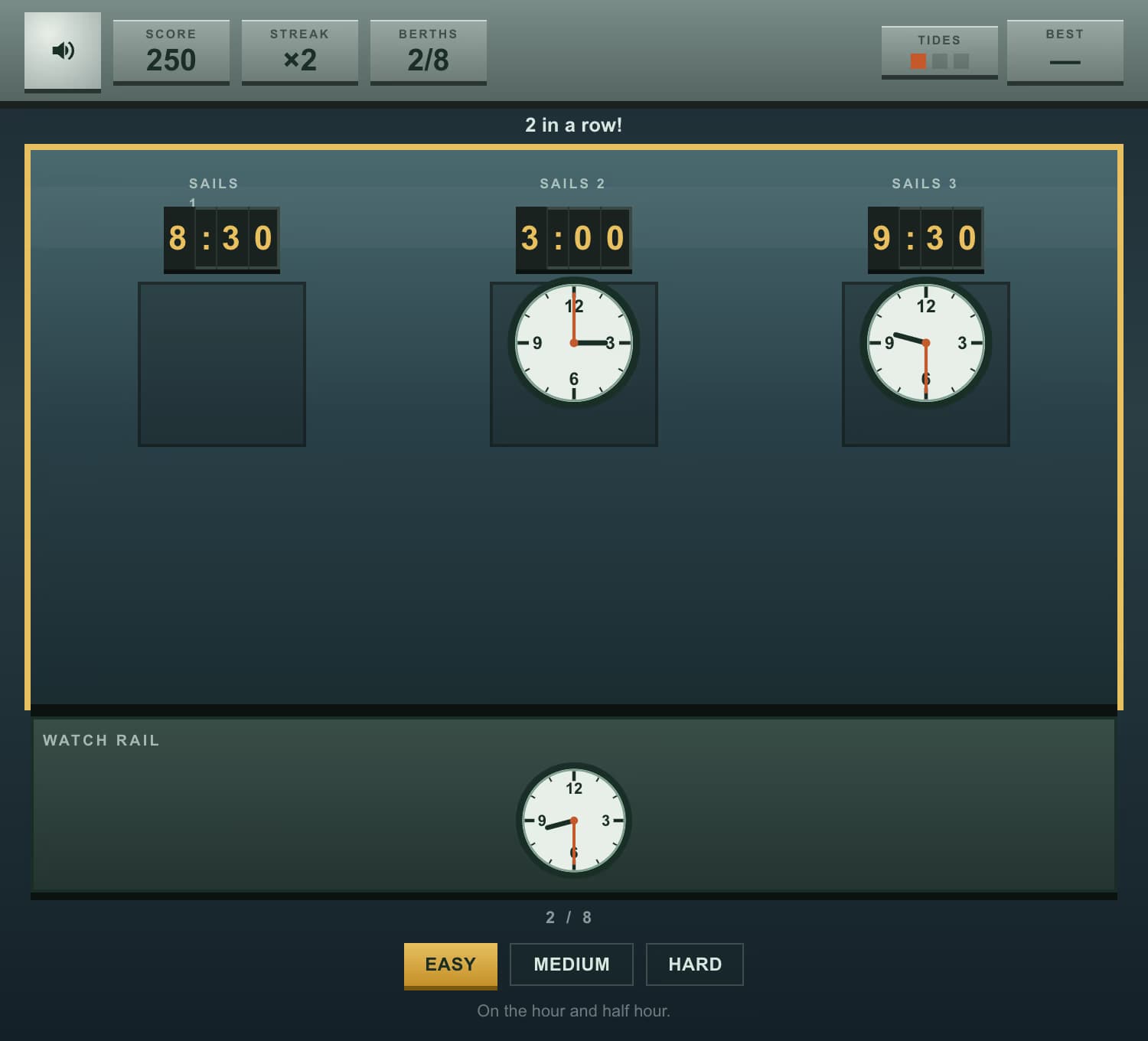
Match Analog Faces to Digital Ferry Times
A dusk watch-house on the quay. Amber flip times show when each berth sails. Enamel watches hang on the rail. Drag the face that shows that time into the cubby. Built for second-grade telling time to five minutes — analog hands to digital time, not a multiple-choice strip.
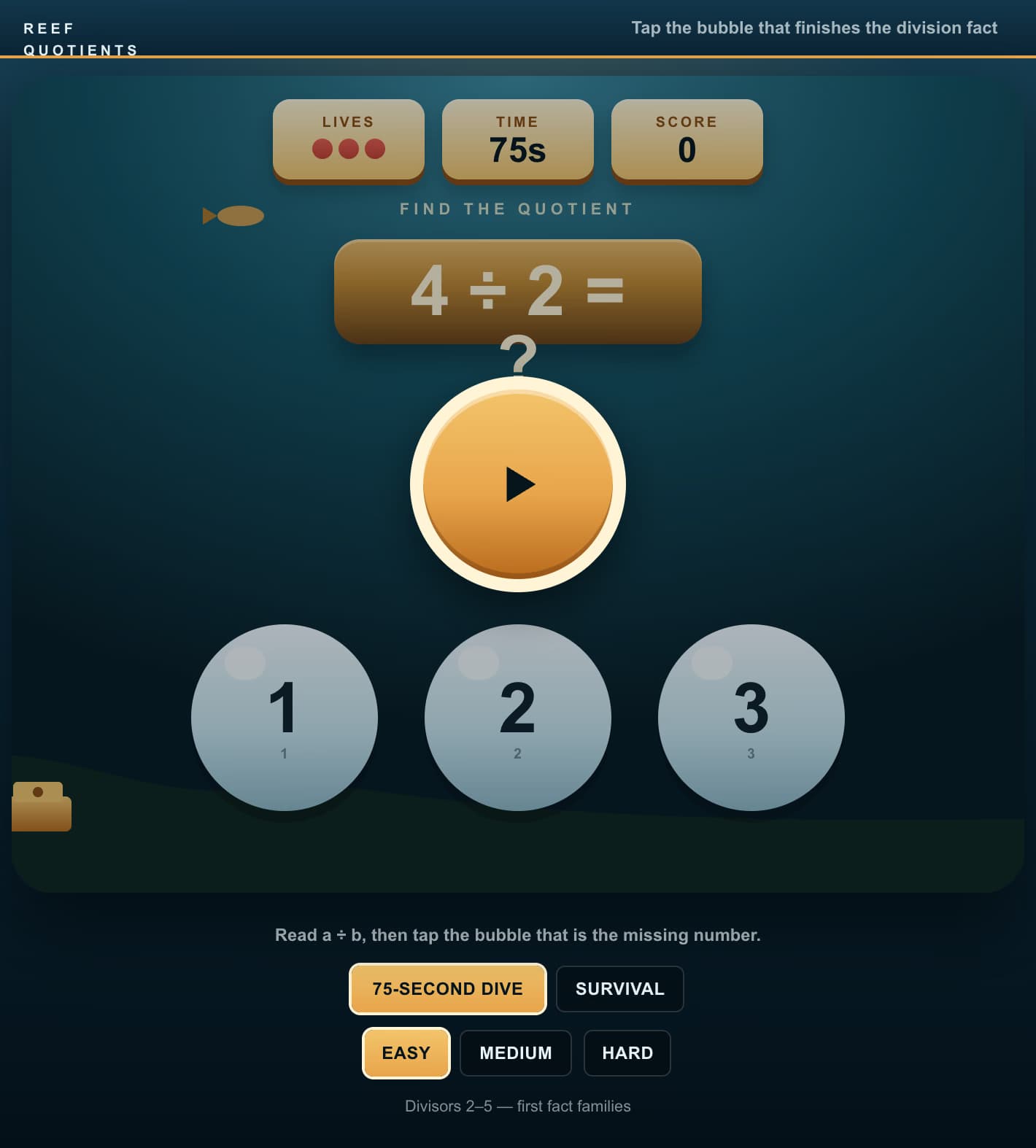
Division Facts
Read a division fact and tap the bubble that holds the quotient. Fourth graders build fact fluency with one-digit divisors by choosing among three answers on a reef dive, not by typing.
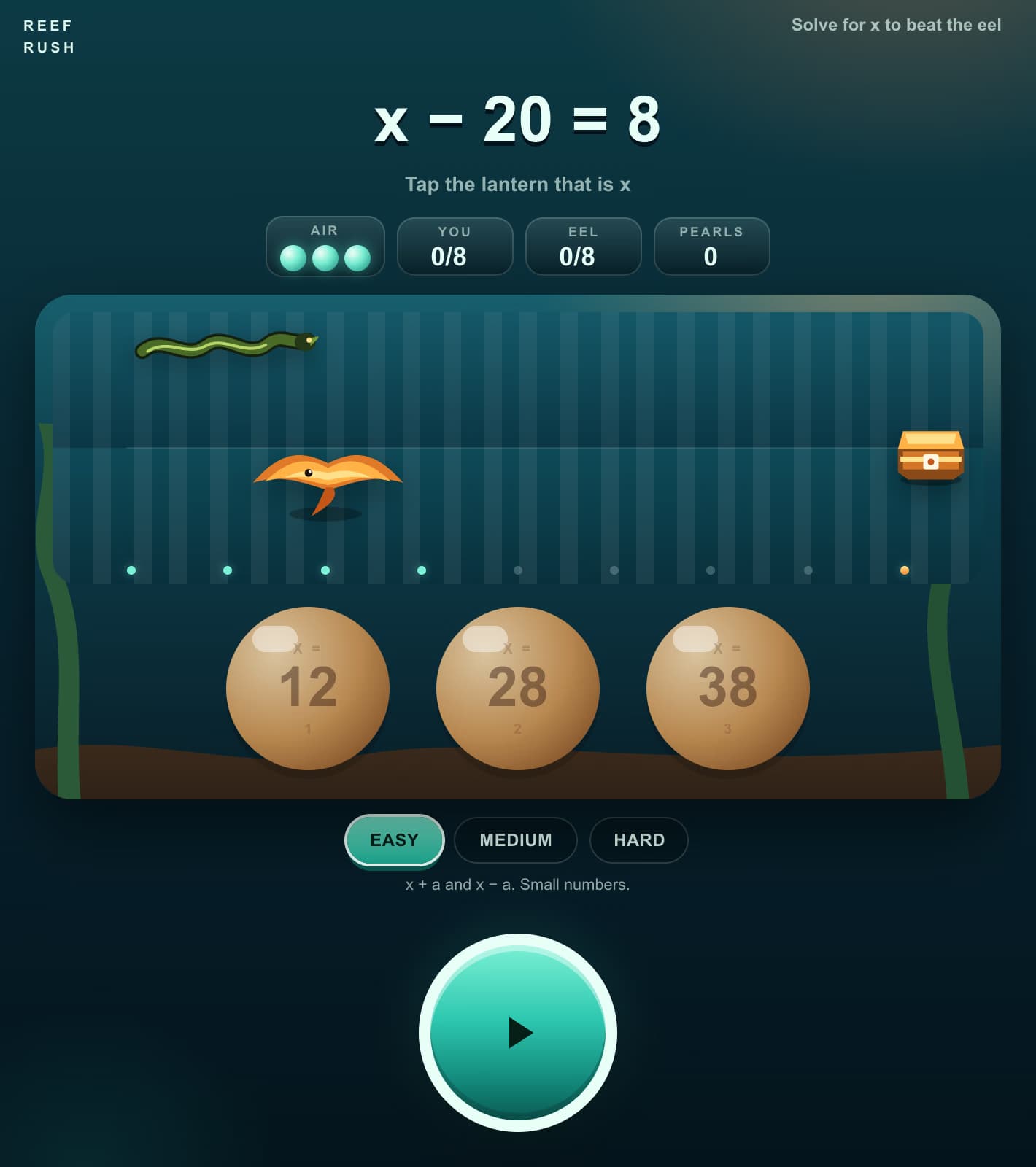
One-Step Addition and Subtraction Equations Race
A dusk lagoon, a mango manta, and an ink eel racing for a copper pearl chest. A one-step equation such as x − 20 = 8 sits under the channel. Tap the lantern that is x. A correct stroke surges you forward. A miss lets the eel close in and costs a tank of air. First to the chest wins.
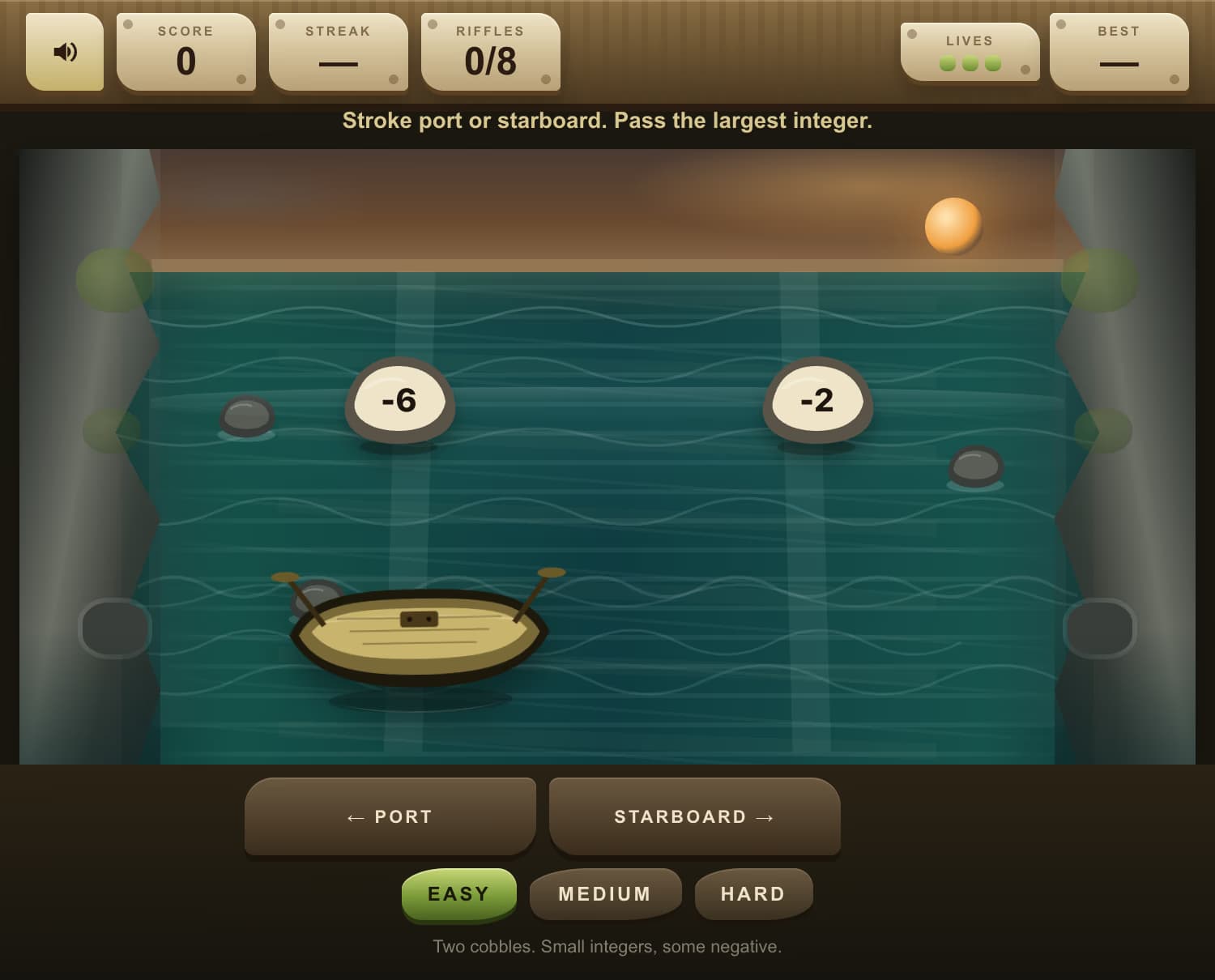
Order Integers in the Gorge
A tea-colored riffle, granite walls, and a canvas dory. Stroke port or starboard to sit under the largest integer before the cobble bar reaches the bow. Built for sixth-grade number sense with positives and negatives.
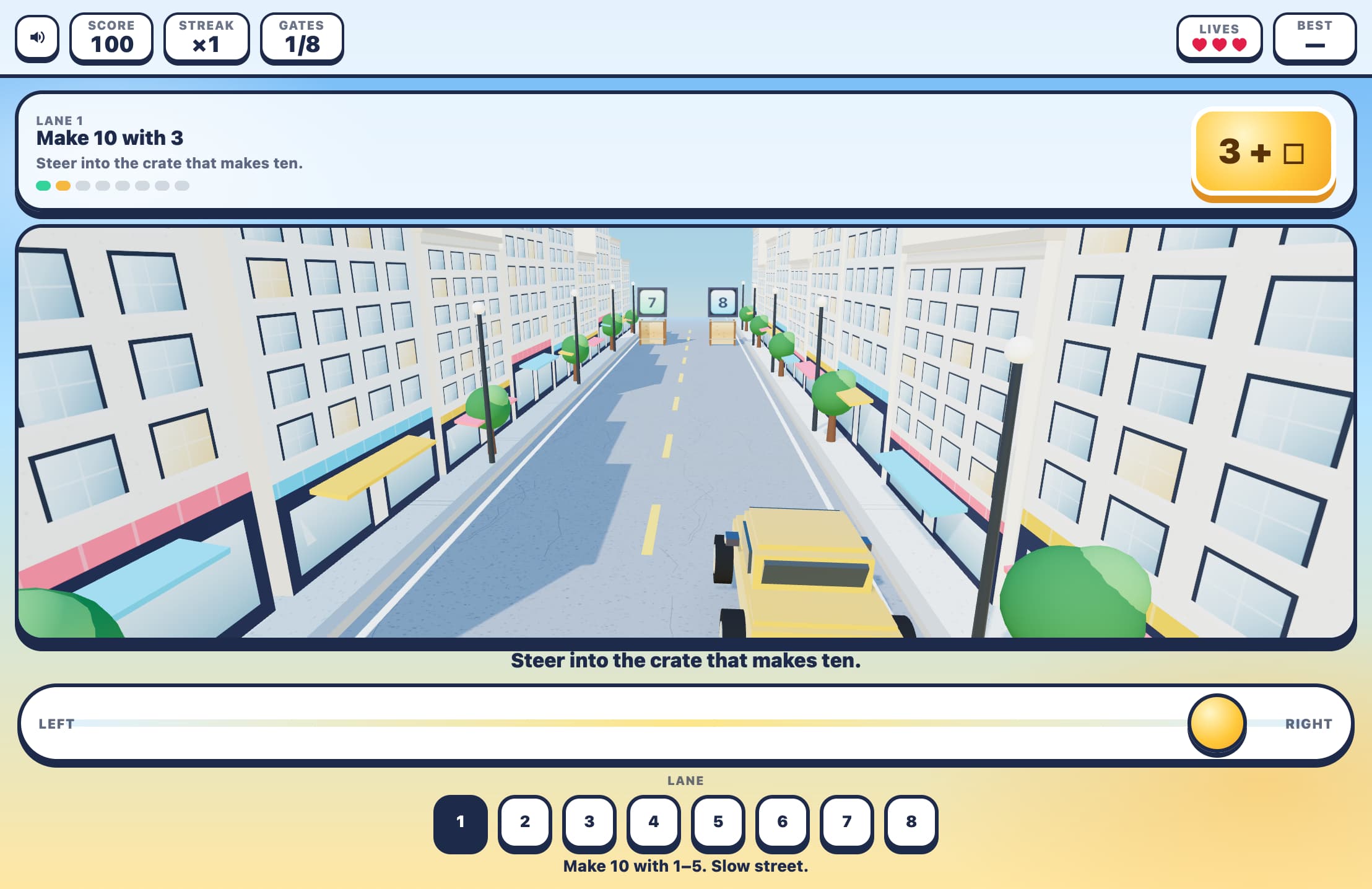
3D Making Ten Addition
A night icehouse aisle. Steer a copper sled toward frost crates and blast the number that makes ten. Easy is bonds to 10. Medium and Hard use addition within 20: make ten first, then add the leftover. Three lives, a streak bonus, and a live score.
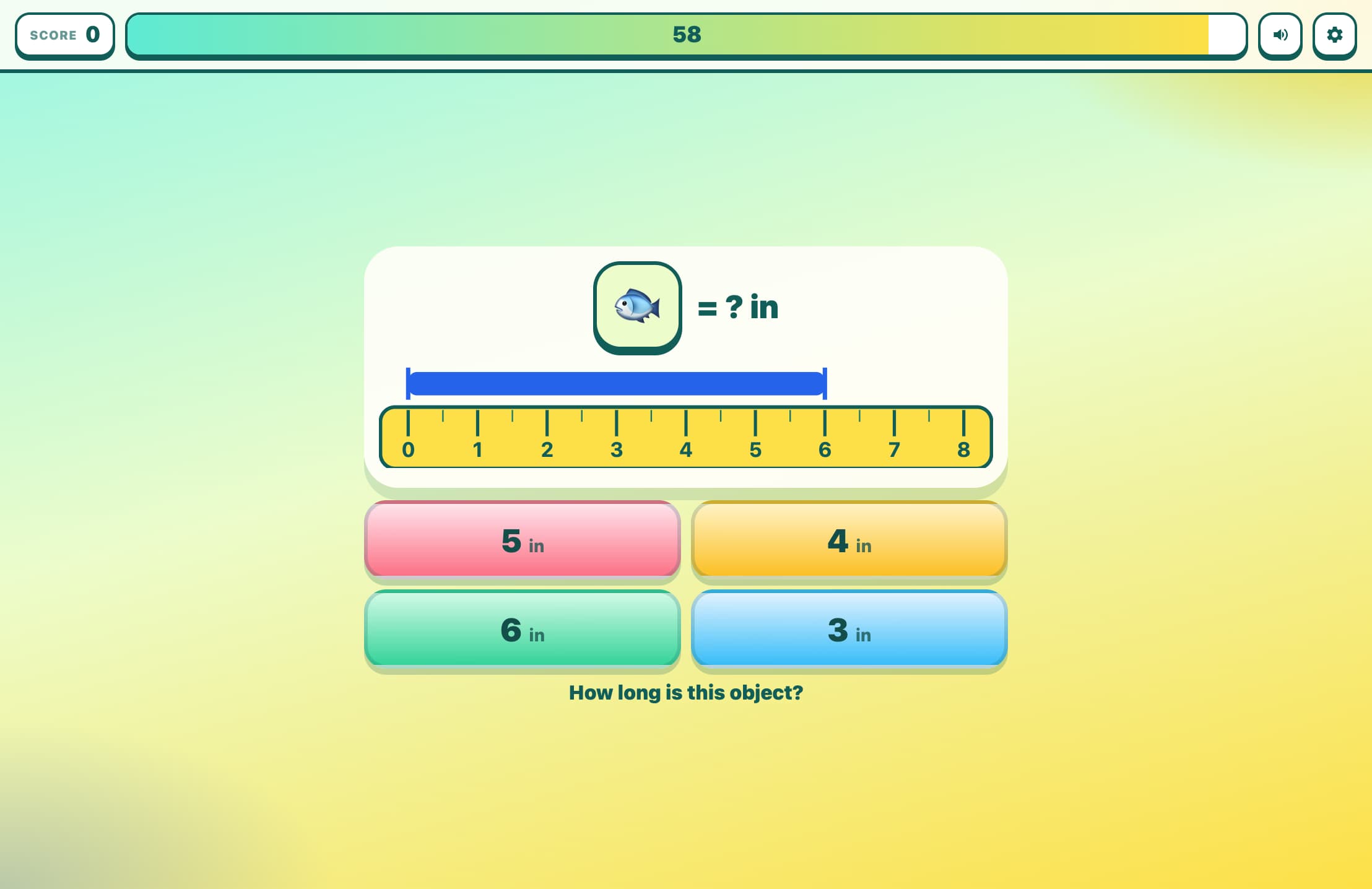
Measure Objects on an On-Screen Ruler
How long is this object? A blue bar sits on the ruler. Pick the length in in or cm. 60-Second Rush or Survival, on Easy, Medium, or Hard.
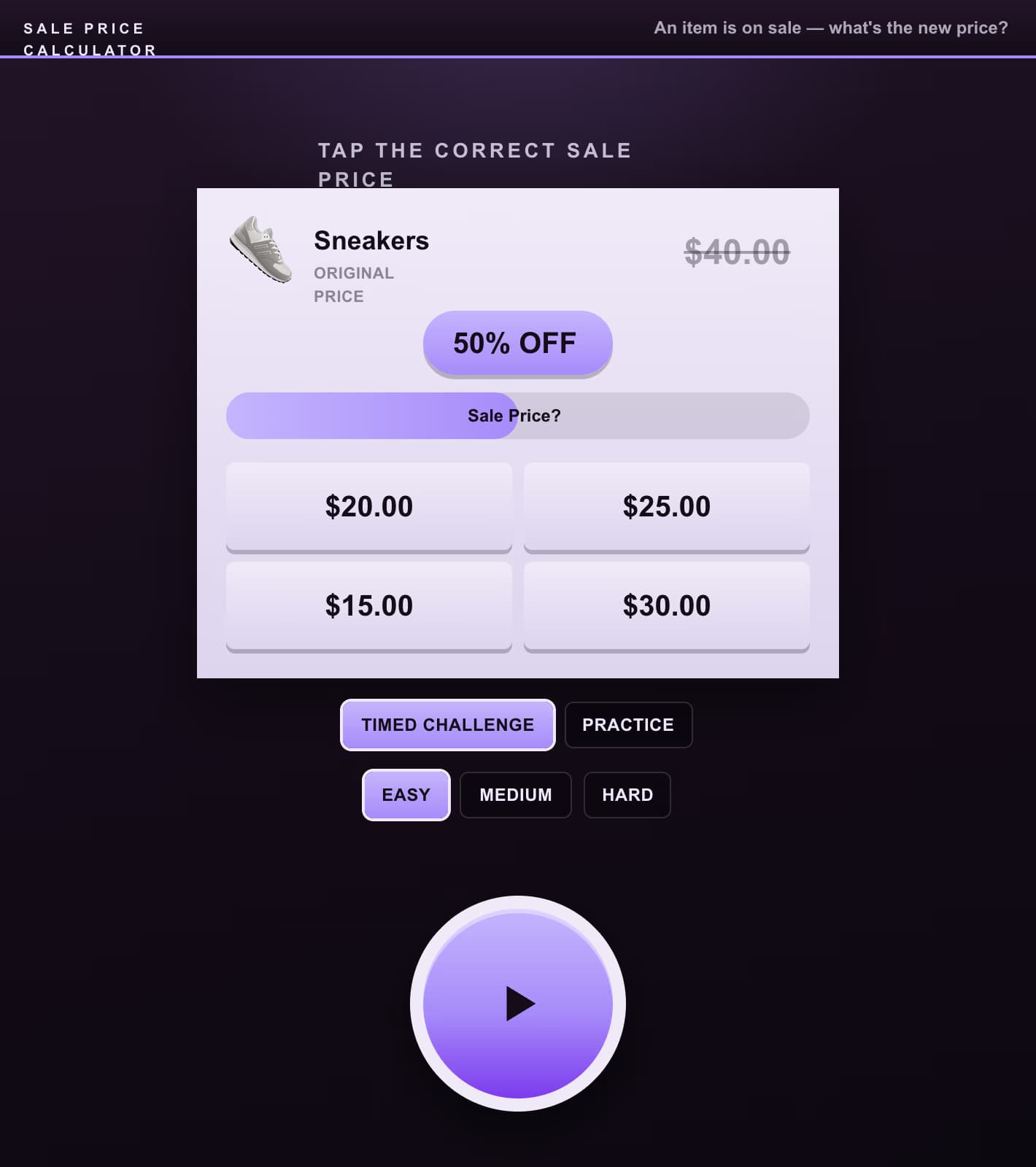
Calculate Discounts and Find the New Price
An item is X% off — what is the new price? See the discount visually and calculate the sale price. Covers 10%, 25%, 50%, and 75% off for grades 3–5.
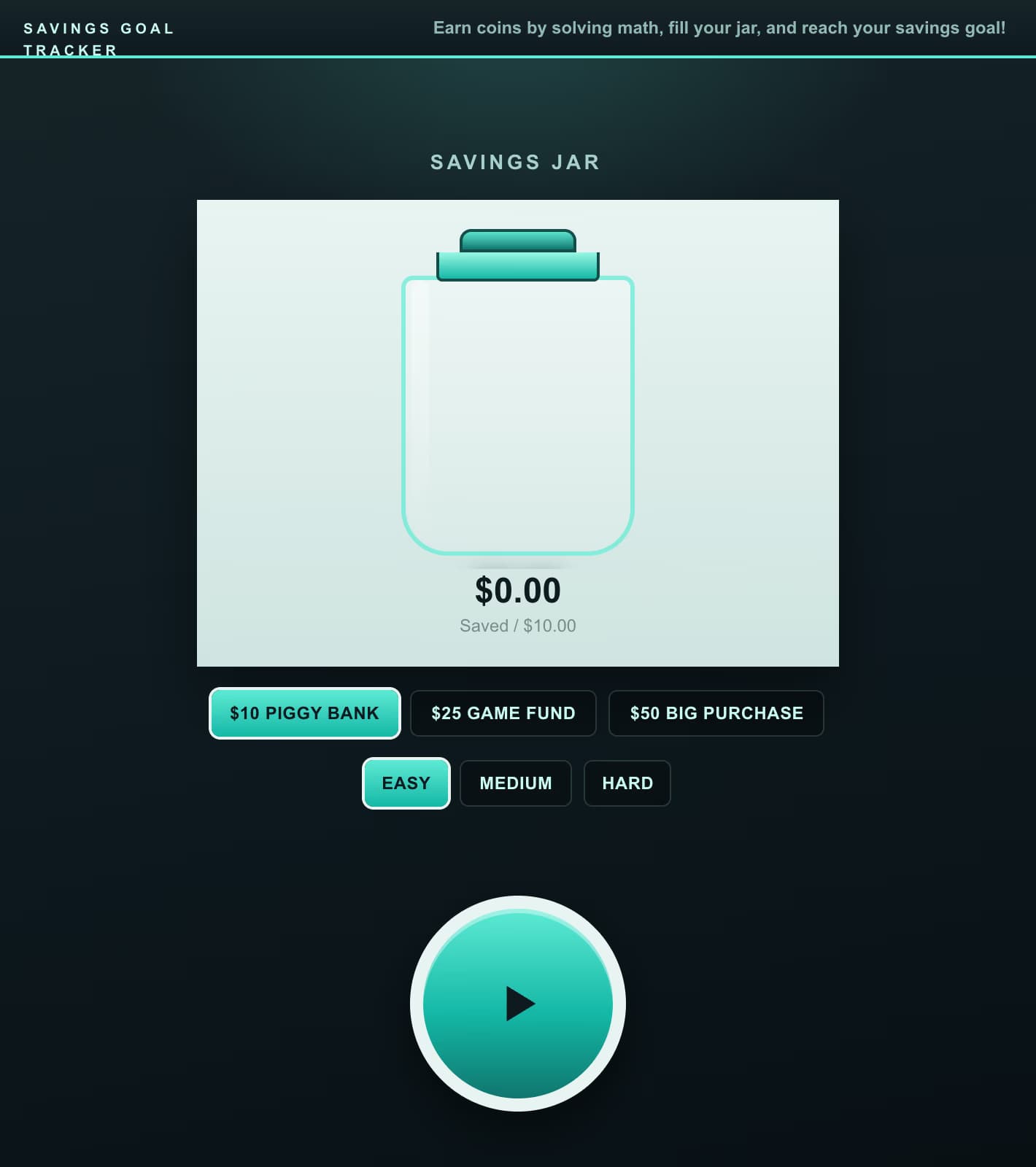
Earn Money by Solving Math & Fill Your Jar
Set a savings target, earn money by answering math questions, and watch a visual jar fill up toward your goal. Teaches delayed gratification and saving habits.
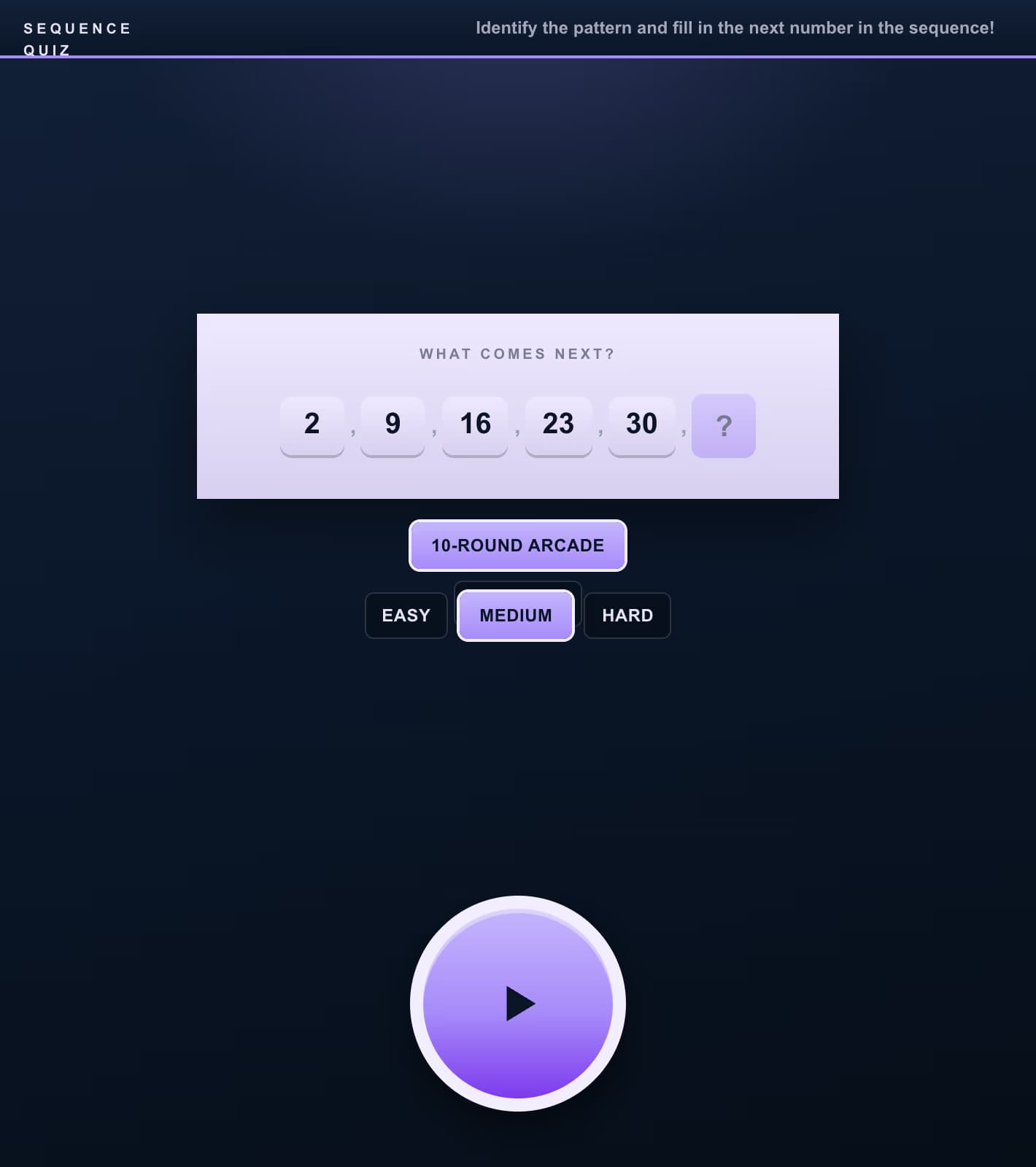
Fibonacci, Primes & Number Patterns
Spot the pattern and fill in the missing number! Each round shows a well-known mathematical sequence with the next term hidden. Identify whether it's Fibonacci, prime numbers, perfect squares, factorials, or one of nine other sequence types — then type your answer before the countdown runs out.
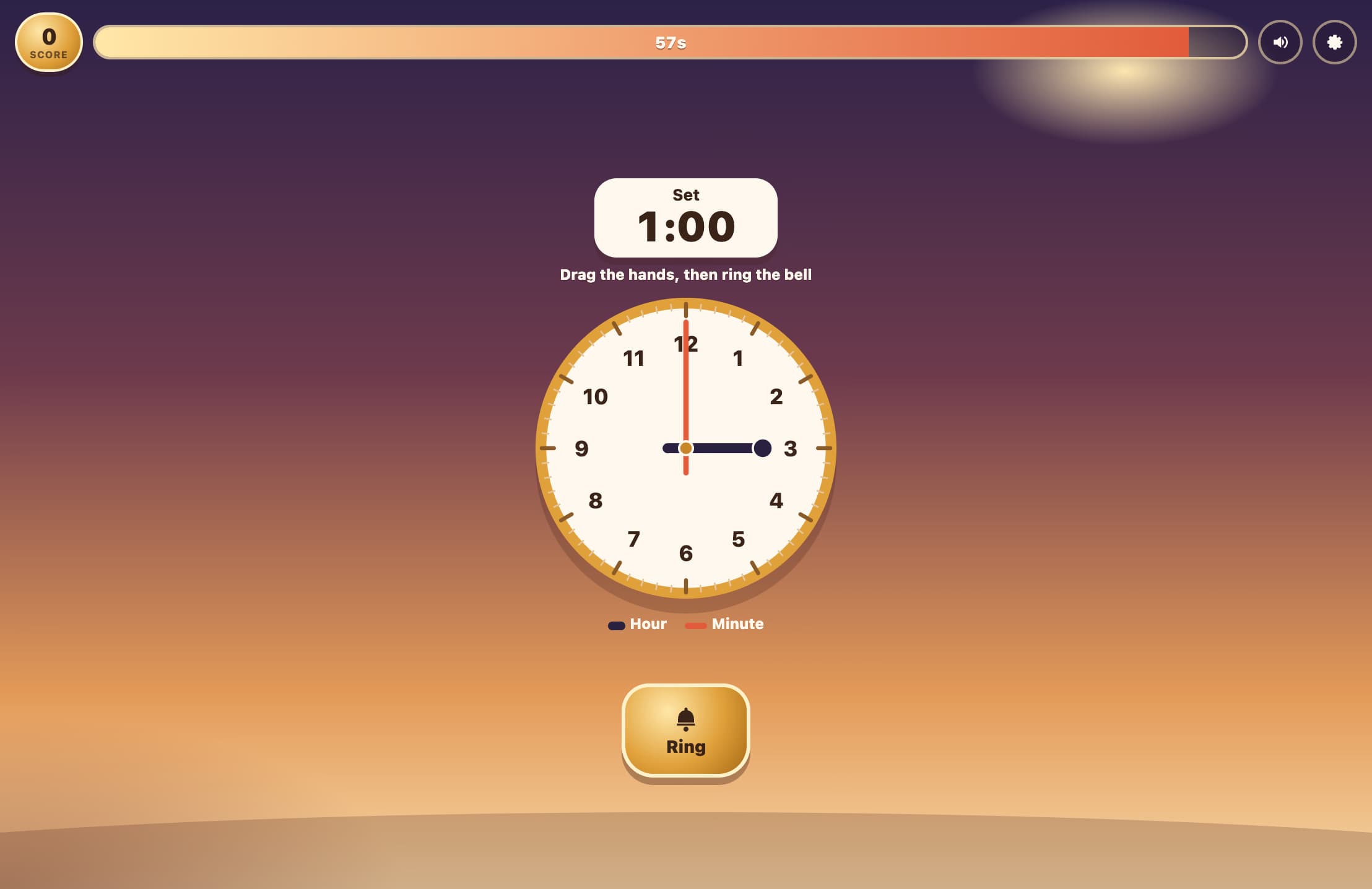
Drag the Hands and Tell Time
Drag the hour hand and minute hand so the clock shows the time, then ring the bell. Easy is whole hours, Medium adds half hours, and Hard uses every five minutes. Play a 60-Second Rush or Survival with three lives.
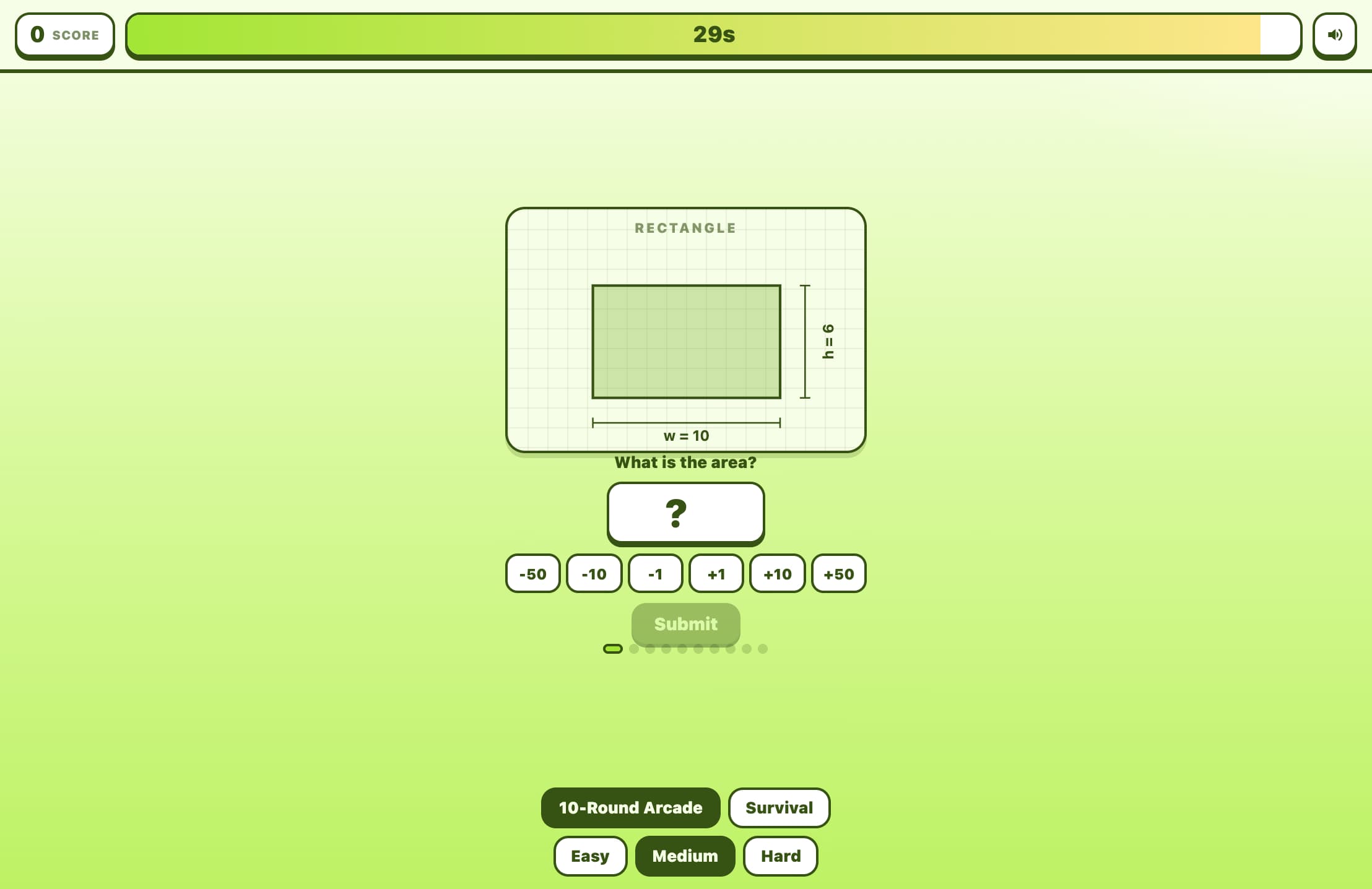
Geometry Area Formula
Put your geometry skills to the test! A shape is drawn on screen with labeled dimensions. Calculate the area using the right formula, then enter your answer before the countdown hits zero. Correct answers earn bonus points for speed.
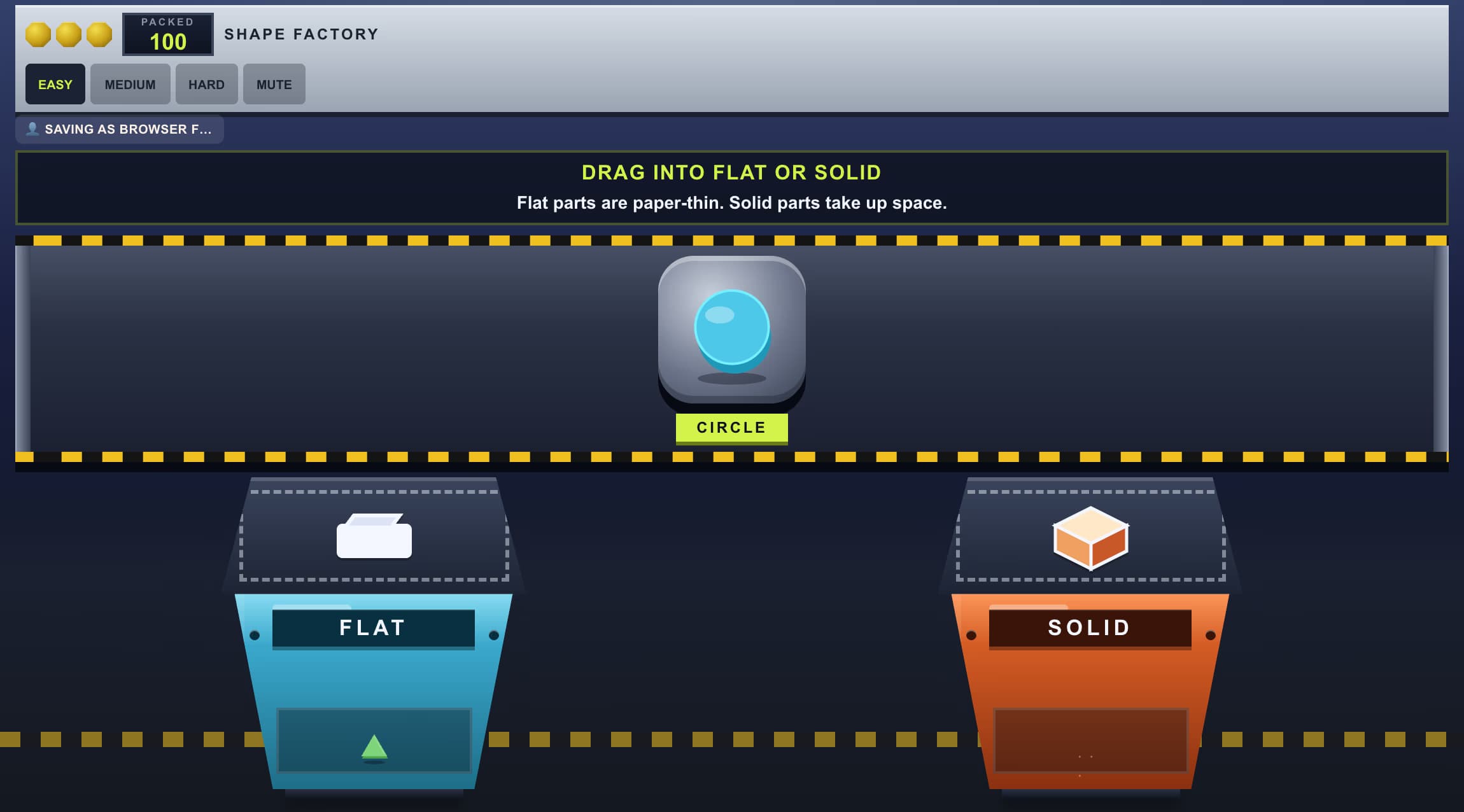
Sort Flat and Solid Shapes on the Packing Line
Help the night packing line in Shape Factory. Drag each part into Flat or Solid: circles, squares, and triangles are paper-thin, while cubes, cylinders, and pyramids take up space. Kindergarten geometry practice that feels like a real factory run.
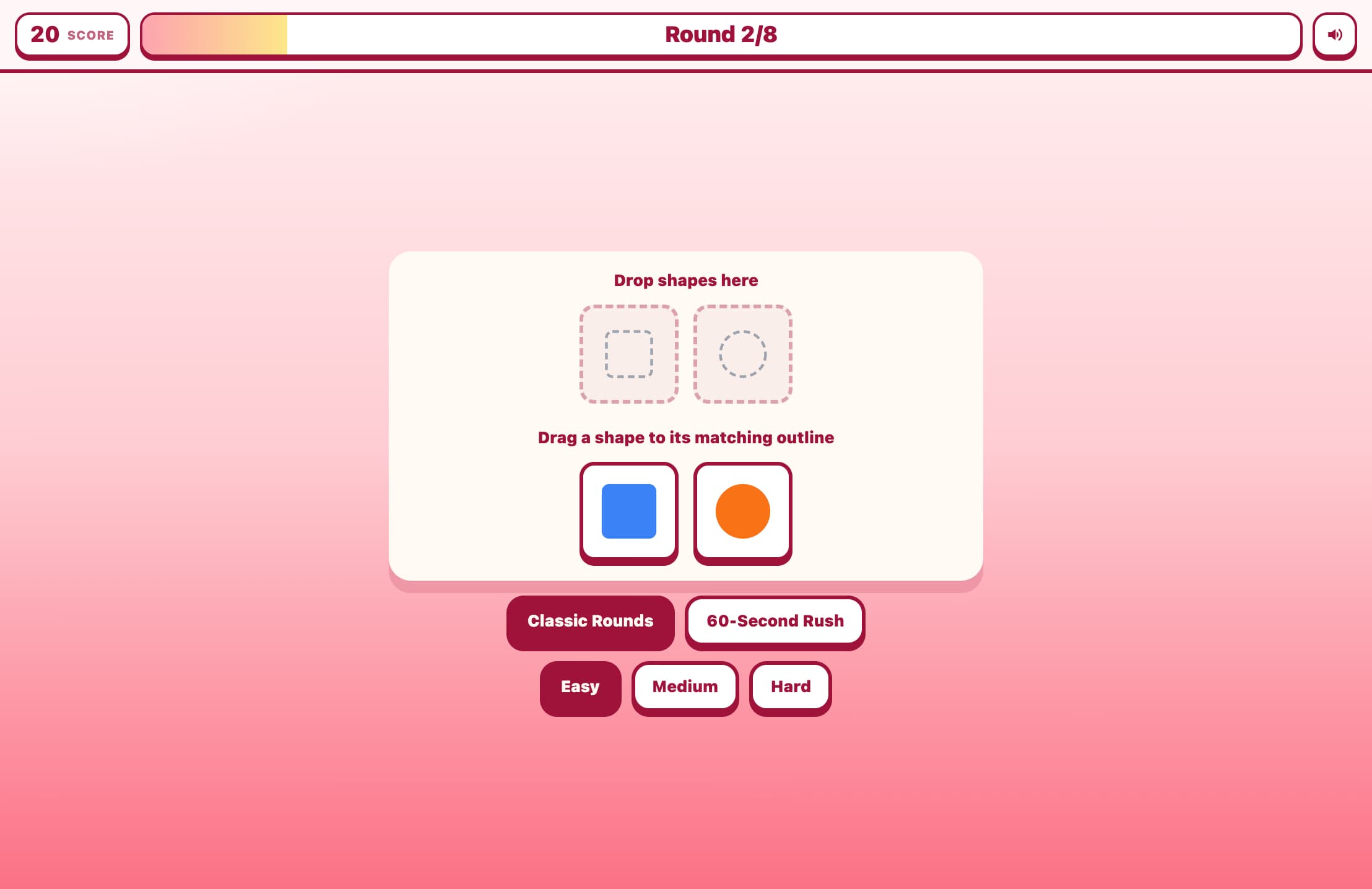
Drag and Drop Shapes Into Matching Slots
Drag circles, squares, triangles, and rectangles into their matching outline slots in this fun shape-sorting game. Race the clock or sort shapes across 8 classic rounds — great for early geometry and shape recognition!
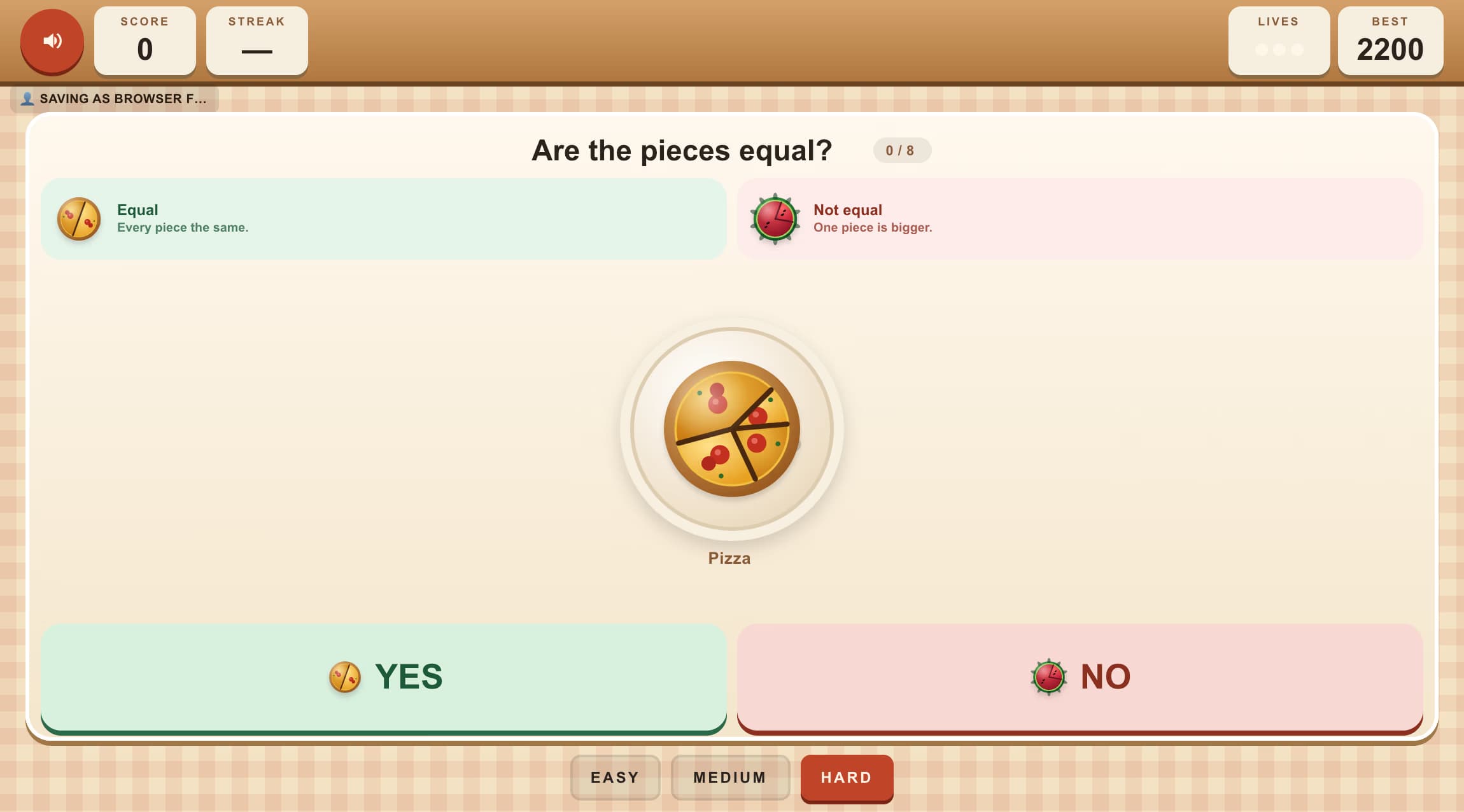
Scoop Fair Equal-Part Shells
Six shells sit in a tide pool. Scoop every shell whose pieces are the same size. Leave the crooked ones. Eight waves win.
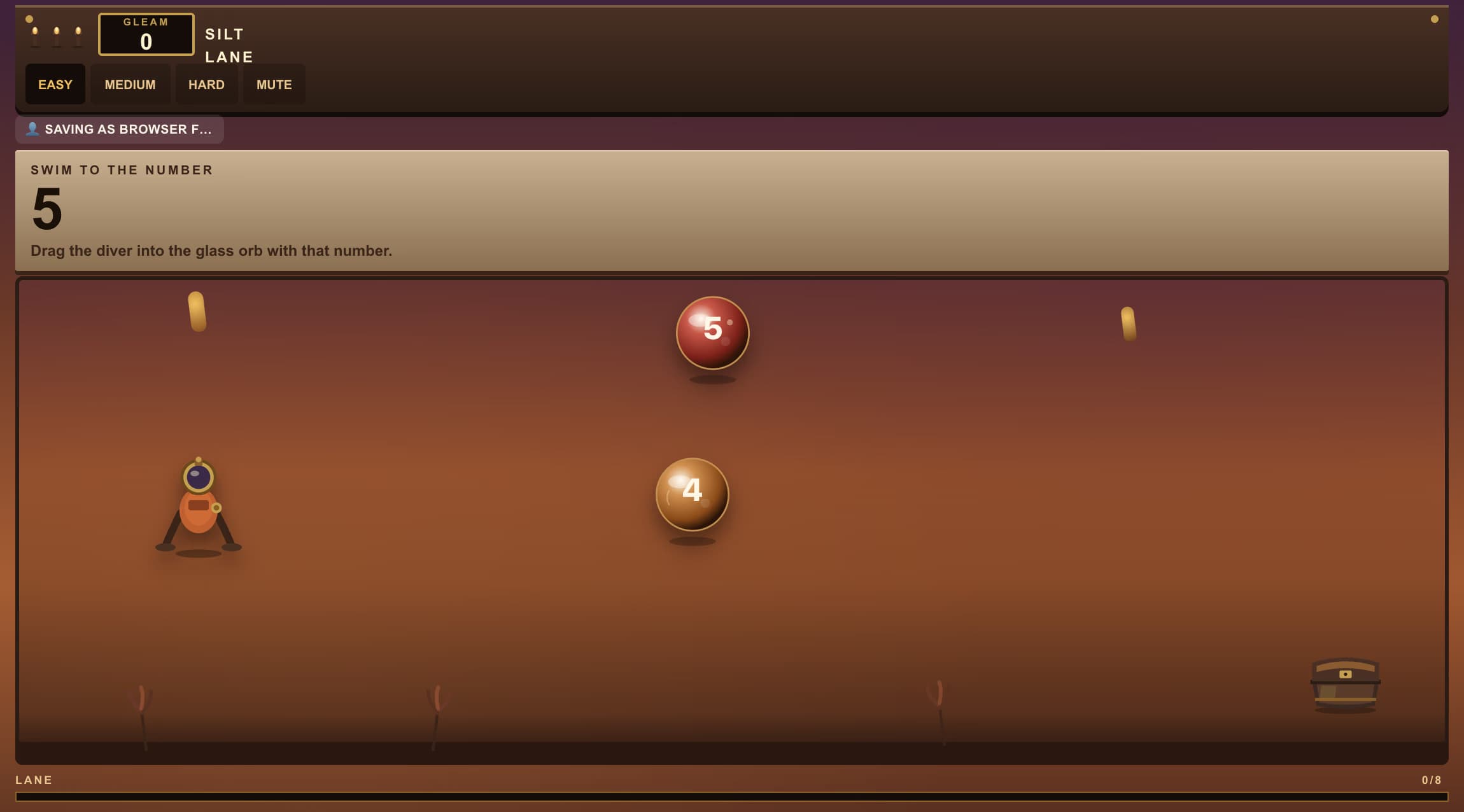
Treasure Diving: Numbers 1-10
Steer a lamp-helmet diver down Silt Lane. A barnacle plate shows a number from 0 to 10. Drag the diver into the glass orb with that number and kick toward the stone chest. Pre-K and kindergarten practice identifying numbers 0-10, with Gleam points for every clean swim.
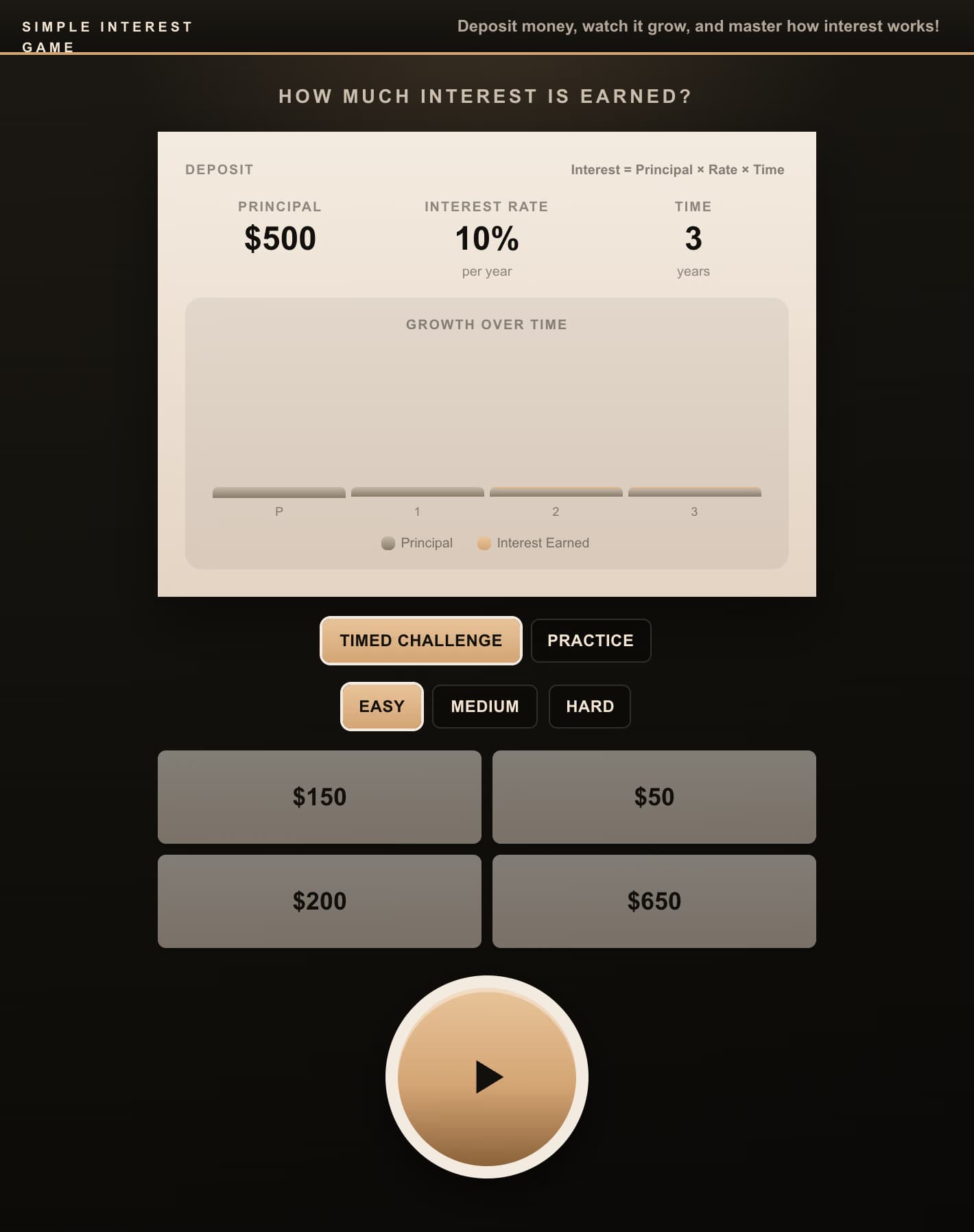
Deposit Money & Watch It Grow
Deposit money into a virtual bank and watch it grow with simple interest. Adjust rate and time to compare outcomes and understand how interest works.
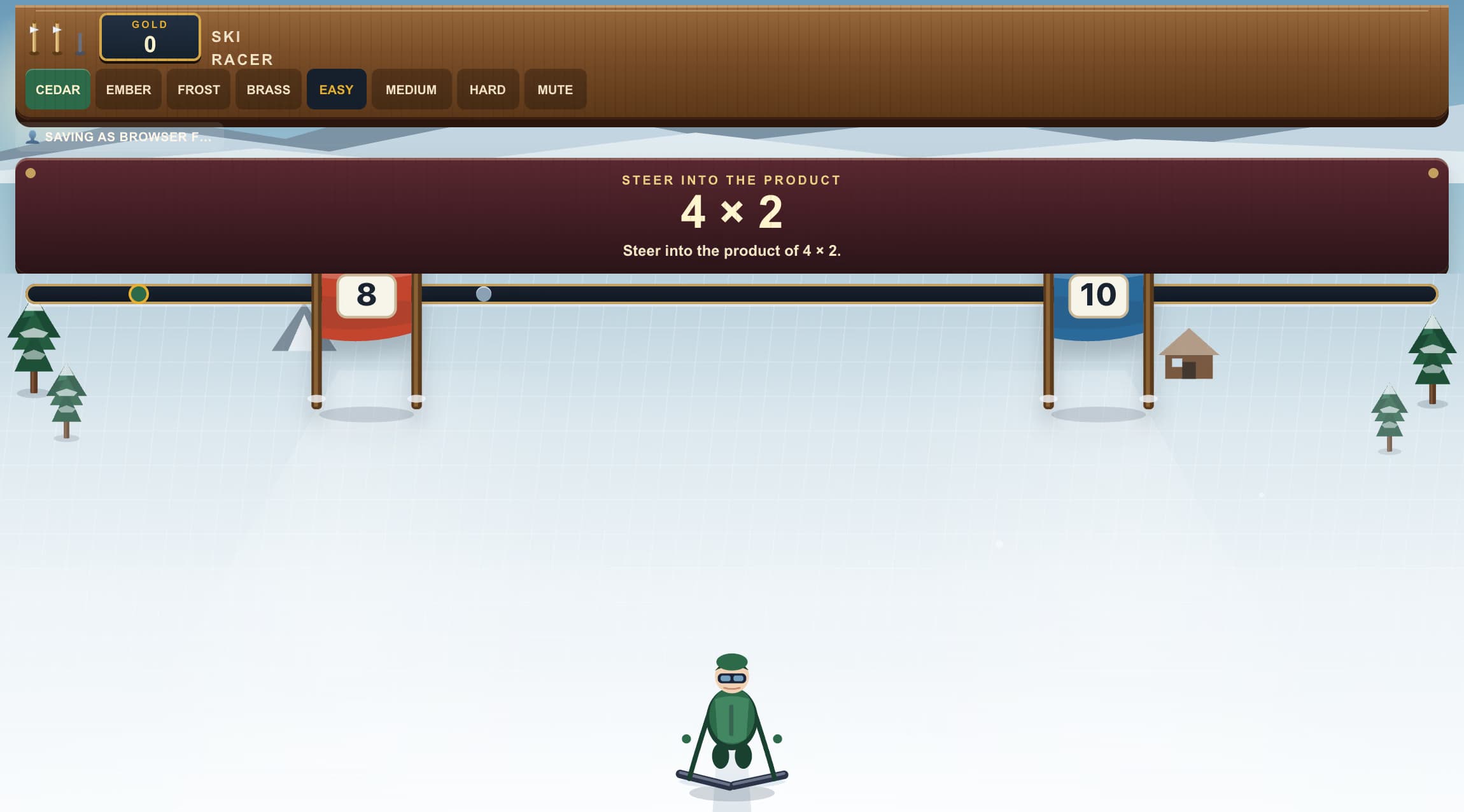
Multiply by 4 and Steer into the Product
Race the alpine slope in Ski Racer. A trail sign shows 4 times a number. Drag your skier — Cedar, Ember, Frost, or Brass — and steer into the product on the falling slalom gate. Third-grade multiply-by-4 facts, with Gold points for every clean gate.
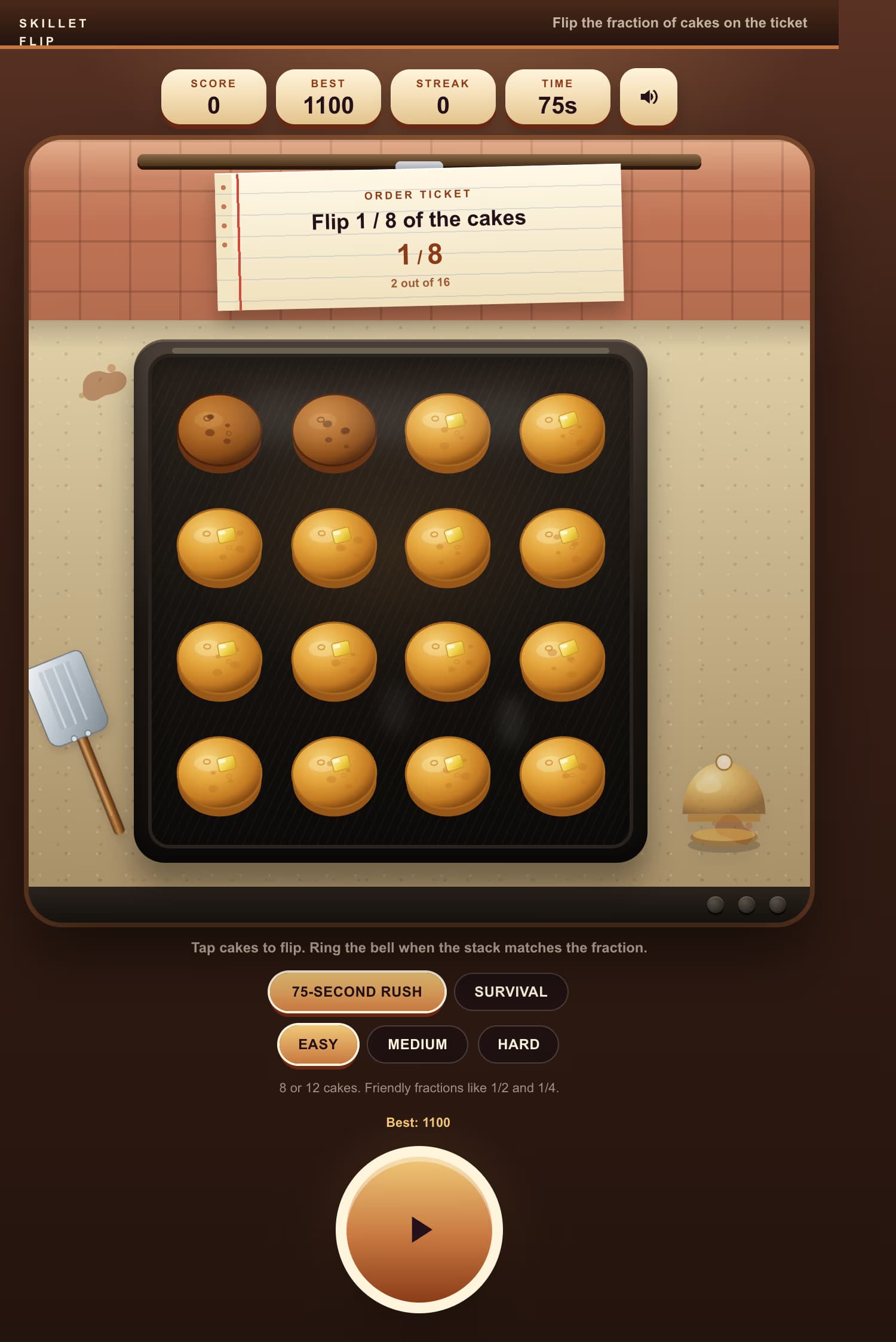
Fractions of a Set
Flip the right number of cakes so the skillet matches a fraction of the whole set. Fourth and fifth graders tap cakes, then ring the bell when 3/8 of 16 or 2/5 of 20 is on the stack. Fast rounds make parts of a set feel like a short-order rush instead of a worksheet.
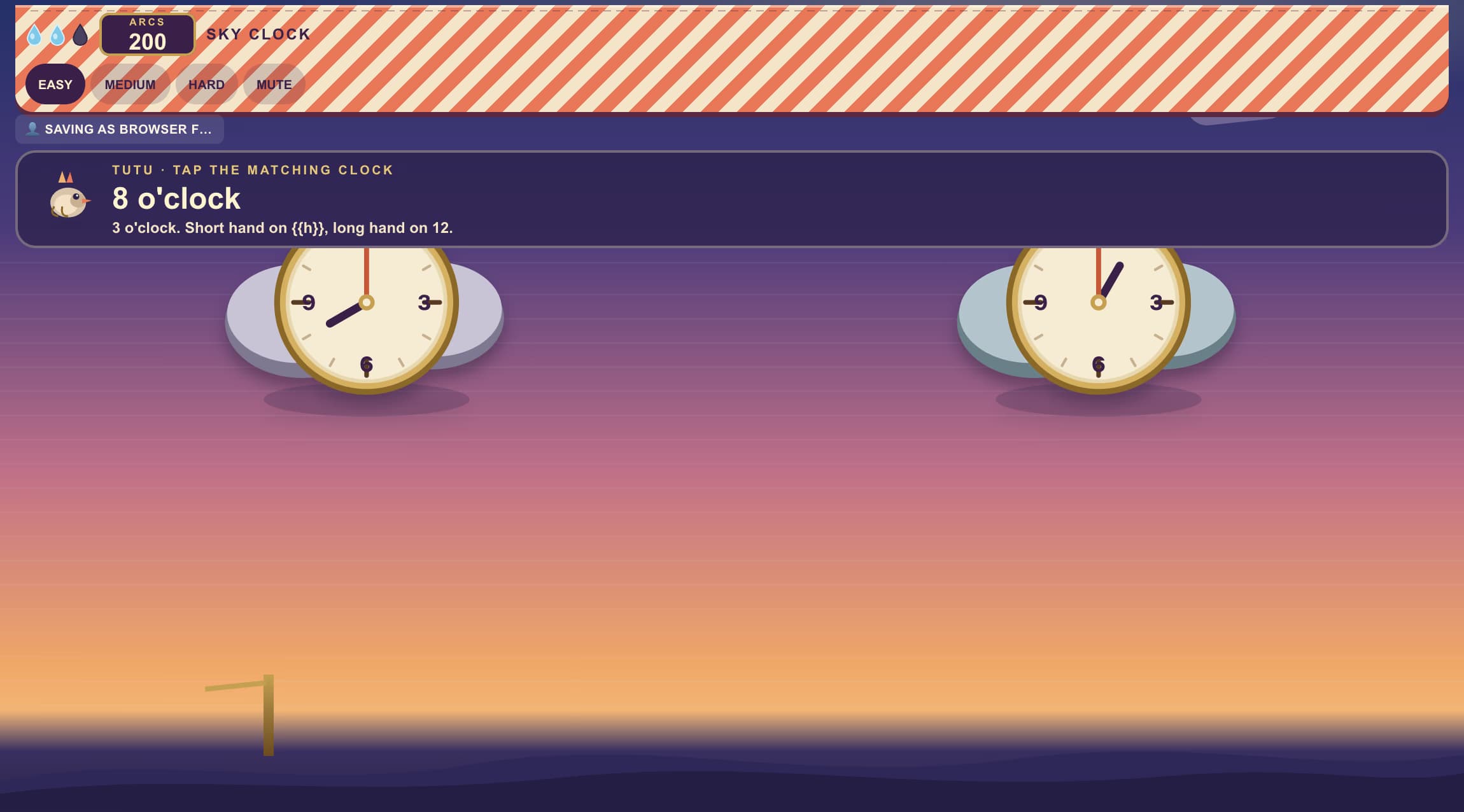
Telling Time in the Sky to the Hour and Half Hour
Help Tutu turn rain clouds into rainbows in Sky Clock. Listen for the time, scan the falling clouds, and tap the matching clock. First-grade practice telling time to the hour and half hour, with analog clocks that bloom into rainbows when you catch the right one.
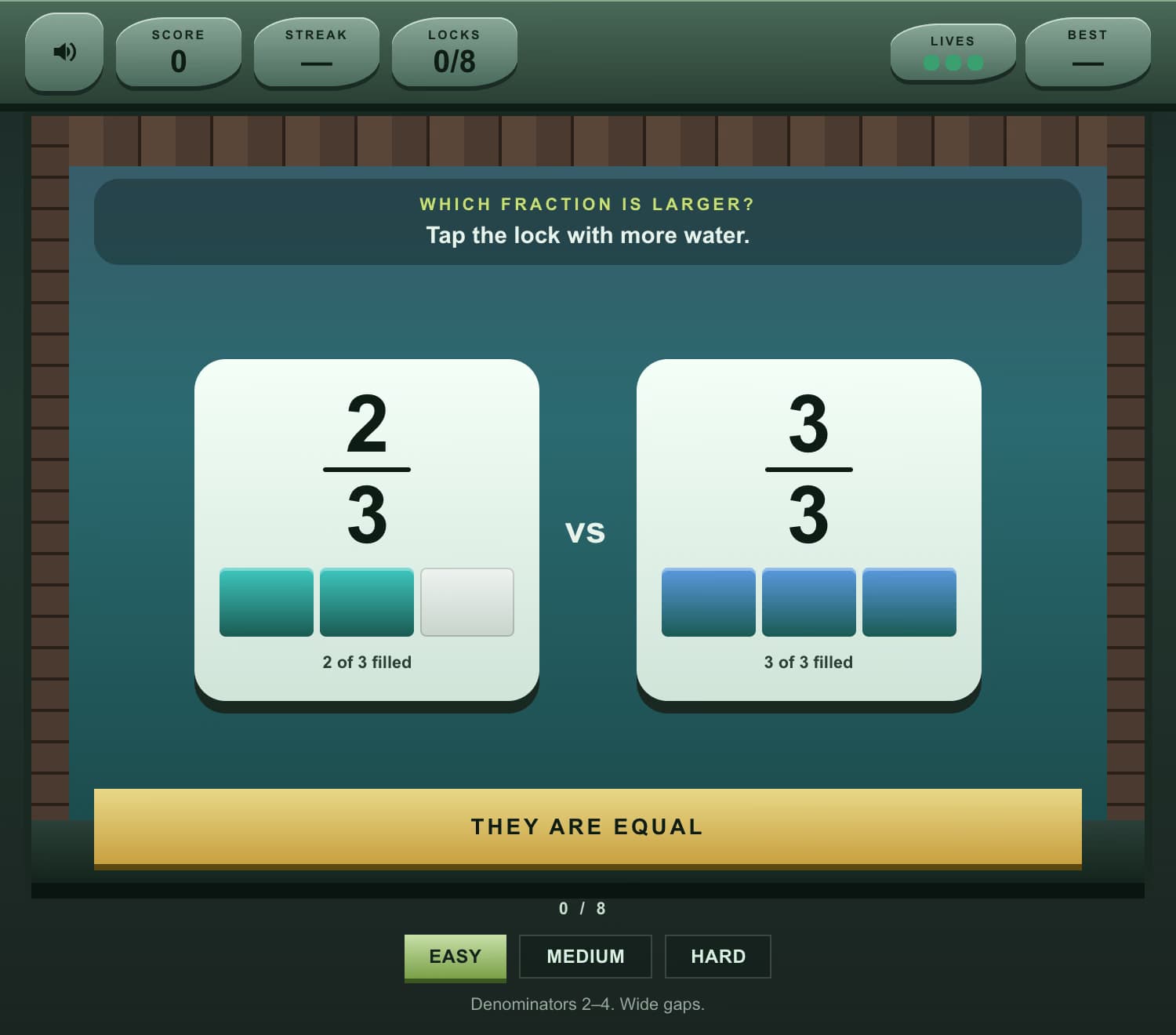
Compare Fractions with Like Denominators
A dusk lock house on a canal. Two chambers share the same number of marks — the denominator. The water fill is the numerator. Yank the brass tiller toward the fuller lock, or leave it in the middle when the fills match. Built for third- and fourth-grade fraction comparison.
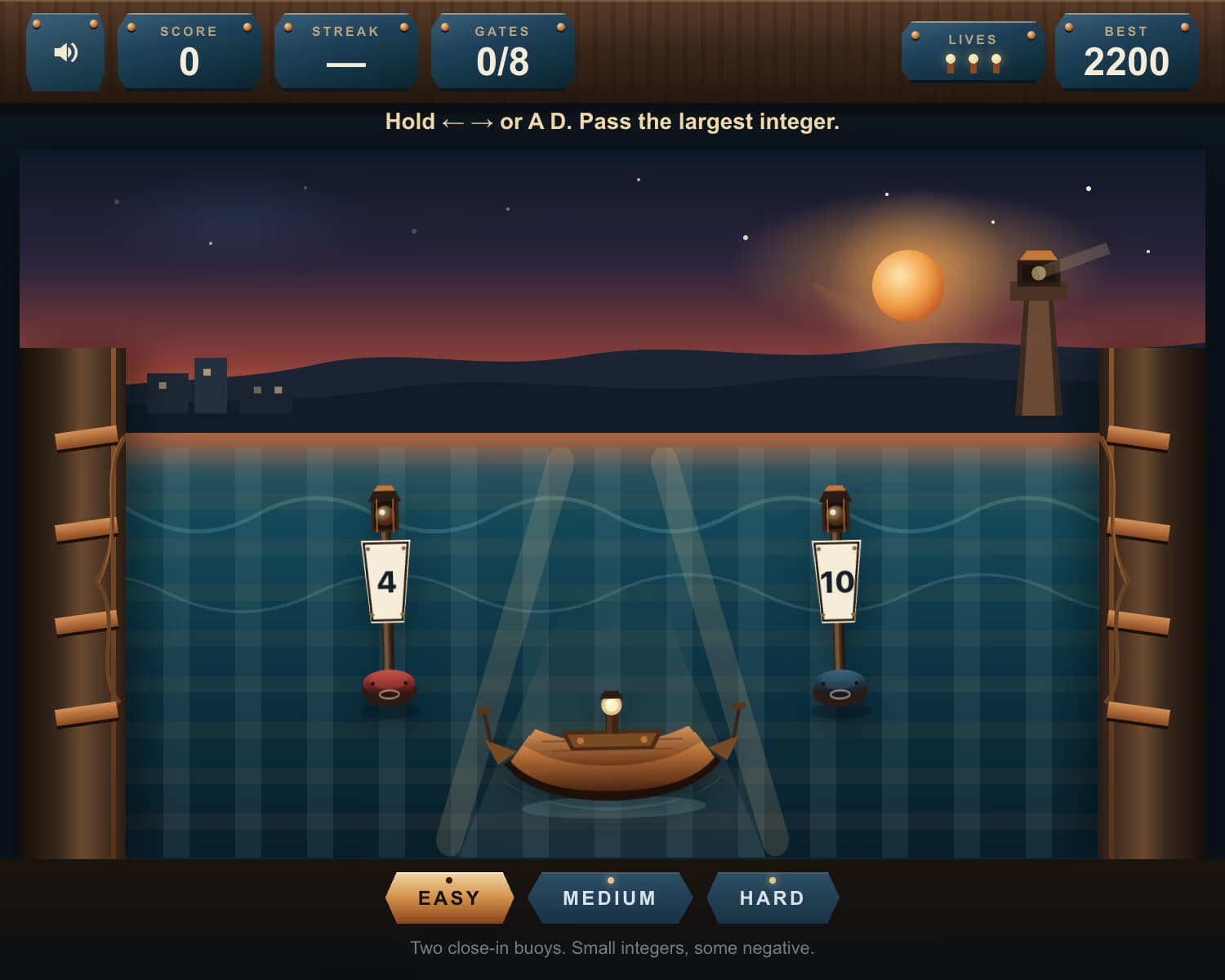
Order Integers on the Harbor
A dusk harbor, a teak skiff, and spar buoys marked with integers. Drag left and right to steer. The largest integer is the open channel. Smaller marks swamp the boat. Built for sixth-grade number sense with positives and negatives.
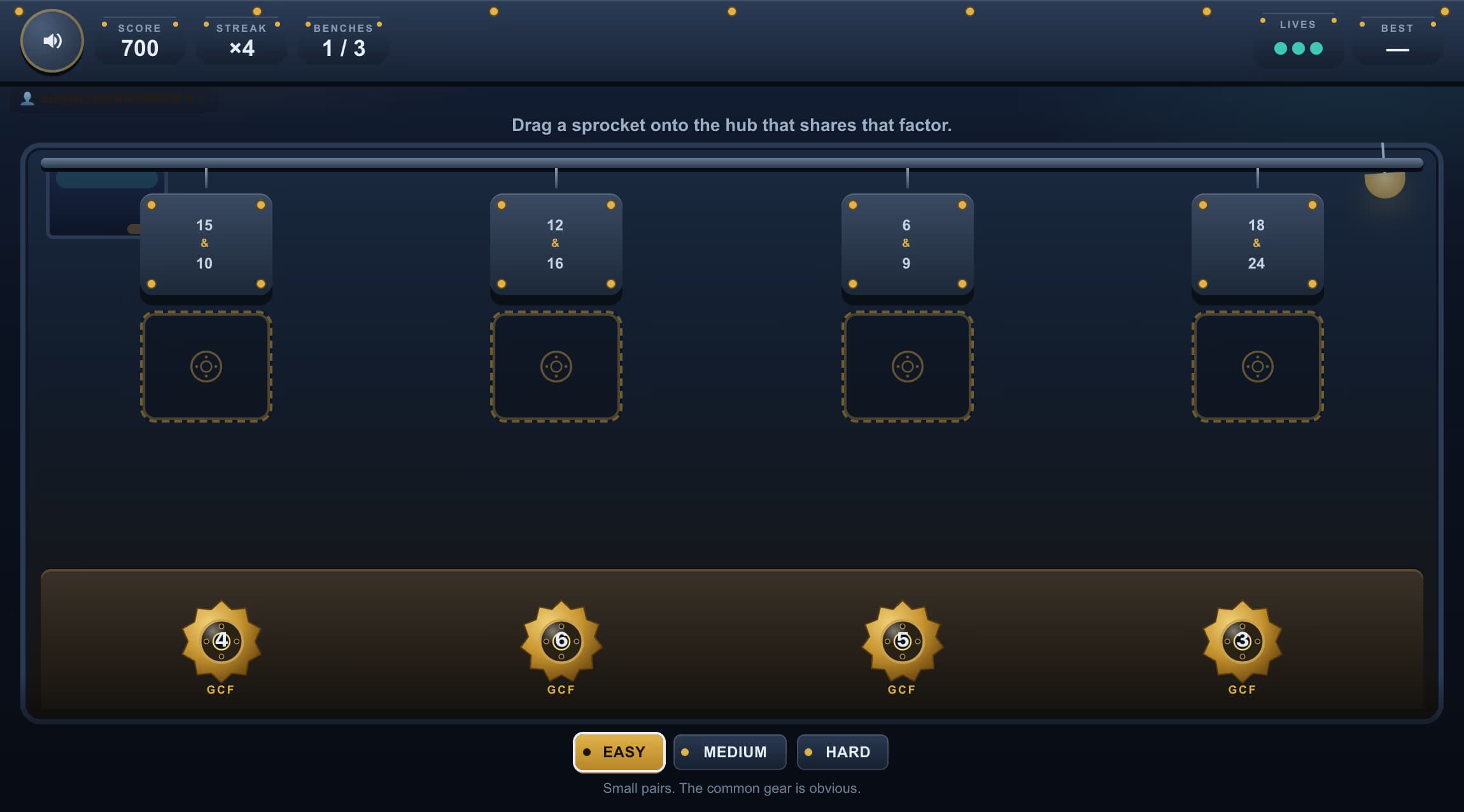
Match Pairs to the Greatest Common Factor
Hang the common gear. Four number plates swing over empty hubs. Drag the sprocket whose size is the greatest common factor onto the right hub. Three benches win.
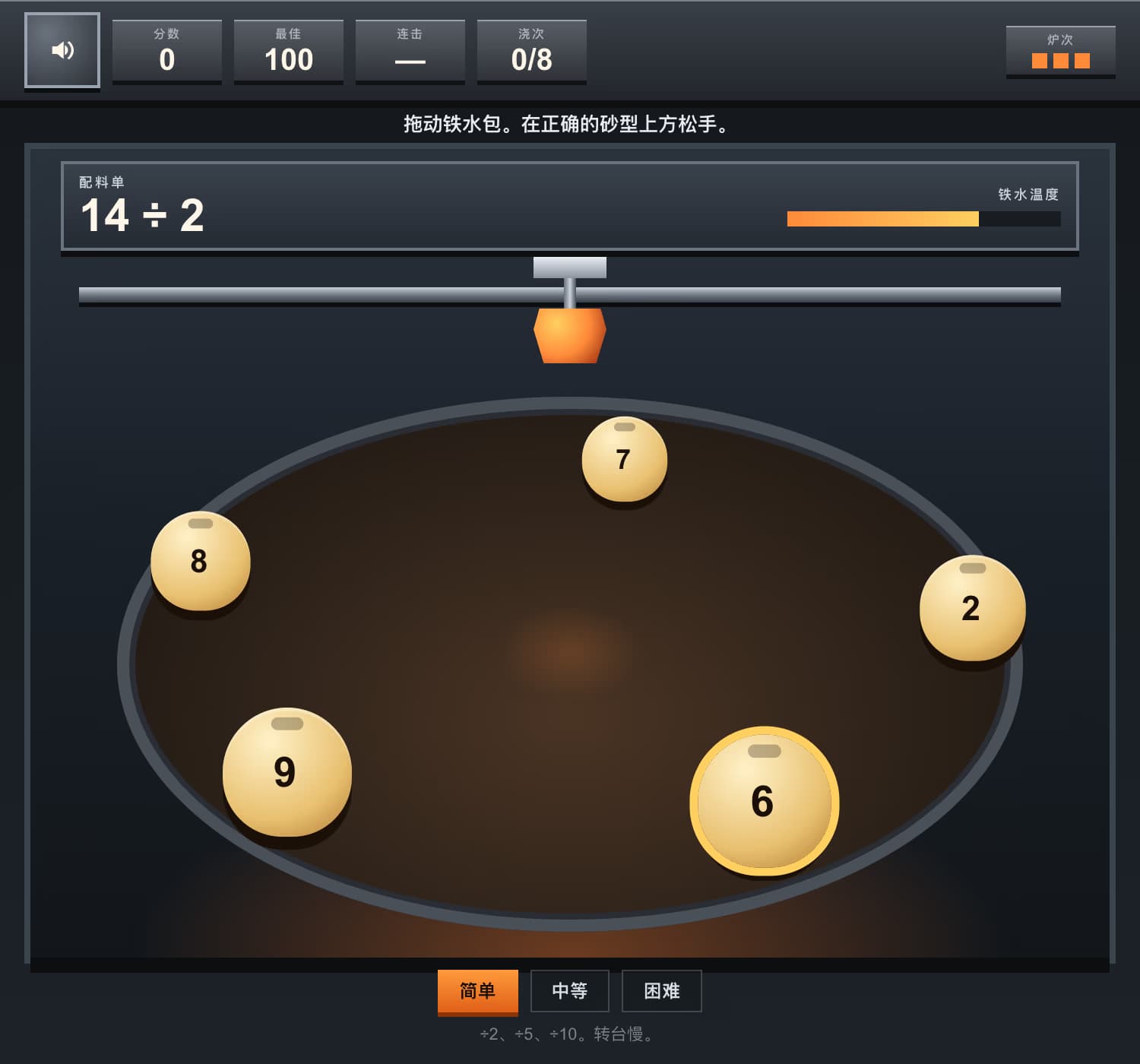
Division Facts Foundry Pour
A night sand floor. A slate shows a division fact. Sand molds spin on a turntable. Drag the ladle and dump the melt into the mold that is the quotient before the heat dies. Built for third- and fourth-grade division fact fluency — one-digit divisors, moving gates, no multiple-choice strip.
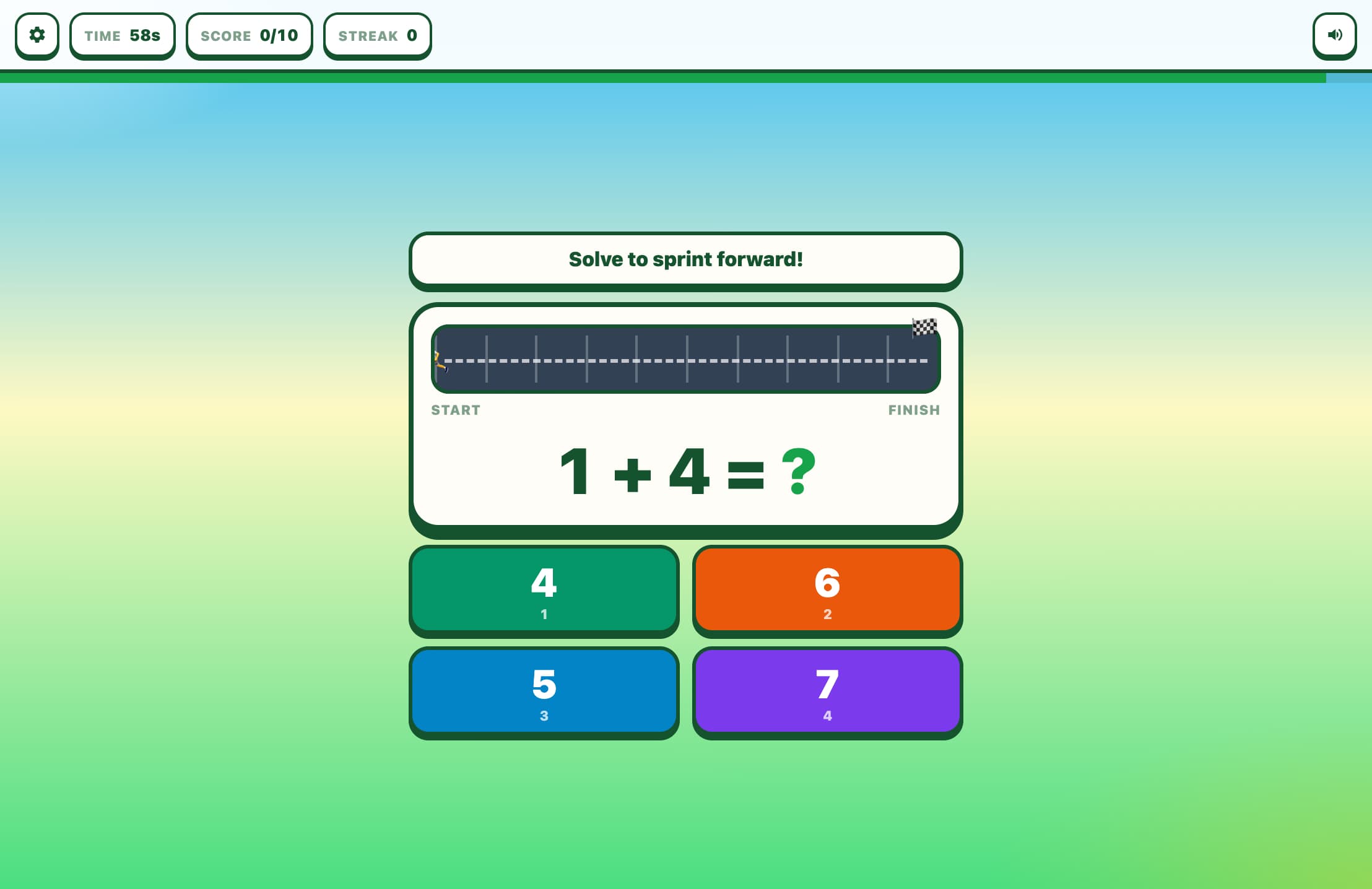
Race to the Finish Line Math
Answer addition and subtraction facts to move a runner along a track. Each correct answer sprints forward one step — race to the finish line before time runs out or you lose all lives.
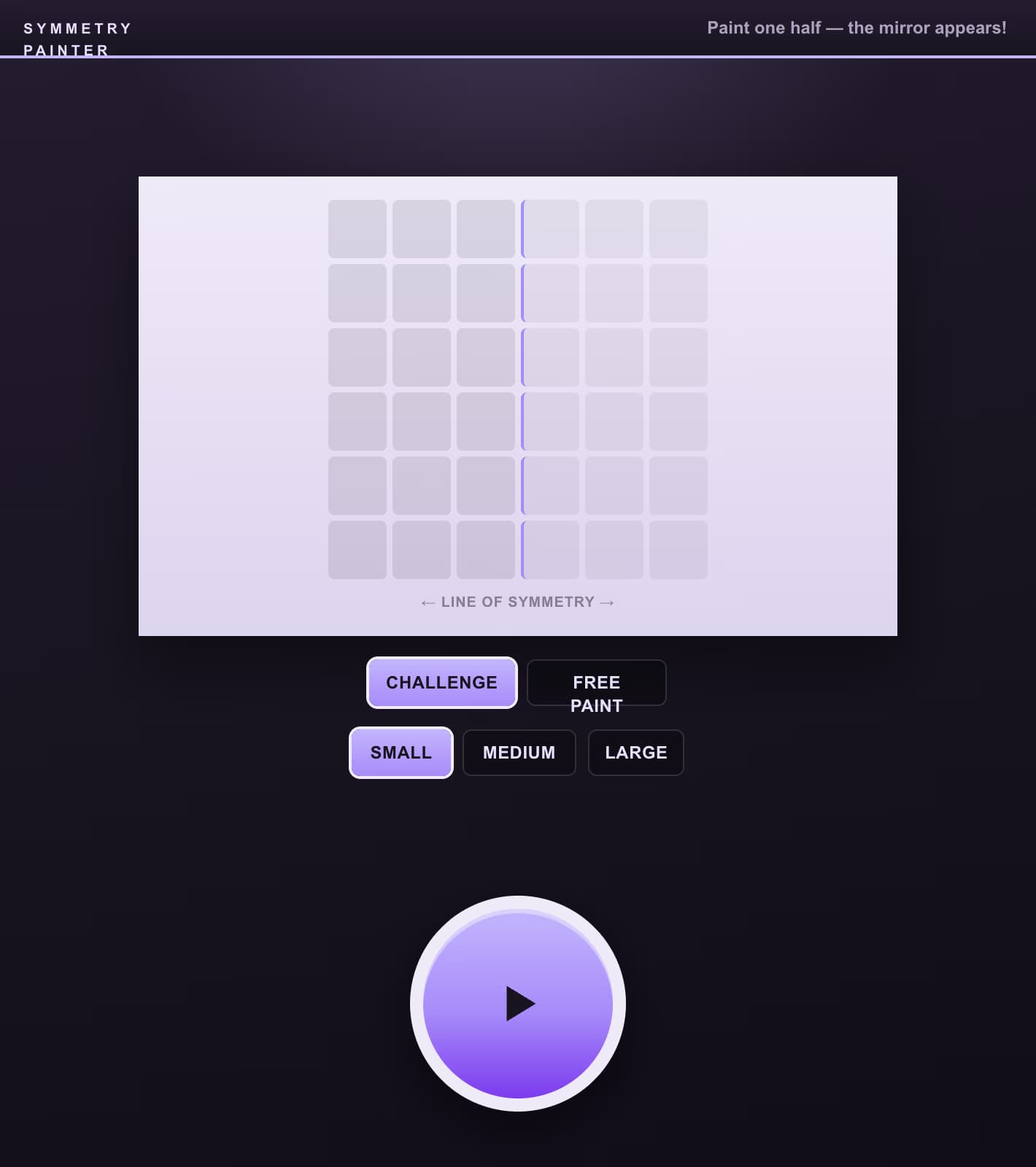
Mirror Drawing & Lines of Symmetry
Paint one half of a grid and watch the mirror reflection appear automatically on the other side. In challenge mode, match target patterns to score points. Teaches lines of symmetry, reflection, and spatial reasoning.
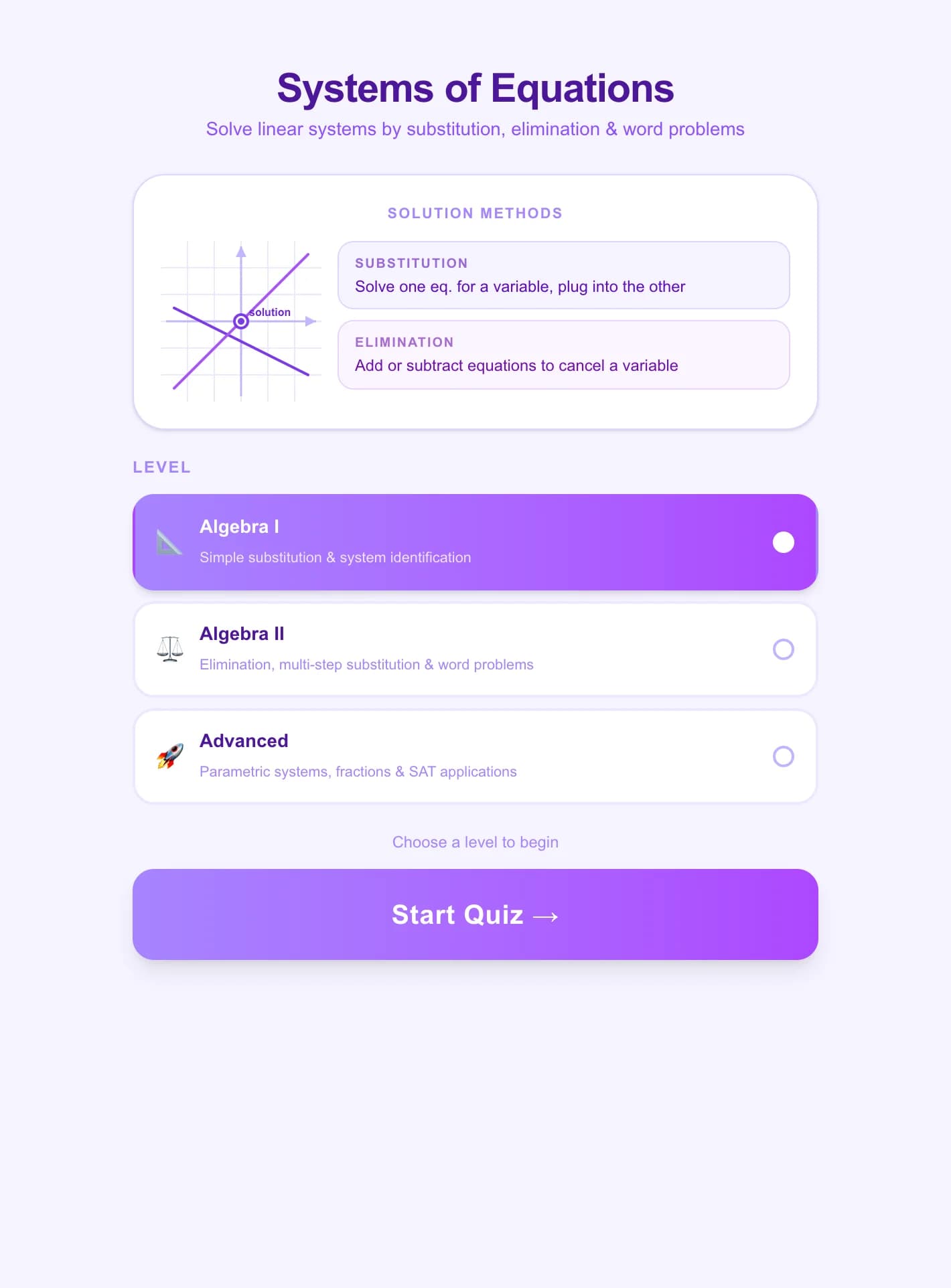
High School Math Quiz
Solve linear systems of two equations by substitution, elimination, and word problems. 45 problems across three tiers: Algebra I (simple substitution and system identification), Algebra II (multi-step elimination, multi-step substitution, and real-world word problems), and Advanced (parametric systems, fractional coefficients, three-variable extensions, and SAT-style applications).
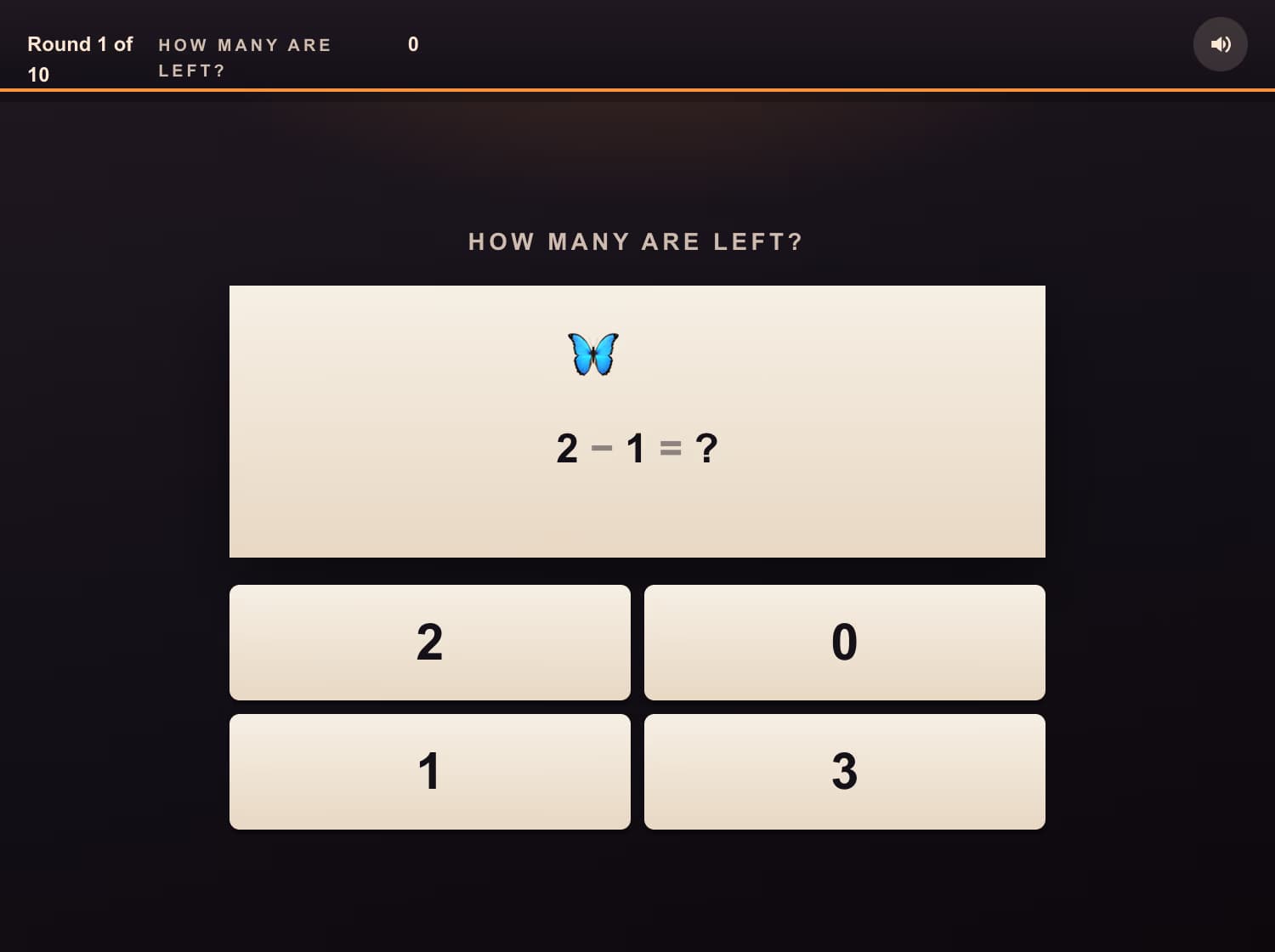
Visual Subtraction with Disappearing Objects
Watch objects disappear with animation and figure out how many are left! 5 cookies, eat 2 — how many remain? A visual, animated approach to learning subtraction for young children.
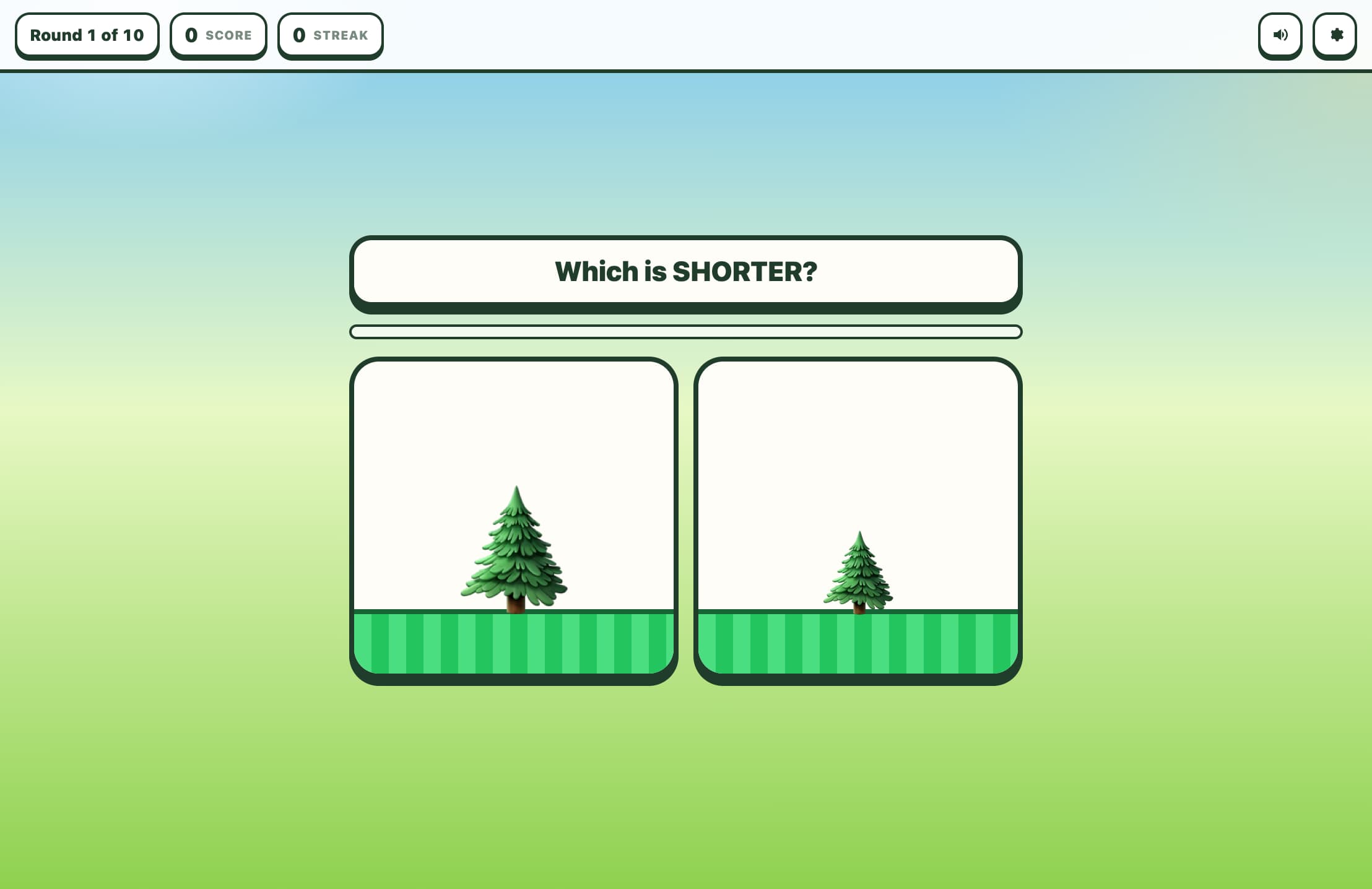
Compare Sizes and Build Measurement Concepts
Two illustrated objects appear at different sizes — tap the taller, shorter, bigger, or smaller one! A fun visual game that teaches measurement vocabulary and size comparison for young learners.
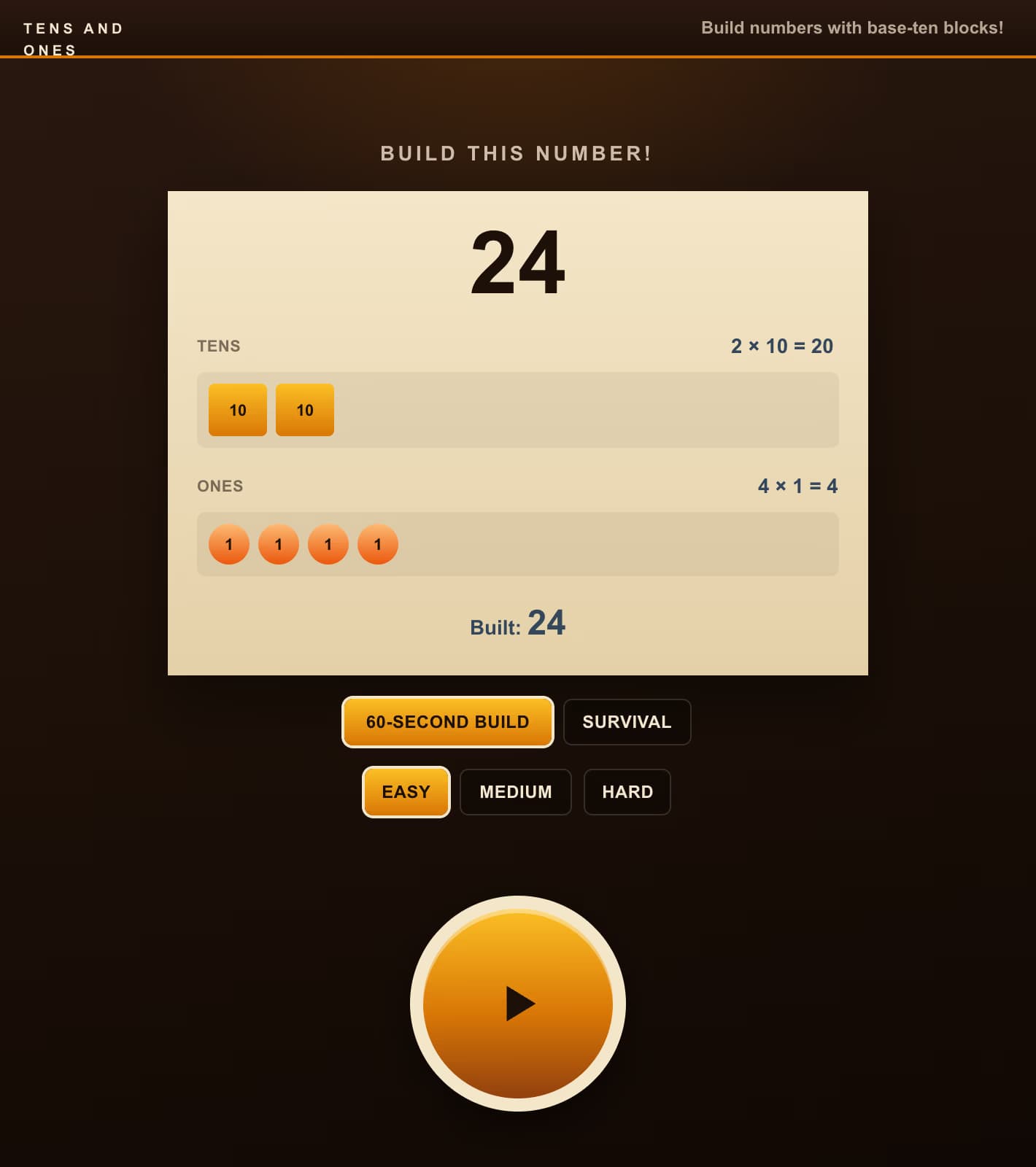
Base Ten Blocks Place Value
Build numbers using base-ten blocks! Tap to add tens (orange) and ones (blue) blocks to match a target number. Visual stacking reinforces place value understanding for numbers up to 99.
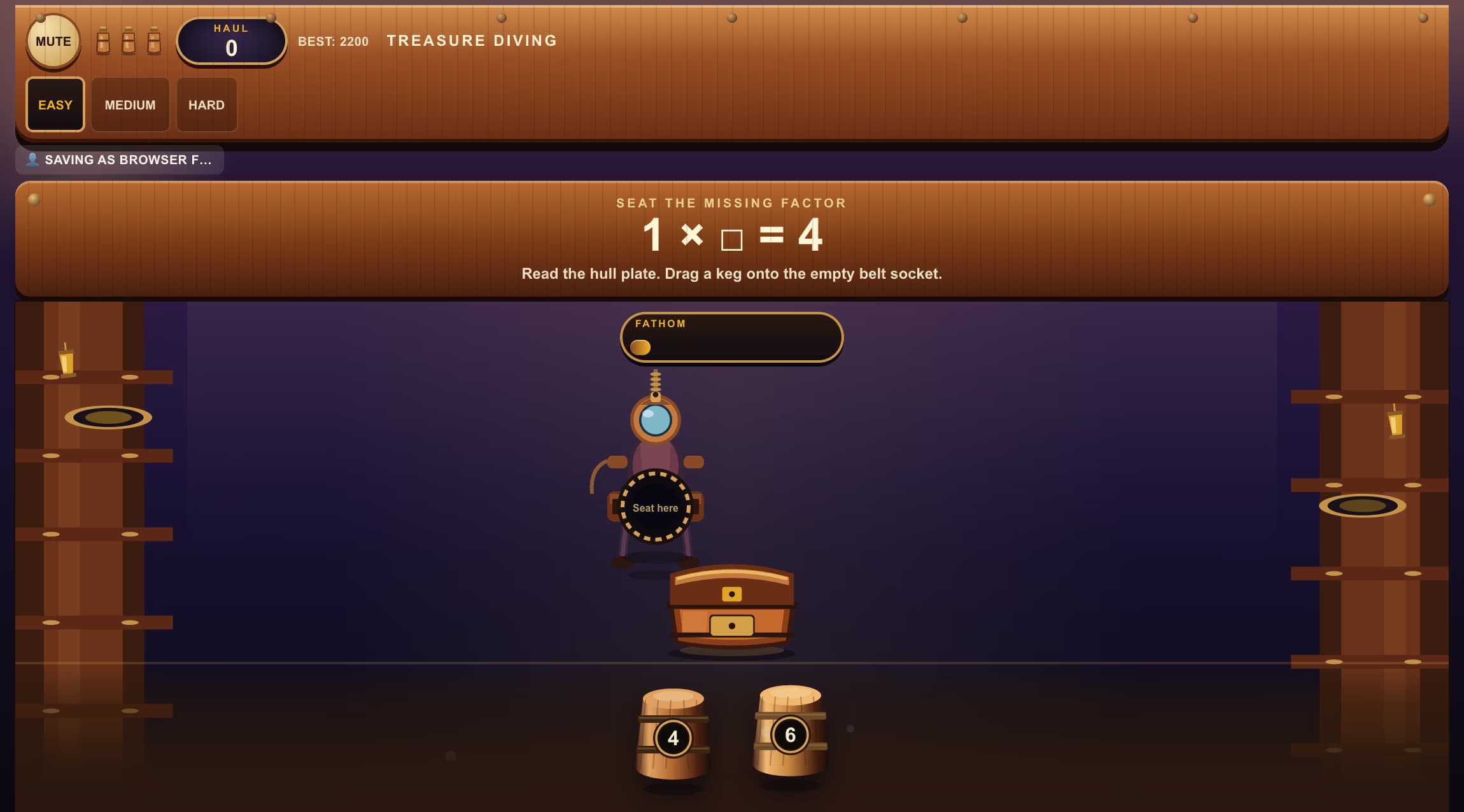
Multiplication Facts and Missing Factors
Dive a copper wreck in Treasure Diving. A hull plate shows a times fact with a gap — a missing factor or the product. Drag a numbered keg onto the empty belt socket. Seat the missing factor and the diver drops a fathom toward the chest. Third-grade multiplication fact fluency, with Haul points for every seated keg.
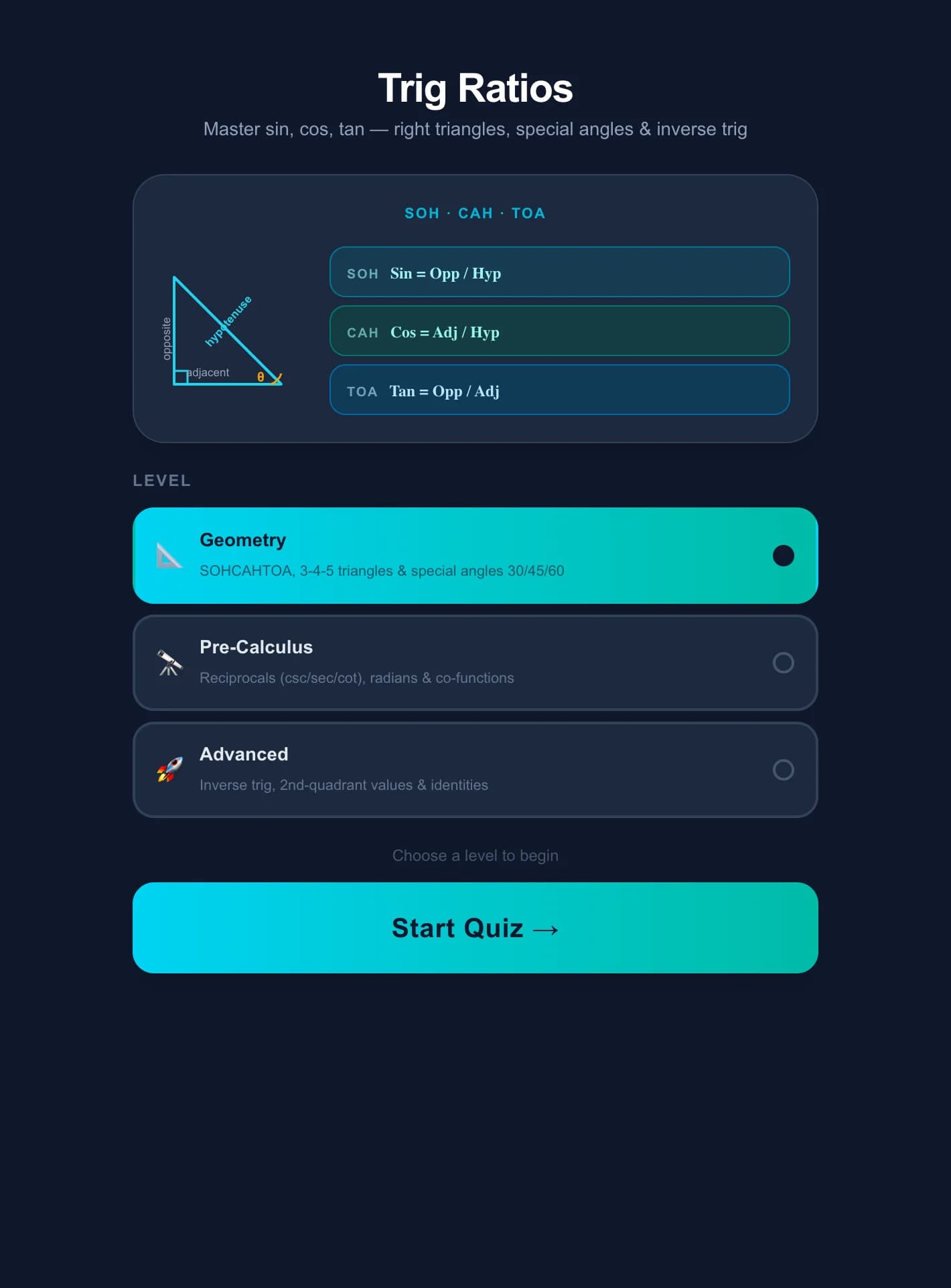
High School Math Quiz
Master sine, cosine, and tangent — the three foundational trigonometric ratios. 45 problems across three tiers: Geometry (SOHCAHTOA definitions, 3-4-5 triangles, special angles 30/45/60), Pre-Calculus (reciprocal functions csc/sec/cot, radian conversion, co-function identities), and Advanced (inverse trig, second-quadrant values, Pythagorean identities, real-world triangle applications).
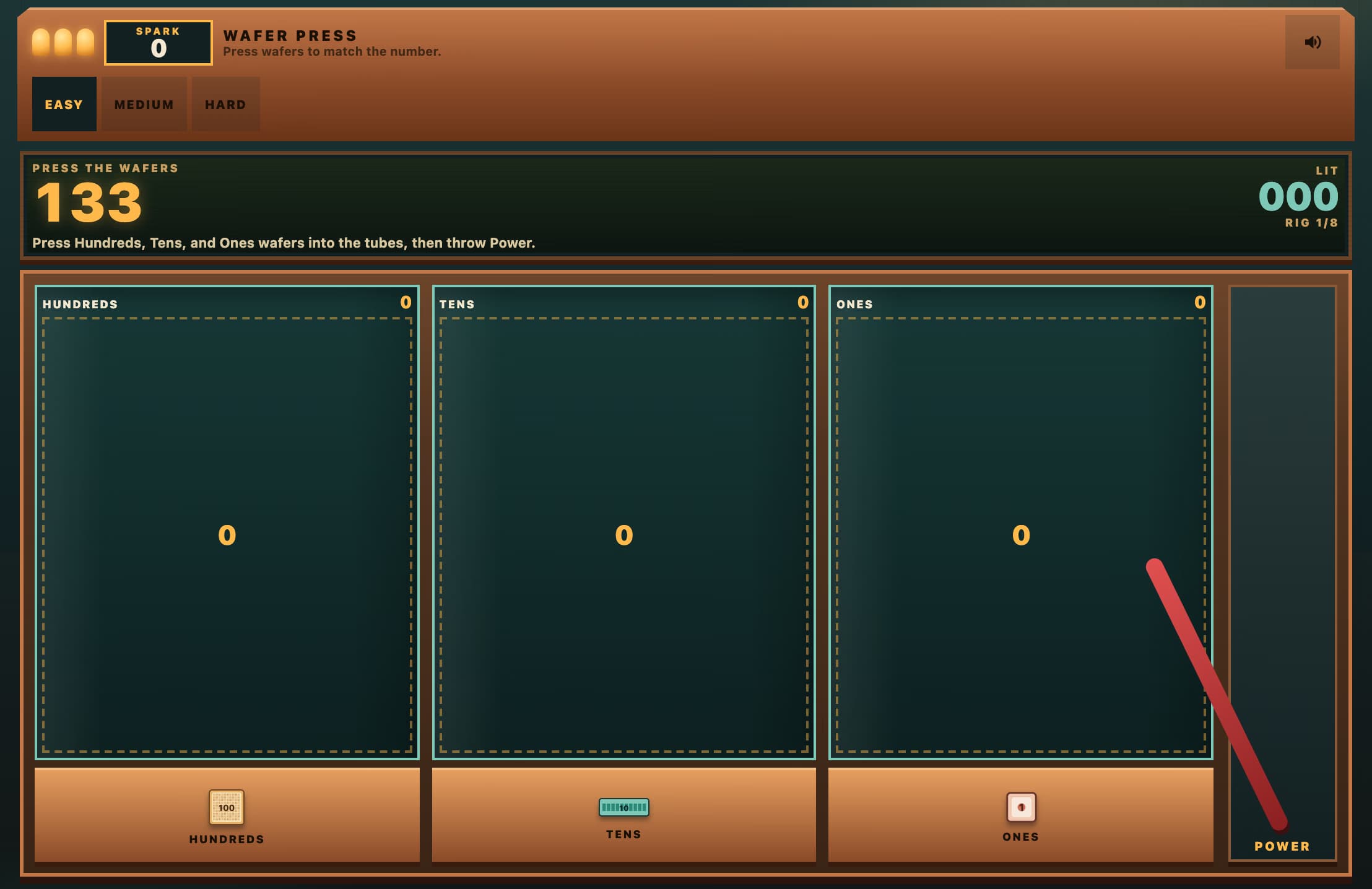
3-Digit Place Value Machine
The three-digit place value machine is broken. A CRT shows a number. Press Hundreds, Tens, and Ones wafers into the tubes, then throw Power so Lit matches. Second grade kids practice place value by building a visual three-digit number. Spark points grow with a streak.
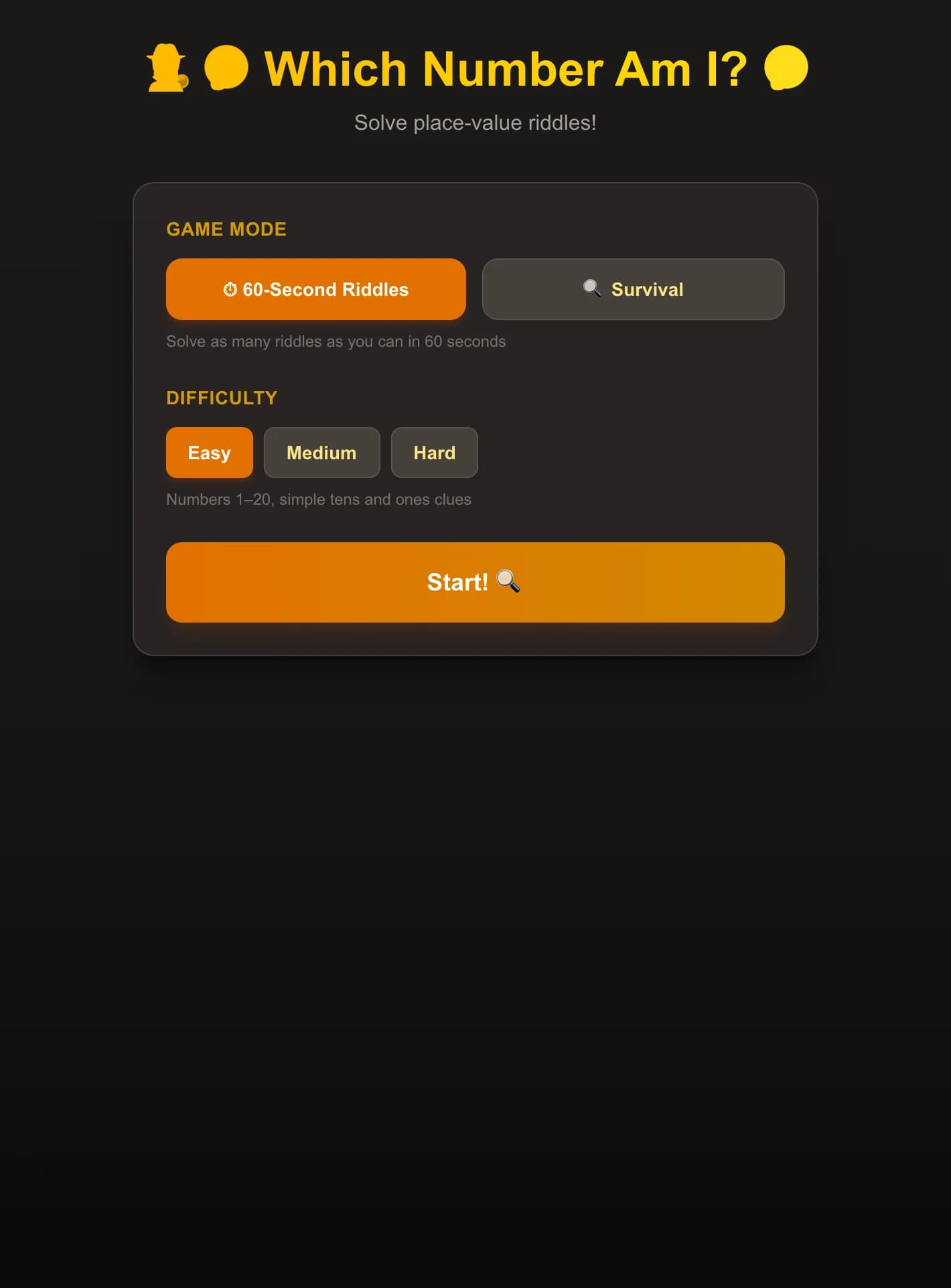
Place Value Riddles
Solve riddles like 'I have 3 tens and 5 ones — what number am I?' A visual place-value chart reveals the answer. Multiple clue styles from simple to tricky, with 3 difficulty levels.
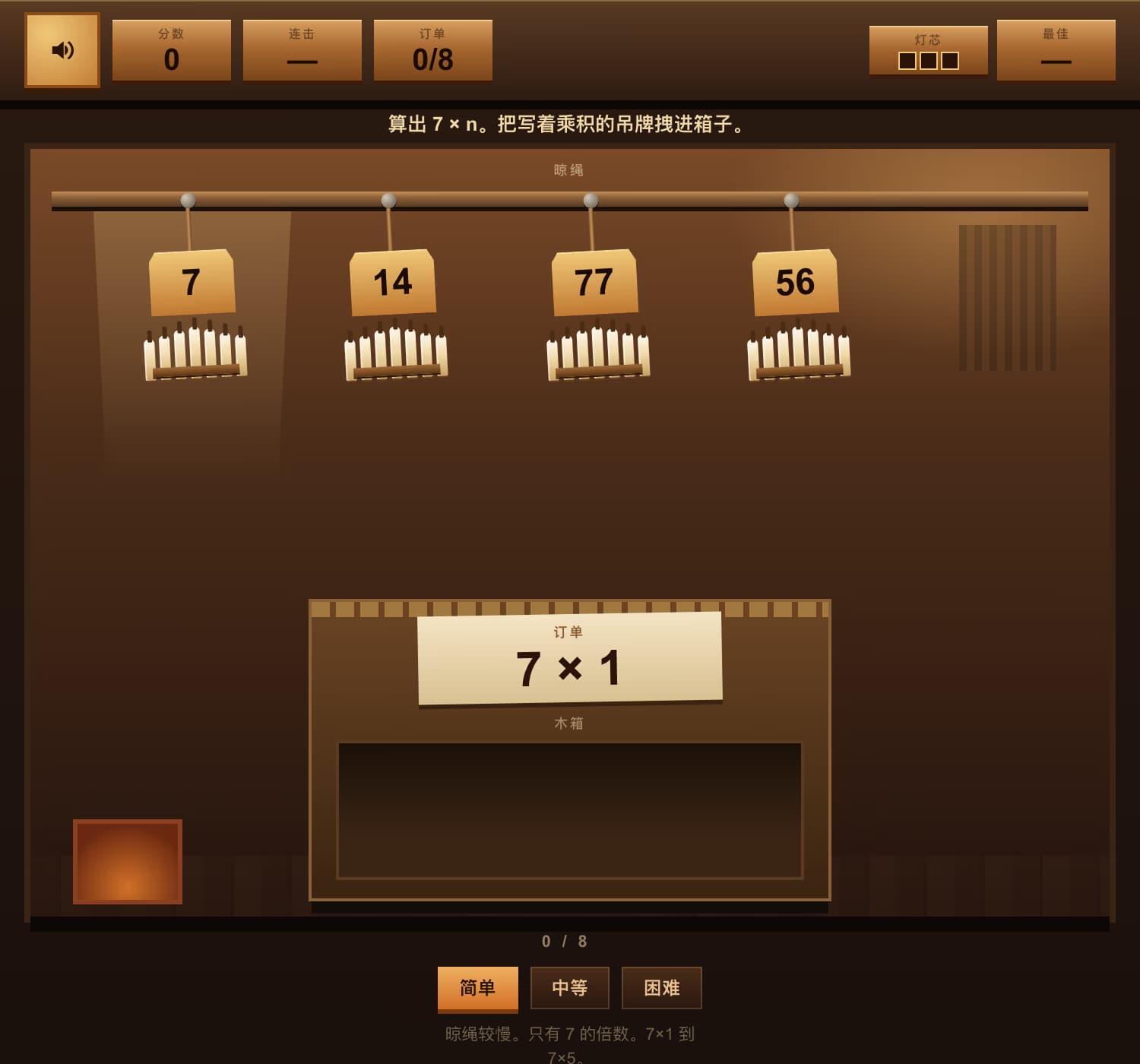
Stack Sevens to Fill the Candle Order
A tallow loft with a packing crate and twine-tied sevens. The slip shows 7 times a number. Drag each seven-candle bundle into the crate until the stack matches the product. Overfill dumps the order. Built for third-grade sevens fluency — equal groups you can stack, not a bubble to tap.
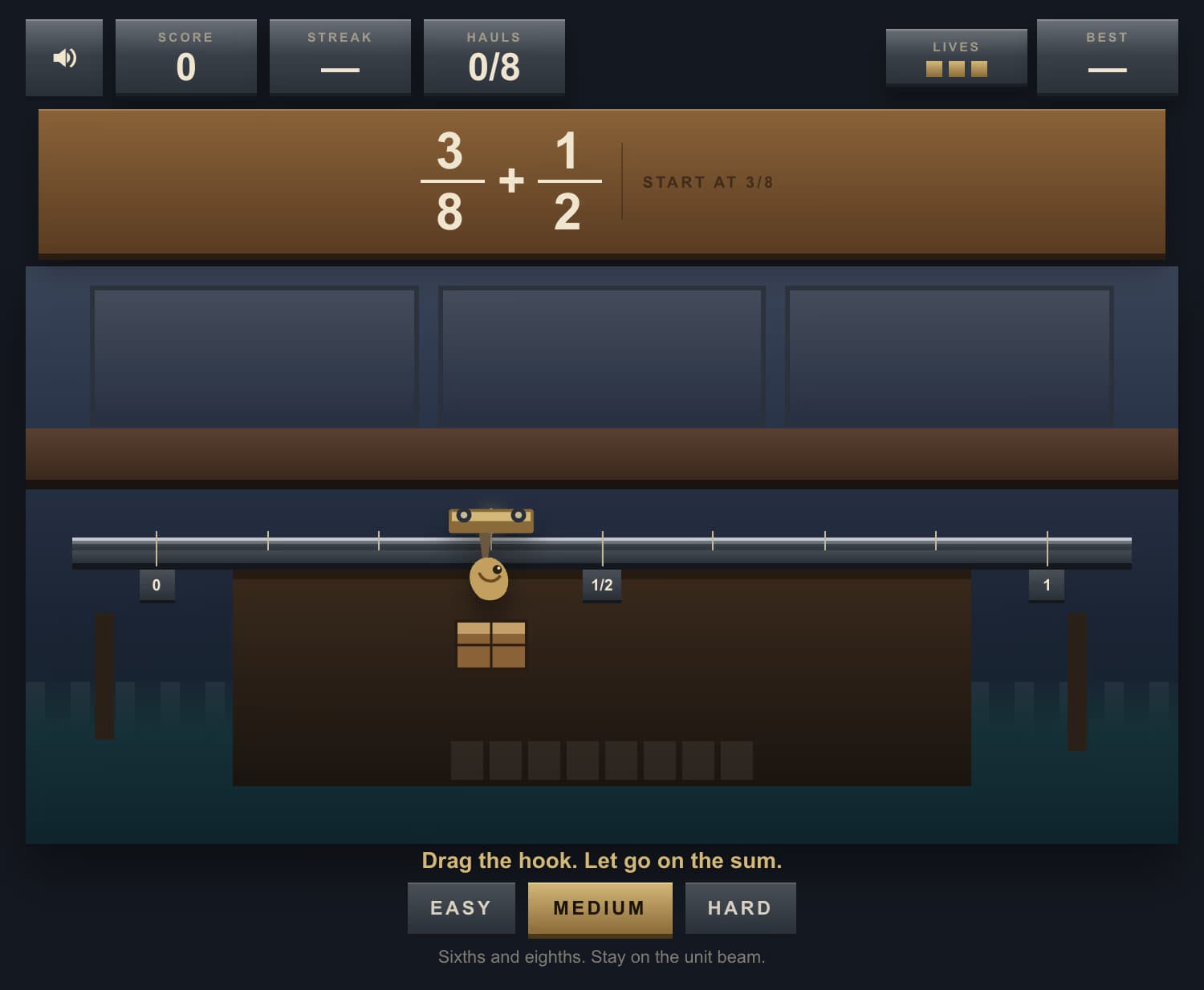
Add Fractions on a Number Line
Drag a brass cargo hook along a harbor loft beam to add fractions on a number line. Start on the first addend, haul the distance of the second, and let go on the sum. Three lives, a streak bonus, and Easy / Medium / Hard.
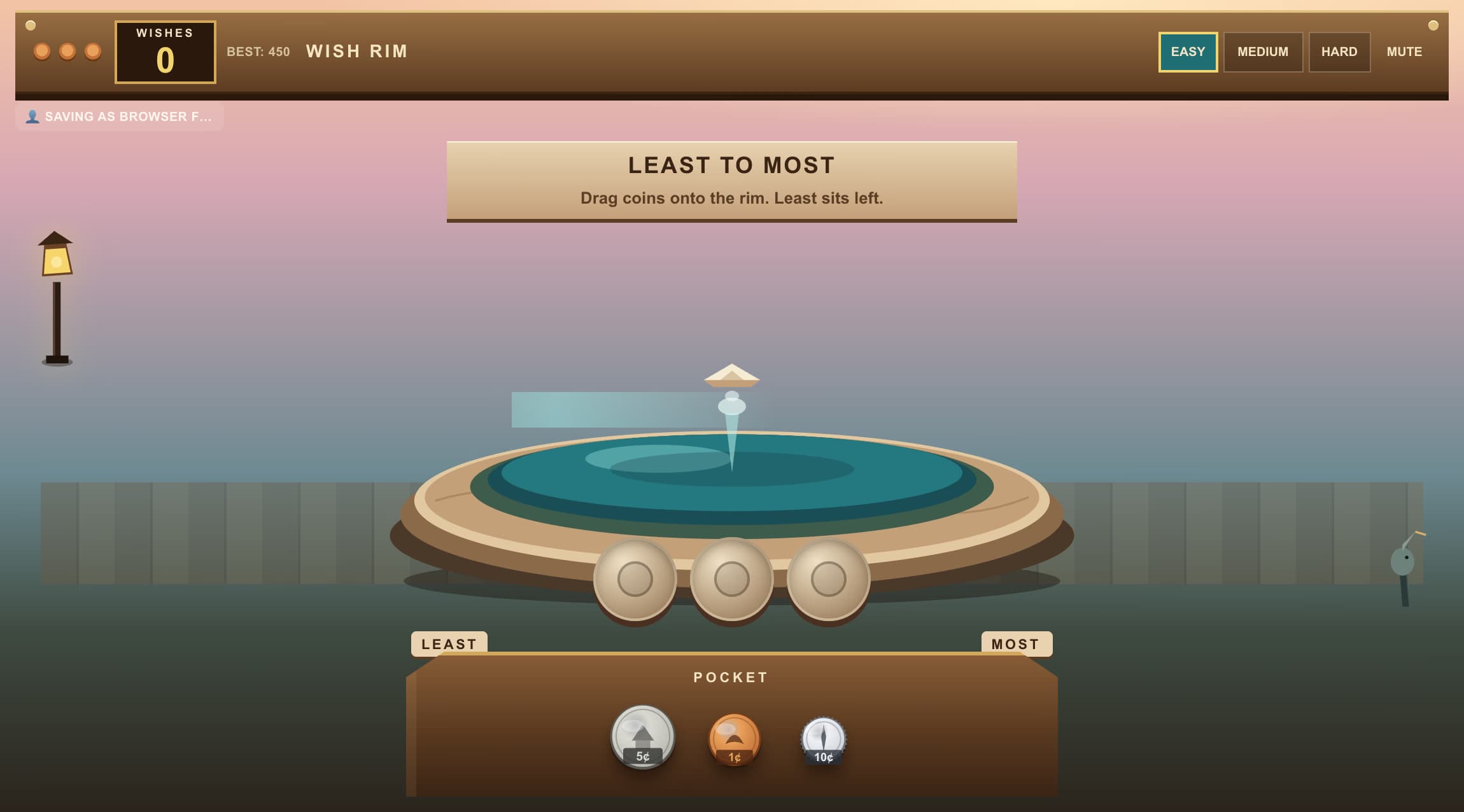
Ordering Coins By Value
Penny, nickel, dime, quarter! Kids drag coins from the Pocket onto the Wish Rim and line them Least to most — or Most to least on Hard. A dusk fountain, not a quiz card. Built for first- and second-grade money math so children grasp real-life coin values.