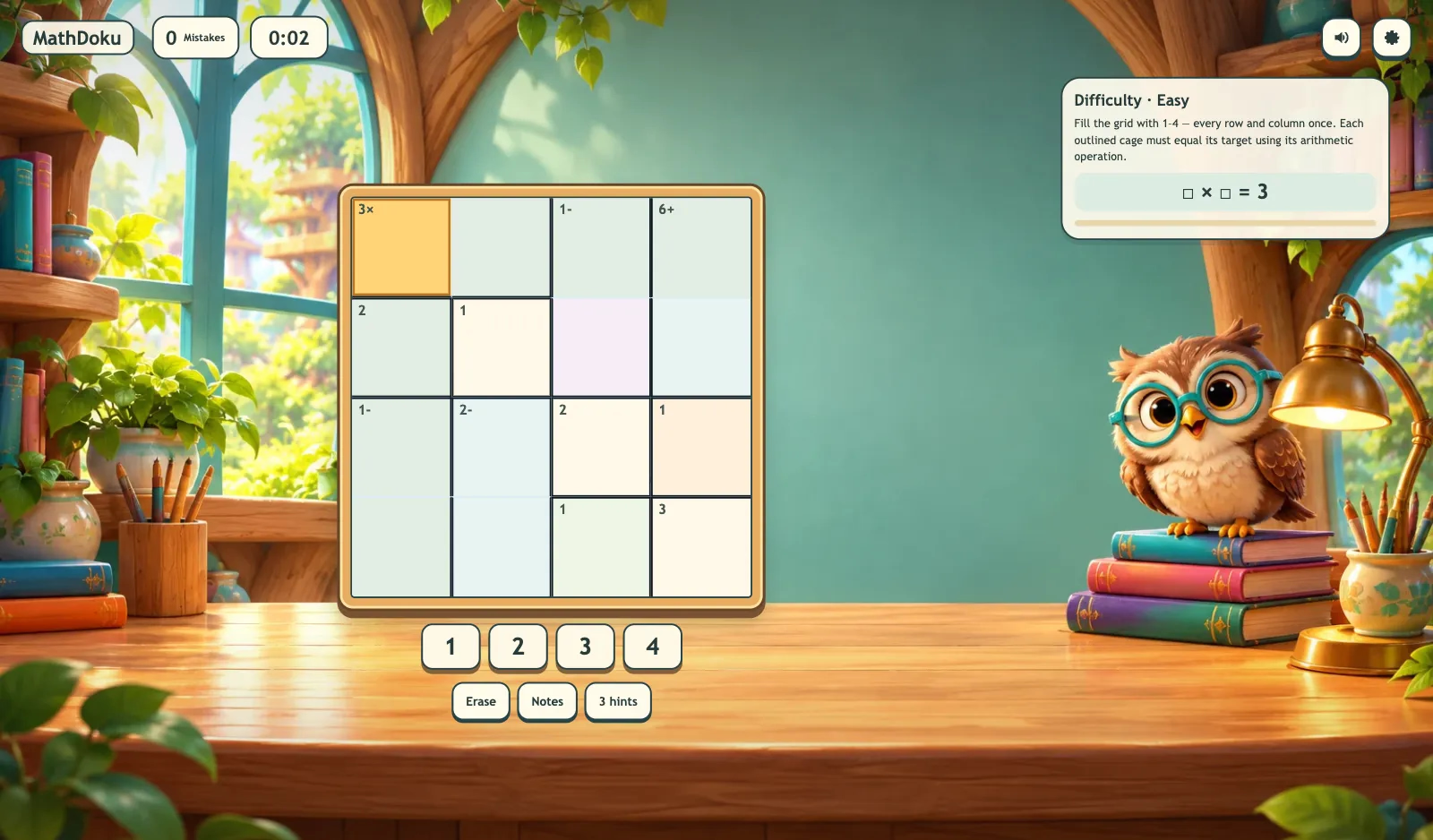
MathDoku
A KenKen-style arithmetic puzzle! Fill the grid with 1–N so every row and column contains each number exactly once. Each outlined cage must equal its target value using addition, subtraction, multiplication, or division. Choose from 4×4, 5×5, or 6×6 grids.
More like this

How To Use
Select a difficulty and click 'New Game'. Each outlined cage shows a target number and an operation (e.g. '6+' means the cells sum to 6, '3−' means the difference is 3). Fill in numbers so every row and column contains 1 through N exactly once, AND each cage satisfies its arithmetic clue. Click a cell, then click a number (or press a key) to fill it in. Use Notes (📝) to mark candidates and Hints (💡) when stuck.
Key Features
KenKen-style cages with addition (+), subtraction (−), multiplication (×), and division (÷) targets
Four difficulty levels: Easy (4×4), Medium (5×5), Hard (6×6), Expert (6×6 with larger cages)
Procedurally generated puzzles — every game is unique using a shuffled Latin square
Cage labels turn green ✅ when all cells in a cage are correctly filled
Live timer and mistake counter for performance tracking
Pencil notes mode to jot candidate digits in each cell
Auto-clears notes from a cell's row and column when the correct number is placed
3 hints per puzzle to reveal a random cell's correct value
Keyboard support: numbers, Backspace to erase, N for notes, arrow keys to navigate
Best time per difficulty saved in your browser
What Is This?
MathDoku (also known as KenKen) combines the Latin square constraint of Sudoku with arithmetic cage clues. Instead of the familiar 9×9 grid with boxes, you work on smaller grids (4×4 to 6×6) where every outlined region must produce a target value through a specific arithmetic operation. It's a perfect brain workout that blends number placement with mental arithmetic.
Why Use This?
MathDoku is ideal for players who want more than pure logic — the arithmetic cages add a satisfying mental math challenge. It's great for improving both number sense and logical deduction, making it one of the most stimulating pencil-puzzle formats for all ages.
Frequently Asked Questions
What is the difference between Easy, Medium, Hard, and Expert?
Difficulty scales both grid size and cage complexity. Easy uses a 4×4 grid (numbers 1–4) with small 2-cell cages. Medium uses 5×5, Hard uses 6×6 with 3-cell cages, and Expert uses 6×6 with larger 4-cell cages and more multiplication and division clues.
How do cage operations work?
'+' means the cells sum to the target. '−' means the absolute difference equals the target (2-cell cages only). '×' means the product equals the target. '÷' means the larger divided by smaller equals the target (2-cell cages only). A cage showing just a number with no symbol means that cell must contain exactly that number.
When does a cage label turn green?
The cage label turns green when every cell in that cage contains the correct value. It's a satisfying confirmation that you've solved that portion of the puzzle!
Are the puzzles guaranteed to have a unique solution?
Puzzles are generated from a valid Latin square, so a solution always exists. Like classic KenKen, very occasionally a randomly generated cage layout may admit more than one valid solution; the game guides you to the originally generated solution.