Calculate Discounts and Find the New Price
An item is X% off — what is the new price? See the discount visually and calculate the sale price. Covers 10%, 25%, 50%, and 75% off for grades 3–5.
More like this
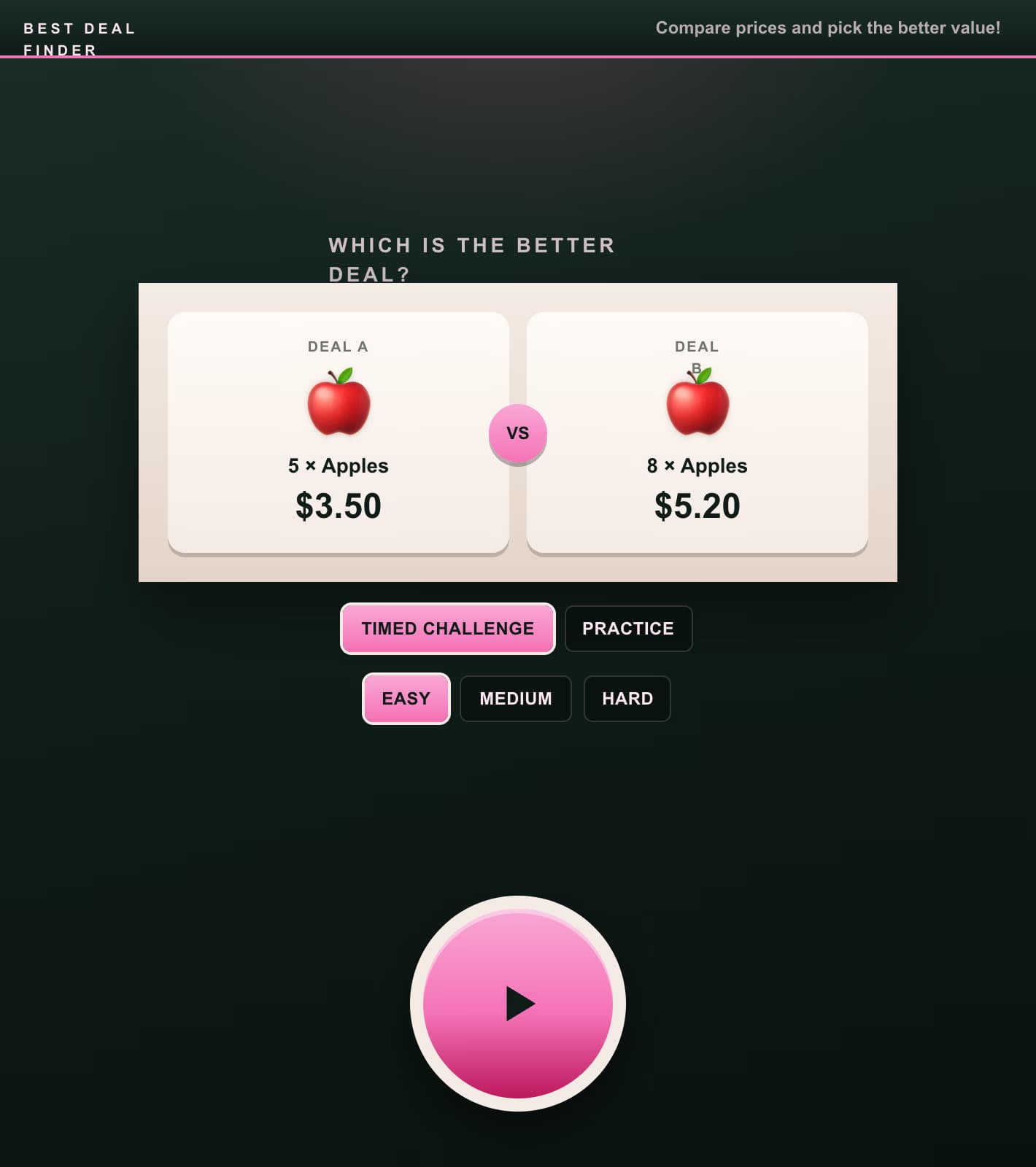
How to Play Sale Price Calculator
Choose your game mode (Timed Challenge or Practice) and difficulty level.
An item appears with its original price and a discount percentage (e.g., 50% OFF).
A visual bar shows you how much of the price is 'left' after the discount.
Calculate the sale price in your head: Original Price × (100% - Discount%) = Sale Price.
Tap or click the correct sale price from the four answer choices.
If correct, you score a point and build your streak. If wrong, the correct answer is highlighted.
In Timed mode, answer as many as you can before time runs out!
Try to beat your high score and build long streaks of correct answers.
Key Features
Visual Discount Bar
A progress bar visually shows how much of the original price remains after the discount, helping students connect percentages to visual proportions.
Common Store Discounts
Practice with the most common real-world discount percentages: 10% off, 25% off, 50% off, and 75% off — the exact numbers kids encounter in stores.
Multiple Choice Answers
Four price options are presented for each question. The wrong answers are carefully designed to reflect common calculation errors, reinforcing correct methods.
Three Difficulty Levels
Easy uses only 50% off with round dollar prices. Medium introduces 10% and 25% off. Hard adds 75% off with trickier original prices that yield cents.
Timed and Practice Modes
Race against 60 seconds in Timed Challenge mode, or take your time in Practice mode to build confidence with discount calculations.
What is Sale Price Calculator?
Sale Price Calculator is a math game that teaches students to calculate discount prices — a critical everyday skill. Players see an item with its original price and a 'percent off' tag (like you'd see in a real store), then must determine what the new sale price is. The game covers the four most common discount percentages (10%, 25%, 50%, 75%) and uses a visual discount bar to help students understand that a percentage is a fraction of the whole price.
Why Play Sale Price Calculator?
Real-World Discount Skills
Builds the practical skill of calculating discounts — used every time you see a sale sign in a store.
Visual Percentage Learning
Connects percentage concepts to visual representations through the discount bar, helping students see percentages as parts of a whole.
Common Store Discounts
Covers the four most common store discount levels (10%, 25%, 50%, 75%) — the exact numbers kids encounter in real life.
Error-Aware Distractors
Wrong answers reflect real calculation errors, helping students identify and correct common mistakes like confusing savings with sale price.
Progressive Difficulty
Three difficulty levels match grade 3 through grade 5 ability, from simple halving to multi-step percentage calculations.
Savings Awareness
The savings reveal after each answer reinforces the concept of 'how much you save' — building smart consumer thinking.
Frequently Asked Questions
What grade level is this game for?
Designed for grades 3–5. Easy mode (50% only with round prices) works for grade 3. Medium and Hard modes challenge grade 4–5 students with more percentages and non-round prices.
How do I calculate a discount?
Multiply the original price by the discount percentage, then subtract. For 25% off $20: 25% × $20 = $5 savings, so the sale price is $20 - $5 = $15. For 50% off, just divide by 2!
What does the visual bar represent?
The filled portion of the bar represents the sale price (what you pay). The empty portion represents the discount (what you save). This helps students see percentages as parts of a whole.
Why are the wrong answers so close to the right one?
The distractor answers are based on common mistakes: calculating the savings amount instead of the sale price, applying the wrong percentage, or arithmetic errors. This helps students learn to check their work.
What is the streak counter?
The streak counts correct answers in a row. Making a mistake resets it. It encourages careful thinking over quick guessing.
Is 50% off always half?
Yes! 50% off means you pay half the original price. This is the easiest discount to calculate mentally, which is why it's the only one used in Easy mode.