BrowserFun
GamesCategoriesView All Tools
© 2026 BrowserFun. All rights reserved.
Privacy PolicyTerms & ConditionsCookie PolicyDisclaimerConsent Preferences
  1. Home
  2. Tools
  3. Add the Animals

Add the Animals

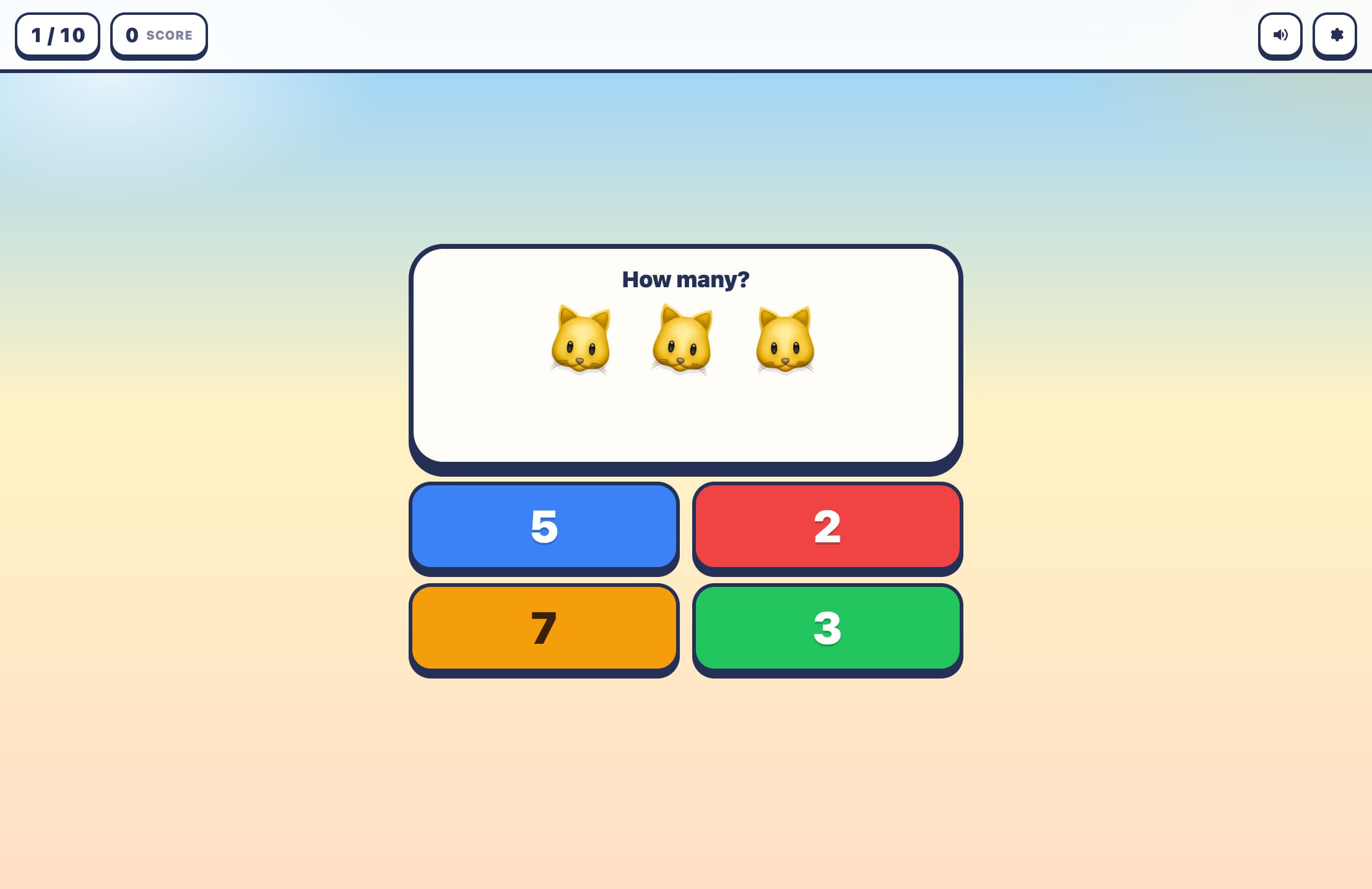
2 cats + 3 cats = ? Count adorable animal emoji to solve addition problems up to 10. A visual and engaging way for young learners to practice adding numbers through counting.

additioncountingearly mathanimalsmath games
Add the Animals preview

How To Use

  1. 1

    Choose your difficulty (Easy, Medium, or Hard) and game mode.

  2. 2

    Look at the two groups of animals shown on screen — count each group.

  3. 3

    Find the total by adding the two groups together in your head.

  4. 4

    Tap the number button that matches the total count.

  5. 5

    When correct, watch all the animals merge together to confirm your answer!

Key Features

  • 20 rotating adorable animal emoji keep every round visually fresh

  • Visual groups show exact animals to count, building number sense

  • Answer box reveals all animals merged together after each answer

  • Two modes: 10-Question Arcade and 60-Second Rush

  • Three difficulty levels from sums up to 6 through sums up to 10

  • Streak bonus scoring rewards consistent correct answers

What Is Add the Animals?

Add the Animals is a visual math game where you count groups of adorable animals to solve addition problems. Each round shows two groups — like 2 dogs on the left and 3 dogs on the right — and asks you to find the total. Choose the correct answer from four big numbered buttons. With 20 different animals rotating through, every problem looks fresh and fun!

Why Play Add the Animals?

  • 1

    Builds Number Sense Through Counting

    Seeing physical groups of emoji builds a concrete understanding of quantity before moving to abstract numbers. This is exactly how early math education recommends introducing addition.

  • 2

    Instant Visual Confirmation

    When you answer, all the animals merge together in the answer box — visually showing the sum. This 'aha' moment reinforces the addition concept in a way that just seeing a number cannot.

  • 3

    Scales With Growing Skills

    Easy mode keeps sums under 6, Medium goes up to 10, and Hard challenges with larger addends. The timed mode adds excitement for children who are ready for speed practice.

Frequently Asked Questions

What age group is Add the Animals designed for?

The game is ideal for children aged 4–8 who are learning to count and add small numbers. Easy mode (sums up to 6) is perfect for beginners, while Hard mode (sums up to 10 with larger addends) suits children who are building fluency.

Why do all the animals show together after I answer?

Seeing all the animals grouped together in the answer box is a key learning moment. It visually confirms that 2 + 3 really does make 5, reinforcing the concrete meaning of addition before children rely on memorized facts.

What is the maximum sum in the game?

The maximum sum is 10, which aligns with early math curricula worldwide. Keeping sums within 10 ensures all animal groups can be displayed clearly and counted at a glance.

How does the streak bonus work?

Getting consecutive correct answers builds a streak. Each answer beyond your first in a streak adds 2 bonus points on top of the base 10 points, rewarding accuracy and consistency.

Can I play on a phone or tablet?

Yes! The large emoji and big answer buttons are designed to be finger-friendly on touch screens. The layout automatically adapts to phone, tablet, and desktop screen sizes.

Related Tools

additionAll →

Coin Counter

Drag or tap pennies, nickels, dimes, and quarters into a piggy bank to make exact target amounts! Three difficulty levels introduce money concepts step by step — from 1–10¢ with just pennies and nickels, up to 50¢ with all four US coin types.

Math Bingo

A classic bingo card filled with numbers 1–24 — but instead of hearing a number called, kids solve a math equation and find the answer on their card! Three difficulty levels take players from simple addition sums up through mixed subtraction and on to multiplication and division. First to complete a row, column, or diagonal wins BINGO!

countingAll →

Count the Objects

A colorful counting game where you count cartoon emoji items and tap the right number. Perfect intro to counting 1–20 for young learners.

More or Less

Two groups of objects appear side by side — tap the one with more (or fewer)! A quick, visual way to build number sense and comparison skills for young learners.

Take Away Game

Watch objects disappear with animation and figure out how many are left! 5 cookies, eat 2 — how many remain? A visual, animated approach to learning subtraction for young children.

early mathAll →

Coin Counter

Drag or tap pennies, nickels, dimes, and quarters into a piggy bank to make exact target amounts! Three difficulty levels introduce money concepts step by step — from 1–10¢ with just pennies and nickels, up to 50¢ with all four US coin types.

Color & Shape Match

A gentle introduction to classification and sorting! Match objects by color, shape, or both. Find the card that follows the rule — from easy single-attribute sorting to tricky two-attribute matching with near-miss distractors.

Count the Objects

A colorful counting game where you count cartoon emoji items and tap the right number. Perfect intro to counting 1–20 for young learners.

Heavy or Light?

Watch a balance scale tip and decide which side is heavier or lighter! A rock vs a feather, an elephant vs a butterfly — learn about weight and measurement concepts through an interactive animated scale.

Math Bingo

A classic bingo card filled with numbers 1–24 — but instead of hearing a number called, kids solve a math equation and find the answer on their card! Three difficulty levels take players from simple addition sums up through mixed subtraction and on to multiplication and division. First to complete a row, column, or diagonal wins BINGO!

More or Less

Two groups of objects appear side by side — tap the one with more (or fewer)! A quick, visual way to build number sense and comparison skills for young learners.