More like this
How to Play Hoop Solve
Read the Equation
The prompt shows a one-step equation. x is the unknown. Example: x × 4 = 12 means the ball you want is 3.
Find x
Undo the operation. Divide, subtract, or think of the missing factor. Do not pick the number already on the right side unless that is truly x.
Tap That Ball
Each ball has a plate with a number. Tap the plate or the ball. The shot flies if you are right.
Keep the Run Alive
Three misses and the buzzer sounds. Chase a new best on Easy, Medium, or Hard.
Key Features
Solve, Then Shoot
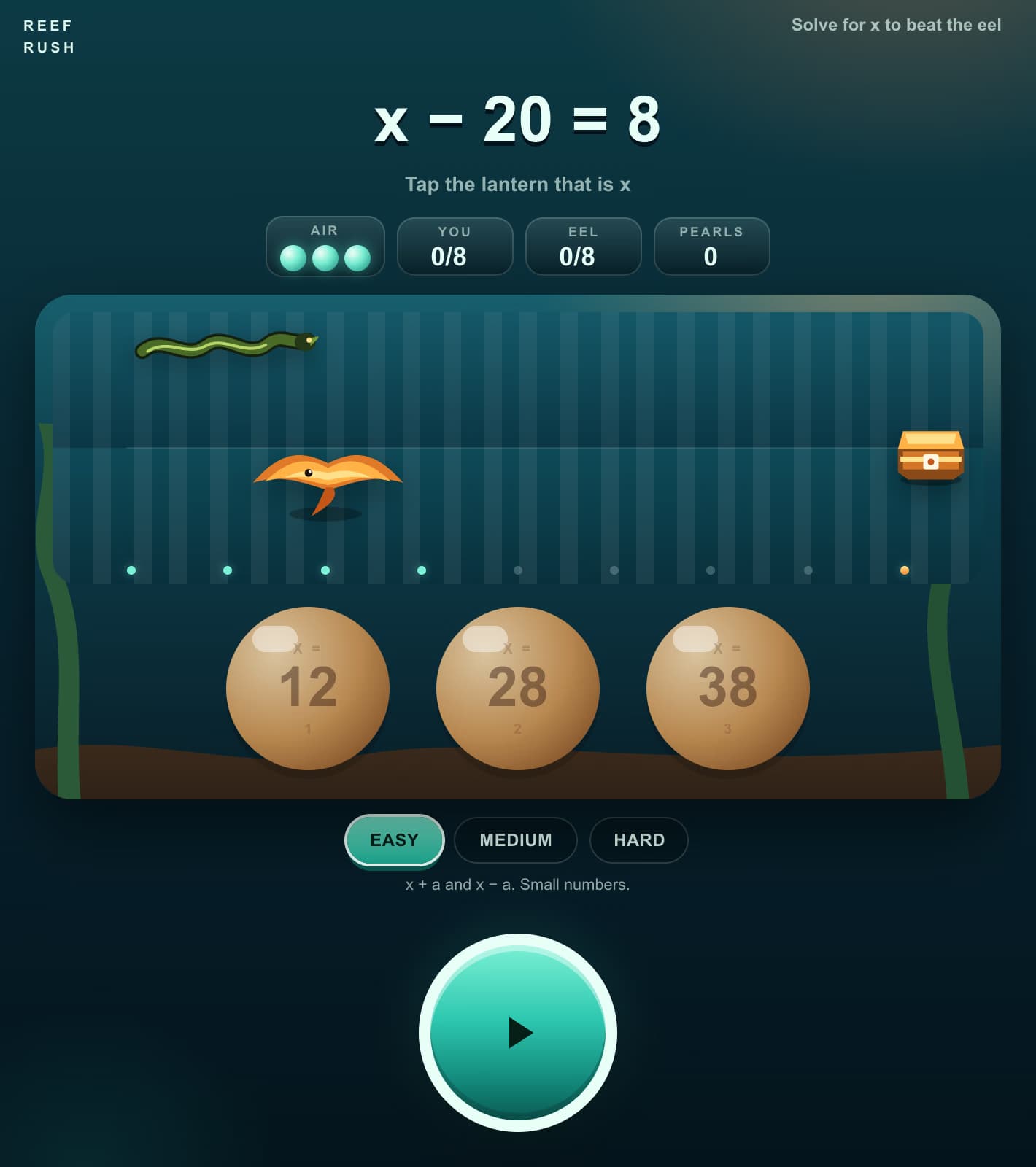
Read x × a = b or a − x = c. The balls on the floor are candidate values. Only one is x.
The Court Moves
A correct tap sends that ball on an arc through the copper rim. A wrong tap shakes and costs a life.
Hits on the Board
Makes add to Hits above the court. Three clanks end the game. Best hits save per difficulty.
Three Fact Ranges
Easy stays with small + − ×. Medium puts x on either side and adds division. Hard uses larger facts.
What is Hoop Solve?
Hoop Solve is a fifth-grade pre-algebra arcade. A 3D court holds numbered balls. A one-step equation sits above the floor. The player taps the value of x. Correct shots swish. Wrong shots clank. The goal is a long streak of hits before three misses.
Why Play Hoop Solve?
Unknown First
Students treat x as a number they must find, not a letter to ignore. That is the start of formal equation work.
Instant Make or Miss
The rim is the judge. No worksheet step sits between the choice and the result.
Operations Mixed
Addition, subtraction, multiplication, and division rotate, so students cannot lock onto one trick.
Touch First
Balls are large. Labels sit beside them. Play sits under the court, not on the hoop.
Frequently Asked Questions
What kinds of equations appear?
One-step equations with a whole-number x. Easy uses x + a, x − a, and x × a. Medium and Hard add x on the other side and division.
What happens if I tap the wrong ball?
The ball shakes, you hear a clank, and you lose a life. Three lives and the run ends.
Do I shoot with a button?
No. Tapping the correct ball is the shot. The ball flies to the rim on its own.
What do Easy, Medium, and Hard change?
The operations and the size of the numbers. The court and the three-life rule stay the same.
What grade is this for?
Fourth through sixth grade (about ages 9–12), when students meet a variable as a missing number. Stay on Easy for early facts.