Pattern Completion
What comes next? Complete repeating patterns made of emoji like 🔴🔵🔴🔵__? Choose from 4 options. From simple AB patterns to complex ABCD sequences — great for early math, logical reasoning, and pre-algebra thinking!
How to Play Pattern Completion
- 1
Choose Difficulty and Mode
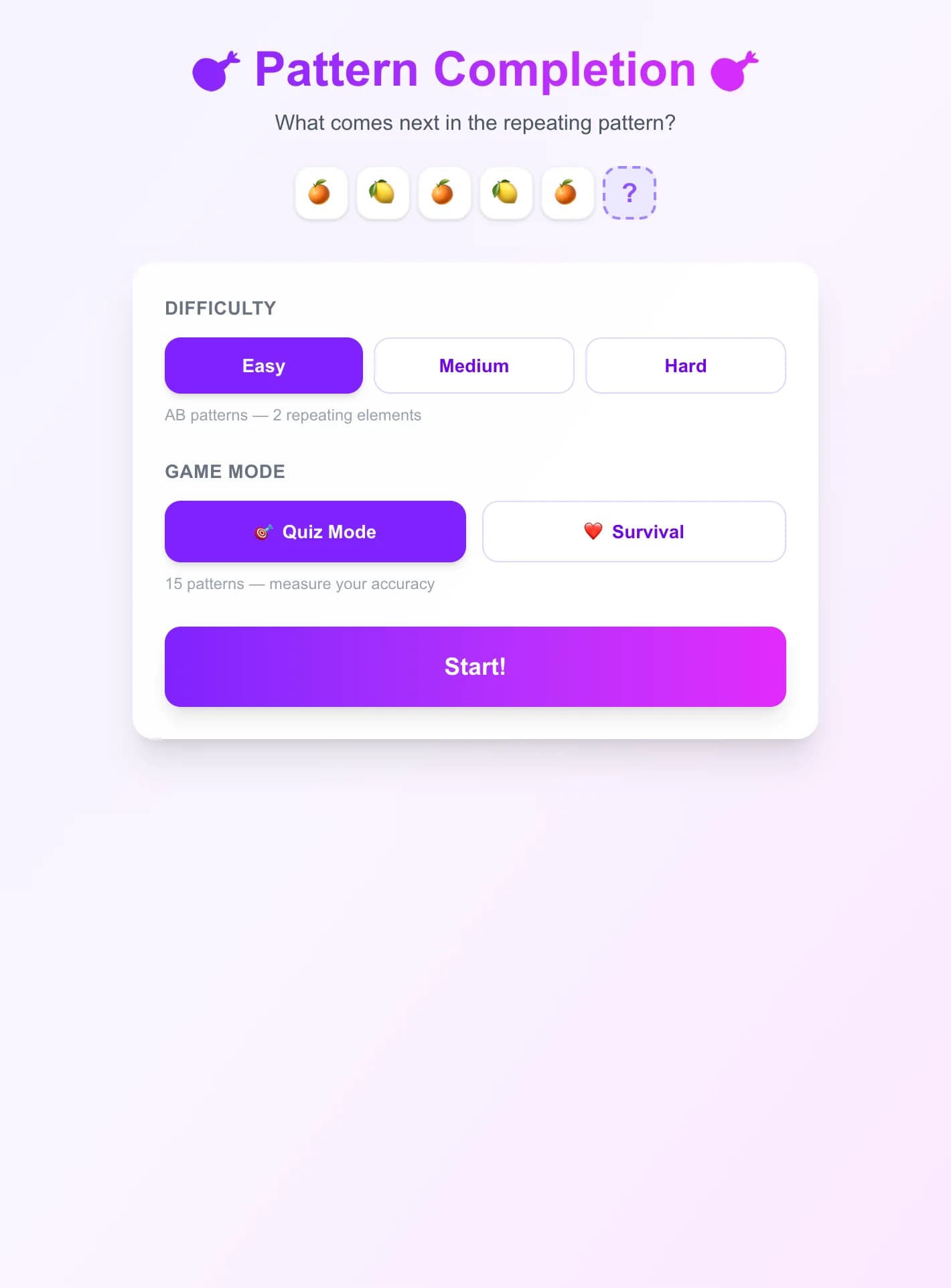
Easy uses AB patterns with 2 repeating elements. Medium adds 3-element rules (AAB, ABB, ABC). Hard introduces 4-element rules including ABCD and ABAC. Then pick Quiz Mode (15 questions) or Survival (3 lives).
- 2
Read the Pattern
A row of emoji appears with a '?' box at the end. Study the sequence carefully — identify the repeating unit (the core pattern that repeats) before selecting your answer.
- 3
Pick the Answer
Four emoji buttons appear below. Tap the one that correctly continues the pattern. The '?' box reveals the answer in green (correct) or red (wrong), and the correct choice is always highlighted.
- 4
Build Your Streak
Consecutive correct answers build a streak shown with a 🔥 counter. Streaks award bonus points — keep your streak alive for the highest possible score!
Key Features
9 Distinct Pattern Types
From simple AB (🔴🔵🔴🔵) patterns on Easy, through AAB, ABB, and ABC on Medium, up to AABB, ABCD, ABAC, ABBC, and ABCB on Hard — each difficulty introduces new structural complexity.
8 Emoji Categories
Patterns are built from colorful emoji drawn from 8 rotating categories: colors, animals, fruits, weather, food, sports, space, and music. Every round uses a fresh random category so no two games feel the same.
Streak Bonus Scoring
Each correct answer scores 10 points, plus 2 extra for every step of your active streak. A streak of 5 earns 18 points on the 5th answer — rewarding consistent correct answers.
Quiz Mode and Survival Mode
Quiz Mode gives you exactly 15 patterns to answer, then shows your final accuracy and score. Survival Mode gives you 3 lives — one lost per wrong answer — and keeps going until all lives are gone.
What is Pattern Completion?
Pattern Completion is a repeating-sequence recognition game that covers the full range of pattern structures taught in early childhood through early elementary math: AB (two-element alternating), AAB and ABB (three-element with repeats), ABC (three-element rotating), and four-element rules like AABB and ABCD. Recognizing and extending patterns is one of the earliest forms of algebraic thinking — it trains the mind to extract structure from sequences and predict what comes next, skills that underpin multiplication tables, function rules, and mathematical induction. The game uses emoji so it is language-neutral and visually engaging for all ages.
Why Play Pattern Completion?
- 1
Develops Algebraic Thinking Early
Pattern recognition is the first step toward algebra. Identifying a repeating unit in 🔴🔵🔴🔵 is the same cognitive skill as identifying the rule in f(n) = n mod 2 — just dressed in emoji. Starting early builds strong mathematical intuition.
- 2
Trains Working Memory and Attention
To complete a 7-element ABCD pattern, the player must hold the entire visible sequence in working memory and extract a 4-step rule. This trains sustained attention and short-term memory alongside math reasoning.
- 3
Immediate Corrective Feedback
When a wrong choice is made, the correct answer is highlighted immediately. This gives players the chance to see the right pattern before the next question — turning mistakes into learning moments rather than frustrations.
- 4
Naturally Scaffolded Difficulty
Easy starts with the simplest possible pattern (AB), so even very young children can succeed and build confidence. Hard mode's ABCD and ABAC patterns challenge older students and adults who want a genuine cognitive workout.
Frequently Asked Questions
What patterns are used on each difficulty?
Easy: AB (e.g. 🔴🔵🔴🔵?). Medium: AAB (🔴🔴🔵🔴🔴?), ABB (🔴🔵🔵🔴🔵?), ABC (🔴🔵🟡🔴🔵?). Hard: AABB (🔴🔴🔵🔵🔴🔴🔵?), ABCD (🔴🔵🟡🟢🔴🔵🟡?), ABAC (🔴🔵🔴🟡🔴🔵🔴?), ABBC, ABCB.
How does scoring work?
Each correct answer scores 10 points. If you are on a streak of N consecutive correct answers, the Nth correct answer scores 10 + 2×(N-1) extra bonus points. A 5-answer streak earns 10+8=18 on the 5th answer. Wrong answers reset the streak.
What is the difference between Quiz Mode and Survival Mode?
Quiz Mode always gives you exactly 15 patterns regardless of how many you get wrong — you answer all 15 and see your final accuracy and score. Survival Mode ends early when you use all 3 lives, but there is no fixed limit so it can go on indefinitely with perfect play.
How do I identify the repeating unit quickly?
Look at the first element, then find when it repeats. For 🔴🔵🔴🔵🔴?, the 🔴 repeats at positions 1 and 3, giving a 2-element unit AB. For 🐶🐱🐱🐶🐱🐱?, the 🐶 repeats every 3 positions, giving unit ABB. The unit length is your key clue.
Why are emojis used instead of letters or shapes?
Emoji are language-neutral, immediately recognizable, and visually distinct at small sizes, making the game accessible to young learners who may not yet read. They also make patterns more engaging and memorable than abstract shapes or letters.