BrowserFun
New GamesCategoriesView All
© 2026 BrowserFun. All rights reserved.
Privacy PolicyTerms & ConditionsCookie PolicyDisclaimer
  1. Home
  2. Tools
  3. More or Less

More or Less

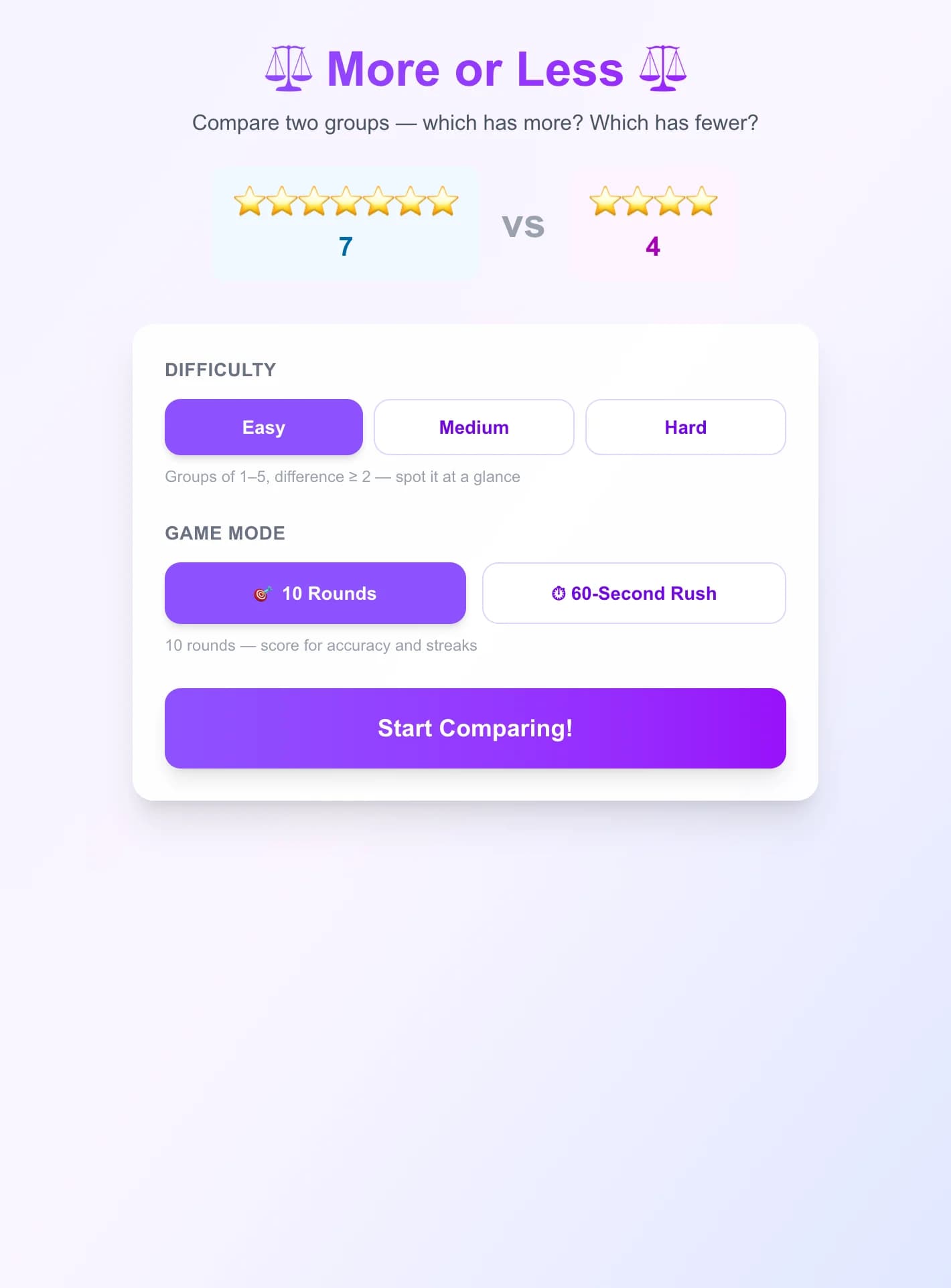
Two groups of objects appear side by side — tap the one with more (or fewer)! A quick, visual way to build number sense and comparison skills for young learners.
GameMathNumber SensePre-KKindergarten
More or Less - Two groups of objects appear side by side — tap the one with more (or fewer)! A

How To Use

  1. 1

    Choose your difficulty and game mode, then tap 'Start Comparing!'

  2. 2

    Read the question at the top — it asks for MORE or FEWER.

  3. 3

    Look at both groups of objects displayed side by side.

  4. 4

    Tap the group that answers the question correctly.

  5. 5

    After your answer, the numbers appear under each group to confirm the comparison.

Key Features

  • 24 rotating emoji objects keep every comparison visually fresh and engaging

  • Both 'MORE' and 'FEWER' questions practice comparison in both directions

  • Counts revealed after each answer to confirm the correct comparison

  • Easy mode: groups differ by ≥ 2 for instant visual recognition

  • Hard mode: groups of 1–10 that may differ by just 1 — requires precise counting

  • Two modes: 10-Round Arcade and 60-Second Rush for sustained practice

What Is More or Less?

More or Less is a visual comparison game that builds foundational number sense. Each round, two groups of the same emoji appear side by side. You're asked 'Which has MORE?' or 'Which has FEWER?' — simply tap the correct group. After your answer, the counts appear under each group so you can confirm your thinking with numbers. The questions alternate between more and fewer to make sure you practice both directions of comparison.

Why Play More or Less?

  • 1

    Develops Subitizing and Number Sense

    Subitizing — the ability to instantly see 'how many' without counting one by one — is a foundational math skill. Easy mode features clearly different group sizes that can be perceived at a glance, training this automatic visual number recognition.

  • 2

    Practices Both Sides of Comparison

    By alternating between 'which has MORE' and 'which has FEWER', the game ensures children understand quantity comparison in both directions. This is crucial for understanding the concepts of greater than (>) and less than (<) that appear throughout school math.

  • 3

    Scales From Glance-and-Guess to Careful Counting

    Easy mode keeps differences large (≥ 2) and groups small (1–5), so children can answer by visual estimation alone. Hard mode introduces groups of 1–10 where the difference may be just 1, requiring actual counting — a natural progression as skills grow.

Frequently Asked Questions

What age group is this game for?

More or Less is ideal for children aged 3–8. Younger children (3–5) benefit from Easy mode where large differences are instantly visible. Older children (6–8) are challenged by Hard mode where groups may differ by just 1 object, requiring careful counting.

Why does the game ask both 'more' and 'fewer'?

Children often learn 'more' before 'fewer'. By practicing both, the game ensures a complete understanding of comparison — the same relationship seen from two perspectives. This mirrors how 'greater than' and 'less than' symbols work in school math.

What is subitizing and why does it matter?

Subitizing is the ability to instantly recognize small quantities without counting — like knowing there are 3 dots on a die without counting each one. It's a foundational number sense skill. Easy mode trains subitizing by presenting groups where the difference is large and immediately visible.

Why do the counts appear only after I answer?

Showing the counts before the answer would make it a reading exercise rather than a visual comparison one. By hiding the numbers until after the choice, the game builds visual estimation and subitizing skills first, then reveals the numbers to confirm and reinforce the learning.

How does the streak bonus work?

Answering consecutive questions correctly builds a streak. Each correct answer beyond the first in a streak earns 2 bonus points on top of the base 10, rewarding focus and sustained accuracy.

Related Tools

GameAll →

🃏 24 Game 🃏

The classic 24 card game! Given 4 random numbers, combine them using +, −, ×, ÷ to reach exactly 24. Every number must be used exactly once. Choose your difficulty (1–6, 1–9, or 1–13), build a streak, and beat your best time!

🔢 Sudoku 🔢

Classic 9×9 Sudoku with four difficulty levels — Easy, Medium, Hard, and Expert. Features a live timer, mistake counter, pencil notes, and 3 hints per puzzle. Beat your best time!

🧩 MathDoku 🧩

A KenKen-style arithmetic puzzle! Fill the grid with 1–N so every row and column contains each number exactly once. Each outlined cage must equal its target value using addition, subtraction, multiplication, or division. Choose from 4×4, 5×5, or 6×6 grids.

2D Shape Explorer

Identify 2D shapes like triangles, squares, pentagons, hexagons, and more by counting their sides and corners. Features colorful SVG shapes, multiple question types (name, sides count, corners count), and three difficulty levels.

Acronym Generator

Turn any word into a creative acronym expansion! Pick a word from 42 preset options across 6 categories — or type your own — then fill in a word for each letter to build your unique acronym. Compare your creation with a built-in fun alternative.

Acrostic Puzzle – Solve Clues to Reveal a Hidden Phrase

Play acrostic puzzles where you solve word clues and the first letters of each answer spell out a hidden phrase. Features five categories, three difficulty levels, and a hint system.

MathAll →

🃏 24 Game 🃏

The classic 24 card game! Given 4 random numbers, combine them using +, −, ×, ÷ to reach exactly 24. Every number must be used exactly once. Choose your difficulty (1–6, 1–9, or 1–13), build a streak, and beat your best time!

🔢 Sudoku 🔢

Classic 9×9 Sudoku with four difficulty levels — Easy, Medium, Hard, and Expert. Features a live timer, mistake counter, pencil notes, and 3 hints per puzzle. Beat your best time!

🧩 MathDoku 🧩

A KenKen-style arithmetic puzzle! Fill the grid with 1–N so every row and column contains each number exactly once. Each outlined cage must equal its target value using addition, subtraction, multiplication, or division. Choose from 4×4, 5×5, or 6×6 grids.

2D Shape Explorer

Identify 2D shapes like triangles, squares, pentagons, hexagons, and more by counting their sides and corners. Features colorful SVG shapes, multiple question types (name, sides count, corners count), and three difficulty levels.

Add the Animals

2 cats + 3 cats = ? Count adorable animal emoji to solve addition problems up to 10. A visual and engaging way for young learners to practice adding numbers through counting.

Algebra Challenge — High School Math Quiz

Solve equations, factor polynomials, simplify expressions — pick the correct answer from four choices. 45 problems across three tiers: Algebra I (linear equations, slope, basic factoring), Algebra II (quadratics, systems, logs, sequences), and Advanced (pre-calculus, complex numbers, inverse functions, infinite series).

Number SenseAll →

🃏 24 Game 🃏

The classic 24 card game! Given 4 random numbers, combine them using +, −, ×, ÷ to reach exactly 24. Every number must be used exactly once. Choose your difficulty (1–6, 1–9, or 1–13), build a streak, and beat your best time!

🔢 Sudoku 🔢

Classic 9×9 Sudoku with four difficulty levels — Easy, Medium, Hard, and Expert. Features a live timer, mistake counter, pencil notes, and 3 hints per puzzle. Beat your best time!

🧩 MathDoku 🧩

A KenKen-style arithmetic puzzle! Fill the grid with 1–N so every row and column contains each number exactly once. Each outlined cage must equal its target value using addition, subtraction, multiplication, or division. Choose from 4×4, 5×5, or 6×6 grids.

Closest Number Wins

Estimate the result of a math expression. The player with the closest guess scores the most points — great for multiplayer fun!

Crocodile Chomp

The hungry crocodile always eats the bigger number! Place the >, <, or = sign between two numbers up to 100. A fun animated crocodile turns to face the larger number after each answer.

Double Trouble

Practice doubles addition facts (1+1, 2+2, … 10+10) with a fun mirror/shadow visual theme. See the number and its reflection, then tap the correct double. Three difficulty levels including near-doubles.