Sequence Quiz
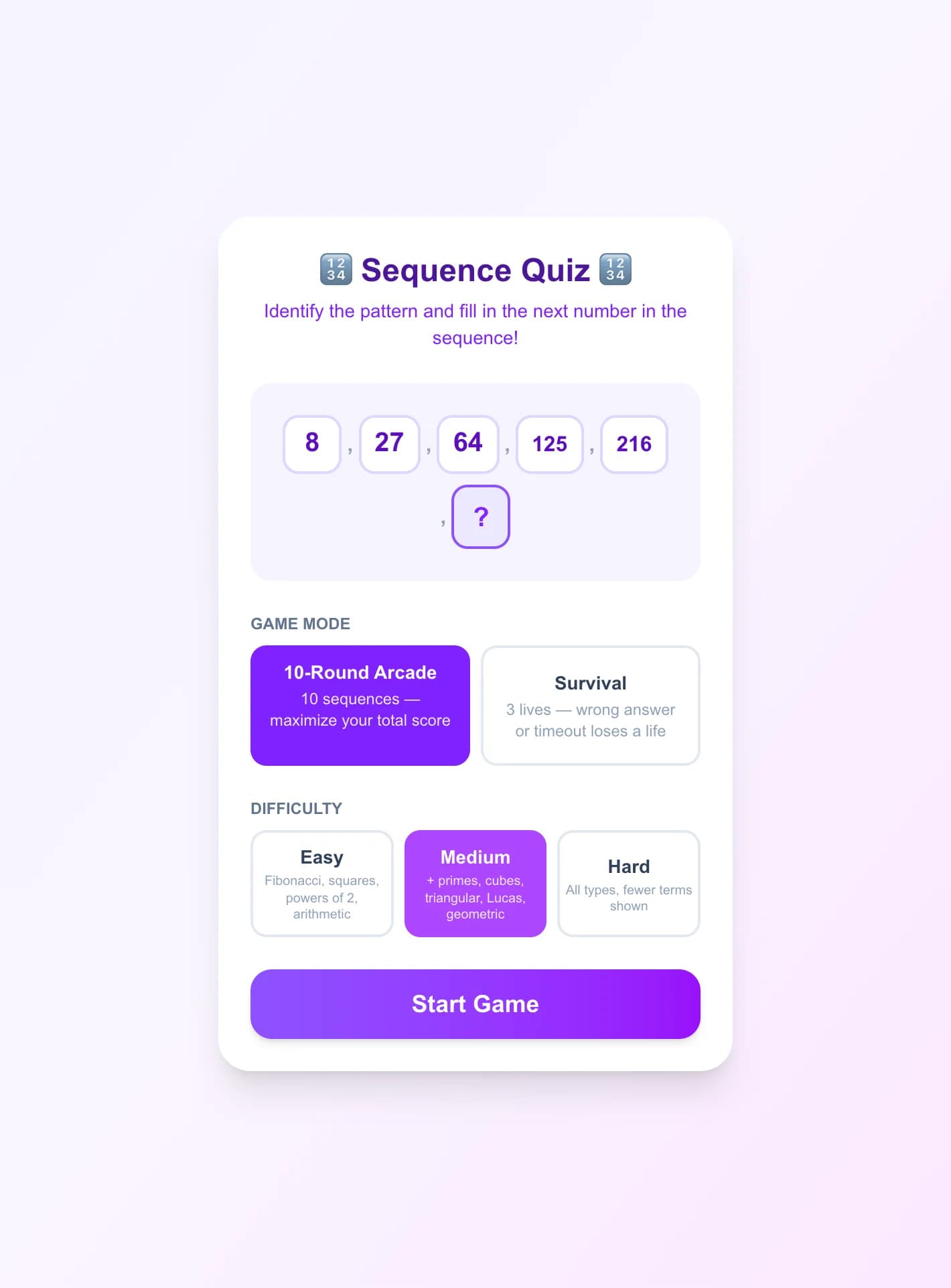
Spot the pattern and fill in the missing number! Each round shows a well-known mathematical sequence with the next term hidden. Identify whether it's Fibonacci, prime numbers, perfect squares, factorials, or one of nine other sequence types — then type your answer before the countdown runs out.
How to Play Sequence Quiz
- 1
Choose Settings
Select a difficulty (Easy shows 6 terms, Medium 5, Hard 4) and pick Arcade (10 rounds) or Survival (3 lives). Fewer visible terms make it harder to identify the pattern.
- 2
Study the Sequence
A row of numbers appears with the last term hidden as a '?'. Study the visible terms — look for differences, ratios, or recognizable growth patterns.
- 3
Enter the Missing Number
Type the next term in the sequence into the input field. Work quickly — a countdown timer ticks down and fast correct answers earn speed bonus points.
- 4
Learn and Move On
After submitting, the sequence name and correct answer are revealed. Whether right or wrong, you learn what pattern was hidden. The game tracks your streak and score.
Key Features
12 Sequence Types in One Game
Fibonacci, Lucas, primes, perfect squares, cubes, triangular numbers, powers of 2 and 3, factorials, oblong numbers, arithmetic progressions, and geometric progressions — all in a single game.
Sequence Revealed After Each Answer
After submitting, the full sequence name is shown (e.g. 'Triangular Numbers' or 'Powers of 3') along with the correct answer — so every round is a learning moment.
Progressive Difficulty by Sequence Type
Easy mode uses accessible sequences (Fibonacci, squares). Medium and Hard unlock rarer types like factorials, powers of 3, and oblong numbers — rewarding players who learn the patterns.
Varied Starting Positions
Sequences don't always start at the beginning — the visible terms shift to different offsets each round, preventing memorization and requiring true pattern understanding.
What is the Sequence Quiz?
The Sequence Quiz is an educational math game that challenges players to identify mathematical sequences and predict the next term. It covers 12 classic sequence types from the Fibonacci sequence (1, 1, 2, 3, 5, 8…) and prime numbers to more advanced patterns like triangular numbers, Lucas numbers, and factorials. The game is designed to build both pattern recognition skill and knowledge of important mathematical sequences — concepts that appear in number theory, computer science, and competitive math.
Why Play the Sequence Quiz?
- 1
Discover Famous Math Sequences
Learn the Fibonacci sequence, perfect squares, triangular numbers, and prime numbers through play — sequences that appear everywhere from nature to computer algorithms.
- 2
Sharpen Pattern Recognition
Identifying whether a sequence grows linearly, quadratically, multiplicatively, or follows a sum rule builds the abstract reasoning central to higher mathematics.
- 3
Great for Competitive Math Prep
AMC, MATHCOUNTS, and other competitions frequently test knowledge of number sequences. This game builds familiarity with the most commonly tested types.
- 4
Adaptive Challenge Levels
From straightforward Fibonacci (Easy) to factorials with only 4 terms visible (Hard), the difficulty scales smoothly from elementary through advanced level.
Frequently Asked Questions
What are all the sequence types included?
Fibonacci (1,1,2,3,5…), Lucas (2,1,3,4,7…), Primes (2,3,5,7,11…), Perfect Squares (1,4,9,16…), Cubes (1,8,27,64…), Triangular Numbers (1,3,6,10…), Powers of 2 (1,2,4,8…), Powers of 3 (1,3,9,27…), Factorials (1,2,6,24…), Oblong Numbers (2,6,12,20…), Arithmetic Progressions (random start and step), and Geometric Progressions (random ratio).
What does difficulty level change?
Difficulty controls two things: how many terms are shown (6 for Easy, 5 for Medium, 4 for Hard), and which sequence types appear. Easy sticks to the most recognizable sequences. Hard includes all types, making pattern identification with fewer terms genuinely challenging.
How is the speed bonus calculated?
The speed bonus adds up to 50 extra points for answering immediately. The bonus decreases as the countdown runs down — if you answer with 3 seconds left, you get a small bonus; answering in the first second earns nearly the full +50.
Why do arithmetic and geometric sequences have different numbers each time?
Random parameters keep these sequences fresh. An arithmetic sequence might be 7, 12, 17, 22… in one round (step +5) and 3, 8, 13, 18… in another (also step +5 but different start). This prevents memorization.
What does the 'round-by-round table' show in the results?
The results table shows every question's sequence name, the answer you gave, the correct answer, and whether you got it right — making it a useful review to see which sequence types you struggled with.