BrowserFun
New GamesCategoriesView All
© 2026 BrowserFun. All rights reserved.
Privacy PolicyTerms & ConditionsCookie PolicyDisclaimer
  1. Home
  2. Tools
  3. Word Ladder Game – Transform Words One Letter at a Time

Word Ladder Game – Transform Words One Letter at a Time

Play the classic word ladder puzzle! Change one letter at a time to transform a start word into a target word. Choose from 3, 4, or 5-letter challenges across multiple categories.

GameWordPuzzle3rd Grade4th Grade
Word Ladder Game – Transform Words One Letter at a Time - Play the classic word ladder puzzle! Change one letter at a time to transform a

How To Use

  1. 1

    Pick a difficulty level and category, or choose a specific puzzle

  2. 2

    Look at the start word and target word

  3. 3

    Type a new word that differs by exactly one letter from the current word

  4. 4

    Each word must be a valid English word

  5. 5

    Keep going until you reach the target word

  6. 6

    Try to reach the target in as few steps as possible — par or under!

Key Features

  • Three difficulty levels: Easy (3-letter words), Medium (4-letter words), Hard (5-letter words)

  • Multiple categories: Classic, Opposites, Animals, Nature, Body, and Mixed puzzles

  • Par scoring: compare your solution to the optimal path length

  • Hints system: get up to 3 hints per puzzle revealing the next optimal step

  • Undo & review: take back moves and view your complete path

  • Solution reveal: see the optimal path if you get stuck

What Is Word Ladder?

Word Ladder is a classic word puzzle invented by Lewis Carroll in 1877. Your goal is to transform a start word into a target word by changing exactly one letter at each step, with every intermediate step being a valid English word. Choose from 3, 4, or 5-letter challenges across multiple categories.

Why Play Word Ladder?

  • 1

    Strengthens Vocabulary and Spelling

    Finding valid one-letter changes forces you to actively explore the space of English words, reinforcing spelling patterns and expanding vocabulary through play.

  • 2

    Develops Lateral Thinking

    The most direct path between two words is rarely obvious — the game trains creative, non-linear problem solving as you experiment with intermediate steps.

  • 3

    Par System Encourages Optimization

    Comparing your solution length to the optimal par gives a built-in challenge beyond just completing the puzzle, motivating players to find more efficient paths.

Frequently Asked Questions

What is a Word Ladder?

A Word Ladder is a word puzzle where you transform one word into another by changing one letter at a time, with each intermediate step being a valid English word. It was invented by Lewis Carroll in 1877.

What does 'par' mean in Word Ladder?

Par is the minimum number of steps needed to complete the puzzle using the optimal path. Finishing at or under par means you found an efficient solution!

How many hints do I get?

You get 3 hints per puzzle. Each hint reveals the next word in the optimal solution path.

What word lengths are available?

Easy mode uses 3-letter words, Medium uses 4-letter words, and Hard uses 5-letter words.

Related Tools

GameAll →

🃏 24 Game 🃏

The classic 24 card game! Given 4 random numbers, combine them using +, −, ×, ÷ to reach exactly 24. Every number must be used exactly once. Choose your difficulty (1–6, 1–9, or 1–13), build a streak, and beat your best time!

🔢 Sudoku 🔢

Classic 9×9 Sudoku with four difficulty levels — Easy, Medium, Hard, and Expert. Features a live timer, mistake counter, pencil notes, and 3 hints per puzzle. Beat your best time!

🧩 MathDoku 🧩

A KenKen-style arithmetic puzzle! Fill the grid with 1–N so every row and column contains each number exactly once. Each outlined cage must equal its target value using addition, subtraction, multiplication, or division. Choose from 4×4, 5×5, or 6×6 grids.

2D Shape Explorer

Identify 2D shapes like triangles, squares, pentagons, hexagons, and more by counting their sides and corners. Features colorful SVG shapes, multiple question types (name, sides count, corners count), and three difficulty levels.

Acronym Generator

Turn any word into a creative acronym expansion! Pick a word from 42 preset options across 6 categories — or type your own — then fill in a word for each letter to build your unique acronym. Compare your creation with a built-in fun alternative.

Acrostic Puzzle – Solve Clues to Reveal a Hidden Phrase

Play acrostic puzzles where you solve word clues and the first letters of each answer spell out a hidden phrase. Features five categories, three difficulty levels, and a hint system.

WordAll →

Acronym Generator

Turn any word into a creative acronym expansion! Pick a word from 42 preset options across 6 categories — or type your own — then fill in a word for each letter to build your unique acronym. Compare your creation with a built-in fun alternative.

Acrostic Puzzle – Solve Clues to Reveal a Hidden Phrase

Play acrostic puzzles where you solve word clues and the first letters of each answer spell out a hidden phrase. Features five categories, three difficulty levels, and a hint system.

Anagram Solver Game

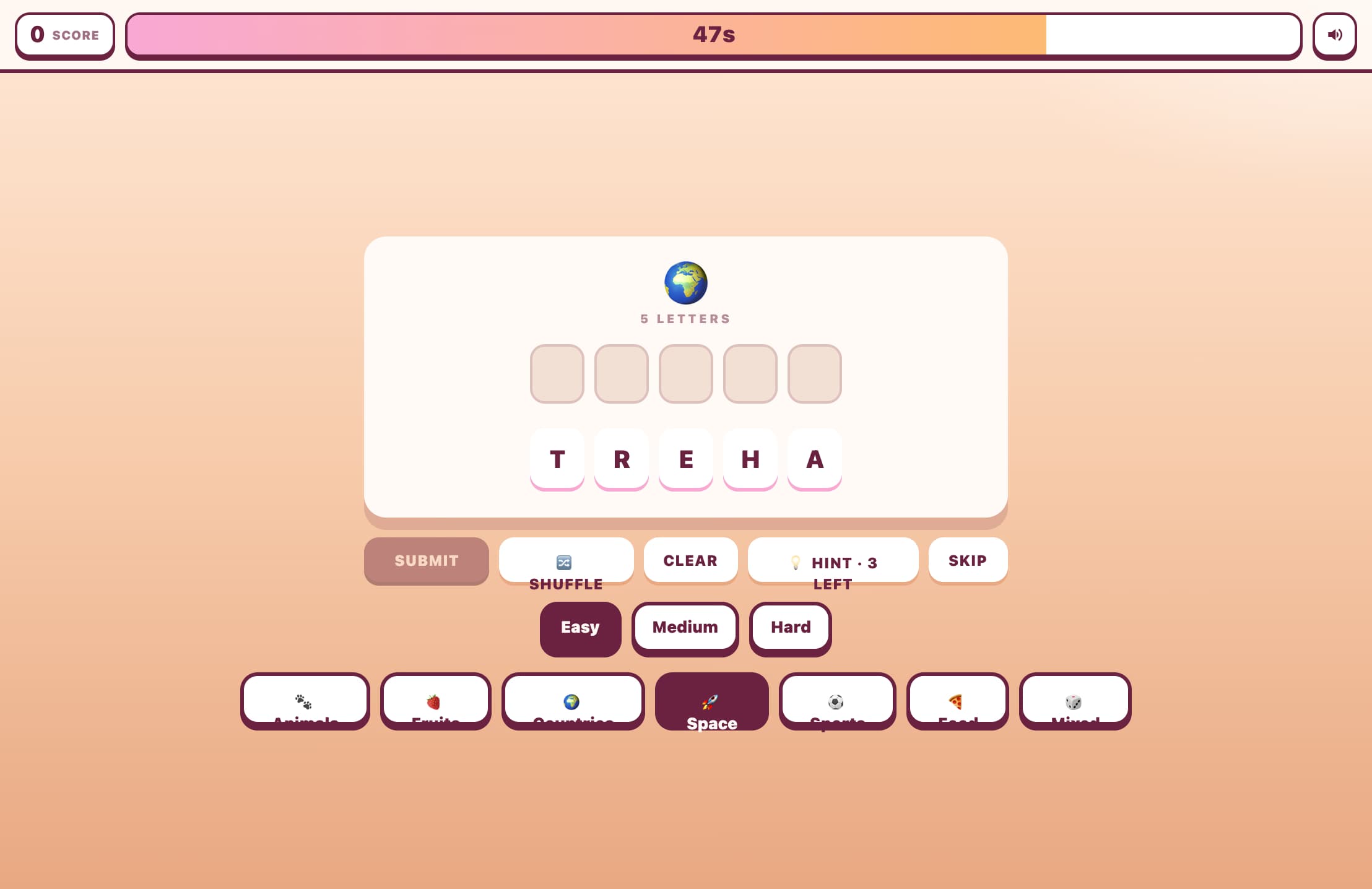
Unscramble jumbled letters to form the hidden word! Choose from 7 categories and 3 difficulty levels. Race against the timer, use hints, and build your streak in this fun anagram word game.

Complete the Phrase — Collocation Quiz

A phrase with a missing word — pick the one that sounds natural in English. Covers the three biggest collocation challenges: which verb fits (make/do/take/have), which preposition follows the verb (rely on, consist of), and classic fixed phrases (burn the midnight oil, foregone conclusion).

Connotation Vocabulary Game — Word Tone Quiz

Four near-synonyms appear on screen — same basic meaning, but very different emotional weight. Is 'thrifty' the most positive, or is it 'frugal'? Is 'arrogant' worse than 'presumptuous'? Pick the word that best matches the prompt (most positive or most negative) across 45 questions tiered from Grade 9 to SAT Prep.

Context Clues — Vocabulary in Passages

A short passage appears with one word highlighted. Use the surrounding sentences to figure out what it means, then pick from four definitions. Directly simulates SAT Reading comprehension questions. The SAT tier focuses on common words used in unexpected academic senses — the most tested skill on the exam.

PuzzleAll →

🔢 Sudoku 🔢

Classic 9×9 Sudoku with four difficulty levels — Easy, Medium, Hard, and Expert. Features a live timer, mistake counter, pencil notes, and 3 hints per puzzle. Beat your best time!

🧩 MathDoku 🧩

A KenKen-style arithmetic puzzle! Fill the grid with 1–N so every row and column contains each number exactly once. Each outlined cage must equal its target value using addition, subtraction, multiplication, or division. Choose from 4×4, 5×5, or 6×6 grids.

Acrostic Puzzle – Solve Clues to Reveal a Hidden Phrase

Play acrostic puzzles where you solve word clues and the first letters of each answer spell out a hidden phrase. Features five categories, three difficulty levels, and a hint system.

Algebra Challenge — High School Math Quiz

Solve equations, factor polynomials, simplify expressions — pick the correct answer from four choices. 45 problems across three tiers: Algebra I (linear equations, slope, basic factoring), Algebra II (quadratics, systems, logs, sequences), and Advanced (pre-calculus, complex numbers, inverse functions, infinite series).

Anagram Solver Game

Unscramble jumbled letters to form the hidden word! Choose from 7 categories and 3 difficulty levels. Race against the timer, use hints, and build your streak in this fun anagram word game.

Argument Types — Logic & Fallacy Quiz

Identify whether an argument is deductive, inductive, or abductive — and name the logical fallacy when one is present. 45 problems across three tiers: Foundation covers the most common fallacies (ad hominem, straw man, false dilemma, slippery slope, appeal to authority, bandwagon, hasty generalization, appeal to ignorance) and basic argument types. Intermediate adds subtle informal fallacies (post hoc, tu quoque, anecdotal evidence, appeal to nature, poisoning the well, circular reasoning, relative privation). Advanced covers formal fallacies (affirming the consequent, denying the antecedent, modus tollens), validity vs. soundness, equivocation, and abductive reasoning.