Compare Sizes and Build Measurement Concepts
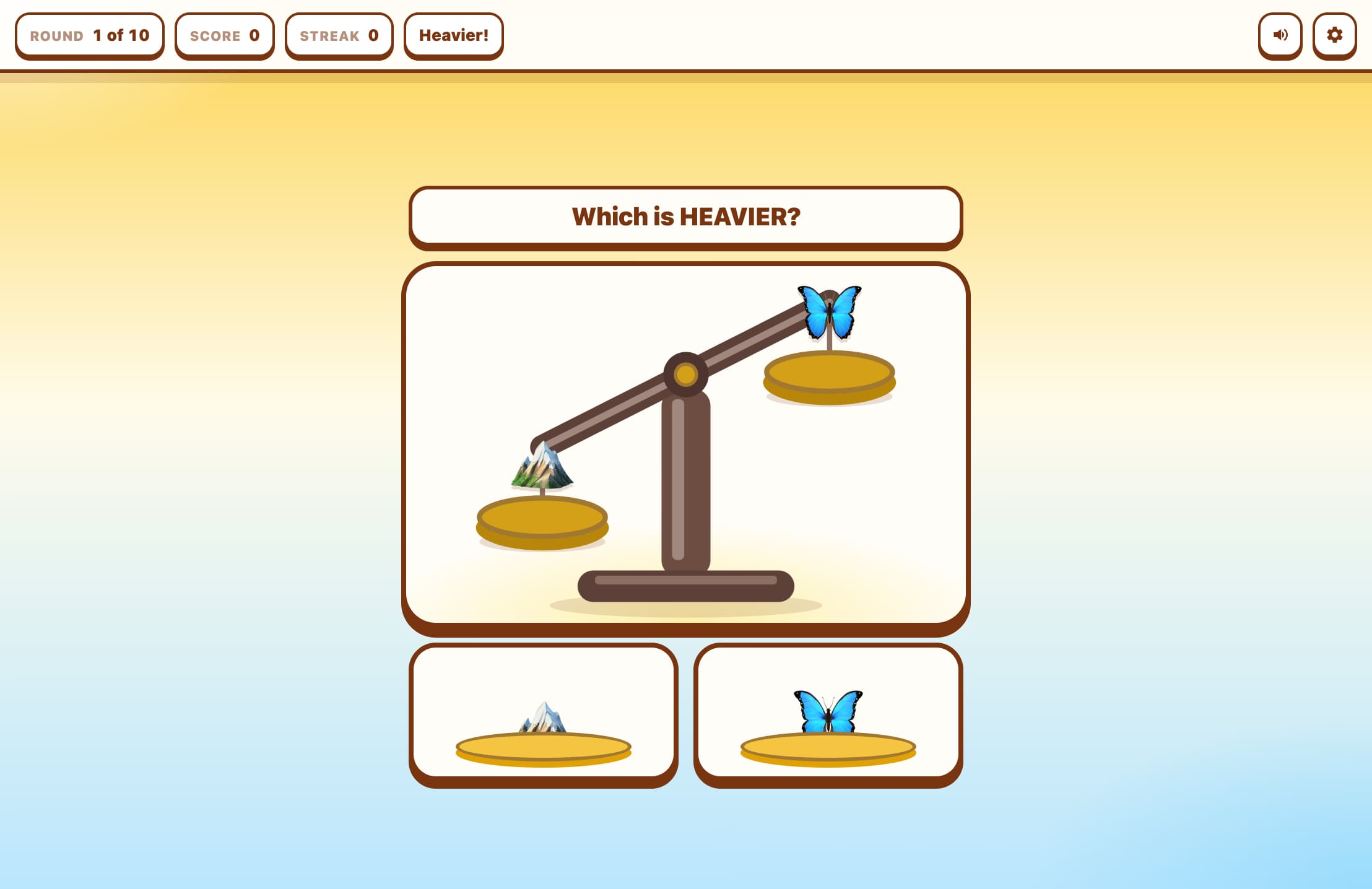
Two illustrated objects appear at different sizes — tap the taller, shorter, bigger, or smaller one! A fun visual game that teaches measurement vocabulary and size comparison for young learners.
More like this
How To Use
Choose your difficulty — Easy for obvious differences, Hard for sizes just one step apart.
Read the question in the banner at the top (e.g. 'Which is TALLER?').
Look at the two objects shown at different sizes side by side.
Tap the one that correctly answers the question.
See 'Taller!', 'Shorter', 'Bigger!', or 'Smaller' labels appear on each card to confirm!
Key Features
22 rotating objects including trees, animals, buildings, and flowers keep every round fresh
5 distinct size levels create clearly visible differences between the two objects
Green ground baseline for taller/shorter questions mirrors real-world height measurement
4 question types: taller, shorter, bigger, smaller — all practiced in rotation
Vocabulary labels appear on cards after each answer to reinforce size words
Two modes: 10-Round Arcade and 60-Second Rush for quick daily practice
What Is Tall or Short?
Tall or Short? is a visual size-comparison game that builds foundational measurement concepts. Each round, the same emoji character or object appears side by side at two different sizes. You're asked one of four questions: 'Which is TALLER?', 'Which is SHORTER?', 'Which is BIGGER?', or 'Which is SMALLER?' — tap the correct side to answer. For taller/shorter questions, both objects stand on a visible ground line so the height difference is intuitive. Labels appear after each answer to reinforce the vocabulary.
Why Play Tall or Short?
Builds Measurement Vocabulary Through Play
Words like 'taller', 'shorter', 'bigger', and 'smaller' are core measurement vocabulary in early math. By repeatedly using these words in context — seeing and choosing — children build a concrete, visual understanding of what they mean.
The Ground Line Makes Height Intuitive
For taller/shorter questions, both objects 'stand' on a green ground baseline. This mirrors how height is actually measured in real life — from the ground up — making the concept immediately understandable even to very young children.
Scales From Obvious to Subtle
Easy mode shows sizes that are dramatically different (≥ 2 levels apart) so children can answer instantly by visual perception alone. Hard mode presents sizes just one step apart, requiring careful visual discrimination — excellent for developing perceptual acuity.
Frequently Asked Questions
What age group is this game designed for?
The game is ideal for children aged 3–8. Easy mode (very obvious size differences, only taller/shorter) is accessible to 3–4 year olds. Medium mode introduces all four vocabulary words. Hard mode (sizes just 1 step apart) challenges 6–8 year olds developing precise visual discrimination.
Why does the game use the same emoji at different sizes rather than different objects?
Using the same emoji ensures the comparison is purely about size, not about which object type is inherently larger. Children must judge the displayed size rather than using prior knowledge (e.g., knowing elephants are bigger than mice). This isolates the size comparison skill.
What is the difference between 'taller/shorter' and 'bigger/smaller' questions?
For taller/shorter, both objects stand on a ground line so the comparison is vertical height. For bigger/smaller, objects float in the center of the card for an overall size comparison. This introduces the idea that 'tall' specifically refers to height while 'big' refers to overall size — a subtle but important distinction.
Why are labels like 'Taller!' shown on both cards after answering?
Labeling both cards (the winner with 'Taller!' and the other with 'Shorter') reinforces the relationship between the two objects. Children see both vocabulary words simultaneously, understanding that the same comparison looks different from each object's perspective.
How many size levels are there?
There are 5 size levels. Objects can be 32px, 50px, 68px, 86px, or 104px in displayed size. Easy mode picks pairs ≥ 2 levels apart, Hard mode picks pairs exactly 1 level apart. This gives a nice graduated challenge that grows with the player.