BrowserFun
New GamesAll Games
  • Home
  • New Games
  • Games
BrowserFun

Free educational games for every classroom.

Categories

  • Math
  • English Language Arts
  • Social Studies
  • Technology
  • Science & Nature

Explore

  • All Games
  • New Games
  • All categories

Legal

  • Privacy Policy
  • Terms & Conditions
  • Cookie Policy
  • Disclaimer

© 2026 BrowserFun. All rights reserved.

  1. Home
  2. Tools
  3. Dye Rack

Dye Rack

A sunlit dye stall, glass jars, and a wooden crate. Each jar is a strip model of a fraction with the same denominator. Pick a jar up and set it on the crate from least full to most full. Wrong seats slosh. Eight crates win a run. Built for fourth-grade ordering fractions.

GameMathFractions3rd–5th

How to Play Dye Rack

  1. 1

    Read the Jars

    Jars on the table show fractions such as 2/7 and 5/7. Same denominator. The shorter dye fill is the smaller fraction.

  2. 2

    Pick One Up

    Drag a jar onto the wooden crate. Least full goes in the left bay. Most full goes in the right bay.

  3. 3

    Keep What Seats

    A correct drop scores and stays. A wrong bay sloshes the jar back and costs a life.

  4. 4

    Clear Eight Crates

    Fill every bay to dry a crate. Streaks add fifty a pop. Three sloshes close the stall.

Key Features

  • Glass Strip Models

    Every jar is the same height. The dye fill is the numerator. Students compare how full the jars are.

  • Set Them on the Crate

    Pick a jar up and drop it in a bay. Left is least full. Right is most full.

  • A Slosh Is a Miss

    A jar in the wrong bay rocks back to the table. The ones already seated stay put.

  • Three Stall Speeds

    Easy seats two jars. Medium adds a third. Hard lines up four tight fills.

What is Dye Rack?

Dye Rack is a fourth-grade fractions game. A market stall holds glass dye jars. Each jar is a strip model of a fraction with a shared denominator. The player sets the jars on a crate from least full to most full. Ordering numerators is moving bottles, not ticking boxes.

Why Play Dye Rack?

  • 1

    Fill You Can See

    Dye height is the numerator. Students order by looking at the glass, then check the tag.

  • 2

    Like Denominators

    A shared denominator makes the rule plain: fewer filled rings means a smaller fraction.

  • 3

    Hands on the Crate

    Jars are picked up and set down. Wrong seats splash back. The stall changes on every drop.

  • 4

    Touch First

    Jars and bays are large. The mute plate sits with the score row, not under the fullscreen control.

Frequently Asked Questions

Which jar goes on the left?

The least full jar — the smallest fraction. That is the shortest dye fill.

How do I move a jar?

Press and drag it onto a crate bay. Drop it in the bay that matches its order from least to most.

What if I put a full jar on the left?

It sloshes back to the table. That costs a life. Jars already seated stay in the crate.

What do Easy, Medium, and Hard change?

How many jars sit on the stall. The least-to-most rule stays the same.

What grade is this for?

Third through fifth grade (about ages 8–11), when students compare and order fractions with like denominators. Stay on Easy for two jars.

Related Tools

GameAll →

🃏 24 Game 🃏

The classic 24 card game! Given 4 random numbers, combine them using +, −, ×, ÷ to reach exactly 24. Every number must be used exactly once. Choose your difficulty (1–6, 1–9, or 1–13), build a streak, and beat your best time!

🔢 Sudoku 🔢

Classic 9×9 Sudoku with four difficulty levels — Easy, Medium, Hard, and Expert. Features a live timer, mistake counter, pencil notes, and 3 hints per puzzle. Beat your best time!

🧩 MathDoku 🧩

A KenKen-style arithmetic puzzle! Fill the grid with 1–N so every row and column contains each number exactly once. Each outlined cage must equal its target value using addition, subtraction, multiplication, or division. Choose from 4×4, 5×5, or 6×6 grids.

2D Shape Explorer

Identify 2D shapes like triangles, squares, pentagons, hexagons, and more by counting their sides and corners. Features colorful SVG shapes, multiple question types (name, sides count, corners count), and three difficulty levels.

Acronym Slam – Build a Funny Backronym

Play Acronym Slam in the browser. A word lands on the board, then you slam a silly English slip onto each letter to invent a backronym. Party mode is untimed. Lightning races a 28-second clock. Compare your phrase with a built-in funny expansion and keep a best score.

Acrostic Puzzle – Tap Words to Reveal a Secret Word

Play a kid-friendly acrostic game: tap the word that matches each clue. The first letters stack up and spell a secret word. Three difficulty levels, lives, and a high score.

MathAll →

🃏 24 Game 🃏

The classic 24 card game! Given 4 random numbers, combine them using +, −, ×, ÷ to reach exactly 24. Every number must be used exactly once. Choose your difficulty (1–6, 1–9, or 1–13), build a streak, and beat your best time!

🔢 Sudoku 🔢

Classic 9×9 Sudoku with four difficulty levels — Easy, Medium, Hard, and Expert. Features a live timer, mistake counter, pencil notes, and 3 hints per puzzle. Beat your best time!

🧩 MathDoku 🧩

A KenKen-style arithmetic puzzle! Fill the grid with 1–N so every row and column contains each number exactly once. Each outlined cage must equal its target value using addition, subtraction, multiplication, or division. Choose from 4×4, 5×5, or 6×6 grids.

2D Shape Explorer

Identify 2D shapes like triangles, squares, pentagons, hexagons, and more by counting their sides and corners. Features colorful SVG shapes, multiple question types (name, sides count, corners count), and three difficulty levels.

Add the Animals

2 cats + 3 cats = ? Count adorable animal emoji to solve addition problems up to 10. A visual and engaging way for young learners to practice adding numbers through counting.

Algebra Challenge — High School Math Quiz

Solve equations, factor polynomials, simplify expressions — pick the correct answer from four choices. 45 problems across three tiers: Algebra I (linear equations, slope, basic factoring), Algebra II (quadratics, systems, logs, sequences), and Advanced (pre-calculus, complex numbers, inverse functions, infinite series).

FractionsAll →

Fraction Frenzy

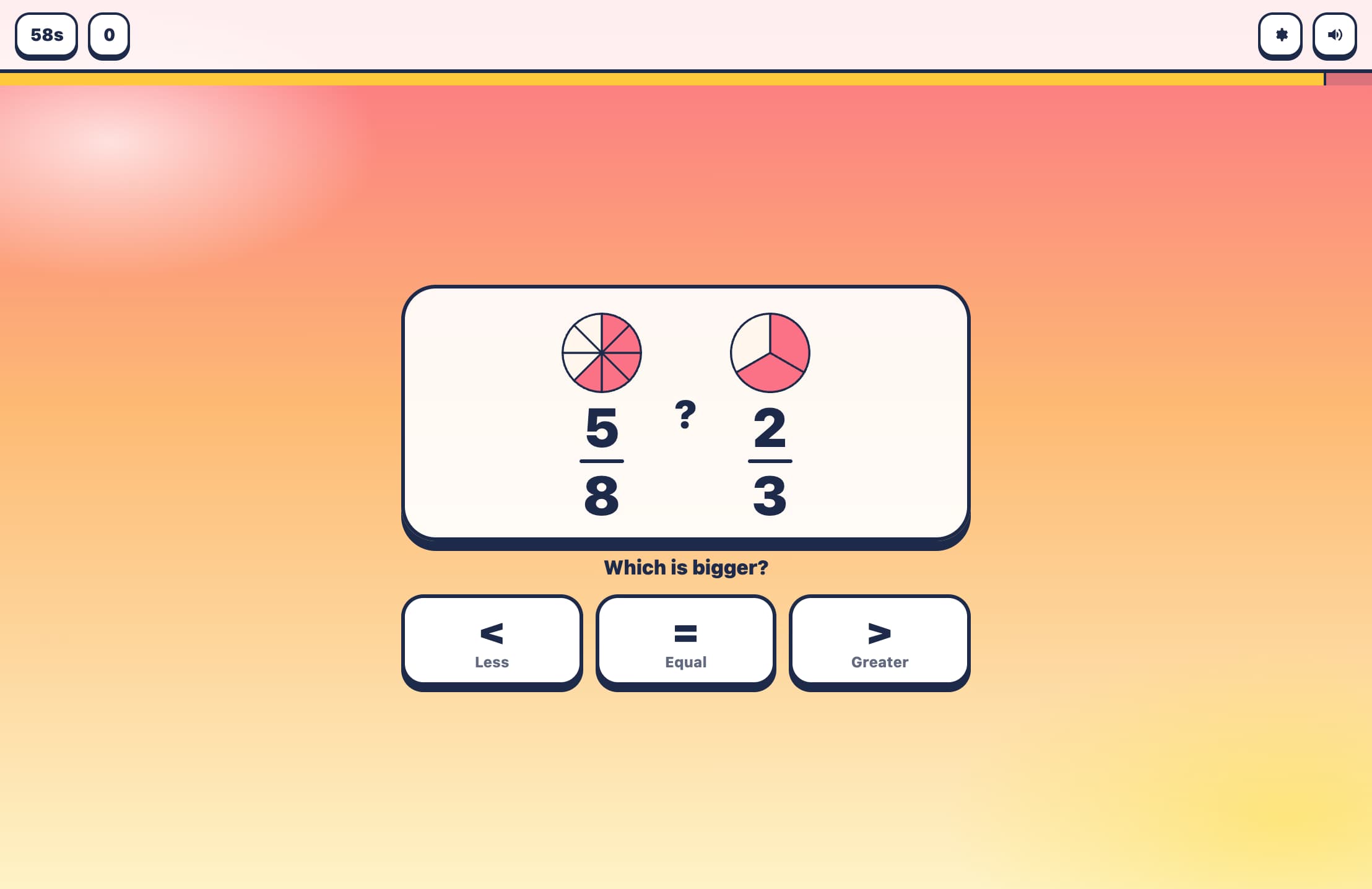
Compare or sort fractions in this fast-paced math challenge. Which fraction is bigger? Tap them in order smallest to largest — race the clock or survive on 3 lives!

Kelp Roll

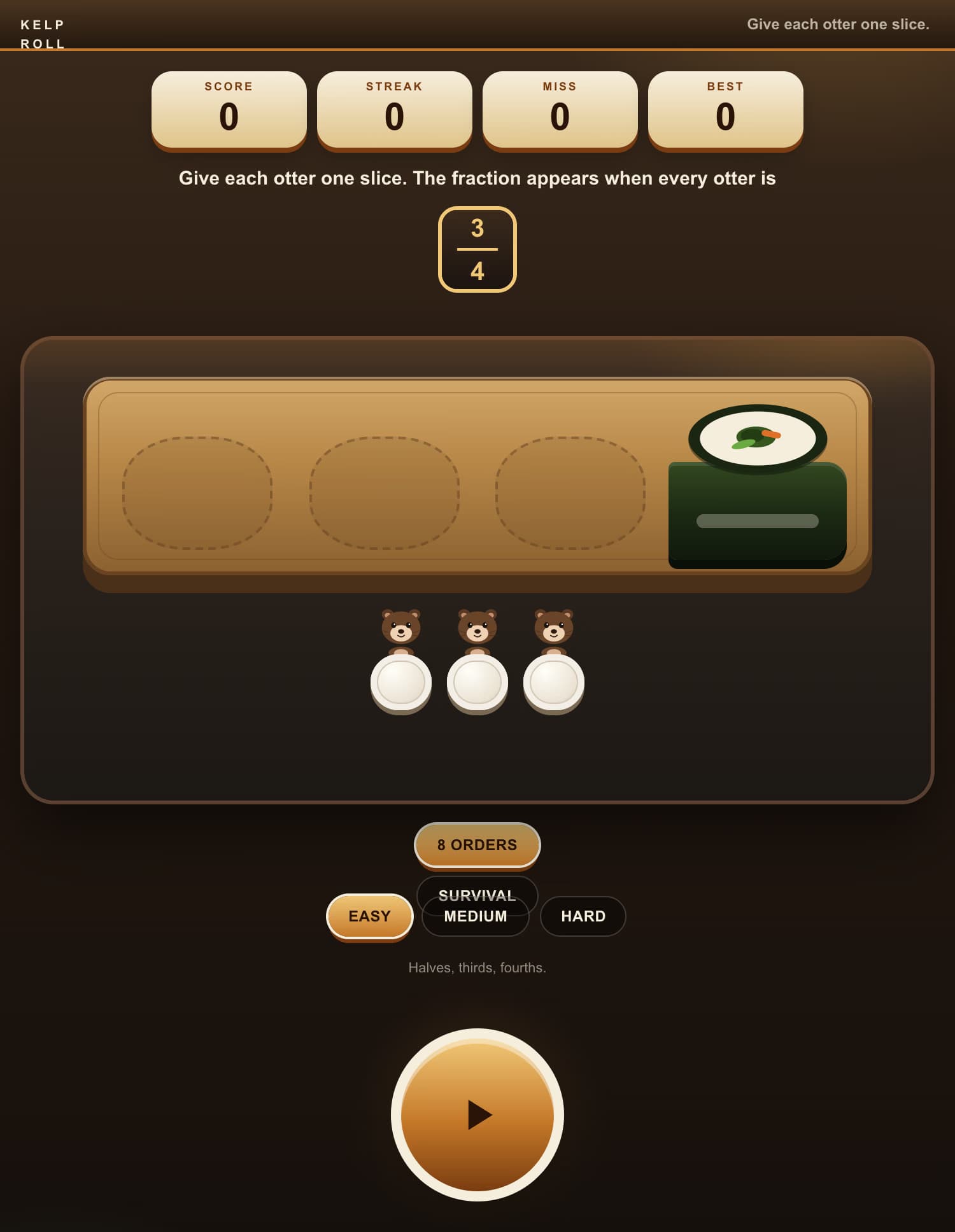
A tide kitchen, a kelp roll cut into equal rings, and hungry otters with empty plates. Tap one ring for each guest. When every plate is full, the fraction of the roll you served lights up. Built for third-grade equal parts.

Lode Crack

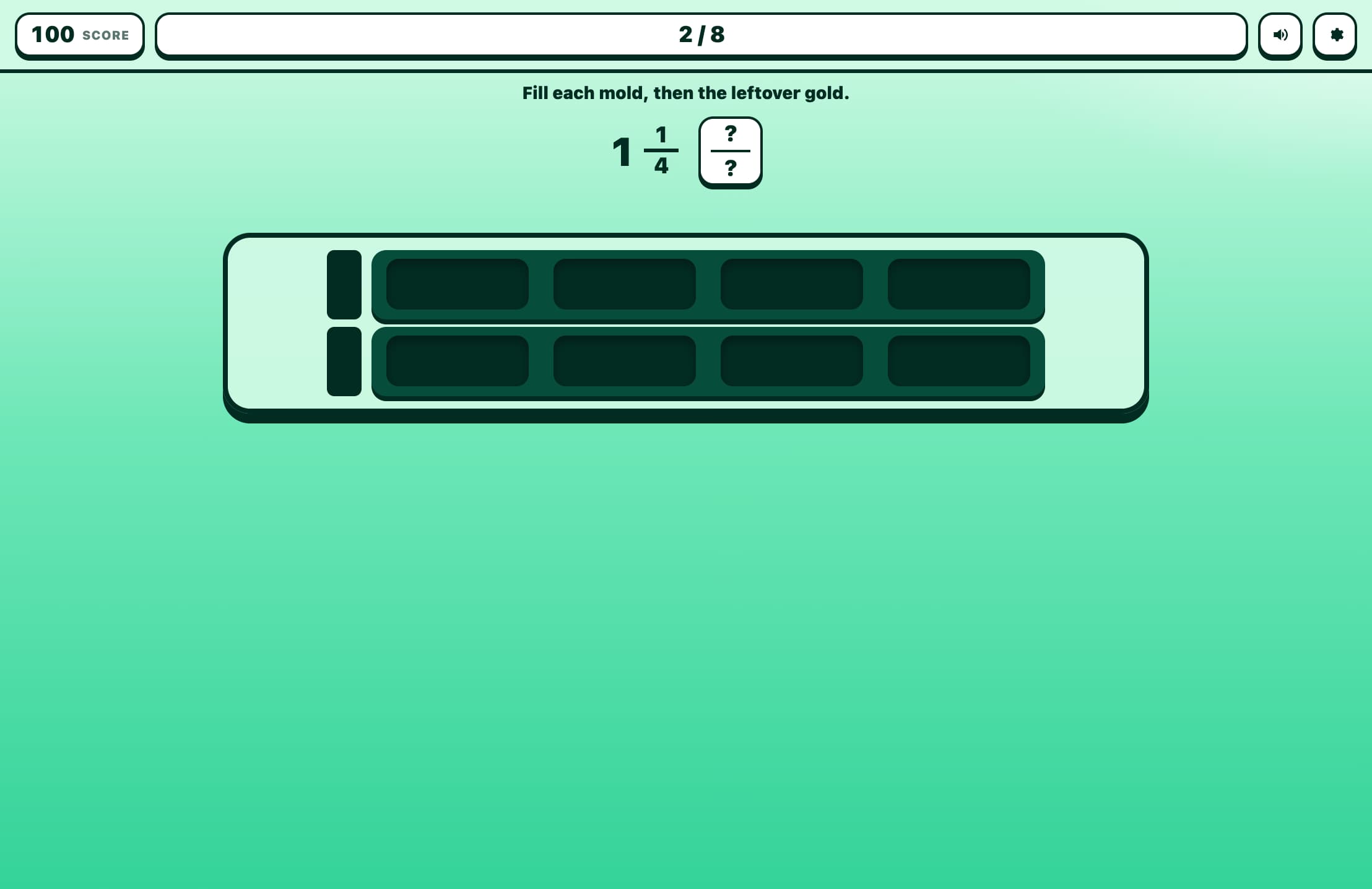
A mine workbench, iron molds, and gold ingots. Each mold is one whole cut into equal chunks. Pour the whole molds, then the leftover gold. When the haul matches the mix, the improper fraction lights up. Built for fourth-grade mixed numbers.

Mesa Hop

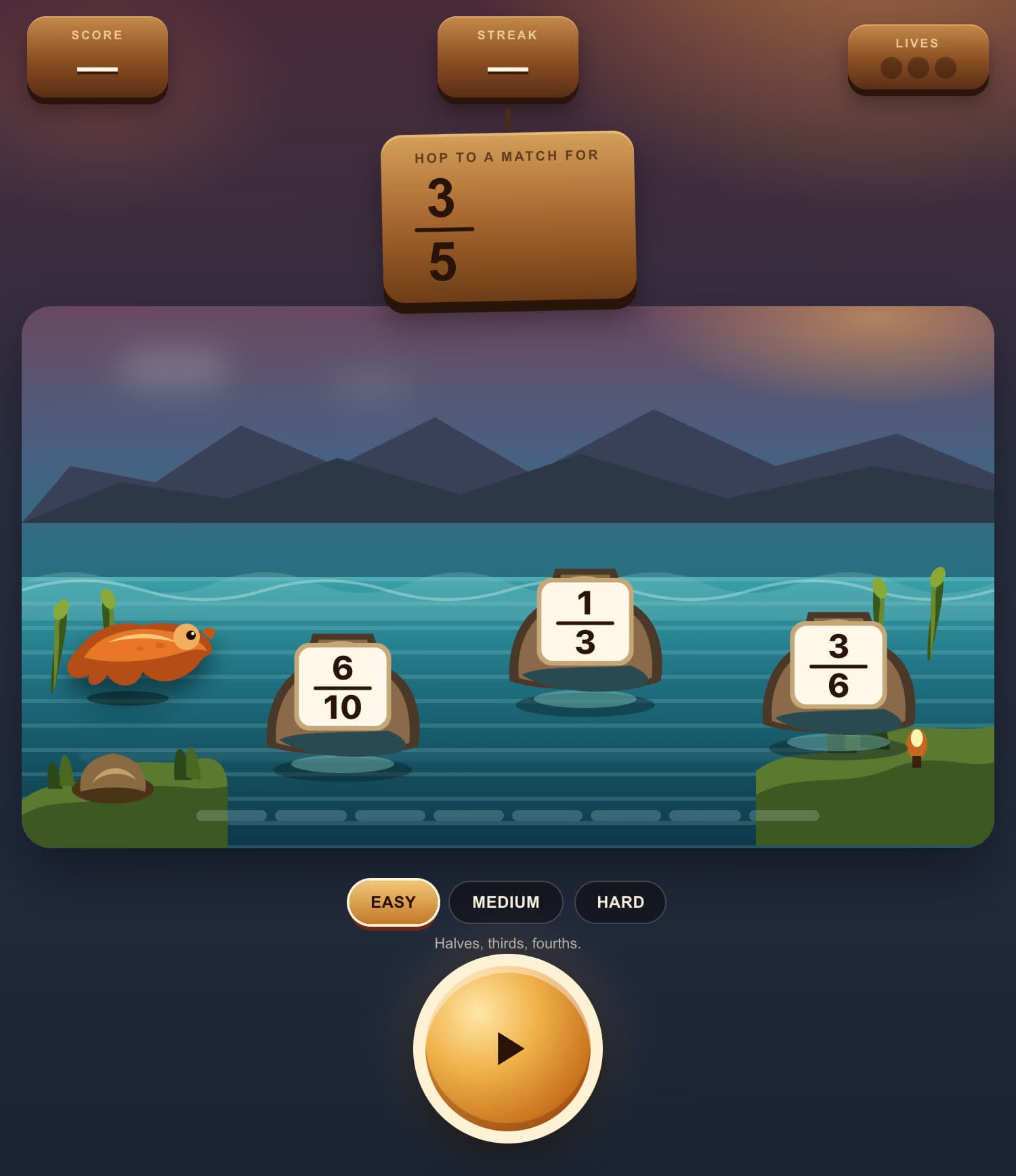
Help a copper gecko hop across a twilight canyon. A fraction such as 1/2 sits on the prompt plaque. Jump only onto sandstone pillars that show an equivalent, like 2/4 or 3/6. Space, Hop, or a tap on a stone sends the gecko. A miss drops into the wash and costs a life. Eight safe hops reach the lantern camp.

Prism Mix

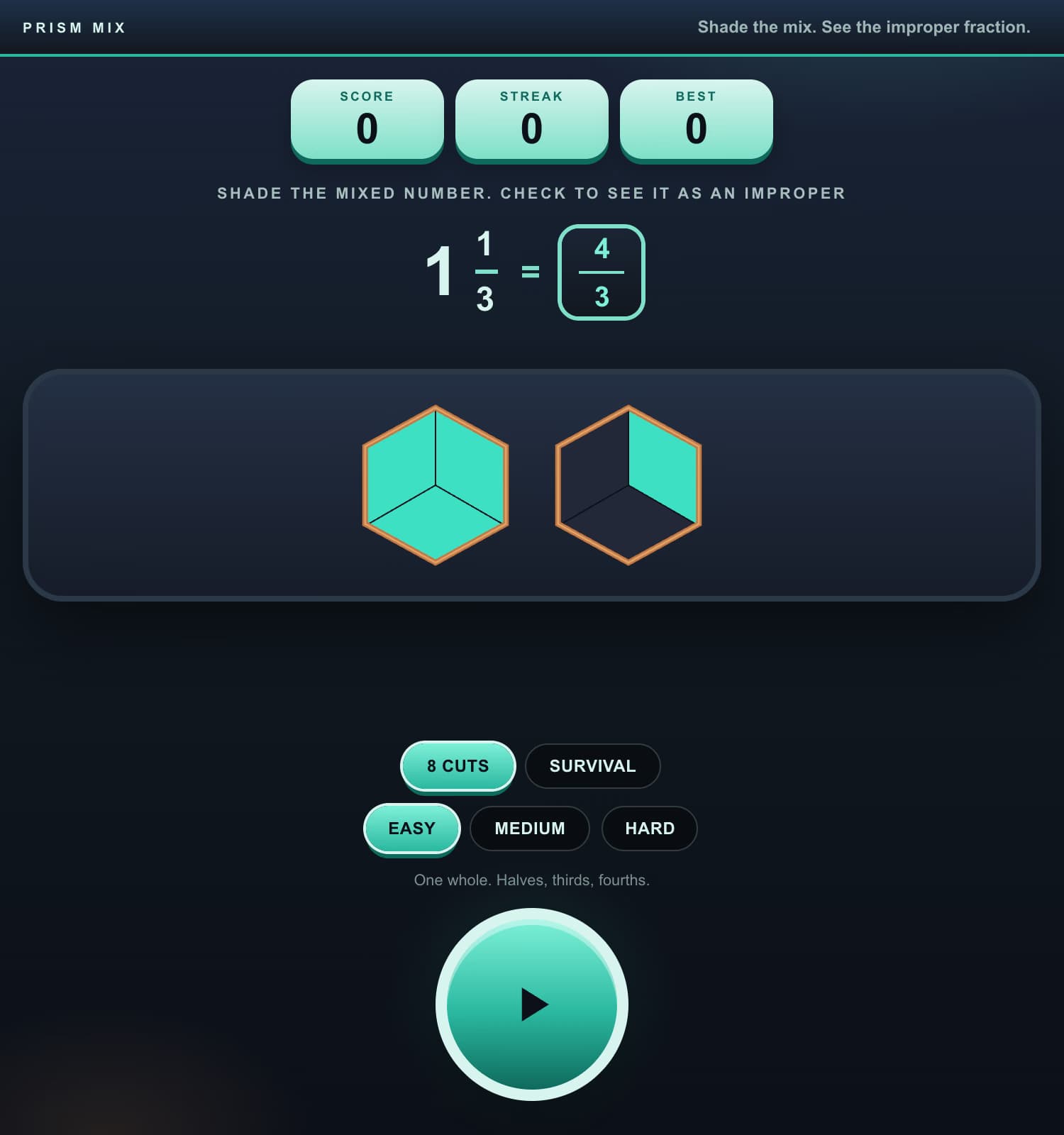
A dusk glass studio, copper frames, and hexagonal prisms. Shade facets to match a mixed number like 1 1/6. Then type the improper fraction on the workbench pad. A clean shade and a clean write both score. Built for fourth-grade mixed numbers.

Skillet Flip

Flip the right number of cakes so the skillet matches a fraction of the whole set. Fourth and fifth graders tap cakes, then ring the bell when 3/8 of 16 or 2/5 of 20 is on the stack. Fast rounds make parts of a set feel like a short-order rush instead of a worksheet.

Dye Rack - A sunlit dye stall, glass jars, and a wooden crate. Each jar is a strip model of