Classify Quadrilaterals and Triangles
Shape Glassworks
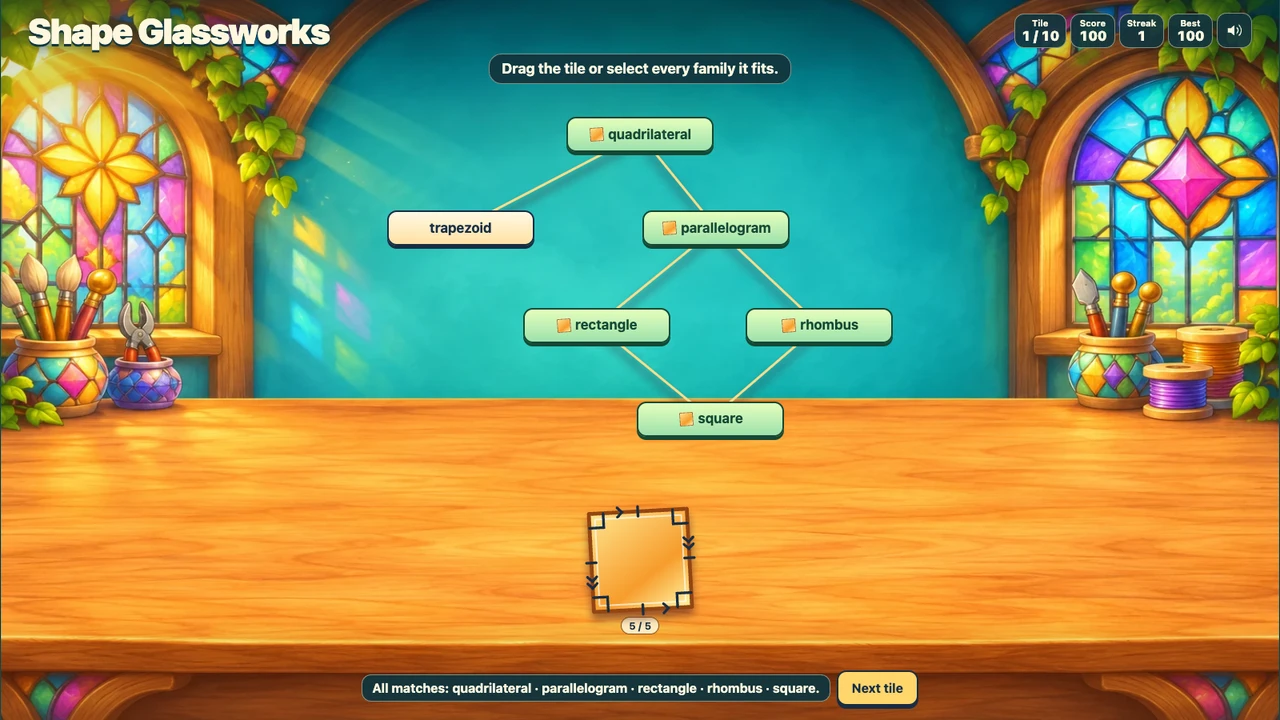
Sort ten stained-glass tiles in a geometry workshop. Place each quadrilateral in every family it belongs to, then classify triangles by their sides and angles.
More like this
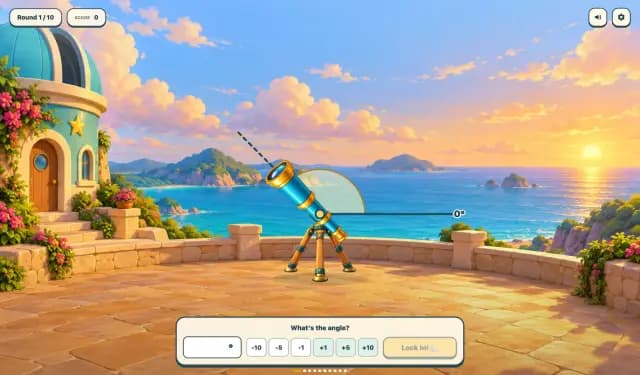
How to Play Shape Glassworks
- 1
Inspect the tile
Look at the tile on the workbench. Check its sides and corners before choosing a family.
- 2
Place the tile
Drag the tile to a family or select that family directly. With a keyboard, use Tab to reach a family and Enter or Space to select it.
- 3
Find every match
A correct match leaves a copy in its spot. Keep sorting the same tile until all its families are filled. If a spot doesn’t fit, try another.
- 4
Keep sorting
Select Next tile to continue. After the tenth tile, choose Play again for a new set with different shapes or orientations.
Key Features
Follow the family tree
The branches link quadrilaterals to more specific groups. Place a copy of the tile in each matching group to light up its spot.
Sort triangles two ways
Look for equal sides on the first row and classify the angles on the second. Some triangles fit more than one side group.
Read the marks
Matching tick marks show sides of equal length. Small squares mark right angles. Tiles come in different colors and orientations.
Finish ten tiles
A tile earns 100 points without a miss or 60 after a retry. A miss resets the streak, and Best saves your highest score in this browser.
What is Shape Glassworks?
Shape Glassworks is a fifth-grade geometry game about classifying flat shapes by their properties. The quadrilateral tree shows how groups overlap. The triangle rows sort the same tile by both sides and angles. For example, a square fits quadrilateral because it has four sides and parallelogram because it has two pairs of parallel sides. It also fits rectangle because it has four right angles, rhombus because all four sides are equal, and square because it has both of those properties.
Why Play Shape Glassworks?
- 1
See what shapes inherit
The square has two parent branches. Its copies show why the same shape fits both the rectangle and rhombus families.
- 2
Distinguish parallel sides
The game uses the lesson’s definition of a trapezoid: exactly one pair of parallel sides. A parallelogram has two pairs.
- 3
Keep sides and angles separate
A right isosceles triangle fits isosceles on the sides row and right on the angles row.
- 4
Recognize shapes in new positions
The tiles vary in proportions and rotation where their properties allow. Classify them by their sides and angles each time.
Frequently Asked Questions
Can one tile belong to several families?
Yes. A match leaves a copy in its spot so you can place the same tile in every family it fits.
Is an equilateral triangle also isosceles?
Yes. Isosceles means at least two equal sides. An equilateral triangle fits both of those side families, and it is acute by its angles.
What happens if a family doesn’t fit?
The spot stays empty, your streak resets, and you can keep trying. You still earn 60 points when you finish the tile.
Do I have to drag the pieces?
You can drag, tap or click a family directly, or select it with Tab and Enter or Space. There is no typing or timer.
What does Play again change?
It clears the score and streak and deals a fresh set of ten tiles. Best and your sound setting stay saved in the browser.