Volume Formulas
Cube Cargo
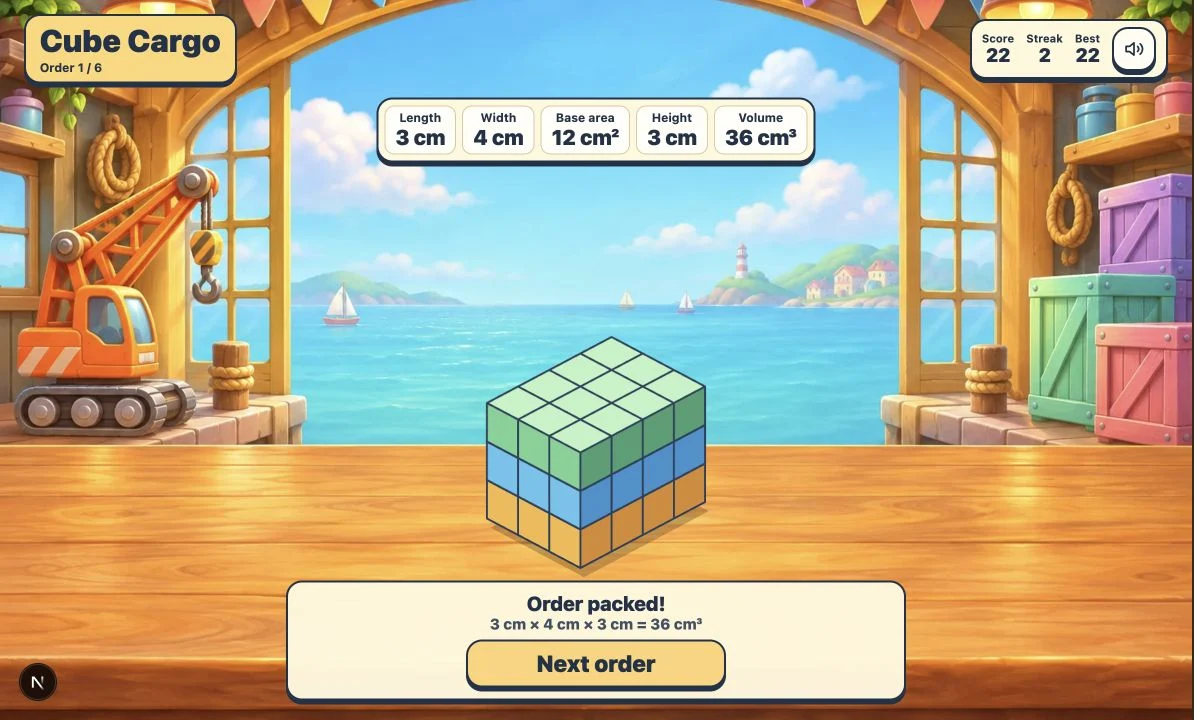
Fill cargo orders by stacking unit-cube layers into rectangular prisms. Find the base area, calculate the volume, and work backward to find a missing height. Six untimed orders make a run.
More like this
How to Play Cube Cargo
- 1
Read the order
Check which measurements are given and which is missing. An order can ask for the base area, volume, or height.
- 2
Place the base layer
When given length and width, multiply them and pick the base area in square centimeters. When the base area is supplied, the first layer is already in place.
- 3
Fill the prism
Multiply base area by height to choose a volume, or divide the target volume by base area to choose a height. A correct choice stacks the layers and shows the calculation.
- 4
Pack the next order
Check the completed stack, then advance. After six orders you can start a fresh run.
Key Features
Build with unit cubes
A numbered choice adds a base layer or fills a prism. Rows, columns, and colored layers show how the cubes fit together.
Use both volume formulas
Some orders give length, width, and height. Others supply the base area and height so you can multiply directly.
Find the missing height
When an order gives volume and base area, choose how many layers will fill it.
Pack six fresh orders
Try again after a mistake at your own pace. Every replay generates a new set of dimensions.
What is Cube Cargo?
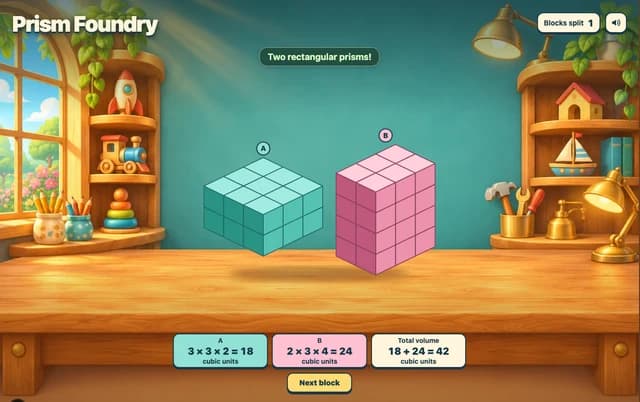
Cube Cargo is a fifth-grade geometry game about volume. Each order is a rectangular prism built from cubes that measure 1 cm along each edge. Choosing the base area lays down the first layer. Finishing the order fills the prism with equal layers. For a 4 cm by 3 cm base and a height of 5 cm, choose 12 cm² for the base. Five layers of 12 cubes take up 60 cm³. If the order instead gives 60 cm³ and a 12 cm² base, divide 60 by 12 to find a height of 5 cm.
Why Play Cube Cargo?
- 1
See what the factors count
Length and width determine the grid in each layer. Height determines how many layers are stacked.
- 2
Connect the two formulas
The base area is length times width, so V = B × h and V = l × w × h give the same volume.
- 3
Distinguish the units
The orders pair edge lengths with cm, base areas with cm², and volumes with cm³.
- 4
Use multiplication and division together
Finding volume and recovering height use the same relationship in opposite directions.
Frequently Asked Questions
Which shapes do I pack?
Every order uses a rectangular prism with whole-number dimensions and a base made from a rectangular grid of unit cubes.
What happens after a mistake?
The choice is crossed out, your streak resets, and you can try the same step again.
How are points awarded?
Each correct choice earns 10 points plus a streak bonus of up to 10 points. The game saves your best score on this device.
Can I play on a tablet or with a keyboard?
Tap or click a choice, or use Tab and Enter or Space. There is no timer.
Can I mute the music?
Use the sound button in the top corner. The game remembers the setting on this device.