Line Plots with Fractions
Ribbon Plot Studio
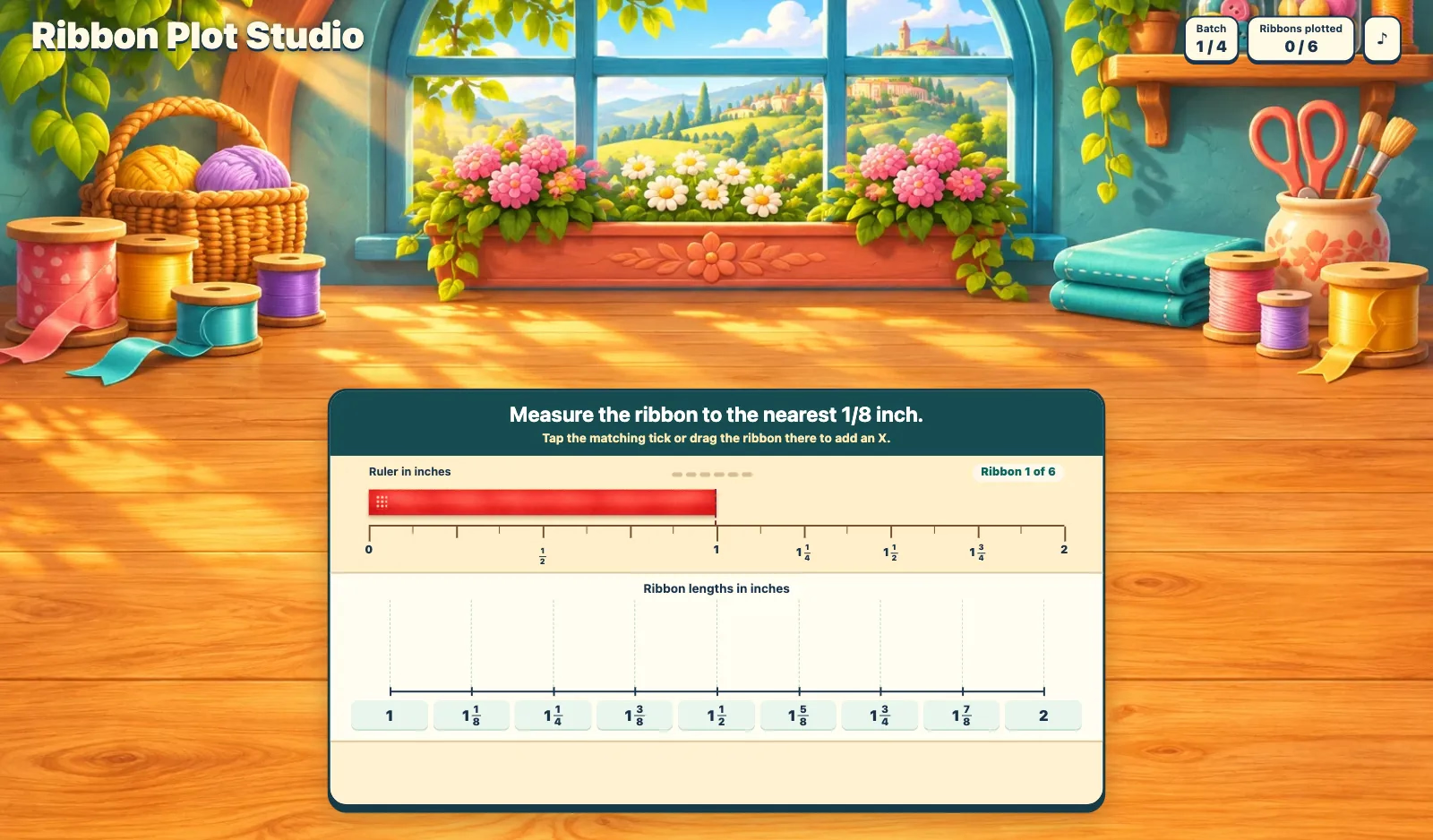
Measure six craft ribbons to the nearest eighth of an inch, plot their lengths with X marks, and find how much longer the longest ribbon is than the shortest. Four batches give fourth graders practice reading halves, fourths, and eighths on the same number line.
More like this
How to Play Ribbon Plot Studio
- 1
Read the ruler
Look where the ribbon ends. Find the nearest eighth-inch tick. Some ticks are labeled as equivalent halves or fourths.
- 2
Select a length on the line plot
Tap or click the tick that matches the measurement. With a keyboard, use Tab to reach the tick and Enter or Space to select it. A correct measurement adds one X. A miss leaves the same ribbon in place and tells you which way to look.
- 3
Compare the two ends of the data
After six ribbons, find the smallest and largest lengths with X marks. Choose how much longer the largest is. The game shows the subtraction when you get it right.
- 4
Move to the next batch
Select Next batch after you solve the difference. After the fourth batch, select Play again to start a new run.
Key Features
Measure real-looking ribbons
Each ribbon starts at zero on a ruler marked in eighths of an inch. Use the tick nearest the right end to read its length.
Build the line plot one X at a time
Select the matching tick to record a measurement and bring out the next ribbon. Repeated measurements stack vertically at the same tick.
Find the difference from the plot
After six measurements, compare the leftmost and rightmost stacks. Choose their difference to reveal the subtraction equation.
Practice with four fresh batches
Each batch draws a new set of lengths. Try again after the fourth batch to measure a fresh set of ribbons.
What is Ribbon Plot Studio?
Ribbon Plot Studio is a fourth-grade measurement game. Use a ruler to measure each ribbon to the nearest eighth of an inch, then place its X on a line plot. Every ribbon has one X, even when several ribbons share a length. For example, suppose two ribbons measure 1 1/4 inches and the longest ribbon measures 1 7/8 inches. Both 1 1/4-inch ribbons belong in the same stack. If 1 1/4 inches is also the shortest length, rewrite 1 1/4 as 1 2/8. Then subtract 1 2/8 from 1 7/8 to get 5/8 inch.
Why Play Ribbon Plot Studio?
- 1
Connect the ruler to the graph
The ruler shows how far a ribbon reaches. The line plot records the rounded length at the corresponding tick.
- 2
See equivalent fractions in place
The tick halfway between 1 and 2 is 1 1/2. Counting four eighth-inch steps from 1 reaches that same tick.
- 3
Separate length from frequency
Moving right means the ribbons are longer. A taller stack means more ribbons share that length.
- 4
Use data to subtract fractions
Find the extreme values on the graph and count or subtract the eighth-inch intervals between them.
Frequently Asked Questions
What does each X stand for?
One X stands for one measured ribbon. Three X marks above one tick mean three ribbons rounded to that length.
What if a ribbon ends between ticks?
Use the closer eighth-inch tick. The generated ribbons avoid exact halfway ties.
How do I find the longest and shortest ribbons?
Look for the occupied tick farthest right for the longest, and the occupied tick farthest left for the shortest. Empty ticks do not represent measurements.
What happens if I choose the wrong tick or difference?
You can try again immediately. A wrong tick tells you to look for a longer or shorter length. A wrong difference reminds you to subtract the shortest length from the longest.
How long is one game?
There are four batches, with six ribbons and one comparison in each. Work at your own pace, then use Play again to try new batches.