Nets and Surface Area
Net Workshop
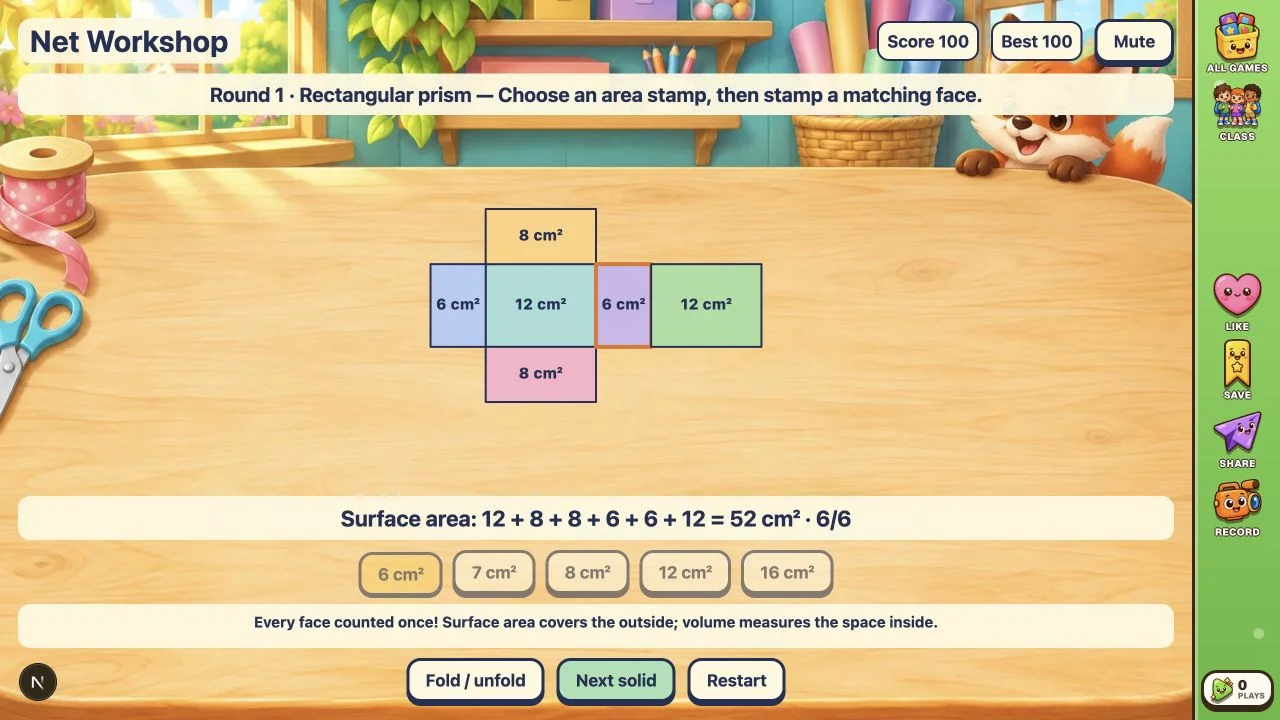
Stamp the areas of faces on an unfolded solid in a sunny craft workshop. Build the total surface area of rectangular prisms and square pyramids, then fold the completed net to connect the flat model with its solid.
More like this
How to play Net Workshop
- 1
Read the net
Start immediately with the unfolded solid. Read the dimensions inside each face. All lengths use centimeters and all area stamps use square centimeters.
- 2
Choose an area stamp
Calculate a rectangular face with length × width. For a triangular face use half of base × perpendicular triangle height. Select the matching area stamp below the workbench.
- 3
Stamp matching faces
Tap or click each face that matches the selected stamp. You can stamp more than one equal-area face with the same stamp. Use Tab and Enter or Space for keyboard play.
- 4
Read the total
When every face is colored, the full sum appears automatically and Score increases by 100. Use Fold / unfold to inspect the solid without losing the calculation.
- 5
Keep building
Choose Next solid for another net or Restart to reset the run. Best is kept. The sound button toggles the quiet workshop music.
Key Features
Stamp the net
Choose an area stamp and tap a face with that area. A correct stamp colors the face and adds its area to the running total; each face counts once.
Two kinds of solid
Rectangular prisms have six rectangular faces. Square pyramids have a square base and four triangular faces, with perpendicular triangle heights shown.
Fold the model
After all faces are stamped, Fold / unfold switches between the net and a folded view. The full area sum stays visible.
Fresh workshop orders
The first two rounds use the same 4 × 3 × 2 prism dimensions with different net orientations. Later rounds vary dimensions and alternate prisms and pyramids.
Gentle practice
There is no timer or life limit. Incorrect stamps leave the face unchanged and explain the area rule. Each completed solid earns 100 points, and Best and sound preferences are saved in this browser.
What is Net Workshop?
Net Workshop is a geometry building game for the Nets and Surface Area lesson. Players connect each face of a flat net to its area, rather than entering a total without a model. Coloring every face produces the surface-area sum automatically. For a 4 × 3 × 2 cm rectangular prism, two faces have area 12 cm², two have area 8 cm², and two have area 6 cm². The surface area is 12 + 12 + 8 + 8 + 6 + 6 = 52 cm². Its volume would be 24 cm³, a different quantity. A square pyramid with base side 4 cm and triangular face height 3 cm has a 16 cm² base and four 6 cm² triangles, totaling 40 cm².
Why play Net Workshop?
- 1
Account for every face
The colored net makes it visible which faces have been counted, including opposite faces and the pyramid base.
- 2
Connect dimensions and area
Every stamp is linked to the dimensions on a particular rectangle or triangle.
- 3
Connect flat and solid models
The completed model can fold and unfold while retaining the same surface-area total.
- 4
Separate area from volume
Results use cm² and explain that surface area covers the outside while volume measures interior space.
Frequently Asked Questions
Do I type answers?
No. Select an area stamp, then select a matching face. Touch, mouse, and keyboard controls all use the same moves.
Why did a triangular face reject my stamp?
A triangle has half the area of a rectangle with the same base and perpendicular height. For base 4 cm and triangle height 3 cm, use 6 cm², not 12 cm². The marked triangle height is not the pyramid's vertical height.
Can I count one face twice?
No. A stamped face is locked, so each face contributes exactly once. Equal opposite faces still need separate stamps.
How do points and retries work?
A completed solid adds 100 points. Incorrect stamps do not remove points or consume lives. Restart resets Score and the round, while Best stays saved in the browser.
Does the game repeat the same nets?
The first two rounds deliberately show the same prism dimensions in different orientations. After that, varied prism and pyramid dimensions supply ongoing practice without consecutive identical challenges.
Is surface area the same as volume?
No. Surface area adds the areas of the outside faces and uses square units. Volume measures space inside and uses cubic units. For the opening 4 × 3 × 2 cm prism, surface area is 52 cm² and volume is 24 cm³.