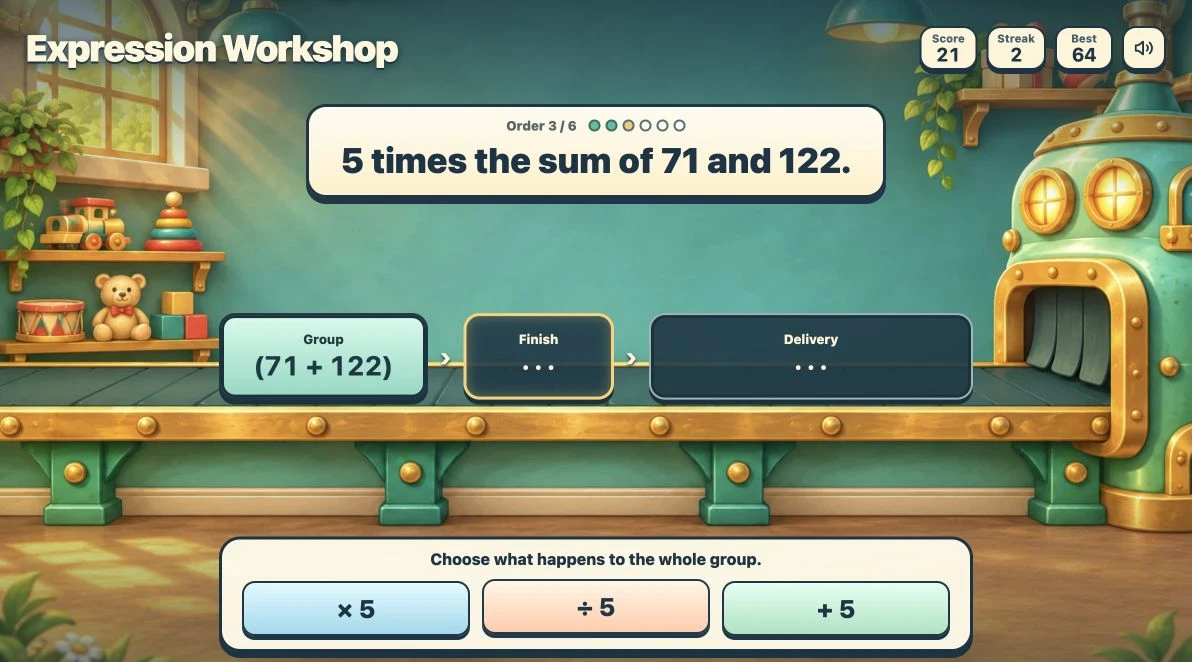
Expression Workshop
Build and read numerical expressions in a toy factory. Group the first operation, attach the next one, and match expressions to words to fill six work orders. Practice fifth-grade parentheses and multiplication as a comparison without finding the numerical answers.
More like this
How to Play Expression Workshop
- 1
Read the work order
Look for the operation that happens first and what the machine should do with its result.
- 2
Build the group
For “Add 8 and 7, then multiply by 2,” select (8 + 7). The parentheses keep that sum together on the conveyor.
- 3
Finish the expression
Choose × 2 to send 2 × (8 + 7) through the machine. Multiplication applies to everything in parentheses.
- 4
Match the words
When the work order shows symbols, select the phrase that reads the whole expression correctly.
- 5
Start a new shift
Use Next order after each delivery. After six deliveries, choose Play again for a fresh set of orders.
Key Features
Build in two steps
Choose the operation that belongs inside the parentheses, then choose what happens to the entire group. Watch each piece join the expression on the conveyor.
Read the machine’s expression
Some work orders show an expression. Match it to the phrase that describes both the group and what happens to it.
Compare without calculating
Read expressions such as 3 × (18 + 932) as three times the sum of 18 and 932. Keep the sum grouped even when the numbers are large.
Six work orders per run
Take as much time as you need. A wrong choice gives you a hint and lets you try again. Play another shift for new numbers.
What is Expression Workshop?
Expression Workshop is a fifth-grade game about writing and interpreting numerical expressions. In a build order, you turn a phrase into a grouped operation and attach a second operation. If the order says “Subtract 4 from 16, then divide by 3,” load (16 − 4), then choose ÷ 3 to deliver (16 − 4) ÷ 3. In a reading order, you go the other way, from symbols to words. The goal is to represent the instructions accurately without evaluating the expression.
Why Play Expression Workshop?
- 1
See what parentheses do
The grouped part remains visible as a single piece while you attach a second operation to it.
- 2
Read subtraction in order
Compare groups with the same numbers in opposite orders and see which one follows the wording.
- 3
Interpret a multiplier
Connect “times the sum” to multiplying the entire group, including when the sum contains larger numbers.
- 4
Practice both directions
Switch between building symbols from a phrase and reading a complete expression back into words.
Frequently Asked Questions
Do I have to calculate the answer?
No. Build or interpret the expression. Leave the operations and parentheses visible.
What happens if I make a mistake?
You can retry the same step as often as you need. A wrong choice resets your streak and brings up a hint.
How do I score points?
Each completed order earns 10 points, plus one for each order already in your current streak. Your browser remembers your best score.
Can I play without a mouse?
Yes. Use Tab to focus a choice and Enter or Space to select it. You can also tap any choice on a touch screen.
Does Play again change the orders?
Yes. Each shift follows the same skill sequence with different numbers and shuffled choices.