Flat or Solid
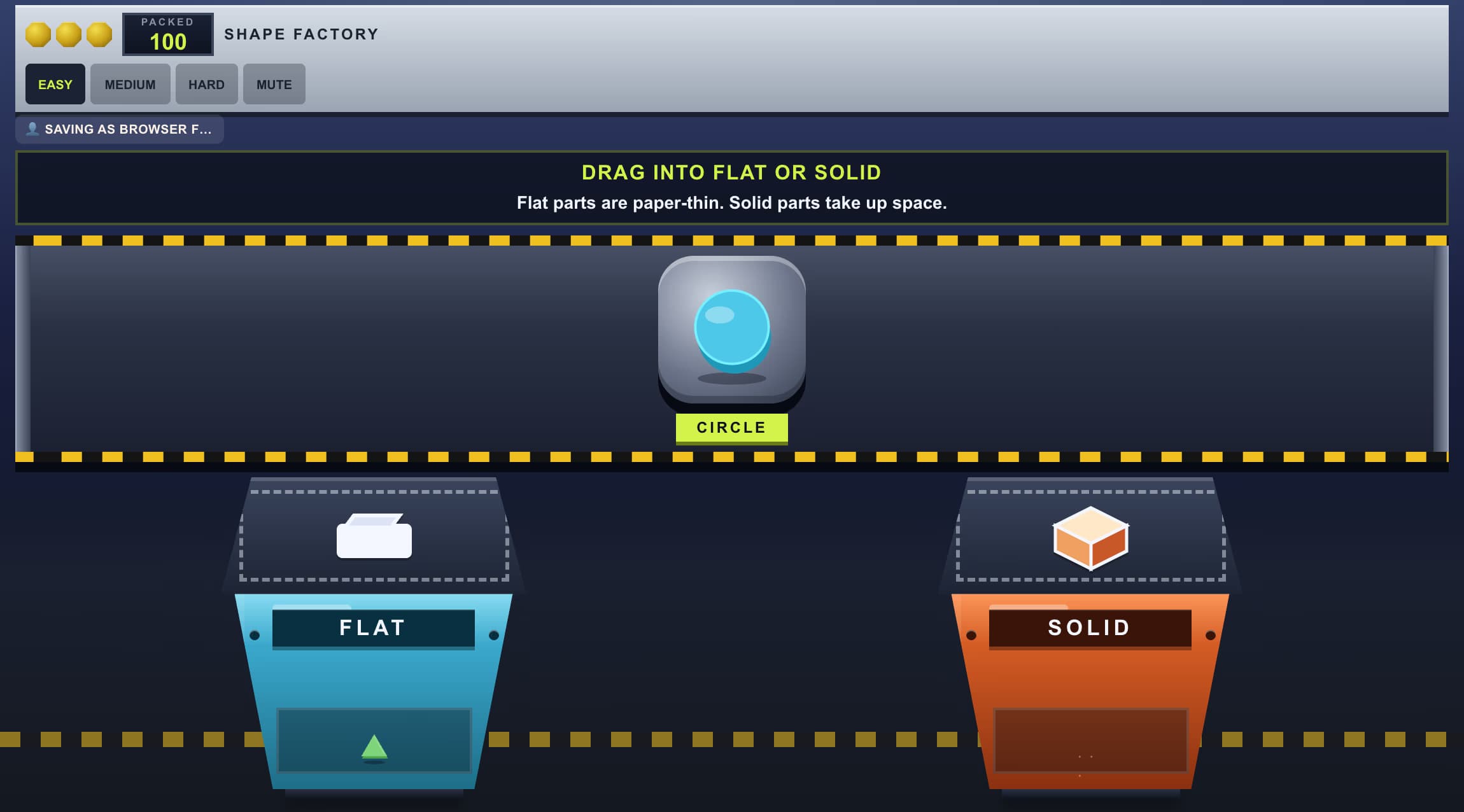
A kraft packing loft is waiting on the next tray. Drag paper-flat 2D shapes into the Flat bin and chunky 3D solids into the Solid crate. Kindergarten geometry practice: circles stay flat, cubes take up space. Clear five trays, keep three brass dies, and race the press on harder runs.
More like this
How to Play Die Press Shape Sort
Look at the Tray
A mix of paper-flat shapes and chunky solids lands on the platen. Flat shapes have no thickness. Solids look like blocks you could hold.
Drag into a Bin
Pull a piece into Flat or Solid. Easy labels the bins. Hard hides the extra hint and adds look-alikes like triangle and pyramid.
Beat the Ram
On Medium and Hard the brass press comes down. Clear the tray before it lands or you lose a die and the next tray is dealt.
Clear Five Trays
Five empty platens win the run. You have three brass dies. Chase the streak for bigger pops.
Key Features
Sort Flat from Solid
Paper cutouts (circle, square, triangle) go in the Flat bin. Wooden solids (cube, sphere, pyramid) go in the Solid crate. Instant snap or recoil so the sort is obvious.
Die-Press Loft
Shapes sit on a kraft platen under a brass ram. Medium and Hard drop the ram if the tray is still full — leftover pieces cost a die.
English Shape Names
Each piece keeps its English name (cube, cylinder, hexagon) so the geometry words stay consistent in every language. Hopper labels translate.
Streak Scoring
A correct drop scores 100 plus 50 for each extra hit in the streak. Misses reset the streak. Best is saved per difficulty.
What is a 2D and 3D Shape Sort?
Two-dimensional shapes are flat — a circle, square, or triangle lives on the page. Three-dimensional shapes are solid — a cube, cylinder, or pyramid takes up space. This game turns that idea into a packing loft: kids drag each piece into the Flat paper bin or the Solid crate so they practice classifying common kindergarten shapes by whether they are flat or solid.
Why Play Die Press Shape Sort?
See Flat versus Solid
Paper cutouts and chunky blocks sit on the same tray, so the difference is visual, not a vocabulary list.
Kindergarten Geometry
Circles, squares, triangles, cubes, cylinders, and pyramids are the core set. Harder trays add ovals, cones, hexagons, and prisms.
Sort, Do Not Tap
Dragging a piece into a hopper is a different verb from tapping a multiple-choice card. The bin lights up while you hover.
Names Stay in English
Shape words on the tickets stay English so cube and cylinder sound the same in every locale. Buttons and hopper titles translate.
Frequently Asked Questions
What is the difference between 2D and 3D shapes?
A 2D shape is flat, like a paper circle or square. A 3D shape is solid, like a cube or cylinder you could hold. The game sorts those two groups into Flat and Solid bins.
Which shapes are in the game?
Easy uses circle, square, triangle, sphere, cube, and pyramid. Medium adds rectangle, oval, cylinder, and cone. Hard adds hexagon and rectangular prism.
How does scoring work?
Each correct drop scores 100, plus 50 for every extra hit in the current streak. A wrong bin or a ram that finishes first resets the streak and costs one of three lives.
What happens if the press comes down?
On Medium and Hard a brass ram drops if any piece is still on the tray. You lose a die and the loft deals a fresh tray.
Are the shape names translated?
No. Cube, cylinder, and the other shape words stay English on the tickets. Hopper labels and buttons follow the page language.
Is this a multiple-choice quiz?
No. You drag paper cutouts and wooden solids into two factory bins and race the die press. Wrong pieces recoil; right pieces snap in.