Tree Species Spinner Wheel
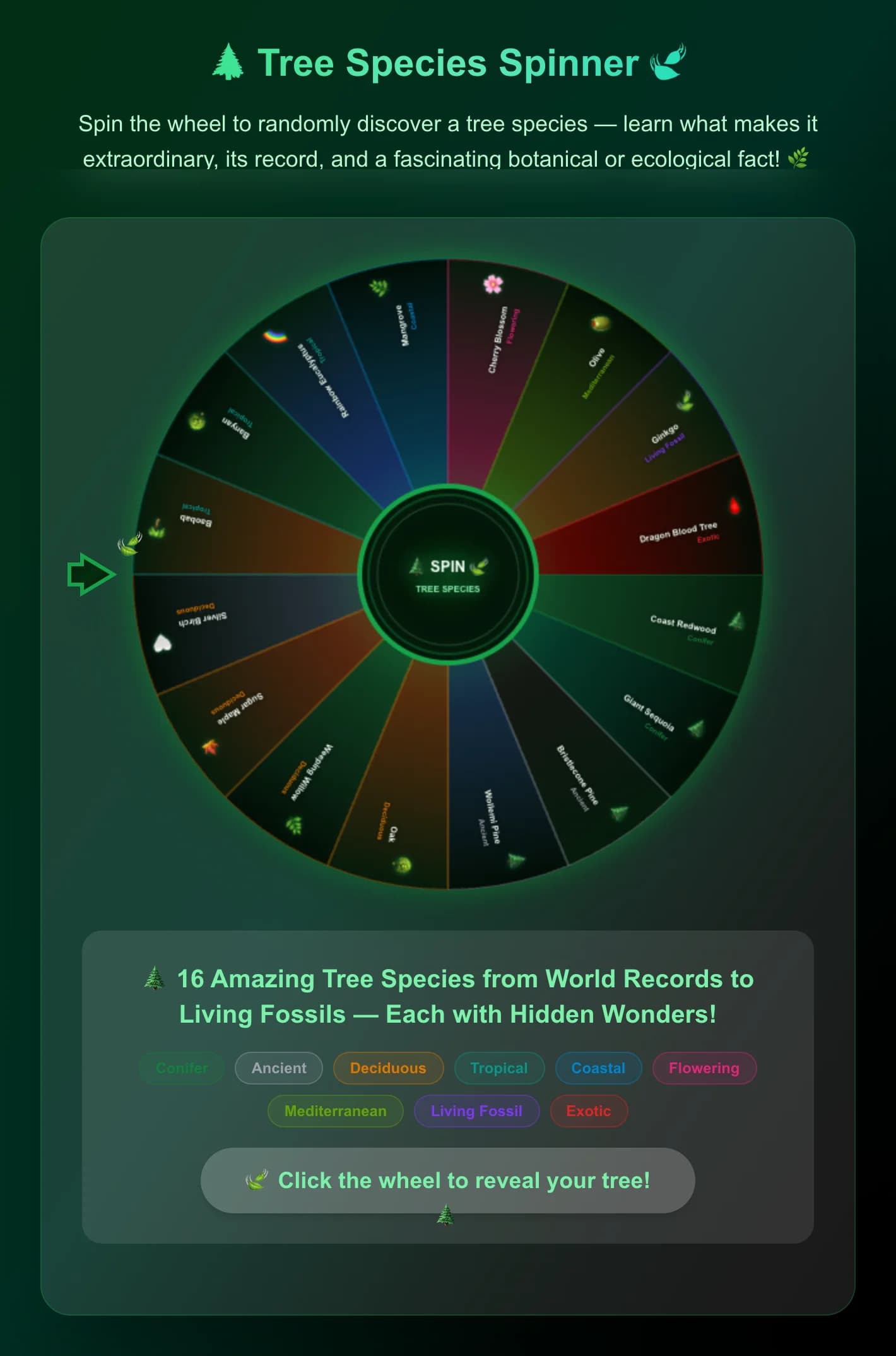
Spin the wheel to randomly discover one of 16 extraordinary tree species — from the world's tallest Coast Redwood to the 270-million-year-old Ginkgo, the alien Dragon Blood Tree, and the one-tree forest of the Banyan. Each result reveals what makes the tree remarkable and a fascinating botanical or ecological fact.
How To Use
Click or tap the spinning wheel to randomly land on one of 16 remarkable tree species. The result reveals the tree's name, its category (Conifer, Deciduous, Tropical, etc.), what it's 'Famous For,' and a detailed botanical or ecological fact about its records, history, ecology, or biological adaptations.
Key Features
16 tree species spanning 9 categories: Conifer, Deciduous, Tropical, Ancient, Coastal, Flowering, Mediterranean, Living Fossil, and Exotic
Each result reveals what the tree is 'Famous For' — from World's Tallest and World's Oldest to Dinosaur Era Survivor and Earth's Most Alien Tree
Deep botanical and ecological facts — including world records, survival stories, evolutionary history, and ecological roles
Color-coded categories make every slice of the wheel visually distinct (forest green, amber, teal, crimson, pink, olive, purple)
Deep forest-at-night themed spinning wheel with emerald glow
Perfect for nature lovers, botany students, ecology enthusiasts, school projects, trivia nights, and anyone curious about the planet's most extraordinary trees
What Is This?
The Tree Species Spinner covers the full spectrum of extraordinary trees: Record-holders (Coast Redwood — tallest; Giant Sequoia — largest; Bristlecone Pine — oldest), Ancient survivors (Wollemi Pine — 90 million years; Ginkgo — 270 million years), Tropical giants (Baobab, Banyan, Rainbow Eucalyptus, Mangrove), Temperate classics (Oak, Weeping Willow, Sugar Maple, Silver Birch), Flowering beauties (Cherry Blossom, Olive), and the Exotic outlier (Dragon Blood Tree of Socotra). Every entry includes science-grade facts.
Why Use This?
Trees are Earth's most visible and important organisms — but most people know only a handful by name. Did you know the oldest living tree was already ancient when the pyramids were built? That a single mature oak supports 500+ other species? That a one-tree 'forest' in Kolkata covers 1.5 hectares? That ginkgo trees survived the Hiroshima atomic bomb? That obsidian-sharp willow bark chemistry gave us aspirin? That rainbow eucalyptus naturally grows in psychedelic multicolors? Spin and discover the planet's most extraordinary trees.
Frequently Asked Questions
What is the tallest tree in the world?
Hyperion, a Coast Redwood (Sequoia sempervirens) in Redwood National and State Parks, California, measures 115.92 meters (380.3 feet) — the tallest known living tree on Earth. It was discovered in 2006 by naturalists Chris Atkins and Michael Taylor. Its exact location is kept confidential by the National Park Service to prevent damage from visitor traffic. The top 10 tallest trees in the world are all Coast Redwoods located in Northern California.
What is the oldest tree in the world?
Methuselah, a Great Basin Bristlecone Pine (Pinus longaeva) located in the White Mountains of California, is 4,855 years old (as of 2026) — making it the oldest confirmed living non-clonal organism on Earth. When Methuselah germinated around 2832 BCE, Stonehenge was still under construction and the Egyptian Old Kingdom had just begun. Its precise location within the Ancient Bristlecone Pine Forest is kept secret by the US Forest Service. Note: some clonal organisms like the Pando aspen grove in Utah are far older as a connected root system (80,000+ years).
What is the largest tree in the world?
General Sherman, a Giant Sequoia (Sequoiadendron giganteum) in Sequoia National Park, California, is the world's largest tree by volume at 1,384.5 cubic meters and an estimated mass of 2.7 million kilograms. It stands 84 meters (275 feet) tall with a base circumference of 31.3 meters (102.6 feet). Despite being the largest by volume, it holds none of the other 'largest' records: the tallest tree is a Coast Redwood, the widest trunk belongs to a Montezuma cypress in Mexico (14.05m diameter), and the oldest is a Bristlecone Pine.
How long can trees live?
Individual tree lifespans vary enormously by species: Bristlecone pines (4,000–5,000+ years), Giant sequoias (2,000–3,000 years), Coast redwoods (1,200–2,000+ years), olive trees (2,000–4,000 years), baobabs (1,000–2,500 years), oaks (500–1,500+ years), sugar maples (300–500 years), silver birches (60–90 years). Clonal tree colonies — where a single root system supports many trunks — can be dramatically older: the Pando aspen colony in Utah is estimated at 80,000 years, and some seagrass meadows (clonal plants) are over 100,000 years old.
Why are trees important to the environment?
Trees perform critical ecosystem services: (1) Carbon sequestration — the world's forests store 45% of all terrestrial carbon; (2) Oxygen production — a mature tree produces enough oxygen annually for 2–4 people to breathe; (3) Water cycling — forests generate up to 75% of all inland rainfall through evapotranspiration; (4) Biodiversity — a single oak can support 500+ species; (5) Soil protection — tree roots prevent erosion and maintain soil structure; (6) Temperature regulation — urban tree cover reduces city temperatures by 2–8°C; (7) Watershed protection — forested watersheds filter water and prevent flooding. Mangroves additionally protect coastlines from storm surges and tsunamis.
What is a 'living fossil' tree?
A 'living fossil' is an organism that appears virtually unchanged from ancient fossil specimens found in the geological record. In trees, the clearest examples are: Ginkgo biloba (unchanged for 270 million years — fossil leaves are morphologically identical to living ones), Wollemi Pine (appeared in 90-million-year-old fossils, then unknown in the wild until 1994), and Metasequoia (dawn redwood — widespread in the Northern Hemisphere 65+ million years ago, believed extinct until discovered alive in China in 1944). These trees survived mass extinctions, ice ages, and continental drift largely unchanged.
Which trees produce the most oxygen?
In terms of total oxygen output per tree, the largest trees naturally produce the most: Giant sequoias and coast redwoods produce enormous volumes due to their massive leaf area — a single coast redwood has roughly 10× the leaf surface area of a mature oak. However, for oxygen production per unit of land area, fast-growing tropical trees (including eucalyptus) are most efficient. For urban planting, trees with large leaf surface areas like oaks, maple, and beech provide the best combined benefits of oxygen production, carbon storage, and biodiversity support. Algae and phytoplankton in the ocean actually produce ~50% of Earth's oxygen.