Rock Types Spinner Wheel
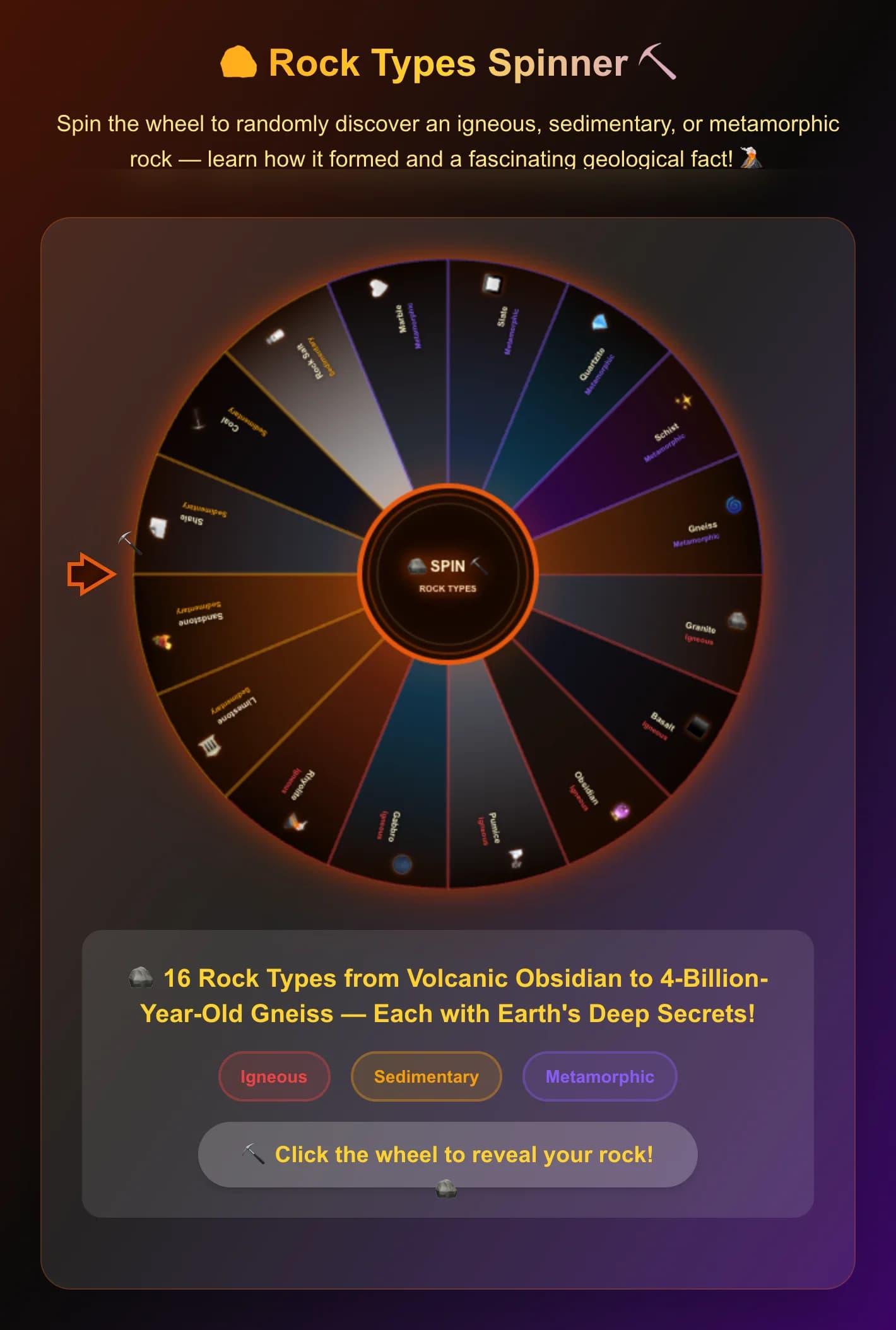
Spin the wheel to randomly discover one of 16 fascinating rock types across all three rock families — Igneous (Granite, Basalt, Obsidian, Pumice, Gabbro, Rhyolite), Sedimentary (Limestone, Sandstone, Shale, Coal, Rock Salt), and Metamorphic (Marble, Slate, Quartzite, Schist, Gneiss). Each result explains what makes the rock famous and a deep geological fact.
How To Use
Click or tap the spinning wheel to randomly land on one of 16 rock types. The result reveals the rock's name, its family (Igneous/Sedimentary/Metamorphic), its specific subtype, what it's 'Famous For,' and a detailed geological fact about how it formed, its world records, or its historical importance.
Key Features
16 rock types spanning all three rock families: Igneous (6), Sedimentary (5), and Metamorphic (5)
Each result shows both the main rock family (Igneous/Sedimentary/Metamorphic) AND the specific subtype (Intrusive, Extrusive, Clastic, Chemical, Organic, Foliated, Non-foliated)
Each result reveals what makes the rock 'Famous For' and a detailed geological fact about formation, world records, and historical significance
Color-coded families: red for Igneous (volcanic), amber for Sedimentary (sandy), purple for Metamorphic (deep transformation)
Deep earth cross-section themed spinning wheel with molten-core orange glow
Perfect for geology students, earth science classes, rock collectors, trivia enthusiasts, and anyone curious about what the planet is made of
What Is This?
The Rock Types Spinner covers all three rock families with authentic depth: Igneous rocks (Granite, Basalt, Obsidian, Pumice, Gabbro, Rhyolite — formed from cooled magma, split into intrusive and extrusive), Sedimentary rocks (Limestone, Sandstone, Shale, Coal, Rock Salt — formed from compressed sediments, split into clastic, chemical, and organic), and Metamorphic rocks (Marble, Slate, Quartzite, Schist, Gneiss — formed from heat and pressure, split into foliated and non-foliated). Every entry contains science-grade geology.
Why Use This?
Rocks are the Earth's autobiography — each layer tells a story spanning millions to billions of years. Did you know obsidian blades are 300× sharper than surgical steel? That the Great Pyramid is limestone made from ancient sea shells? That all of Manhattan's skyscrapers are built on schist? That the oldest rock on Earth is a 4-billion-year-old gneiss? That pumice is the only rock that floats? That coal is literally compressed ancient sunlight? Spin and discover what Earth is really made of.
Frequently Asked Questions
What are the three types of rocks?
All rocks on Earth belong to one of three families based on how they formed: (1) Igneous rocks — formed when molten rock (magma underground, lava at the surface) cools and solidifies. Intrusive igneous rocks (like granite) cool slowly deep underground, forming large crystals. Extrusive igneous rocks (like basalt) cool quickly at the surface, forming fine-grained or glassy textures. (2) Sedimentary rocks — formed from compressed and cemented sediments (sand, mud, shells, plant material) deposited in layers over millions of years. (3) Metamorphic rocks — existing rocks transformed by intense heat, pressure, or chemically active fluids deep in the Earth's crust, without melting.
What is the rock cycle?
The rock cycle describes the continuous transformation of rocks from one type to another over geological time: Magma cools to form igneous rock → Igneous rock weathers and erodes into sediment → Sediment compresses into sedimentary rock → Sedimentary rock is buried and heated/pressurized into metamorphic rock → Metamorphic rock is buried deeper, melts back into magma, and the cycle restarts. Any rock can transform into any other type given sufficient time and the right conditions. The cycle is driven by plate tectonics (which buries and melts rocks) and erosion (which breaks them down at the surface).
What is the difference between igneous intrusive and extrusive rocks?
The difference is entirely about where and how fast the magma cooled: Intrusive (plutonic) igneous rocks form when magma cools slowly deep underground (1–50 km depth, over thousands to millions of years), allowing large, visible crystals to grow — granite is the classic example, with its easily visible quartz, feldspar, and mica grains. Extrusive (volcanic) igneous rocks form when lava erupts at the surface and cools rapidly in air or water — the fast cooling prevents large crystals from forming, producing fine-grained rocks (basalt) or even glass (obsidian). Same chemical composition, completely different texture.
What is the difference between foliated and non-foliated metamorphic rocks?
Foliated metamorphic rocks have a layered or banded texture caused by minerals recrystallizing under directional pressure — the platy minerals align perpendicular to the pressure direction. Examples: slate (low-grade, thin layers), schist (medium-grade, visible mica flakes), and gneiss (high-grade, distinct dark-and-light banding). Non-foliated metamorphic rocks lack this directional texture because they formed from rocks with few platy minerals, or because pressure was equal in all directions. Examples: marble (limestone recrystallized into calcite) and quartzite (sandstone recrystallized into interlocking quartz). The distinction matters for understanding how deep in Earth's crust the rock formed.
How old is the oldest rock on Earth?
The Acasta Gneiss in Canada's Northwest Territories is dated at 4.03 billion years old — one of the oldest confirmed rock outcrops on Earth's surface. The Nuvvuagittuq Greenstone Belt in Quebec has been dated at 3.77–4.28 billion years (with some researchers arguing for the higher date). Earth itself is 4.543 billion years old, so these rocks formed within the first 300–500 million years of Earth's existence. Individual zircon crystals (tiny mineral grains within rocks) have been dated even older: the Jack Hills zircons in Australia are 4.404 billion years old — the oldest known Earth material, preserving chemical evidence of Earth's very earliest crust.
How is coal formed?
Coal is organic sedimentary rock — compressed and chemically transformed ancient plant material, primarily from the Carboniferous period (358–299 million years ago). The process: ancient forests (giant tree-ferns, lycopsids, and horsetails) died and accumulated in anaerobic tropical swamps, where limited oxygen prevented full bacterial decomposition. Over millions of years, burial and pressure converted the plant matter through stages: peat (partially decomposed plant matter, ~55% carbon) → lignite / brown coal (~60–70% carbon) → bituminous coal (~80% carbon) → anthracite (~95% carbon, the hardest coal). All coal contains the carbon of ancient living organisms — burning it releases carbon that was removed from the atmosphere during the Carboniferous.
What is metamorphic rock used for?
Metamorphic rocks are among the most commercially valuable: Marble — building material, sculpture, flooring, and countertops (Taj Mahal, Michelangelo's David, Parthenon); Slate — roofing tiles, flooring, blackboards, billiard table beds; Quartzite — construction aggregate, road base, silica source for silicon production; Schist — limited direct use but often bears valuable minerals (gold deposits frequently occur in schist formations — the Witwatersrand goldfields of South Africa are schist-hosted); Gneiss — building stone, aggregate. Metamorphic terrains often host economically critical mineral deposits because the intense heat and fluid flow that creates metamorphic rocks also concentrates valuable minerals.