Random Chores Spinner Wheel
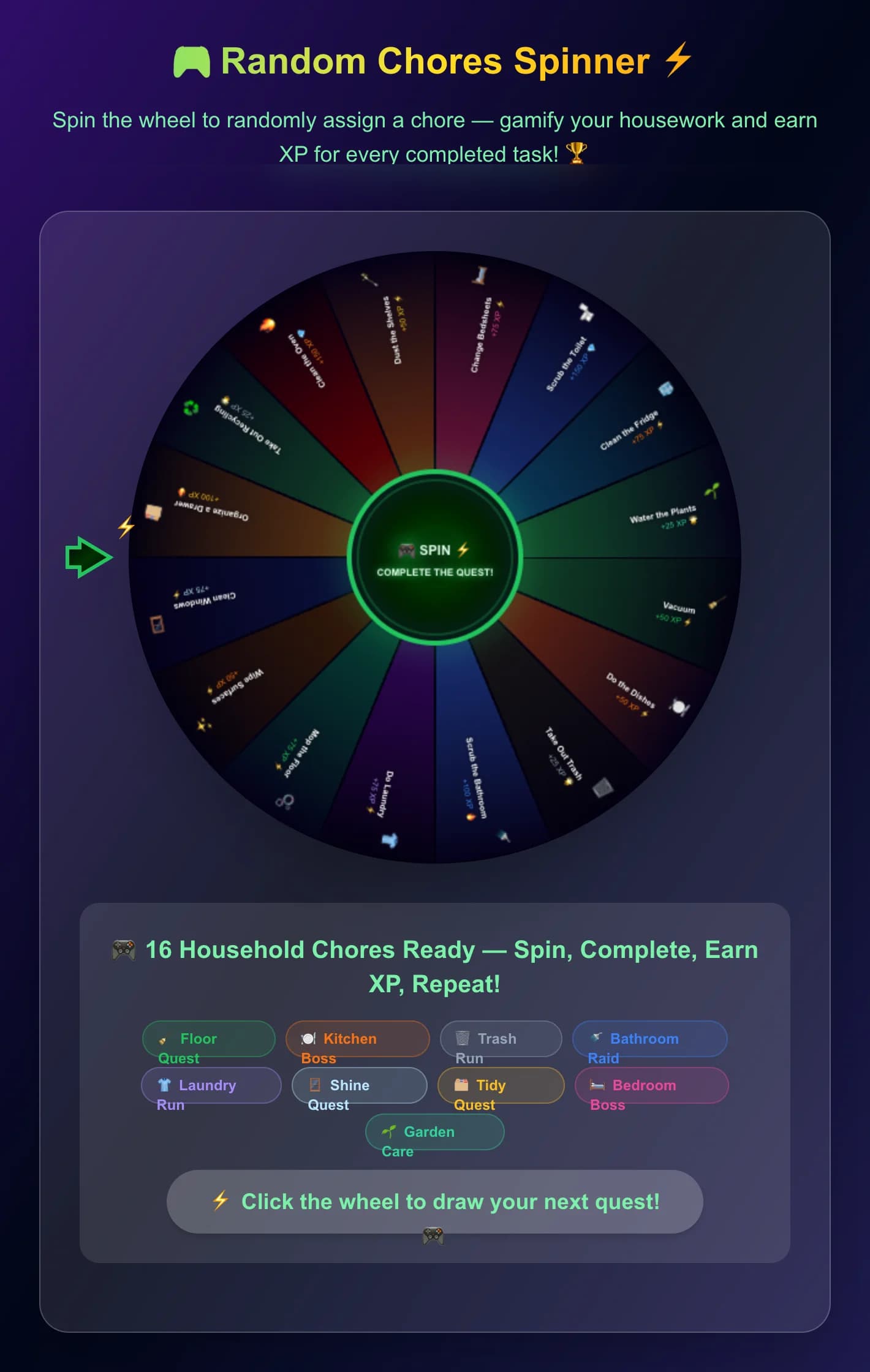
Spin the wheel to randomly assign a household chore and gamify your cleaning routine! Earn XP for every completed task — from +25 XP for taking out the trash to +150 XP for scrubbing the toilet or cleaning the oven. Discover fascinating facts about the history and science of each chore along the way.
How To Use
Click or tap the spinning wheel to randomly assign a household chore. When it stops, discover which chore you've been assigned — complete with its quest type, XP reward, and a surprising fact about the history or science of that chore. Complete the chore to earn your XP, then spin again!
Key Features
16 household chores across 9 quest categories: Floor Quest, Kitchen Boss, Bathroom Raid, Laundry Run, Trash Run, Shine Quest, Tidy Quest, Bedroom Boss, Garden Care
XP reward system from +25 XP (easy tasks) to +150 XP (legendary difficulty chores)
Fascinating historical and scientific facts about each chore
Dark arcade/game night themed spinning wheel with neon green glow
Perfect for families, roommates, solo motivation, or making cleaning fun for kids
Gamified categories with quest-style names to make housework feel like an adventure
What Is This?
The Random Chores Spinner transforms housework into a game by randomly assigning one of 16 common household chores with gamified XP rewards. Each chore is categorized into quest types (Floor Quest, Kitchen Boss, Bathroom Raid, etc.) and rewards different amounts of XP based on difficulty — from quick wins like watering plants (+25 XP) to legendary challenges like scrubbing the toilet or cleaning the oven (+150 XP each).
Why Use This?
Struggling with chore motivation? Decision fatigue about where to start? The Random Chores Spinner takes the choice out of your hands and makes cleaning genuinely fun. Great for kids who need gamification to engage with housework, roommates who want a fair random chore assignment system, or anyone who needs a silly external nudge to get started. Did you know vacuuming burns 190 calories per hour? That the dishwasher actually uses less water than hand-washing? Or that a clean toilet seat has fewer bacteria than a keyboard?
Frequently Asked Questions
How can I use this spinner to gamify chores for kids?
Set up a simple XP tracking system — either a whiteboard, app, or notebook. Each time a child spins the wheel and completes the assigned chore, they record their XP. Set reward thresholds (e.g., 500 XP = choose a movie, 1000 XP = special outing). The randomness makes it fair and removes the 'but that's not my chore' argument, and the XP system provides concrete, visible progress that children find more motivating than abstract praise.
Is there a fair way to use this spinner for roommates or partners?
Yes! Each person spins once and gets assigned that chore for the week. Alternatively, spin together at the start of each week with a 'veto one' rule — each person can reject one spin result per week, then must accept the next result. The randomness removes perceived unfairness since no one can accuse anyone of assigning the worst chores intentionally. Tracking XP between roommates adds a fun competitive or cooperative element.
Which household chores burn the most calories?
Scrubbing the bathroom burns approximately 200 calories per hour — the highest on this list due to the full-body scrubbing motion. Vacuuming burns about 190 calories per hour. Mopping burns 170 calories per hour. Doing dishes burns about 160 calories per hour. These are comparable to a moderate-intensity walk. Doing all 16 chores in a single weekend cleaning session could burn 800–1,200 calories — equivalent to running 8–12 miles.
Why is cleaning the oven worth so much XP (+150 XP)?
Cleaning the oven is one of the most avoided household chores due to its difficulty, heat, chemical fumes, and time requirements — often taking 2–4 hours for a thorough job. Self-cleaning ovens heat to 900°F (480°C) to incinerate residue into ash, a process that takes 2–3 hours. Manual cleaning requires degreasing sprays, scrubbing baked-on carbon deposits, and working in a confined awkward space. Its legendary difficulty status earns it the maximum XP alongside the toilet.
Does the dishwasher really save more water than hand-washing?
Yes — significantly. A modern efficient dishwasher uses 3–5 gallons of water per cycle, while hand-washing the equivalent load uses 27 gallons on average. The Energy Star certification for dishwashers requires using no more than 3.5 gallons per cycle. Additionally, dishwashers sanitize more effectively because they maintain water at 140°F (60°C), which kills bacteria that survive in the warm water typically used for hand-washing. The most water-efficient approach is filling the dishwasher completely before running it.
What household chore has the highest germ density?
Contrary to popular belief, it's not the toilet — it's the kitchen. The kitchen sink harbors 100,000× more bacteria per square inch than the toilet bowl. The refrigerator door handle has 5× more bacteria than the toilet handle. The stovetop, cutting board, and kitchen sponge consistently rank as the germiest items in any home. NSF International found that 75% of dish sponges and 45% of kitchen sinks test positive for fecal bacteria (E. coli and Salmonella), while only 9% of bathroom faucets do.