Meditation Techniques Spinner Wheel
Spin the wheel to randomly discover one of 16 meditation techniques — from Body Scan and Loving-Kindness to Vipassana, Wim Hof Method, Transcendental Meditation, Yoga Nidra, and Trataka. Learn the origins, neuroscience, and a mind-expanding fact about each practice!
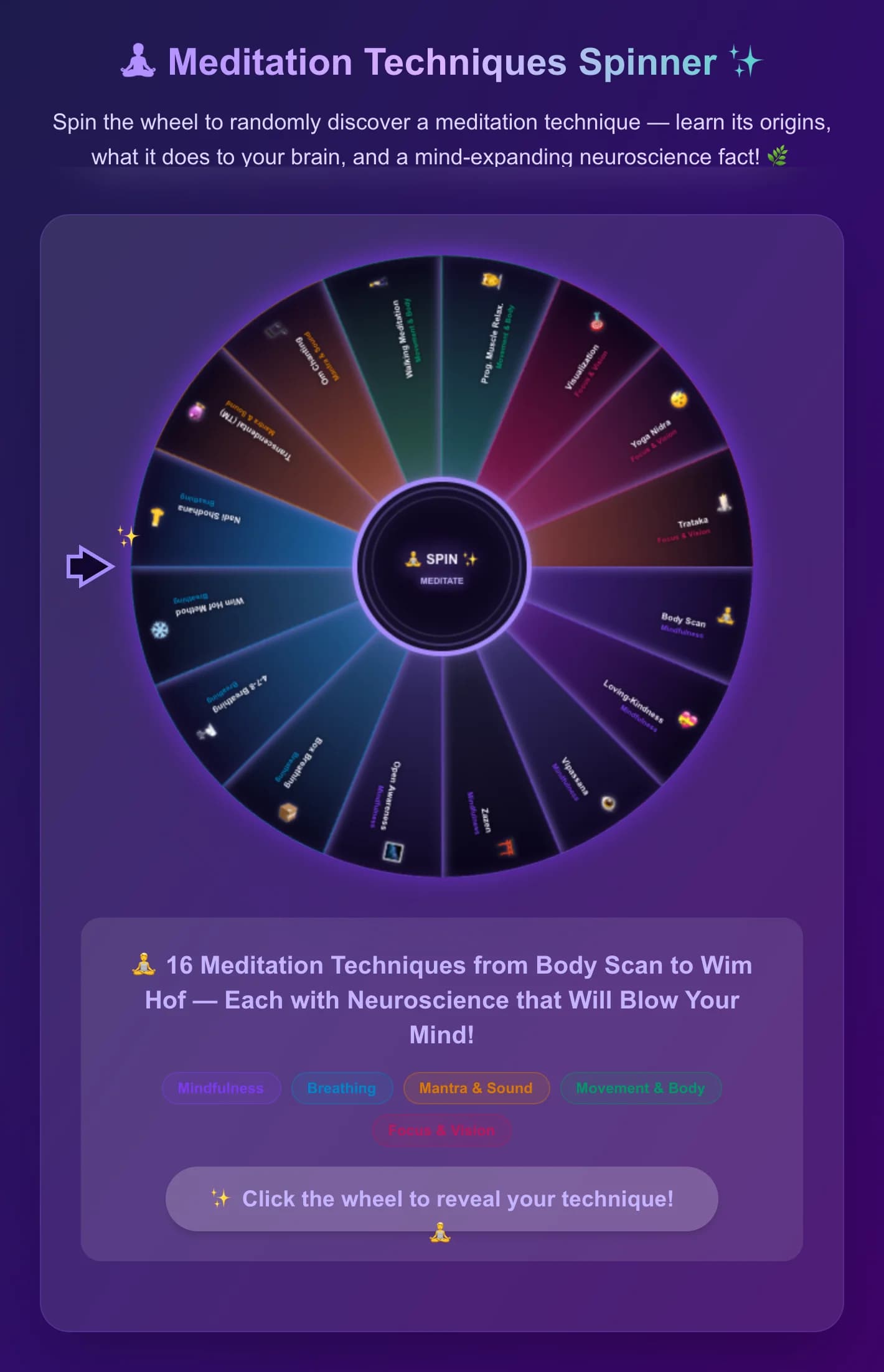
How to Use the Meditation Techniques Spinner
- 1
Click the spinning wheel to set it in motion
- 2
Watch it slow down and land on a random meditation technique
- 3
Read the practice goal, its category, and a fascinating neuroscience or history fact
- 4
Try the technique for 5–20 minutes — then spin again to explore another!
Key Features
16 meditation techniques across 5 categories: Mindfulness, Breathing, Mantra & Sound, Movement & Body, and Focus & Vision
Neuroscience-backed facts: brainwave changes, cortisol reduction stats, immune system research, and clinical trial results
Full technique spectrum: Body Scan, Loving-Kindness, Vipassana, Zazen, Open Awareness, Box Breathing, 4-7-8 Breathing, Wim Hof Method, Nadi Shodhana, Transcendental Meditation, Om Chanting, Walking Meditation, Progressive Muscle Relaxation, Visualization, Yoga Nidra, and Trataka
Deep indigo-violet cosmic aesthetic with spiritual atmosphere
Fully localized into 25 languages for global audiences
What Is the Meditation Techniques Spinner?
The Meditation Techniques Spinner is an educational wellness tool that randomly selects one of 16 scientifically-researched meditation and mindfulness practices. The collection spans five categories: Mindfulness traditions (Body Scan, Loving-Kindness, Vipassana, Zazen, Open Awareness) rooted in Buddhist and modern psychological practice; Breathing techniques (Box Breathing, 4-7-8 Breathing, Wim Hof Method, Nadi Shodhana) that directly regulate the autonomic nervous system; Mantra & Sound practices (Transcendental Meditation, Om Chanting) that use vibration and repetition to alter brainwave states; Movement & Body techniques (Walking Meditation, Progressive Muscle Relaxation) that integrate physical sensation with awareness; and Focus & Visualization practices (Visualization, Yoga Nidra, Trataka) that train attentional control and access altered states of consciousness. Each technique includes origins, neuroscientific research, and surprising facts.
Why Spin the Meditation Techniques Wheel?
Meditation has over 6,000 published scientific studies demonstrating benefits ranging from reduced anxiety and improved immune function to structural brain changes. But with dozens of techniques available, knowing where to start — or how to vary your practice — can be overwhelming. This spinner makes the exploration effortless and educational. Did you know long-term Zazen practitioners produce gamma brainwave synchrony at levels never previously recorded in healthy humans? Or that 30 minutes of Yoga Nidra equals 2–4 hours of conventional sleep in physical restoration? Or that the Wim Hof Method allowed subjects to voluntarily suppress their immune response to an injected endotoxin — a scientific first? Or that Loving-Kindness meditation reduces implicit racial bias in as few as 6 sessions? Every spin reveals a different dimension of the mind-body connection.
Frequently Asked Questions
What is the difference between Vipassana and Zazen?
Both are ancient forms of meditation rooted in Buddhist tradition but differ in origin and approach. Vipassana ('insight') is a Theravada Buddhist technique from South and Southeast Asian traditions, focusing on direct observation of sensations, thoughts, and mental phenomena to develop 'clear seeing' of impermanence and the nature of the mind. Traditional practice involves 10-day silent retreats. Zazen ('just sitting') is the core practice of Zen Buddhism from the East Asian tradition, emphasizing pure sitting without any specific object of attention — 'no aim' is paradoxically the aim. Vipassana tends to be more systematic and instructed; Zazen is more open and formless. Both have strong neuroscientific support for structural brain changes.
How does Box Breathing work and why do Navy SEALs use it?
Box Breathing (4-4-4-4) regulates the autonomic nervous system by exploiting the physiological relationship between breath and the vagus nerve. The breath hold after exhalation activates the parasympathetic nervous system before the next inhale, creating a calming effect that counteracts the sympathetic (fight-or-flight) activation of acute stress. Navy SEALs use it because it can normalize heart rate, blood pressure, and clear cognitive function within 64 seconds (4 breath cycles) — even in life-threatening situations. It works by increasing heart rate variability (HRV), a measure of autonomic flexibility and stress resilience. It has also been approved as a clinical intervention for anxiety by US medical authorities.
What is the Wim Hof Method and has it been scientifically proven?
The Wim Hof Method combines specific breathing hyperventilation cycles (30 deep breaths followed by a breath hold after exhalation, repeated 3–4 rounds) with cold exposure and mental focus. In a landmark 2014 study published in PNAS (Proceedings of the National Academy of Sciences), Hof and 12 trained subjects were injected with bacterial endotoxin that would normally cause flu-like illness. The Wim Hof-trained group showed significantly blunted immune responses and reported minimal symptoms — the first scientifically documented voluntary influence over the innate immune system. fMRI scans showed activation of the periaqueductal gray (PAG), a brain region previously considered involuntary, during the practice.
What is Yoga Nidra and how can it replace sleep?
Yoga Nidra ('yogic sleep') is a guided meditation practice that induces a state of consciousness between waking and sleeping — the hypnagogic state normally experienced only in the few seconds before sleep onset. EEG studies confirm practitioners access theta brainwave states (4–8 Hz), which are associated with deep REM sleep processing, while maintaining conscious awareness. Research from AIIMS (All India Institute of Medical Sciences, New Delhi) found that 30 minutes of Yoga Nidra produces physical restoration equivalent to 2–4 hours of conventional sleep, including muscle repair, immune function, and stress hormone normalization. The US Army's Warrior Wellness program reports 48% reduction in PTSD symptoms after 15 Yoga Nidra sessions.
How does Transcendental Meditation differ from other forms?
Transcendental Meditation (TM) is a specific technique where practitioners receive a personalized Sanskrit mantra (selected by a certified teacher based on specific criteria, kept private) and silently repeat it for 20 minutes twice daily, allowing the mind to settle spontaneously. Unlike focused attention or open monitoring meditation, TM uses the mantra as a vehicle for the mind to naturally transcend active thinking to a state of 'pure awareness' or 'restful alertness.' It has the largest body of research of any single meditation technique (600+ studies), is the only meditation with a 2013 American Heart Association statement regarding blood pressure reduction, and produces a unique EEG pattern combining high alpha coherence with simultaneously low arousal.
What is Trataka and what does it do to the brain?
Trataka (from Sanskrit 'to look' or 'to gaze') is one of the six Shatkarmas (yogic purification practices) of classical Hatha Yoga, involving fixed gazing at a small object — typically a candle flame — without blinking until tears flow naturally. The practice strengthens the ciliary muscles of the eye and the optic nerve pathways connected to visual cortex. Modern neuroscience research shows that sustained single-point visual focus intensively trains the prefrontal cortex's attentional control circuits — specifically the same dorsolateral prefrontal networks targeted by ADHD interventions. University of Rajasthan research found 6 weeks of daily Trataka practice produced a 32% improvement on standardized sustained attention tests (continuous performance tasks), comparable to pharmacological interventions.