Icebreaker Activities Spinner Wheel
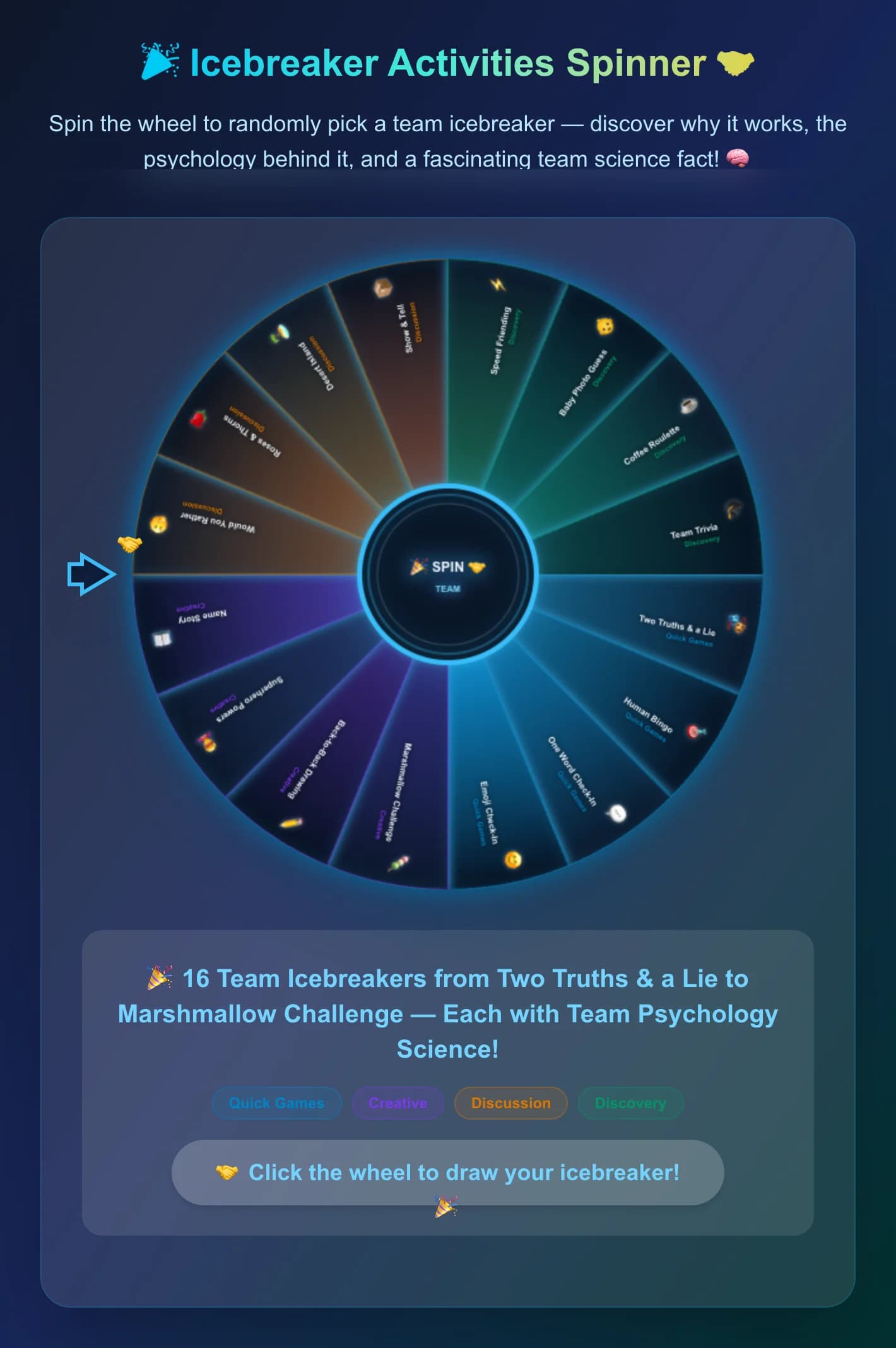
Spin the wheel to randomly pick one of 16 team icebreaker activities — from Two Truths & a Lie and Marshmallow Challenge to Speed Friending, Roses & Thorns, and Virtual Coffee Roulette. Discover why each works, the team psychology behind it, and a fascinating organizational science fact!
How to Use the Icebreaker Activities Spinner
- 1
Click the spinning wheel to set it in motion
- 2
Watch it slow down and land on a random team icebreaker
- 3
Read what it achieves, its category, and the team psychology fact behind it
- 4
Run the activity with your team — then spin again for the next meeting!
Key Features
16 team icebreakers across 4 categories: Quick Games, Creative, Discussion, and Discovery
Organizational psychology research: psychological safety stats, trust-building science, and team performance data from Google, Harvard, and Stanford
Full activity roster: Two Truths & a Lie, Human Bingo, One Word Check-In, Emoji Check-In, Marshmallow Challenge, Back-to-Back Drawing, Superhero Powers, Name Story, Would You Rather, Roses & Thorns, Desert Island, Show & Tell, Speed Friending, Baby Photo Guess, Coffee Roulette, and Team Trivia
Navy and deep teal team aesthetic with a warm, inclusive atmosphere
Fully localized into 25 languages for global teams
What Is the Icebreaker Activities Spinner?
The Icebreaker Activities Spinner is a team facilitation tool that randomly selects one of 16 research-backed icebreaker activities for teams, meetings, onboarding sessions, workshops, and remote work check-ins. The collection spans four categories: Quick Games (Two Truths & a Lie, Human Bingo, One Word Check-In, Emoji Check-In) for fast connection in 5–10 minutes; Creative activities (Marshmallow Challenge, Back-to-Back Drawing, Superhero Powers, Name Story) that reveal team dynamics and communication patterns; Discussion-based activities (Would You Rather, Roses & Thorns, Desert Island, Show & Tell) that build psychological safety and authentic connection; and Discovery activities (Speed Friending, Baby Photo Guess, Coffee Roulette, Team Trivia) that map relationship networks and surface unexpected expertise. Each activity is backed by organizational psychology research explaining why it works.
Why Spin the Icebreaker Activities Wheel?
Icebreakers aren't just fun — they're a scientifically validated method for building the psychological safety that Google's Project Aristotle identified as the #1 predictor of high-performing teams. Yet many facilitators default to the same 2–3 activities they've always used, missing the wide variety of techniques that address different team needs. This spinner solves both problems: it randomizes the selection (reducing facilitator decision fatigue) and teaches the team psychology behind each choice. Did you know kindergartners outperform MBA graduates at the Marshmallow Challenge because they iterate instead of planning? Or that discovering an unexpected commonality with a stranger releases dopamine and increases trust by 40%? Or that MIT researchers found emoji check-ins reduce remote team isolation by 27%? Each spin comes with a fact that helps teams understand why connection matters.
Frequently Asked Questions
Why is psychological safety important and how do icebreakers build it?
Psychological safety — the belief that you won't be punished for speaking up, taking risks, or admitting mistakes — is the #1 predictor of high-performing teams, according to Google's five-year Project Aristotle study (which analyzed 180 teams). Teams with high psychological safety are 67% more likely to report errors, 76% more likely to propose solutions, and 12% more productive. Icebreakers build psychological safety through two mechanisms: they create shared vulnerability (everyone participates equally, including leaders) and they normalize authentic expression by making personal disclosure fun and low-stakes. The 'Roses & Thorns' and 'Show & Tell' activities are particularly powerful for this purpose.
Why do kindergartners beat MBA students at the Marshmallow Challenge?
Designer and researcher Tom Wujec documented this pattern across 70+ groups over several years. MBA graduates arrive with sophisticated planning instincts honed in business school — they spend the first 10 minutes negotiating roles and creating an optimal plan, then build once. Kindergartners, with no professional training and no ego investment in a 'correct' approach, immediately start building, fail, adjust, and iterate repeatedly. Their prototyping mindset means they discover the critical problem — that marshmallows are heavier than expected and destabilize the structure — with time to fix it. MBAs typically discover this in the final seconds. The challenge reveals whether a team has an 'execute a plan' culture or a 'learn through doing' culture.
What is the Benjamin Franklin Effect and how does Human Bingo use it?
The Benjamin Franklin Effect (documented by Franklin himself) describes how asking someone to do you a small favor makes them like you more — because humans resolve the cognitive dissonance of 'I helped this person, so I must like them.' Human Bingo uses a reverse mechanism: asking people about themselves (their interests, experiences, and traits) creates warm feelings through active listening and acknowledgment. When you discover you share an unexpected commonality with someone (you both grew up in the same city, love the same obscure TV show), dopamine is released and affective trust increases by approximately 40% within a single interaction, according to research on social bonding.
How does Speed Friending work and why is it better than open networking?
Speed Friending pairs team members for 3–5 minute structured conversations with a rotating schedule, so each person speaks with multiple partners. Cornell University research shows that a 3-minute conversation focused on a specific question generates the same subjective closeness as 30 minutes of unstructured conversation — because it eliminates 'small talk paralysis,' the awkward hovering over weather and weekend plans. The structured format particularly benefits introverts, who perform equally to or better than extroverts in one-on-one settings but typically struggle in open group networking situations. By the end of a 30-minute session, each participant has formed 5–8 meaningful micro-connections.
Why is the One Word Check-In so effective for remote meetings?
The One Word Check-In works through a neuroscientific mechanism called 'affect labeling.' Naming an emotion (even a single word like 'anxious,' 'energized,' or 'scattered') activates the ventrolateral prefrontal cortex, which simultaneously inhibits the amygdala — the brain's threat-response center. Psychiatrist and author Dan Siegel popularized this as 'Name it to tame it.' In team settings, this reduces meeting anxiety by 22% and increases solution-focused thinking by 18%. The single-word constraint is also a feature, not a limitation: it forces emotional precision that helps people identify feelings they hadn't consciously recognized before the check-in.
What is Virtual Coffee Roulette and why is it important for remote teams?
Virtual Coffee Roulette uses a randomizer (or a tool like Donut for Slack) to pair employees from across the organization for informal 15–30 minute video chats. Before remote work, 70% of informal workplace learning happened through chance encounters — passing in hallways, sharing lunch, overhearing conversations. Remote work eliminated this. Stanford research shows employees with strong 'weak ties' (connections outside their immediate team) are 58% more likely to innovate because cross-team information exposure provides cognitive diversity. Microsoft's 2021 Work Trend Index found remote work caused weak ties to drop 26%, with measurable negative effects on organizational collaboration and innovation metrics.