Gift Ideas Spinner Wheel
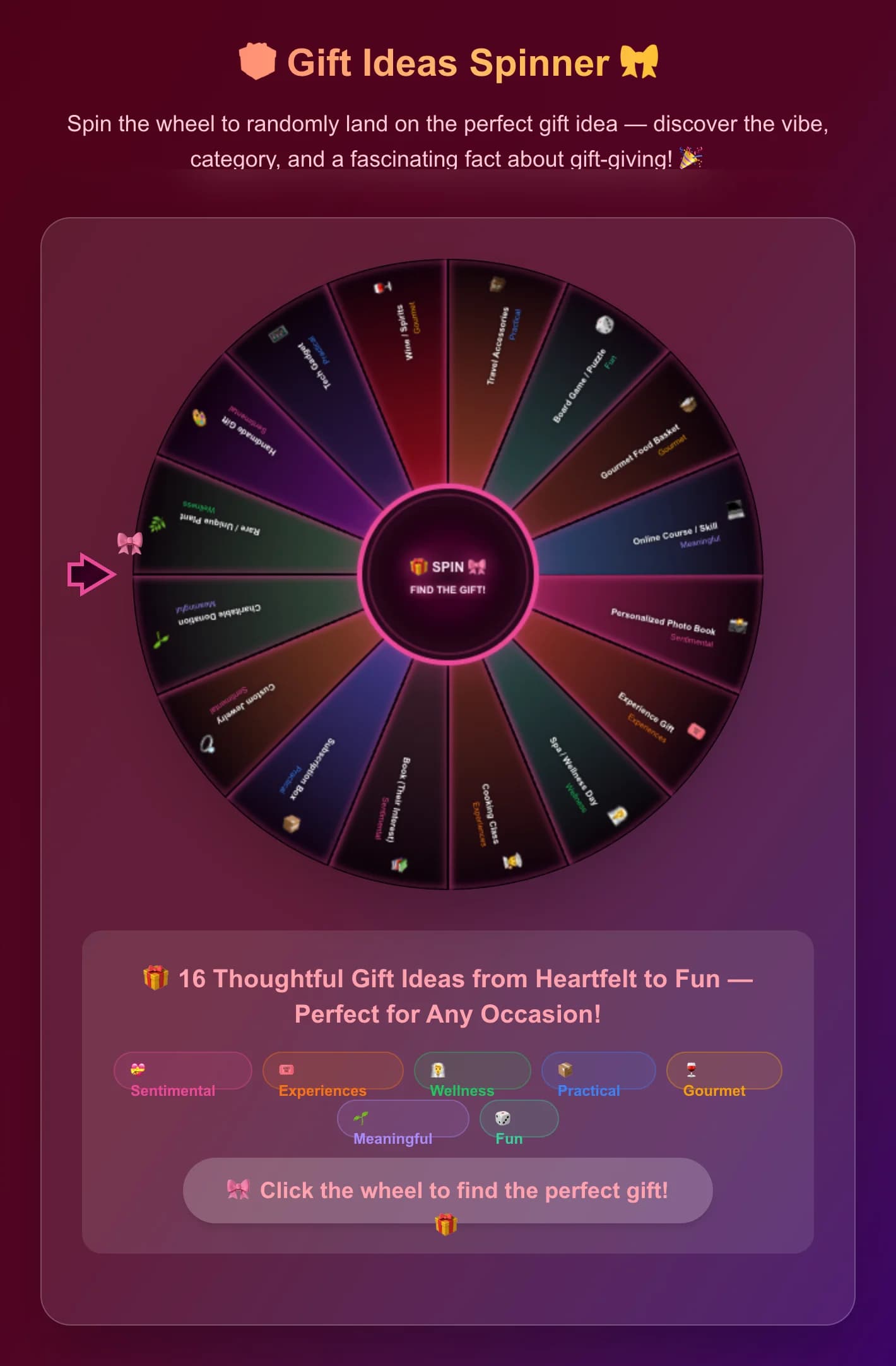
Spin the wheel to randomly land on the perfect gift idea! Discover 16 thoughtful gift categories from sentimental to practical — with fascinating facts about gift-giving psychology, from why experiences outlast possessions to why handmade gifts are kept longer than purchased ones.
How To Use
Click or tap the spinning wheel to randomly land on a gift idea category. Discover the gift type, its vibe, and a fascinating fact about why that type of gift is so meaningful — from the psychology of personalization to why experience gifts create lasting memories. Use it as inspiration to find the perfect gift for any person or occasion.
Key Features
16 thoughtful gift ideas across 7 categories: Sentimental, Experiences, Wellness, Practical, Gourmet, Meaningful, Fun
Gift vibe label for every idea (e.g. 'Memory Maker', 'Forever Keepsake', 'Level Up')
Science-backed and historical facts about gift-giving psychology
Warm rose and pink celebration-themed spinning wheel
Perfect for birthdays, holidays, anniversaries, or any occasion when you're stuck on ideas
Covers all budgets: from handmade gifts to tech gadgets and experiences
What Is This?
The Gift Ideas Spinner covers 16 distinct gift categories ranging from deeply sentimental (personalized photo books, handmade gifts, custom jewelry) to experiential (cooking classes, concert tickets, spa days) to practical (subscription boxes, tech gadgets, travel accessories) to meaningful (charitable donations, online courses). Each comes with science-backed facts about what makes gifts truly memorable.
Why Use This?
Stuck on what to give? The spinner breaks gift-giving paralysis by randomly surfacing categories you might not have considered. It's backed by real research — did you know Cornell University proved experiences make people happier than possessions? That handmade gifts are kept longer than purchased ones due to 'labor illusion'? That a book chosen to match someone's specific interest signals more attentiveness than any expensive generic gift? Let the science of gift-giving guide you.
Frequently Asked Questions
What type of gift makes people the happiest?
Cornell University psychologist Thomas Gilovich's research found that experiences consistently make people happier than material possessions, and this effect grows stronger over time. Material gifts are subject to 'hedonic adaptation' — we stop noticing them within weeks. Experiences, by contrast, become memories that we retell, relive, and share with others, growing richer over time. Among material gifts, personalized items (photo books, custom jewelry, handmade gifts) consistently outperform generic items in satisfaction research regardless of price.
How do I choose between a sentimental and practical gift?
Research suggests matching the relationship depth to the gift type: sentimental gifts (handmade, personalized, experience-based) are most appropriate for close relationships where emotional connection is the primary message. Practical gifts work best when you know a specific need the recipient has expressed — practical gifts given without this knowledge can feel impersonal. When uncertain, experience gifts are the safest choice: they're inherently personal (you chose this experience for this person), create shared memories, and avoid the 'wrong size, wrong color' problem of physical items.
Are expensive gifts better than inexpensive ones?
Surprisingly, no. Multiple studies show that price does not predict recipient satisfaction for most gift categories. The most predictive factors are: (1) personalization — does the gift reflect that the giver knows the recipient? (2) effort signal — does it communicate that the giver invested thought? (3) timing — was it given at the right moment? In fact, research by Jeff Galak at Carnegie Mellon found that givers consistently overestimate how much recipients care about price, and underestimate how much recipients value effort and attentiveness.
What is a good gift for someone who has everything?
Experience gifts are the gold standard for people who 'have everything' because they can't be duplicated by self-purchase. A cooking class in a cuisine they love, tickets to a show they've mentioned, or a spa day gives something material possessions can't — a memory and a story. Second best: a charitable donation in their name to a cause they care about (which also has documented positive psychological effects for the recipient). Third: a book chosen specifically because it connects to something they've said — it signals you were listening.
What makes handmade gifts special according to research?
Two well-documented psychological principles apply. First, 'labor illusion': people value things more when they can see the effort involved — perceived effort dramatically increases perceived value, even when the object is technically less refined than a purchased alternative. Second, handmade gifts create a unique 'provenance story' — the gift carries a narrative that purchased items lack, and research shows people assign far higher emotional value to objects with personal histories. Handmade gifts are the most likely gift category to be kept for 10+ years.
When is a subscription box a good gift idea?
Subscription boxes excel in specific situations: (1) when you want to give something that lasts longer than one moment — subscriptions extend the gift relationship for months; (2) for people who are hard to shop for because you're not sure of specific preferences — subscription boxes in their hobby or interest area let them self-curate; (3) for people in different locations — a monthly delivery creates a recurring connection moment; (4) as a 'bridge gift' when you know what someone likes but not which specific item within that category. The research-backed reason subscriptions work: anticipatory pleasure is as neurologically rewarding as the actual receipt.