Gemstones & Crystals Spinner Wheel
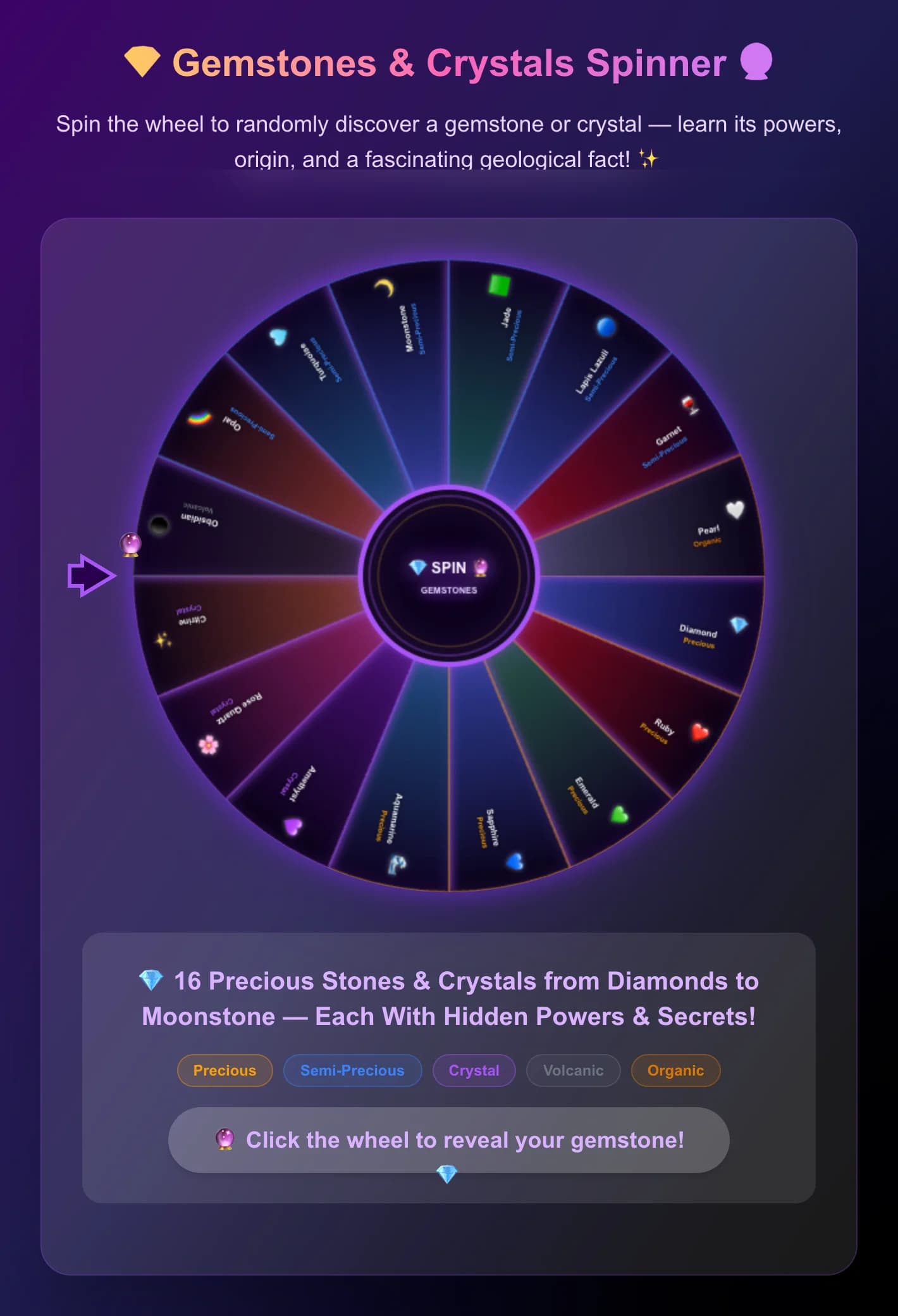
Spin the wheel to randomly discover one of 16 stunning gemstones and crystals — from Diamonds and Rubies to Amethyst, Moonstone, and Obsidian. Each result reveals the gem's symbolic powers, gem type, and a fascinating geological or historical fact you probably didn't know.
How To Use
Click or tap the spinning wheel to randomly land on one of 16 gemstones or crystals. The result reveals the gem's name, type category, symbolic powers (what it's known for), and a fascinating fact about its geology, history, or record-breaking properties.
Key Features
16 gemstones and crystals spanning 5 categories: Precious, Semi-Precious, Crystal, Volcanic, and Organic
Each result shows the gem's symbolic power and what it's 'known for' — from Timeless Power (Diamond) to Intuition & Magic (Moonstone)
Deep geological and historical facts for every gem — including price records, ancient history, and scientific discoveries
Color-coded gem categories (gold for Precious, purple for Crystal, blue for Semi-Precious, gray for Volcanic, amber for Organic)
Deep jewel-cave themed spinning wheel with purple crystal glow
Perfect for crystal enthusiasts, geology lovers, birthstone discovery, gift selection, and mindful jewelry exploration
What Is This?
The Gemstones & Crystals Spinner covers the full spectrum of precious and semi-precious stones: Precious gems (Diamond, Ruby, Emerald, Sapphire, Aquamarine), Healing Crystals (Amethyst, Rose Quartz, Citrine), Semi-Precious stones (Opal, Turquoise, Moonstone, Jade, Lapis Lazuli, Garnet), Volcanic glass (Obsidian), and Organic gems (Pearl). Each entry includes geological science, historical significance, and the symbolic meaning attributed to that stone across cultures.
Why Use This?
Gemstones sit at the intersection of geology, history, mythology, commerce, and spiritual practice — making them fascinating from almost any angle. Did you know amethyst was once as valuable as ruby until 19th-century discoveries crashed the market? That obsidian blades are sharper than modern surgical steel? That the blue ultramarine pigment in Michelangelo's Sistine Chapel came from ground lapis lazuli? That rubies and sapphires are the exact same mineral? Spin and discover the hidden world of precious stones.
Frequently Asked Questions
What are the four precious gemstones?
The four traditionally recognized precious gemstones are Diamond, Ruby, Emerald, and Sapphire. All other gems are classified as semi-precious. However, this classification is largely a marketing and historical distinction rather than a scientific one — many semi-precious gems (such as fine alexandrite, paraíba tourmaline, or red spinel) routinely command higher prices than poor-quality examples of the 'precious four.' The spinner includes all four precious stones plus Aquamarine, which some modern gemologists include in an expanded precious category.
What is the rarest gemstone in the world?
By several measures, painite held the Guinness World Record as the rarest gem for decades — only 3 specimens were known until 2005, when deposits were found in Myanmar. Other extremely rare gems include musgravite (discovered 1967, fewer than 20 gem-quality specimens exist), red beryl (found almost exclusively in Utah's Wah Wah Mountains), and grandidierite (Madagascar, near colorless specimens only). Among well-known gems, natural alexandrite (color-changing chrysoberyl) and paraíba tourmaline (neon blue-green from copper) are exceptionally rare and valuable.
What is the difference between a gemstone and a crystal?
All gemstones with a crystalline structure are technically crystals (which is most of them), but not all crystals are used as gemstones. A crystal is any solid material with atoms arranged in a regular, repeating 3D pattern. A gemstone is a mineral, crystal, or organic material that is cut and used in jewelry or decorative objects due to beauty, durability, and rarity. Obsidian is a gemstone but not a crystal (it's amorphous glass). Pearls are gemstones but not crystals or minerals (they're organic calcium carbonate). Rose quartz is both a crystal and a gemstone.
What is crystal healing and does it work?
Crystal healing is a complementary wellness practice that assigns metaphysical properties to specific gemstones and crystals — amethyst for calm, rose quartz for love, citrine for abundance, obsidian for protection, etc. These traditions predate recorded history and exist in virtually every culture. From a scientific standpoint, no peer-reviewed clinical evidence supports crystals having direct physiological effects beyond placebo. However, the placebo effect itself is well-documented and can produce genuine benefits. Crystal practices also serve as mindfulness tools, with ritual handling and focused intention offering real psychological benefits regardless of any metaphysical mechanism.
What gemstone is best for healing or calming?
Within crystal healing traditions, the most commonly cited calming and healing stones are: Amethyst (stress relief, better sleep — possibly the most universally recommended 'calming' crystal); Blue Lace Agate (gentle anxiety relief); Lepidolite (contains trace lithium, recommended for anxiety); Selenite (mental clarity, clearing energy); and Aquamarine (courage and calm during difficult situations). Rose Quartz is considered the universal heart-healing stone, while Black Tourmaline and Obsidian are protective stones that crystal practitioners recommend for grounding and shielding from negative energy.
How do I find out my birthstone?
The modern birthstone list (established by the American National Retail Jewelers Association in 1912) assigns: January → Garnet, February → Amethyst, March → Aquamarine, April → Diamond, May → Emerald, June → Pearl (or Moonstone), July → Ruby, August → Peridot, September → Sapphire, October → Opal (or Tourmaline), November → Citrine (or Topaz), December → Turquoise (or Blue Topaz or Tanzanite). Several months have multiple options because the traditional 1912 list has been updated — notably in 2002 (tanzanite added for December) and 2016 (spinel added for August). All birthstone gems from this spinner appear in the list.
Which gemstone is the most expensive?
The most expensive gemstones per carat at auction: (1) Pink Star Diamond — $71.2M (59.6 carats, Sotheby's 2017); (2) Sunrise Ruby — $30.3M (25.59 carats, Sotheby's 2015); (3) Oppenheimer Blue Diamond — $57.5M (14.62 carats); among colored stones, Burmese rubies and Kashmiri sapphires regularly exceed $1M per carat, often surpassing diamonds. Imperial jade (vivid green jadeite) has sold for over $3M per carat. The key insight: rarity plus demand drives gem prices more than any intrinsic property — a 1-carat fine Burmese ruby can be worth more than a 1-carat fine diamond.