Find the Constant of Proportionality
Beacon Relay
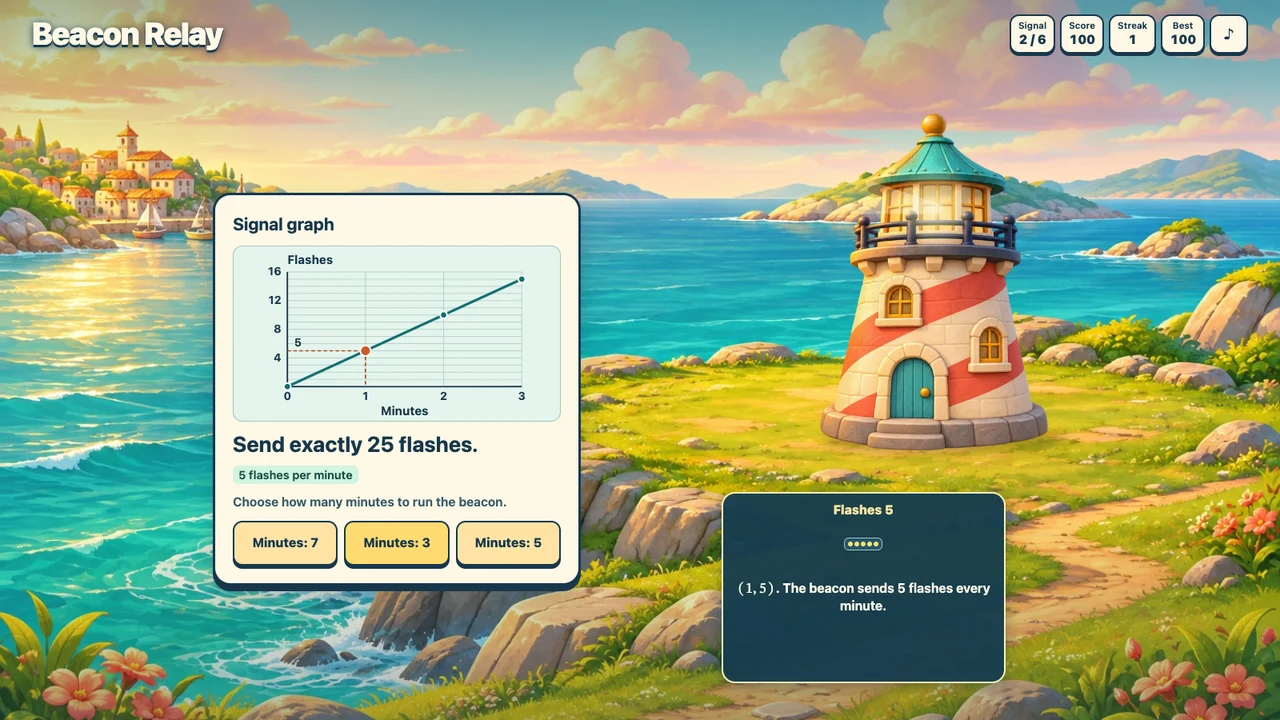
Run a lighthouse relay in this seventh-grade math game. Find the beacon’s flashes per minute from a signal log, a graph, or a keeper’s note, then use that rate to send an exact number of flashes.
More like this


How to Play Beacon Relay
- 1
Read the clue
Use a row of the Signal log, the point at one minute on the Signal graph, or the two quantities in the Keeper’s note.
- 2
Set the flashes per minute
Select a rate. If the setting disagrees with the clue, use the feedback to compare the expected and observed totals.
- 3
Choose how long to run the beacon
Use the rate you just found to reach the requested number of flashes. Pick a duration and check the product shown below the beacon.
- 4
Continue the relay
Choose Next signal after a successful transmission. After six signals, choose Play again for a fresh run.
Key Features
Read three kinds of clues
Find the same kind of rate from a Signal log, a Signal graph, or a Keeper’s note. Each clue describes how the number of flashes grows with time.
Set the beacon
Choose a flashes-per-minute setting. The beacon previews that setting, and a mismatch shows how many flashes it would produce over the time in the clue.
Send an exact signal
Once the rate is set, choose the number of minutes that produces the requested total. The beacon shows the flashes in groups of one minute.
Play six signals per run
Each received signal adds 100 points. You can retry a setting or duration after a miss, which resets the streak. Play again deals a new set of clues.
What is Beacon Relay?
Beacon Relay is a seventh-grade math game about finding and using the constant of proportionality. If x is the number of minutes and y is the number of flashes, the beacon follows y = k × x. The constant k is how many flashes the beacon sends in one minute. Suppose the Signal log shows 12 flashes in 3 minutes. Divide 12 by 3 to set the beacon to 4 flashes per minute. On a graph of the same relationship, the point (1, 4) shows that same rate. If the next transmission calls for 20 flashes, choose 5 minutes because 4 × 5 = 20.
Why Play Beacon Relay?
- 1
Keep the units in order
Flashes per minute means dividing flashes by minutes. The beacon turns that quotient into a count for one minute.
- 2
Read the graph at one minute
The horizontal coordinate is time and the vertical coordinate is flashes. The height at x = 1 gives k directly.
- 3
Use the rate to make a prediction
Carry the same setting into a second decision about how long to run the beacon. Check how the groups of flashes match the multiplication.
- 4
Revise with evidence
When a setting misses, compare the flashes it would produce with the clue. When a duration misses, compare the resulting product with the requested total.
Frequently Asked Questions
What does k represent in Beacon Relay?
It is the number of flashes the beacon sends in one minute. The total after x minutes is k × x flashes.
How can I find k in the Signal log?
Pick any row with a positive number of minutes. Divide the flashes by the minutes in that row.
What point should I read in the Signal graph?
Read the point with a horizontal coordinate of 1. Its vertical coordinate is the number of flashes in one minute.
What happens if I select the wrong setting?
The beacon shows the result of your choice. You can retry on the same signal, and your streak resets.
Can I play with the keyboard?
Yes. Tab to a rate, duration, or action, then press Enter or Space. The same controls work with a tap or click.
What carries over to my next run?
Your best score and sound setting are saved in this browser. A new run starts with zero points and a fresh set of signals.