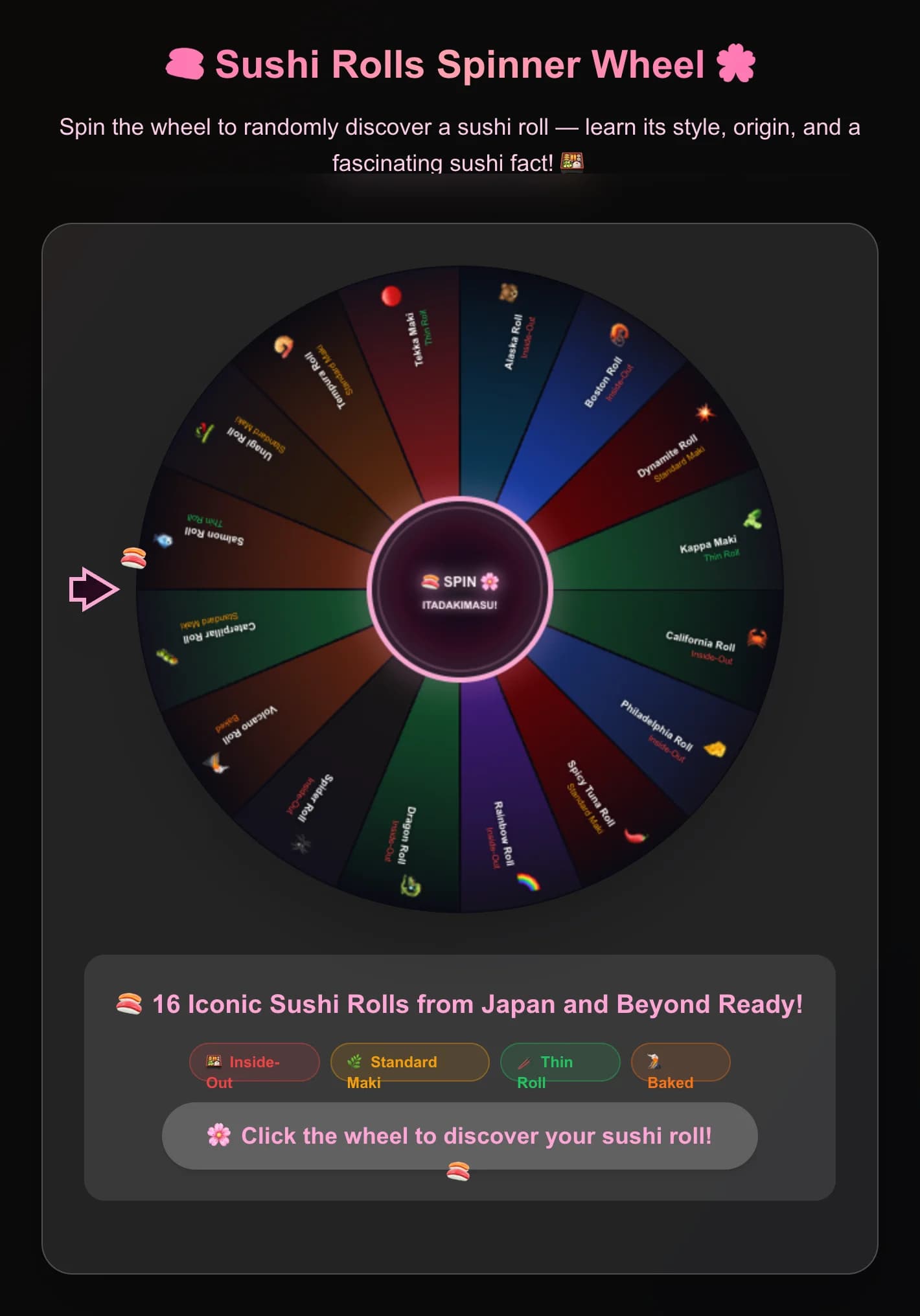
- 1
Click the spinning wheel in the center of the page
- 2
Watch the wheel spin through 16 iconic sushi rolls
- 3
The wheel slows and lands on a random sushi roll
- 4
A roll card reveals the style category, origin, and an amazing historical or culinary fact
- 5
Click 'Itadakimasu!' to dismiss and spin again
Key Features
16 iconic sushi rolls spanning 4 styles: Inside-Out (uramaki), Standard Maki, Thin Roll (hosomaki), and Baked
Region of origin revealed for every roll — from Los Angeles and Philadelphia to Edo-period Japan and Norwegian fjords
Rich historical fact for each roll revealing surprising stories from sushi and food history
Color-coded by roll style category for easy identification
Elegant dark Japanese restaurant theme with cherry blossom pink accents
The Sushi Rolls Spinner Wheel is an interactive food exploration tool that randomly selects one of 16 iconic sushi rolls from Japan, the United States, and beyond. From the California Roll's inside-out format invented to hide seaweed from American diners, to the decade-long Norwegian government campaign that convinced Japan to accept raw salmon, the 17th-century gambling dens that gave Tekka Maki its name, and the Norwegian-Japanese trade breakthrough that created the world's most popular sushi fish — each spin reveals the roll's style, origin, and a fascinating slice of culinary history. Perfect for sushi lovers exploring new options, foodies curious about food history, and anyone who wants to understand the surprising global stories behind their favorite rolls.
Frequently Asked Questions
Which sushi rolls are on the wheel?
The wheel includes California Roll, Philadelphia Roll, Spicy Tuna Roll, Rainbow Roll, Dragon Roll, Spider Roll, Volcano Roll, Caterpillar Roll, Salmon Roll, Unagi Roll, Tempura Roll, Tekka Maki, Alaska Roll, Boston Roll, Dynamite Roll, and Kappa Maki (Cucumber Roll).
Why is the California Roll made inside-out?
The inside-out (uramaki) format — with rice on the outside and seaweed hidden inside — was invented specifically because American diners in the early 1970s found black seaweed visually unappealing. Chef Ichiro Mashita at Tokyo Kaikan restaurant in Los Angeles created the format around 1971 to hide the nori while still providing its structural benefit. He also replaced fatty tuna with avocado, which has a similar buttery richness at a lower cost and year-round availability. The California Roll is now the world's most consumed sushi roll and has even been exported back to Japan as 'American sushi.'
How did raw salmon become acceptable in Japanese sushi?
Raw salmon was not traditionally eaten in Japan — Pacific salmon (masu, chum, pink) could carry the parasitic tapeworm Anisakis, making it unsafe to eat raw. The transformation came through a determined 10-year Norwegian government trade initiative beginning in the 1980s. Norwegian Atlantic salmon, raised in deep, cold fjord waters, was naturally free of the parasites that plagued Pacific salmon. Norwegian trade representative Bjørn Eirik Olsen spent years trying to convince Japanese distributors and restaurants, even personally eating Norwegian salmon sashimi in front of skeptical Japanese buyers to demonstrate its safety. The campaign finally succeeded in the late 1980s. Today, raw salmon is the single most popular sushi fish in the world.
Why is it called Tekka Maki?
'Tekka' has two connected meanings in Japanese. First, it means 'gambling den' (tekkaba) — the thin tuna hosomaki roll was created for Japan's 17th-19th century gambling establishments because gamblers needed a convenient one-handed snack that wouldn't wet their cards or disrupt gameplay. Second, 'tekka' also means 'hot iron,' evoking the red-hot glow of heated metal, which references the vivid red color of the raw tuna filling. Historically, tuna was considered low-prestige 'commoner' fish in Japan before refrigeration because its high fat content made it spoil quickly — it was only elevated to a delicacy in the 20th century when refrigeration technology made fatty tuna both safe to store and desirable.
What is the difference between uramaki, hosomaki, and maki?
These terms describe the physical construction of sushi rolls. Maki (makizushi) is the general term for any sushi wrapped in seaweed (nori) — the seaweed is on the outside. Hosomaki ('thin roll') is a small-diameter maki with just one filling ingredient, like Tekka Maki (tuna) or Kappa Maki (cucumber). Uramaki ('inside-out roll') reverses the standard construction: rice is on the outside, seaweed is inside — this is the format used for the California Roll, Rainbow Roll, Spider Roll, and most American-style rolls. The inside-out format was invented in America specifically to make sushi more visually appealing to Western diners unfamiliar with seaweed.