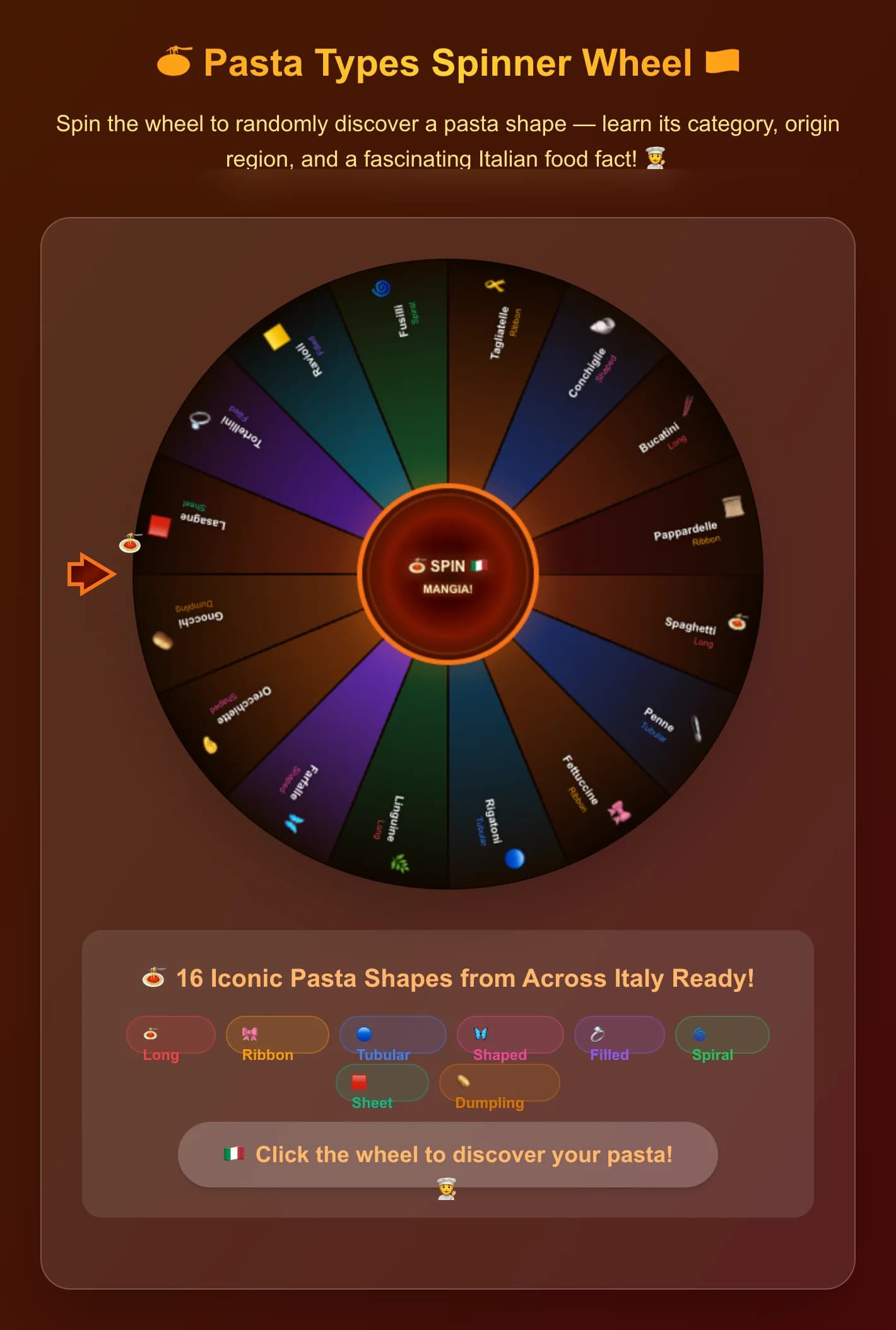
- 1
Click the spinning wheel in the center of the page
- 2
Watch the kitchen wheel spin through 16 iconic pasta shapes
- 3
The wheel slows and lands on a random pasta type
- 4
A pasta card reveals the shape category, origin region, and an amazing historical fact
- 5
Click 'Mangia!' to dismiss and spin again
Key Features
16 iconic pasta shapes spanning 8 categories: Long, Ribbon, Tubular, Shaped, Filled, Sheet, Spiral, and Dumpling
Region of origin revealed for every pasta — from Naples to Bologna to Puglia
Rich historical fact for each pasta revealing surprising stories from Italian culinary history
Color-coded by pasta shape category for easy identification
Warm Italian kitchen themed design with tomato and amber accents
The Pasta Types Spinner Wheel is an interactive Italian food tool that randomly selects one of 16 iconic pasta shapes from across Italy. From spaghetti's pre-fork hand-eating origins and the BBC's famous April Fool's spaghetti tree hoax, to tortellini's official registered recipe at the Bologna Chamber of Commerce and the legendary story of tagliatelle being created to honor Lucrezia Borgia's blonde hair, each spin reveals the pasta's shape category, regional origin, and a fascinating slice of culinary history. Perfect for foodies, home cooks who can't decide what to make, Italian food lovers, and anyone who wants to discover the stories behind their favorite pasta shapes.
Frequently Asked Questions
Which pasta types are on the wheel?
The wheel includes Spaghetti, Penne, Fettuccine, Rigatoni, Linguine, Farfalle, Orecchiette, Gnocchi, Lasagne, Tortellini, Ravioli, Fusilli, Tagliatelle, Conchiglie, Bucatini, and Pappardelle.
What is the difference between spaghetti and linguine?
Spaghetti is a perfectly round strand, while linguine is flattened into an oval cross-section — 'linguine' means 'little tongues' in Italian. The shape difference matters: spaghetti's round profile coats evenly with smooth, thin sauces (like marinara or aglio e olio), while linguine's flat surface clings better to oil-based sauces and is traditionally paired with pesto, which was invented in the same Ligurian city that created linguine.
Why does pasta shape matter so much in Italian cooking?
Each pasta shape was engineered over centuries to maximize the pairing with specific types of sauce. Long, smooth pasta (spaghetti, linguine) coats evenly with thin sauces. Ridged tubes (rigatoni, penne rigate) trap chunky meat sauces inside their hollow and on their ridged surface. Wide ribbons (pappardelle) require thick, heavy ragù that won't fall off. Shell shapes (conchiglie, orecchiette) act as cups, scooping up chunky vegetables and ricotta. Italians consider wrong pasta-sauce pairings a serious culinary mistake.
Is gnocchi actually pasta?
Technically no — gnocchi are dumplings, not pasta. They're made from potato (or ricotta, or semolina) rather than pasta dough. Gnocchi actually predate pasta in Italy: small wheat dumplings were eaten in Roman times, long before the potato version was possible. Potatoes only arrived in Italy from the Americas in the 16th century. The potato gnocchi we know today dates from the 18th century.
What is the BBC spaghetti tree hoax?
On April 1, 1957, the BBC's Panorama news programme broadcast a 3-minute documentary showing Swiss farmers harvesting spaghetti from trees during an 'exceptionally mild winter' that had eliminated the 'spaghetti weevil.' It was completely fabricated. Thousands of viewers called the BBC asking how to grow their own spaghetti tree — the BBC reportedly told some to 'place a sprig of spaghetti in a tin of tomato sauce and hope for the best.' It remains the most successful April Fool's hoax in television history.