BrowserFun
New GamesCategoriesView All
© 2026 BrowserFun. All rights reserved.
Privacy PolicyTerms & ConditionsCookie PolicyDisclaimer
  1. Home
  2. Tools
  3. Systems of Equations — High School Math Quiz

Systems of Equations — High School Math Quiz

Solve linear systems of two equations by substitution, elimination, and word problems. 45 problems across three tiers: Algebra I (simple substitution and system identification), Algebra II (multi-step elimination, multi-step substitution, and real-world word problems), and Advanced (parametric systems, fractional coefficients, three-variable extensions, and SAT-style applications).

GameMathEducationalgebraHigh School
Systems of Equations — High School Math Quiz - Solve linear systems of two equations by substitution, elimination, and word pro

How to Play Systems of Equations

  1. 1

    Review the Method Cards

    The lobby shows two method cards with the core logic of Substitution and Elimination. Substitution: solve one equation for a variable, then plug that expression into the other. Elimination: multiply equations so a variable's coefficients match, then add or subtract to cancel it.

  2. 2

    Choose a Difficulty

    Algebra I stays with simple substitution where one equation is already in the form y = … or x = …. Algebra II requires choosing the right method and sometimes multiplying an equation first. Advanced adds parametric ('find k') problems, fractional equations, and multi-step word problems common on the SAT.

  3. 3

    Pick the Right Method

    Read the problem and look for clues: if one equation is already solved for a variable, use Substitution. If the equations have matching or opposite coefficients on one variable (like +3y and −3y), use Elimination by adding. If you need to create matching coefficients, multiply one equation first. The category badge (SUBSTITUTE, ELIMINATE, IDENTIFY, APPLY) tells you which skill is being tested.

  4. 4

    Check and Learn

    After answering, the step-by-step strategy appears regardless of whether you were right. For identification questions, the hint explains the geometric meaning (parallel lines, same line, or intersecting lines). For word problems, it shows how to set up the equations from the scenario.

Key Features

  • 45 Problems Across 3 Tiers

    Algebra I covers simple substitution — one equation already solved for a variable — and system identification (one solution, no solution, infinitely many). Algebra II adds multi-step substitution, the elimination (addition/subtraction) method with multiplier steps, and word problems translating real scenarios into systems. Advanced includes parametric systems (find the value of k that creates a special case), fractional coefficients, three-number sum puzzles, and classic SAT applications like distance-rate-time and investment problems.

  • 4 Problem Types — Color-Coded

    SUBSTITUTE (violet) presents systems best solved by plugging one expression into the other. ELIMINATE (purple) features problems where adding or subtracting the equations cancels a variable directly. IDENTIFY (indigo) asks about the nature of the system — how many solutions exist or what parameter value creates a special case. APPLY (blue) wraps the algebra in a real-world context like ticket pricing, boat speed, or account interest.

  • Coordinate Grid Lobby Visual

    The lobby features a live mini coordinate plane with two intersecting lines and a labeled solution point, illustrating exactly what 'solving a system' means geometrically. The two method cards (Substitution and Elimination) explain when to use each approach before you start.

  • Step-by-Step Strategy Hints

    Each hint names the method being used and walks through the key algebraic steps — which equation to manipulate first, which variable to isolate, and which arithmetic operation eliminates it. Hints appear as 'Strategy:' notes to reinforce metacognitive problem-solving habits.

Frequently Asked Questions

What methods are covered?

Three methods: (1) Substitution — isolate one variable and substitute; (2) Elimination — add or subtract equations to cancel a variable, sometimes after multiplying to match coefficients; (3) Identification — determine the number of solutions by comparing slopes and y-intercepts (or their ratio forms) without solving.

How do I know when to use substitution vs. elimination?

Use substitution when one equation is already solved for a variable (e.g., y = 2x + 3) or when isolating a variable is quick (coefficient of 1 or −1). Use elimination when the equations have matching or opposite coefficients on one variable, or when multiplying one equation by a small integer creates a match. Both methods always give the same answer — it's a matter of efficiency.

What does 'no solution' vs. 'infinitely many solutions' mean?

No solution means the lines are parallel — same slope, different y-intercepts. They never meet. Infinitely many solutions means the lines are identical — every point on one line is also on the other. Both cases are detectable without solving: if the ratio of x-coefficients equals the ratio of y-coefficients but not the constants, the system has no solution; if all three ratios are equal, it has infinitely many.

How does scoring work?

Correct answers earn 10 pts (Algebra I), 15 pts (Algebra II), or 20 pts (Advanced). Consecutive correct answers add a 5-point streak bonus per answer after the first. A wrong answer resets the streak to zero.

What makes the Advanced / SAT problems harder?

Advanced problems include: parametric questions (for what value of k does this system have no solution / infinitely many solutions), which require understanding when ratios of coefficients are equal; fractional-coefficient systems; three-variable extension problems where you derive x + y + z from three pairwise sums; and classic SAT word problems (boat + current, investment interest split, trains approaching each other).

Is this game useful for SAT prep?

Yes. Systems of equations appear on every SAT math section. Common SAT question types include: finding the number of solutions, solving for one variable in terms of another within a system, word problems that require setting up two equations, and parametric questions asking for the value of a coefficient that produces a special case. The Advanced tier covers all of these.

Related Tools

GameAll →

🃏 24 Game 🃏

The classic 24 card game! Given 4 random numbers, combine them using +, −, ×, ÷ to reach exactly 24. Every number must be used exactly once. Choose your difficulty (1–6, 1–9, or 1–13), build a streak, and beat your best time!

🔢 Sudoku 🔢

Classic 9×9 Sudoku with four difficulty levels — Easy, Medium, Hard, and Expert. Features a live timer, mistake counter, pencil notes, and 3 hints per puzzle. Beat your best time!

🧩 MathDoku 🧩

A KenKen-style arithmetic puzzle! Fill the grid with 1–N so every row and column contains each number exactly once. Each outlined cage must equal its target value using addition, subtraction, multiplication, or division. Choose from 4×4, 5×5, or 6×6 grids.

2D Shape Explorer

Identify 2D shapes like triangles, squares, pentagons, hexagons, and more by counting their sides and corners. Features colorful SVG shapes, multiple question types (name, sides count, corners count), and three difficulty levels.

Acronym Generator

Turn any word into a creative acronym expansion! Pick a word from 42 preset options across 6 categories — or type your own — then fill in a word for each letter to build your unique acronym. Compare your creation with a built-in fun alternative.

Acrostic Puzzle – Solve Clues to Reveal a Hidden Phrase

Play acrostic puzzles where you solve word clues and the first letters of each answer spell out a hidden phrase. Features five categories, three difficulty levels, and a hint system.

MathAll →

🃏 24 Game 🃏

The classic 24 card game! Given 4 random numbers, combine them using +, −, ×, ÷ to reach exactly 24. Every number must be used exactly once. Choose your difficulty (1–6, 1–9, or 1–13), build a streak, and beat your best time!

🔢 Sudoku 🔢

Classic 9×9 Sudoku with four difficulty levels — Easy, Medium, Hard, and Expert. Features a live timer, mistake counter, pencil notes, and 3 hints per puzzle. Beat your best time!

🧩 MathDoku 🧩

A KenKen-style arithmetic puzzle! Fill the grid with 1–N so every row and column contains each number exactly once. Each outlined cage must equal its target value using addition, subtraction, multiplication, or division. Choose from 4×4, 5×5, or 6×6 grids.

2D Shape Explorer

Identify 2D shapes like triangles, squares, pentagons, hexagons, and more by counting their sides and corners. Features colorful SVG shapes, multiple question types (name, sides count, corners count), and three difficulty levels.

Add the Animals

2 cats + 3 cats = ? Count adorable animal emoji to solve addition problems up to 10. A visual and engaging way for young learners to practice adding numbers through counting.

Algebra Challenge — High School Math Quiz

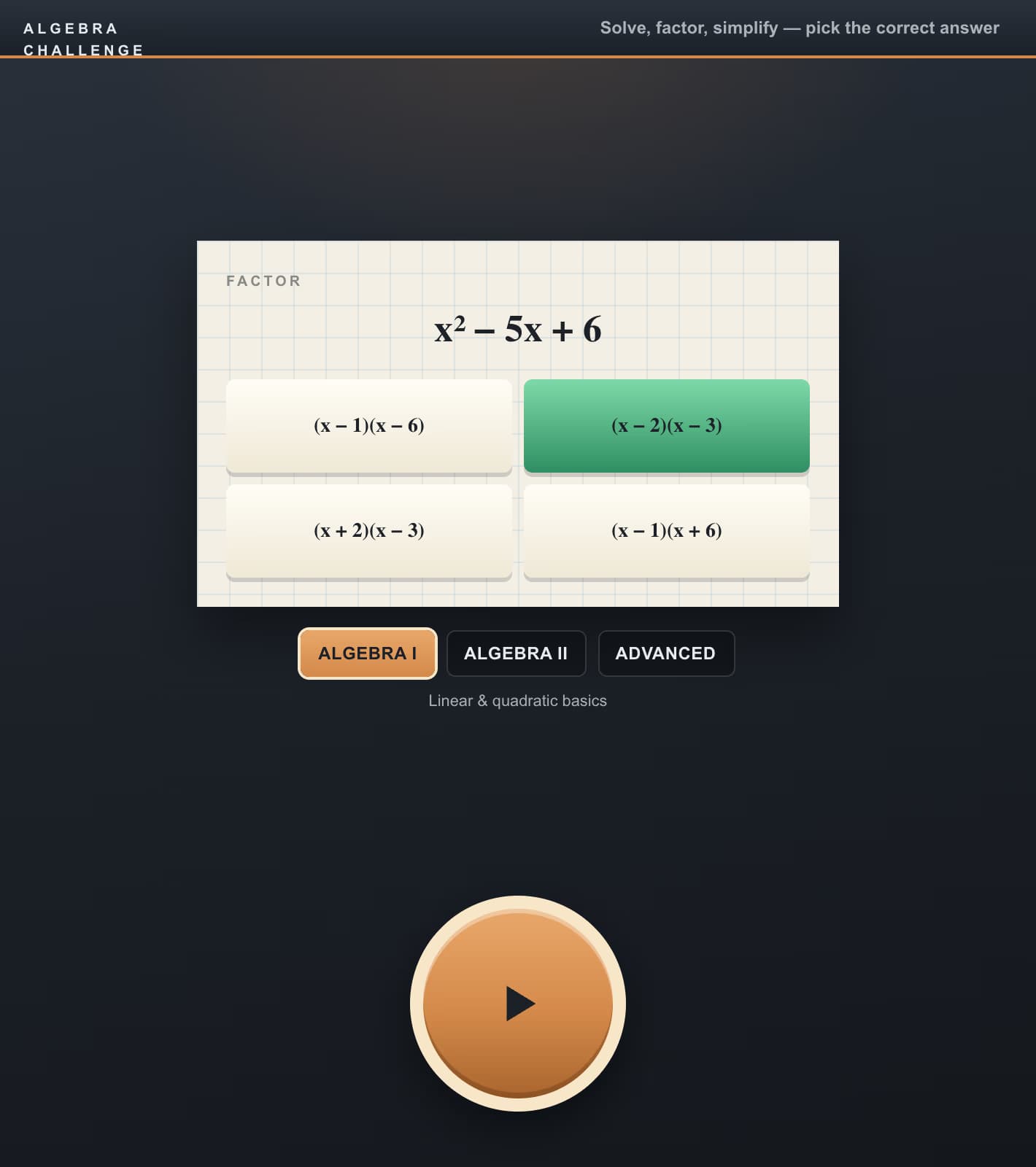
Solve equations, factor polynomials, simplify expressions — pick the correct answer from four choices. 45 problems across three tiers: Algebra I (linear equations, slope, basic factoring), Algebra II (quadratics, systems, logs, sequences), and Advanced (pre-calculus, complex numbers, inverse functions, infinite series).

EducationAll →

Algebra Challenge — High School Math Quiz

Solve equations, factor polynomials, simplify expressions — pick the correct answer from four choices. 45 problems across three tiers: Algebra I (linear equations, slope, basic factoring), Algebra II (quadratics, systems, logs, sequences), and Advanced (pre-calculus, complex numbers, inverse functions, infinite series).

Argument Types — Logic & Fallacy Quiz

Identify whether an argument is deductive, inductive, or abductive — and name the logical fallacy when one is present. 45 problems across three tiers: Foundation covers the most common fallacies (ad hominem, straw man, false dilemma, slippery slope, appeal to authority, bandwagon, hasty generalization, appeal to ignorance) and basic argument types. Intermediate adds subtle informal fallacies (post hoc, tu quoque, anecdotal evidence, appeal to nature, poisoning the well, circular reasoning, relative privation). Advanced covers formal fallacies (affirming the consequent, denying the antecedent, modus tollens), validity vs. soundness, equivocation, and abductive reasoning.

Complete the Phrase — Collocation Quiz

A phrase with a missing word — pick the one that sounds natural in English. Covers the three biggest collocation challenges: which verb fits (make/do/take/have), which preposition follows the verb (rely on, consist of), and classic fixed phrases (burn the midnight oil, foregone conclusion).

Connotation Vocabulary Game — Word Tone Quiz

Four near-synonyms appear on screen — same basic meaning, but very different emotional weight. Is 'thrifty' the most positive, or is it 'frugal'? Is 'arrogant' worse than 'presumptuous'? Pick the word that best matches the prompt (most positive or most negative) across 45 questions tiered from Grade 9 to SAT Prep.

Context Clues — Vocabulary in Passages

A short passage appears with one word highlighted. Use the surrounding sentences to figure out what it means, then pick from four definitions. Directly simulates SAT Reading comprehension questions. The SAT tier focuses on common words used in unexpected academic senses — the most tested skill on the exam.

Exponent Rules — High School Math Quiz

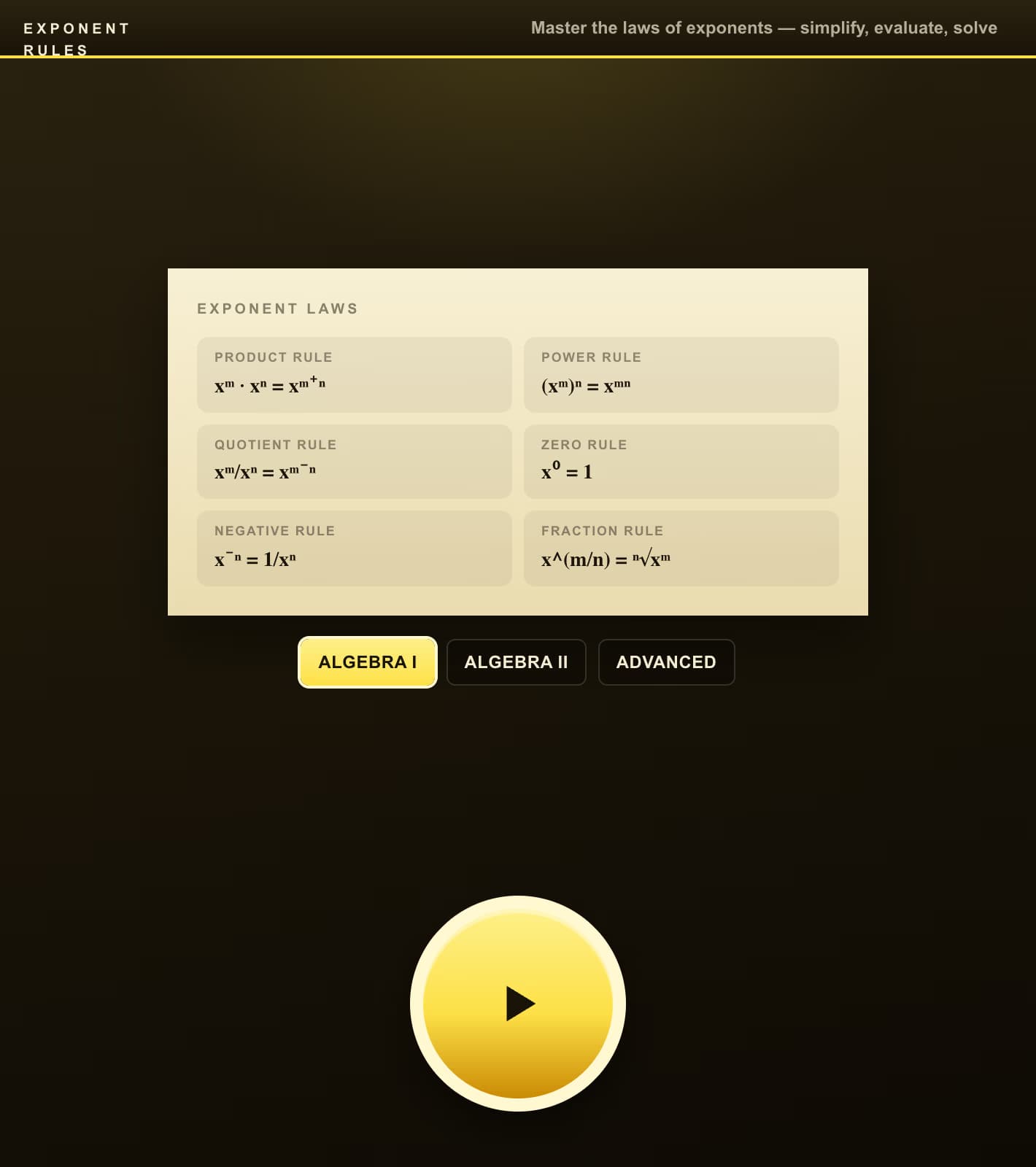
Master the laws of exponents — pick the correct simplified form or value from four choices. 45 problems across three tiers: Algebra I (product, quotient, power, zero, and negative exponent rules), Algebra II (fractional exponents, scientific notation, combining multiple rules), and Advanced (solving exponential equations, complex multi-rule simplifications).