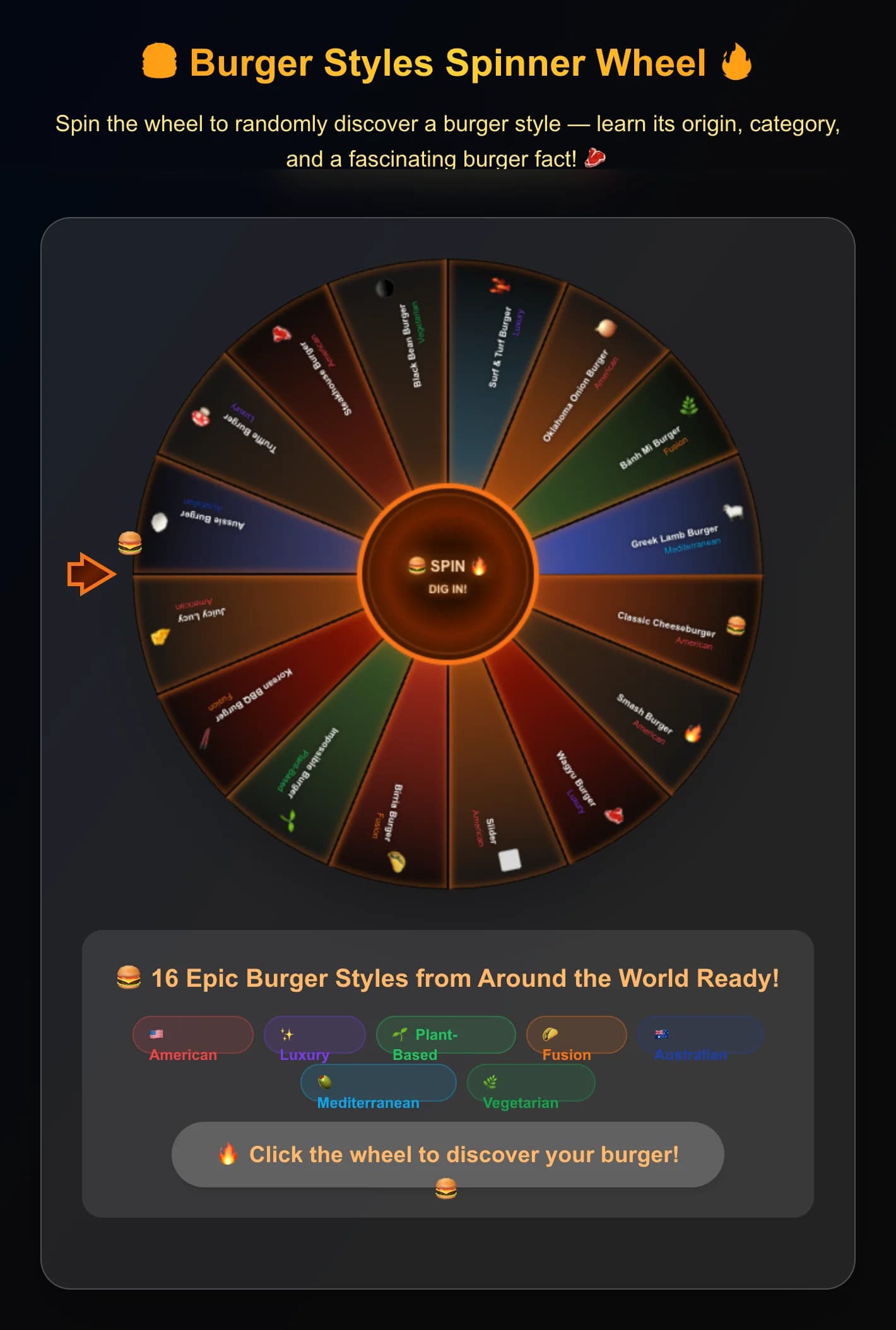
- 1
Click the spinning wheel in the center of the page
- 2
Watch the grill wheel spin through 16 epic burger styles
- 3
The wheel slows and lands on a random burger style
- 4
A burger card reveals the style category, origin, and an amazing historical fact
- 5
Click 'Dig in!' to dismiss and spin again
Key Features
16 epic burger styles spanning 7 categories: American, Luxury, Plant-Based, Fusion, Australian, Mediterranean, and Vegetarian
Region of origin revealed for every burger — from Wichita, Kansas to Jalisco, Mexico to Greece
Rich historical fact for each burger revealing surprising stories from food history
Color-coded by burger style category for easy identification
Dark charcoal grill themed design with fiery orange and amber accents
The Burger Styles Spinner Wheel is an interactive food tool that randomly selects one of 16 iconic burger styles from around the world. From the cheeseburger's Pasadena origins and Oklahoma's Depression-era onion burger, to the Impossible Burger's $200M scientific breakthrough and the viral birria burger that turned Instagram red with consommé-dipped buns, each spin reveals the burger's style category, origin, and a fascinating slice of culinary history. Perfect for food lovers who can't decide what to grill, burger enthusiasts exploring global styles, and anyone curious about the surprising stories behind their favorite foods.
Frequently Asked Questions
Which burger styles are on the wheel?
The wheel includes Classic Cheeseburger, Smash Burger, Wagyu Burger, Slider, Birria Burger, Impossible Burger, Korean BBQ Burger, Juicy Lucy, Aussie Burger, Truffle Burger, Steakhouse Burger, Black Bean Burger, Surf & Turf Burger, Oklahoma Onion Burger, Bánh Mì Burger, and Greek Lamb Burger.
Who invented the cheeseburger?
Lionel Sternberger is most widely credited with inventing the cheeseburger around 1924–1926 at his father's 'The Rite Spot' sandwich shop in Pasadena, California, by experimenting with adding a slice of American cheese to a hamburger. However, a diner in Denver, Colorado also filed a trademark for 'cheeseburger' in 1935. The debate continues, but the Pasadena origin story is the most commonly cited. Today, Americans eat approximately 50 billion burgers per year — around 3 per person per week.
What makes a Smash Burger different from a regular burger?
The difference is the Maillard reaction — the chemical process that occurs when proteins and sugars brown at high heat, creating hundreds of new flavor compounds. When you smash raw beef forcefully onto a screaming-hot griddle, you dramatically maximize the contact surface between meat and metal, creating an ultra-crispy, lacey crust that a thick 'pub-style' patty simply cannot develop. The technique has existed since 1950s American diners but went mainstream when Smashburger launched in 2007 and chains like Shake Shack popularized it nationally.
What is the Juicy Lucy and why do two bars claim to have invented it?
The Juicy Lucy is a Minneapolis burger with cheese stuffed inside the raw patty before cooking, creating a molten cheese core. Both Matt's Bar and the 5-8 Club claim to have invented it in 1954. The rivalry is a point of fierce local pride — Matt's Bar spells it 'Jucy Lucy' (no 'i') while the 5-8 Club uses 'Juicy Lucy.' President Obama visited Matt's Bar in 2014. The local warning to all first-timers is to always wait before biting — the internal cheese reaches 165°F+ and will burn your mouth if you eat it immediately.
How does the Impossible Burger replicate the taste of real beef?
The key ingredient is heme — specifically soy leghemoglobin, an iron-containing molecule found in the roots of soy plants that closely mimics the myoglobin in animal muscle. Heme is what gives real meat its characteristic bloody, metallic, iron-rich taste. Impossible Foods founder Pat Brown (a Stanford biochemist) identified heme as the molecule that makes meat taste like meat after years of research. The burger also uses coconut oil and sunflower oil for fat, potato protein for binding, and methylcellulose to simulate the texture change when beef cooks.