Board Games Spinner Wheel
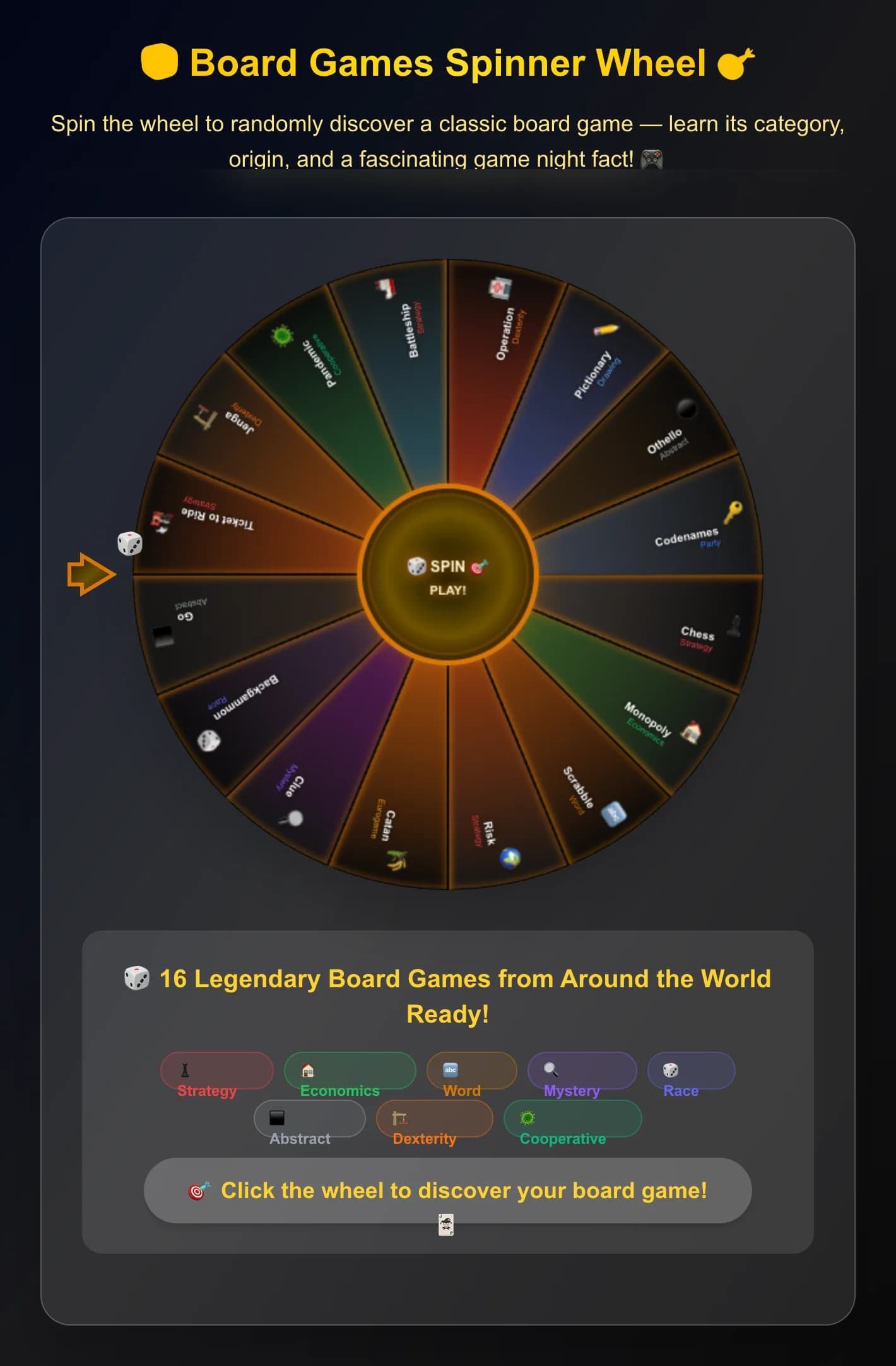
Spin the wheel to randomly land on one of 16 legendary board games from around the world! Discover each game's category, origin, and a fascinating piece of gaming history.
- 1
Click the spinning wheel in the center of the page
- 2
Watch the game table wheel spin through 16 iconic board games
- 3
The wheel slows and lands on a random board game
- 4
A game card reveals the game's category, origin, and an amazing historical fact
- 5
Click 'Let's play!' to dismiss and spin again
Key Features
16 legendary board games spanning 11 categories: Strategy, Economics, Word, Eurogame, Mystery, Race, Abstract, Dexterity, Cooperative, Drawing, and Party
Country or culture of origin revealed for every game
Rich historical fact for each board game revealing surprising stories behind its creation
Color-coded by game category for easy identification
Dark game-table themed design with warm amber accents
The Board Games Spinner Wheel is an interactive game-night tool that randomly selects one of 16 iconic board games from around the world. From the 5,000-year-old ancient game of Backgammon and the AI-baffling complexity of Go, to Monopoly's stolen origin story and Pandemic's 600% sales surge during COVID-19, each spin reveals where the game came from, what category it belongs to, and a fascinating piece of gaming history. Perfect for game nights, trivia lovers, families deciding what to play, and anyone who wants to discover surprising facts behind their favorite games.
Frequently Asked Questions
Which board games are on the wheel?
The wheel includes Chess, Monopoly, Scrabble, Risk, Catan, Clue, Backgammon, Go, Ticket to Ride, Jenga, Pandemic, Battleship, Operation, Pictionary, Othello, and Codenames.
Did Elizabeth Magie really invent Monopoly?
Yes — Elizabeth Magie created 'The Landlord's Game' in 1903 to demonstrate the unfairness of land ownership and wealth concentration. Charles Darrow later played a version of her game, made changes, and sold it to Parker Brothers in 1935 without crediting her. She received $500 and no royalties while Darrow became a millionaire.
Why is Go considered more complex than Chess?
Go is played on a 19×19 board with simple rules, but the number of possible positions is estimated at 10^170 — vastly more than the number of atoms in the observable universe (about 10^80) and far more than chess (10^43). This complexity meant AI programs couldn't beat top human players until Google's AlphaGo in 2016.
Why did Pandemic sales surge during COVID-19?
When the real COVID-19 pandemic began in March 2020, people in lockdown turned to home entertainment. Pandemic's cooperative gameplay — where all players work together to stop global disease outbreaks — felt suddenly very real and relevant. Sales increased over 600% in March 2020 compared to the same period the previous year.
Can I use this to pick a game for game night?
Absolutely! That's one of its best uses. Spin the wheel, check the category to see if it matches your group size and mood (Strategy, Party, Cooperative, etc.), then read the historical fact to spark conversation before you start playing. It's a great way to revisit classics you haven't played in years.