Guess the Equation
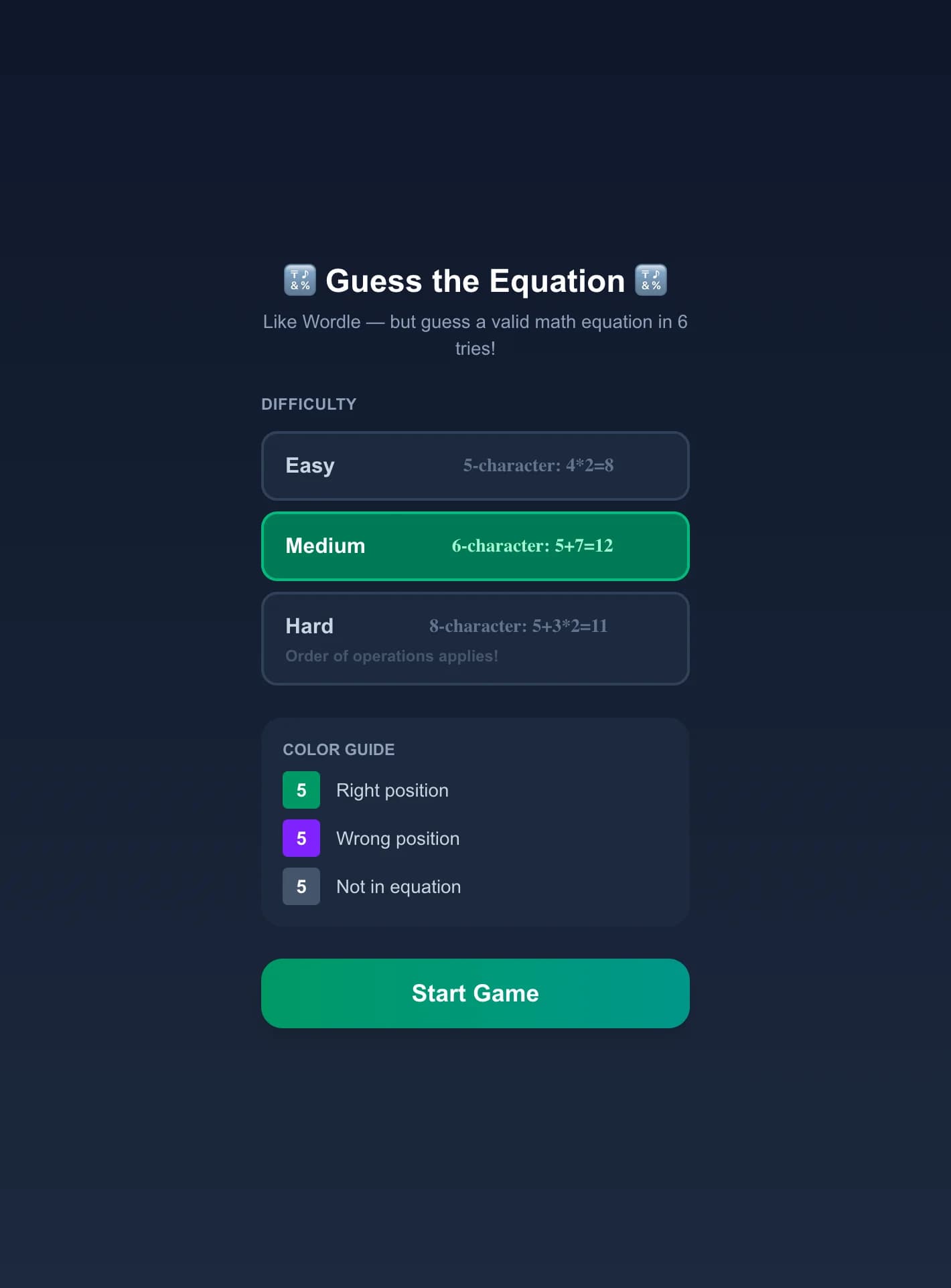
Inspired by Nerdle — guess the hidden math equation one character at a time in 6 tries. Every guess must be a valid equation (left side evaluates to the right side). 🟩 Green means the right character in the right place, 🟪 Purple means right character but wrong place, ⬛ Gray means not in the equation at all.
How to Play Guess the Equation
- 1
Choose Your Difficulty
Pick Easy (5-character equations), Medium (6-character), or Hard (8-character with order of operations). The target equation is hidden.
- 2
Enter a Valid Equation Guess
Type a math equation of the correct length — it must be valid (e.g. 2+3=5 for Easy). Press Enter to submit. Invalid equations show an error and don't count as an attempt.
- 3
Read the Color Feedback
Green tiles: right character in the right position. Purple tiles: that character IS in the equation but in a different spot. Gray tiles: that character is not in the equation at all.
- 4
Narrow Down in 6 Tries
Use the color clues to constrain your next guess. The on-screen keyboard updates colors to track what you've learned. Solve in fewer guesses for a higher score!
Key Features
Wordle Mechanics Applied to Math
The same colored-tile feedback as Wordle — Green (right character, right position), Purple (right character, wrong position), Gray (not in equation) — but applied to math equation characters including digits, +, −, ×, ÷, and =.
Every Guess Must Be a Valid Equation
You can't type random characters — every 6-attempt guess must be a mathematically valid equation where the left side equals the right side. No leading zeros, no division by zero, integer results only.
Three Difficulty Lengths
Easy uses 5-character equations (like 4+5=9), Medium uses 6 characters (like 3*4=12), and Hard uses 8 characters with operator precedence (like 3+4*2=11 where multiplication happens first).
Full Physical Keyboard Support
Type naturally using your keyboard: digits, +, -, *, /, =, Backspace, and Enter all work as expected. The on-screen calculator keyboard also supports mouse and touch for mobile play.
What is Guess the Equation (Nerdle)?
Guess the Equation is a Wordle-style puzzle game for math equations, inspired by the popular Nerdle game. Instead of a 5-letter word, you're guessing a valid arithmetic equation. The challenge has two layers: forming mathematically valid guesses AND using the color feedback to deduce the hidden equation. Hard mode adds operator precedence (multiplication before addition), requiring you to mentally evaluate expressions like 5+3*2=11 correctly. It's a uniquely satisfying puzzle that combines the addictive Wordle format with arithmetic problem-solving.
Why Play Guess the Equation?
- 1
Makes Arithmetic Genuinely Fun
The Wordle format is inherently satisfying — the color feedback and deduction process create the same 'aha!' moments that made Wordle a global phenomenon, now applied to math.
- 2
Reinforces Order of Operations
Hard mode requires correct application of PEMDAS/BODMAS — 3+4*2=11, not 14. Repeatedly forming valid Hard-mode guesses builds real fluency with operator precedence.
- 3
Trains Systematic Reasoning
Deducing the equation from color clues is a logic puzzle: 'the digit 3 is in the equation but not first, and there's no 2 or 7...' This systematic constraint-narrowing is a transferable thinking skill.
- 4
Infinite Replayability
Equation pools are large and pre-validated — equations never repeat immediately, and each difficulty has dozens of possible targets. Unlike the daily Wordle, you can play as many rounds as you like.
Frequently Asked Questions
Why is my guess being rejected?
Guesses must be valid equations. Common rejection reasons: the equation doesn't balance (left side ≠ right side), there's a leading zero (like 07=7), the length is wrong, or there's a division by zero. The error message tells you exactly what's wrong.
How does order of operations work in Hard mode?
In Hard mode (8-character equations), standard operator precedence applies: × and ÷ are calculated before + and −. So 3+4*2 equals 11 (not 14), and 6/2+1 equals 4 (not 2). Your guesses must respect this too — 3+4*2=11 is valid, but 3+4*2=14 is not.
What do the tile colors mean exactly?
Green: that character is correct AND in the right position. Purple: that character appears in the equation but in a different position. Gray: that character does not appear anywhere in the equation. Note that if a digit appears multiple times, each tile refers to a specific position.
How is the score calculated?
Score is based on how few attempts you needed: solve in 1 try = 600 pts, 2 tries = 500 pts, 3 tries = 400 pts, 4 tries = 300 pts, 5 tries = 200 pts, 6 tries = 100 pts. Failing to solve scores 0.
Can I use physical keyboard to play?
Yes! All digit keys (0–9), operator keys (+, -, *, /), equals (=), Backspace, and Enter work as expected. You can complete an entire game without touching the on-screen keyboard.
What equations appear in each difficulty?
Easy (5 chars): single-digit equations like 4+5=9, 8-3=5, 3*3=9. Medium (6 chars): two-digit results like 5+7=12, 4*4=16, 9-4=5. Hard (8 chars): equations with operator precedence like 5+3*2=11, 4*3+2=14, 10-4/2=8.