Missing Number
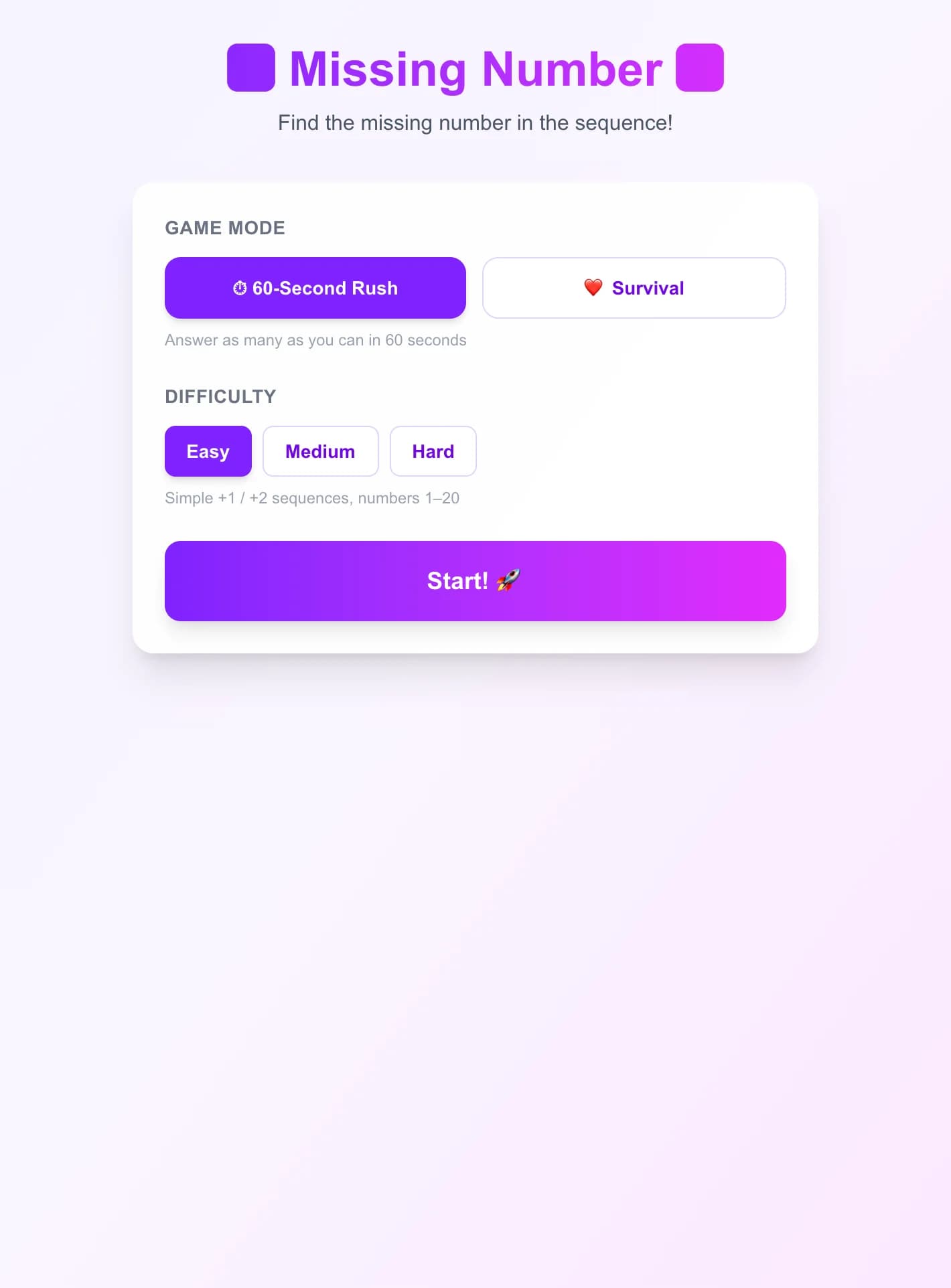
Find the missing number in arithmetic sequences — 3, 4, __, 6. Tap one of four big colorful answer buttons. Race the clock in 60-second mode or survive on 3 lives. Easy, medium, and hard difficulty levels.
How to Play Missing Number
- 1
Choose Difficulty and Mode
Pick Easy, Medium, or Hard to control the range and step sizes. Then select 60-Second Rush (answer as many as possible) or Survival (3 lives, no timer).
- 2
Read the Sequence
A row of numbers appears with one blank — shown as a pulsing ? box. Figure out the pattern: is the step +2? +5? −3?
- 3
Tap the Right Button
Choose from four large colored buttons. You can also use keyboard keys 1–4 for fast desktop play. Correct answers light up green; wrong ones turn red and reveal the answer.
- 4
Build Your Streak
String together correct answers to ignite a 🔥 streak. In Rush mode, keep answering until the 60 seconds are up. In Survival, avoid 3 mistakes to stay alive.
Key Features
Big Colorful Multiple-Choice Buttons
Four oversized buttons in violet, rose, amber, and teal make it easy to tap the correct answer at a glance — designed for both touch screens and desktop.
Three Difficulty Levels
Easy uses simple +1/+2 sequences with numbers 1–20. Medium introduces larger steps up to 50. Hard adds mixed steps, larger numbers, and even descending sequences — great for stretching pattern recognition.
60-Second Rush and Survival Modes
In Rush mode, answer as many sequences as you can before time runs out. In Survival mode, you have 3 lives — each wrong answer costs one. Same puzzles, completely different pressure.
Streak and Best Score Tracking
Consecutive correct answers build a 🔥 streak displayed in real time. Best scores are saved per difficulty and mode in your browser so you can always try to beat your personal record.
What is Missing Number?
Missing Number is a fast-paced arithmetic sequence game where a row of numbers has one blank — your job is to identify the pattern and pick the correct value from four colorful choices. Sequences follow simple arithmetic progressions: a start number plus a constant step. Easy mode uses steps of 1 or 2 with numbers under 20, making it accessible to early learners. Medium and Hard introduce bigger steps, larger numbers, and descending sequences to challenge older students and adults. The multiple-choice format and big buttons make it satisfying to play at speed on any device.
Why Play Missing Number?
- 1
Builds Pattern Recognition
Identifying a constant step in a sequence is a core algebraic reasoning skill. Playing this game repeatedly trains the brain to quickly spot +3 or −5 patterns without counting step by step.
- 2
Strengthens Mental Addition and Subtraction
To verify the pattern and compute the missing term, players mentally add or subtract repeatedly — reinforcing the same arithmetic facts practiced in school.
- 3
Prepares for Pre-Algebra
Understanding arithmetic sequences directly supports topics like linear functions, slope, and algebraic expressions. Fluency with patterns here makes those later topics much more intuitive.
- 4
Accessible to All Ages
Easy mode (numbers 1–20, step ±1 or ±2) works for young children learning to count in skips. Hard mode with multi-digit numbers and larger steps challenges middle schoolers and adults.
Frequently Asked Questions
What kinds of sequences appear in the game?
All sequences are arithmetic progressions — each number differs from the previous by a constant step. Easy mode uses steps of +1 or +2. Medium adds steps up to +5. Hard uses larger steps (up to +10) and can include descending sequences (negative steps).
Where can the blank appear in the sequence?
On Easy difficulty the blank can appear anywhere including the first or last position. On Medium and Hard it always appears somewhere in the middle so there are visible numbers on both sides — which makes it both harder and fairer.
How are the wrong answer choices generated?
Distractors are deliberately chosen to be plausible — they're based on nearby multiples of the step, so they could look correct to someone who miscounts. This prevents simple elimination and encourages careful pattern analysis.
Can I use keyboard shortcuts?
Yes! Press 1, 2, 3, or 4 to select the corresponding colored button. This lets desktop players answer quickly without reaching for the mouse.
Are scores saved?
Yes. Your best score is saved locally in your browser for each combination of difficulty and game mode. It's shown on the settings screen so you always know what to beat.